 Garden

Affiliate Disclosure
Some links on this page are affiliate links. As an Amazon Associate, we earn from qualifying purchases — at no extra cost to you. We do not buy, test, or physically handle the products we cover; our rankings come from aggregated owner reviews, ratings and expert consensus. Commissions never change our verdicts. How we rank · full disclosure.
The short answer: use gravel where the path needs to last, carry weight and drain — main routes, side yards, anything you push a wheelbarrow along. Use mulch where the path is informal, curved, temporary or walked barefoot — through beds, around a play area, in a woodland corner. Gravel costs about twice as much up front, roughly $1.50 to $4 per square foot against $0.75 to $2 for mulch, and lasts five to ten times longer.
Both are loose materials, both need edging to stay where you put them, and both fail in exactly the same way if you skip the preparation underneath. The choice between them comes down to five variables: cost over time, weed behavior, comfort underfoot, drainage and how each one looks after two winters.
We never buy or physically handle the products we mention — every judgment here comes from aggregated owner reviews and expert consensus, described in how we rank. For the wider context, see the landscaping and hardscaping hub.
Head to Head
| Gravel path | Mulch path | |
|---|---|---|
| Materials cost | $1.50 to $4 per sq ft | $0.75 to $2 per sq ft |
| Realistic lifespan | 5 to 10 years before top-up | 1 to 2 years before top-up |
| Ten-year cost | Lower | Higher, repeated |
| Weed pressure | Low at first, rises as debris collects | Moderate and constant |
| Barefoot comfort | Poor with sharp stone, fair with stone dust | Good |
| Wheelbarrow, stroller, walker | Good if compacted 3/8 minus | Poor, sinks and ruts |
| Drainage | Excellent | Good, but holds moisture |
| Snow shoveling | Awkward, shovel lifts stone | Awkward, shovel lifts mulch |
| Slope tolerance | Up to about 5 percent without steps | Washes above about 3 percent |
| Install effort | Higher, excavation and compaction | Lower, a few hours |
Cost: Cheaper Now vs Cheaper Later
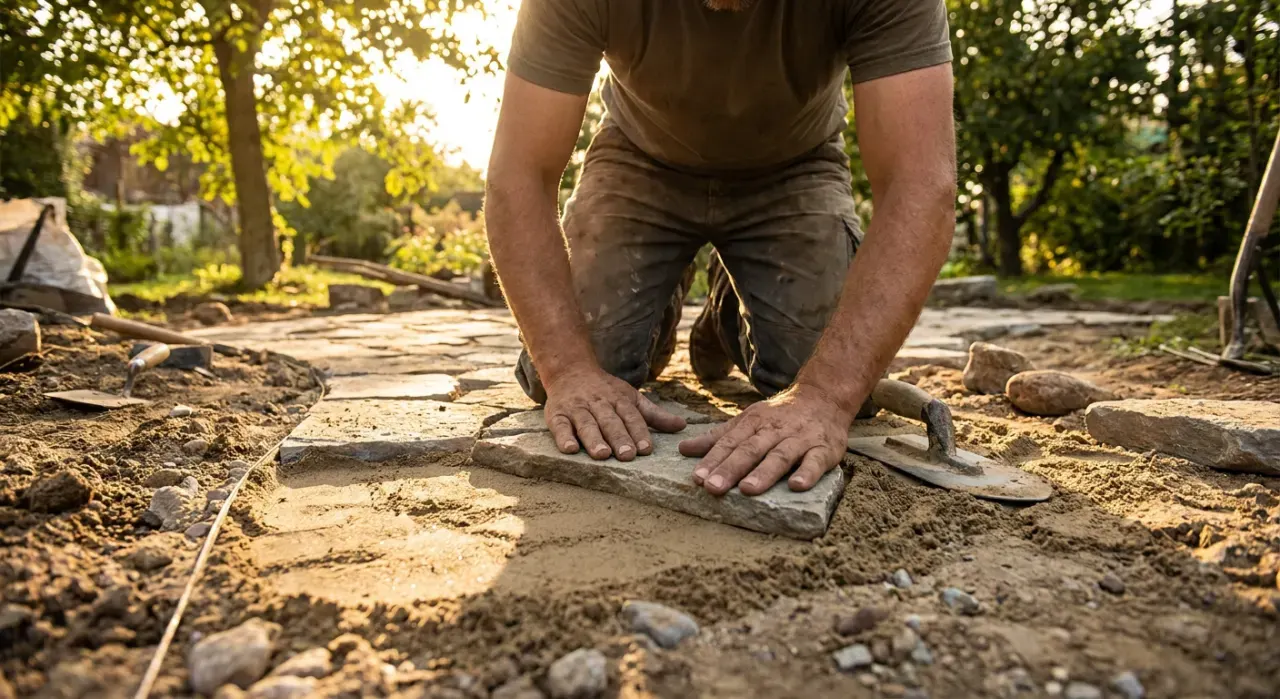
Bulk hardwood or bark mulch runs roughly $30 to $60 per cubic yard delivered in most US markets, and one cubic yard covers about 100 square feet at 3 inches deep. That puts a fresh mulch path at well under a dollar a square foot in many places. Crushed stone runs roughly $40 to $80 per cubic yard delivered, and you need more depth — 3 to 4 inches of stone over a compacted subgrade — plus woven fabric at around $0.20 to $0.50 per square foot.
The number that decides it is the top-up cycle. Organic mulch is food for soil biology and it is actively decomposing from the day it lands. In a warm, wet climate a shredded bark path loses visible depth in a single season and is thin by month eighteen. Gravel does not decompose at all; it only migrates and gradually accumulates debris. A gravel path that was edged properly and built on fabric may need nothing but a rake and a half-yard of top-up stone after five years.
For a 100-foot by 3-foot path, that is roughly $150 to $300 to build in gravel against $80 to $180 in mulch, but with the mulch repeated five or six times over a decade. The math is not close. For full project numbers see what landscaping costs.
Weed Behavior Is Not What Most People Expect
The intuitive assumption is that mulch suppresses weeds and gravel does not. In paths, the opposite is closer to true over time.
Mulch is organic matter. It holds moisture, it breaks down into a fine seedbed, and any weed seed that blows in lands on a warm, damp, nutrient-rich surface. A mulch path is weed-suppressing in year one and weed-hospitable by year three. This is exactly why landscape fabric underneath does so little for it: the weeds are not coming up through the fabric, they are germinating in the mulch on top of it.
Gravel starts as an inhospitable surface — no nutrients, poor water retention, and a hot, dry, well-drained top layer. Weeds arrive only when organic debris fills the voids between stones. In a shaded, leafy yard that takes two to four seasons. In an open sunny yard it can take much longer. The maintenance that matters is blowing or raking leaves and clippings off the path each fall, which is a ten-minute job and prevents the seedbed forming at all.
Both benefit from woven fabric underneath, but for different reasons: under gravel it is primarily a separation layer that keeps stone out of soil, and the weed suppression is a side effect. Which weight of fabric to buy for which job is covered in best landscape fabric.
Comfort, Traffic and Who Uses the Path
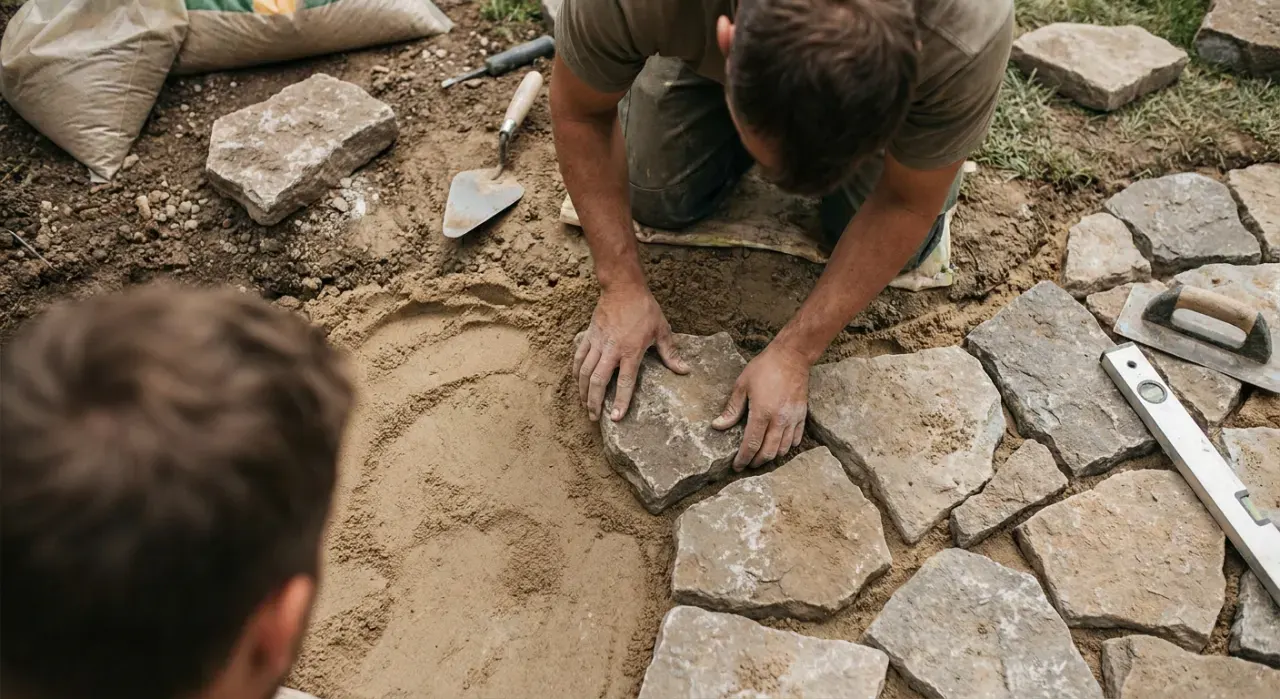
This is where the decision is often made in practice. Sharp angular crushed stone is genuinely unpleasant in bare feet, which rules gravel out for the route between a patio and a pool. Bark mulch is soft, quiet and forgiving, which is why it is the standard surface under playground equipment.
Wheeled traffic reverses the verdict entirely. A compacted 3/8-inch-minus gravel path with its fines packed down forms a firm crust that takes a wheelbarrow, a garden cart, a stroller or a walker without much protest. Mulch does none of that — wheels sink, mulch piles up in front of the tire, and the path develops ruts. If the route is how you move materials around the yard, gravel is the answer.
Round pea gravel deserves a specific warning. It photographs beautifully and it is the single most regretted path material in owner discussions. Rounded stones cannot interlock, so the surface never firms up, rolls underfoot like ball bearings, and migrates out of the path with every footstep. If you want gravel, buy angular crushed stone or decomposed granite with fines, not pea gravel.
Drainage, Slope and Freeze
Gravel drains essentially perfectly. Water passes straight through the voids into the subgrade, which means a gravel path stays usable during rain and does not pond. That makes it the right surface for a low spot, a route beside a downspout, or the side yard that never quite dries out — provided the soil underneath drains too. On heavy clay, a gravel path over an undrained subgrade becomes a bathtub, so tie it into whatever drainage plan the yard needs. See fixing yard drainage.
Mulch absorbs water and holds it, which is useful next to plants and less useful underfoot. A mulch path in a wet, shaded spot stays soggy, grows algae and can get slick.
Slope is the other constraint. Mulch begins washing downhill at grades over roughly 3 percent and will end up in a pile at the bottom after one serious storm. Compacted gravel with fines holds up to about 5 percent. Beyond that, both want steps or a series of terraced landings with timber or stone risers, regardless of surface.
Freeze and thaw treats both reasonably well because neither is rigid — there is nothing to crack. The real winter problem is shoveling. A snow shovel scrapes loose material off both surfaces and redistributes it onto the lawn. If a path must be cleared all winter, that is an argument for pavers or concrete rather than either loose material.
Building Either One Properly
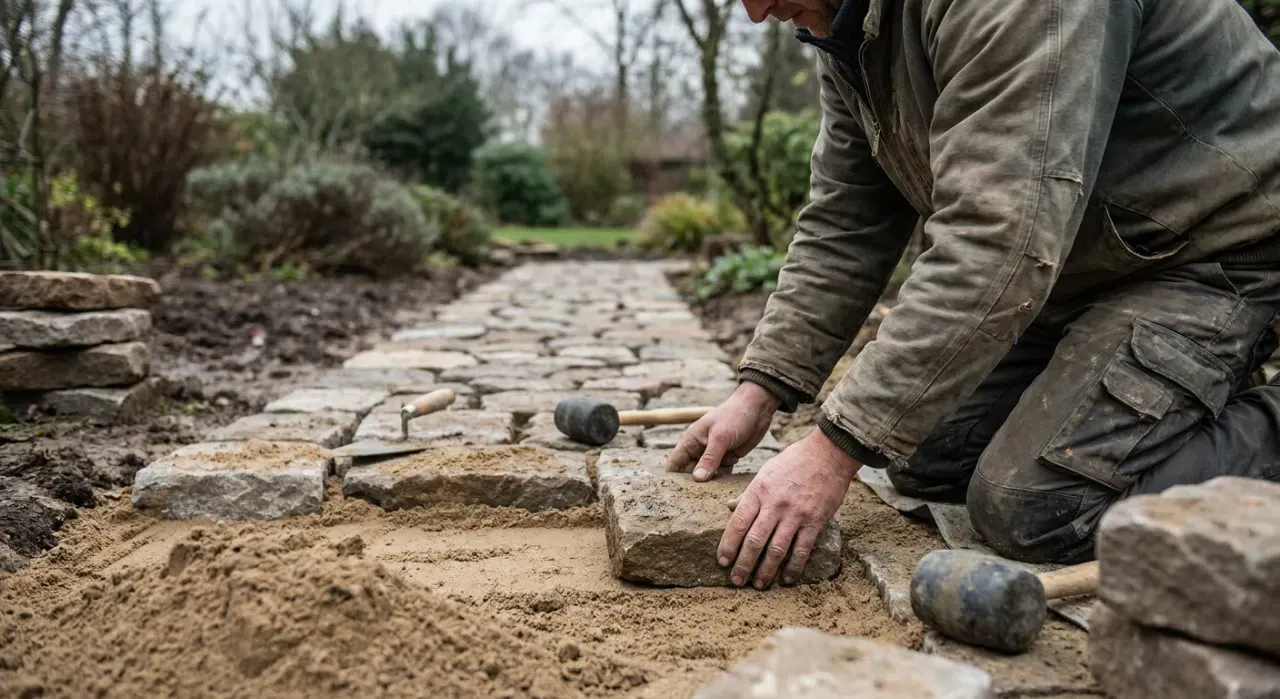
- Mark the route where people actually walk. Lay a hose on the ground and live with the line for a day. Desire lines beat drawn lines.
- Excavate. For mulch, 2 to 3 inches below the surrounding grade. For gravel, 4 to 6 inches. Remove all turf and roots.
- Compact the subgrade. A hand tamper is enough for a path. This step is skipped constantly and it is why paths settle unevenly.
- Lay woven geotextile across the excavation, overlapping seams 6 inches and running the fabric a few inches up the sides.
- Install edging. Both materials migrate without a physical border. Steel, aluminum, rubber or a paver soldier course all work; the install method is in how to install landscape edging.
- Fill. Gravel in two lifts of about 2 inches, compacting each and lightly wetting so the fines bind. Mulch in one 3-inch layer, raked level.
- Crown or slope the surface very slightly — about a quarter inch of fall per foot to one side, or a shallow crown down the center — so water sheds instead of sitting.
Which to Pick
Choose gravel for main routes, side yards, anything carrying wheels, wet or shaded ground, and any path you would rather not rebuild every other spring. It is the durable answer and the cheaper one over a decade.
Choose mulch for informal paths threading through planting beds, barefoot routes, play areas, woodland corners, and any layout you are still experimenting with. It is cheap, forgiving, easy to reroute and it feeds the soil as it breaks down — which around plants is a genuine advantage rather than a compromise.
Plenty of yards use both, and the transition is not awkward: gravel on the working routes, mulch through the planted ones. If the path is going to be permanent and load-bearing, though, price out pavers before committing, because the base preparation is nearly identical and the surface lasts decades — see how to lay a paver patio.