 Garden

Affiliate Disclosure
Some links on this page are affiliate links. As an Amazon Associate, we earn from qualifying purchases — at no extra cost to you. We do not buy, test, or physically handle the products we cover; our rankings come from aggregated owner reviews, ratings and expert consensus. Commissions never change our verdicts. How we rank · full disclosure.
The short answer: steel survives a mower wheel and plastic does not. If you edge by running the mower along the border, buy steel — it holds a line for 15 to 30 years and shrugs off the abuse. If you trim the edge with a string trimmer, or your beds are full of tight curves, or the budget matters more than the lifespan, plastic is a perfectly reasonable choice at roughly half the cost and half the install effort, with a realistic life of 5 to 12 years.
That is the whole decision in one paragraph, but the details matter because the failure modes are so different. Plastic fails gradually and visibly — heaving, chalking, cracking. Steel fails almost never, and its downsides are up front: more digging, more money, sharp edges, and a fight on tight curves.
We never buy or physically handle the products we rank. Everything here is drawn from aggregated owner reviews, star ratings, review volume and expert consensus — see how we rank. The ranked field across all materials is in best landscape edging.
Head to Head
| Steel | Plastic | |
|---|---|---|
| Materials cost | $3 to $7 per linear ft | $1.50 to $3 per linear ft |
| Installed cost | $8 to $15 per linear ft | $5 to $9 per linear ft |
| Realistic lifespan | 15 to 30 years | 5 to 12 years |
| Typical profile | 1/8 to 1/4 in thick, 4 to 6 in tall | Rolled top bead, 4 to 5 in tall |
| Trench required | 4 to 5 in | 3 to 4 in, or no-dig |
| Install time, 60 ft | 5 to 7 hours | 3 to 4 hours |
| Tight curves | Needs notching | Bends by hand |
| Mower wheel on the edge | Excellent | Poor over time |
| Holds back soil or gravel | Yes, several inches | Minimal |
| Frost heave resistance | Good, mass and depth help | Fair, depends on install |
| Visibility once installed | Nearly invisible | Visible black bead |
| Safety | Sharp edges, gloves needed | Blunt, safe around children |
The Mower Test Decides It
Ask one question before anything else: how do you finish the edge? There are two habits and they point to different products.
If you run a mower wheel along the border so the deck overhangs the bed, you are applying repeated lateral and downward load to whatever is there. Steel takes it without comment — it is a rigid plate in the ground, and a mower wheel riding a flush steel edge is exactly the use case the product exists for. It also means you never string-trim the bed line, which saves real time every week.
No-dig plastic under the same treatment flexes with each pass. That flexing works the spikes loose, and once a spike is loose the profile lifts slightly, which exposes more of it, which increases the leverage. Add a cold morning — plastic is noticeably more brittle below about 40°F — and the rolled top bead cracks. Owners repeatedly describe the same sequence, and it typically shows up in year three to five rather than immediately.
If you trim the edge separately with a string trimmer or a half-moon edger, none of that load exists, and plastic performs fine for its full expected life.
Appearance: Invisible vs Present
Steel is thin, and once installed at or near flush it essentially disappears — what you see is a clean line where mulch stops and lawn starts, with no product visible at all. That is why it is the default in professional installations and in modern, minimal designs.
Plastic announces itself. The rolled top bead that gives the profile its rigidity is 3/4 to 1 inch of visible black plastic sitting above grade. Some people do not mind it; some find it the most obviously suburban element in the yard. Brown and green versions exist and fade unevenly. If the aesthetic goal is for the edge to look like a hand-cut spade line that never grows out, that is steel.
Rust is worth understanding rather than fearing. Plain hot-rolled steel edging is meant to weather — it develops a stable dark brown patina within the first year that then slows further corrosion. Against mulch and dark soil it reads as almost nothing. Powder-coated and galvanized options stay dark or bright for longer but chip at cut ends and stake holes, and rust starts at those chips. Aluminum sidesteps the whole question at a higher price and with less stiffness.
Install Effort and Skill
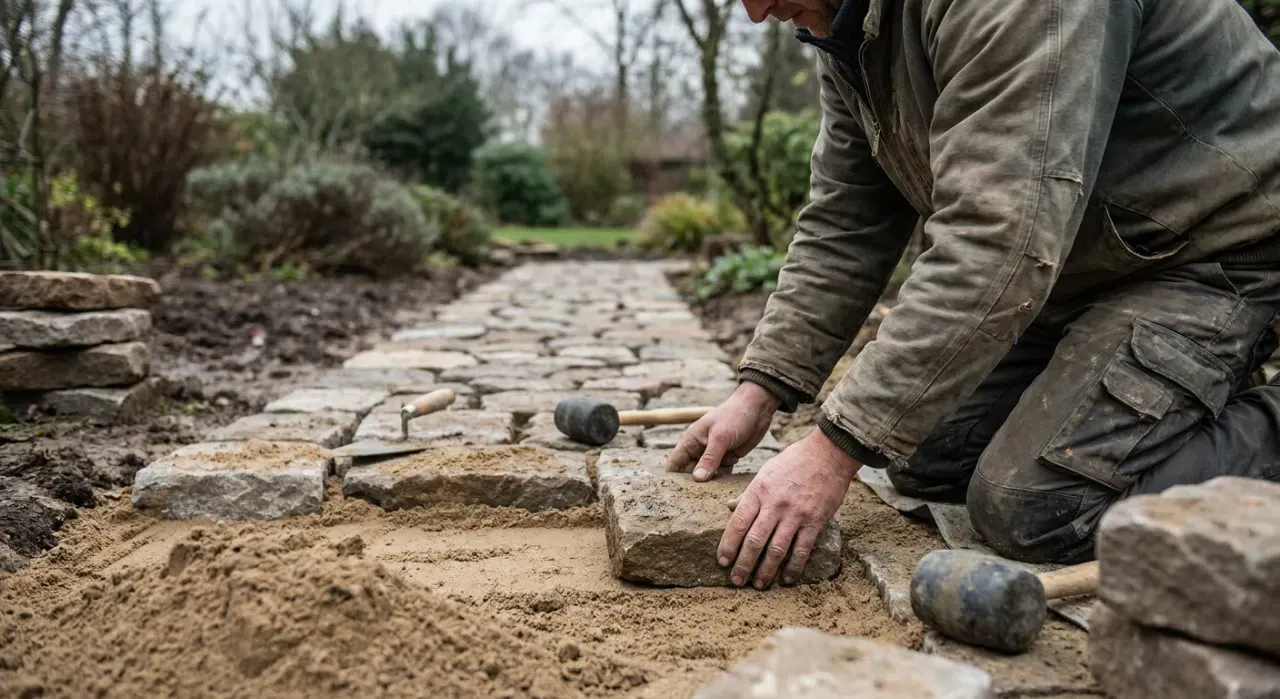
Plastic wins on effort, and by more than the raw hours suggest. No-dig systems need only a shallow trench, they bend by hand, they cut with a utility knife or tin snips, and they connect with sleeves. It is a genuinely beginner-friendly job that a single person completes in an afternoon.
Steel wants a proper trench 4 to 5 inches deep so at least three quarters of the profile is buried, and it wants that trench cut accurately because you cannot flex the material to hide an error. Cutting steel means an angle grinder with a metal blade, and curving it tightly means notching the buried portion so it can close up. Gloves are not optional; the top edge and any cut end will open a hand.
Both share the same failure mode when installed badly, and it has nothing to do with the material. Spikes driven vertically into loose backfill resist nothing when frost pushes up. Spikes driven at roughly 45 degrees into firm undisturbed soil, with the backfill tamped hard, hold either material in place through winter. Two thirds of the profile buried, minimum, in both cases. The full method is in how to install landscape edging.
What Each One Can Actually Hold
This is an under-appreciated difference. Steel is a small retaining structure. Set 4 to 5 inches deep it will hold a couple of inches of grade change, contain gravel in a path, keep a raised mulch bed from spilling, and separate two materials at different heights without complaint.
Plastic holds essentially nothing. It is a boundary marker and a rhizome barrier, not a retainer. Ask a no-dig profile to hold back 3 inches of soil and it will bow outward between spikes within a season. If your beds are mounded, or you are containing gravel, or there is any grade change at the line, that is a steel job — or a paver soldier course. Gravel containment in particular is where plastic disappoints most reliably; the trade-offs of loose surfaces are covered in gravel vs mulch for paths.
The Cost Case Over Ten Years
For 100 linear feet of bed border:
| Steel | Plastic | |
|---|---|---|
| Materials, first install | $300 to $700 | $150 to $300 |
| Replacements in 10 years | 0 | 0 to 1 |
| 10-year materials total | $300 to $700 | $150 to $600 |
| Install hours, 10 years | 8 to 11 | 5 to 12 |
Over a decade the two converge, which surprises people. Plastic is genuinely cheaper if you are in a mild climate, trim rather than mow the edge, and get a full 12 years out of it. In a freeze-thaw climate with mower contact, plastic gets replaced once inside ten years and steel becomes the cheaper option on both money and labor. Broader project pricing is in what landscaping costs.
Which to Buy
Buy steel if: you mow with a wheel on the edge, the beds are straight or gently curved, there is any grade change or gravel to contain, you are in a hard freeze-thaw region, or you want the edge to be invisible. Accept the extra digging and the sharp edges.
Buy plastic if: the beds are full of tight curves, this is your first hardscape job, the budget is tight, you trim the edge separately, or the layout is something you might change in a few years. It is easy, cheap, forgiving and entirely adequate for its intended use.
Consider the alternatives if: you want steel performance without rust or sharp edges, in which case aluminum sits between the two at steel-like prices; or you want the edge to double as a mowing strip, in which case a paver soldier course on a compacted base is the most durable answer of all and the most work.
Whatever you choose, install it properly — the material matters less than the burial depth and the spike angle. Method in how to install landscape edging, product picks in best landscape edging, and the wider yard sequence in the landscaping hub.