 Garden
Affiliate Disclosure
Some links on this page are affiliate links. As an Amazon Associate, we earn from qualifying purchases — at no extra cost to you. We do not buy, test, or physically handle the products we cover; our rankings come from aggregated owner reviews, ratings and expert consensus. Commissions never change our verdicts. How we rank · full disclosure.
The short answer: the best fertilizer for new grass is Scotts Turf Builder Starter Food for New Grass — a high-phosphorus starter formula built for root development, safe to apply at the same time as the seed, covering 5,000 sq ft per bag. It suits seeding, sodding and overseeding on any grass type. For repeated light feeding through the fragile first weeks, the liquid Extreme Grass Growth starter is easier to apply without disturbing seedlings, and for the follow-up feed at week six, Milorganite removes any burn risk.
We do not buy, apply, or physically handle any product. These rankings come from aggregated owner reviews, star ratings, review volume and expert consensus — see how we rank. For the seed itself, see best grass seed, and for the whole process, how to overseed a lawn.
Top Picks at a Glance
Why New Grass Needs a Different Fertilizer
The distinction is not marketing. It comes down to which nutrient a seedling is short of, and it is different from what an established lawn needs.
An established lawn already has a root system. What it wants is nitrogen, which drives leaf growth, density and color — hence the high first number on a bag of maintenance lawn food.
A seedling has almost no roots. Its priority is building a root system fast enough to reach water before the surface dries out, and the nutrient most closely associated with root development is phosphorus. That is why starter fertilizers carry a much higher middle number. Feed new seed a high-nitrogen maintenance product instead, and you get tall, soft, top-heavy seedlings on a root system that cannot support them — which is exactly what fails the first time you miss a watering.
| Starter fertilizer | Maintenance lawn food | |
|---|---|---|
| Nutrient emphasis | Phosphorus, moderate nitrogen | Nitrogen, little phosphorus |
| Drives | Root development | Leaf growth and color |
| When | At seeding and week 4–6 | After the third mowing onwards |
| Burn risk | Real — seedlings are sensitive | Lower on mature turf |
| Local rules | Usually exempt from phosphorus bans for new seeding | Often restricted where P ordinances apply |
Our #1 Pick: Scotts Turf Builder Starter Food for New Grass
This is the product most American new lawns are actually fed with, and the owner-review record is deep enough that the pattern is clear rather than anecdotal. It does the fundamentals right: a starter nutrient balance weighted toward root development, coverage of 5,000 sq ft from a 15 lb bag, and — importantly — it is safe to apply at the same time as seed, which removes a scheduling step people frequently get wrong.
It works on seed, sod and plugs, which matters because sod has the same establishment problem as seed: a shallow, freshly cut root system that needs to knit into the soil below before the lawn can survive a dry week. Reviewers laying sod consistently report faster rooting where starter fertilizer went down on the prepared soil first.
What owners complain about is worth taking seriously on a new lawn. Burn on seedlings from over-application is the most damaging error in this category — mature grass shrugs off a heavy pass, new grass does not, and several reviewers describe scorched strips where the spreader paused. Follow the label rate exactly and water in thoroughly. Granule size causes striping as with any granular product, which is more visible on a thin new lawn than a thick old one. And phosphorus regulations catch some buyers out: a number of states and localities restrict phosphorus fertilizer, and most exempt new seeding, but the exemption usually requires that the application actually is for new seeding, so check your local rules rather than assuming.
Consensus Score █████████░░░ 8.6
Check price on Amazon → (paid link)
The Ranked Field

Best for seeding, sodding and overseeding a lawn of any grass type
- High-phosphorus starter formula for root development
- Covers 5,000 sq ft
- Safe applied at the same time as seed
- Works on seed, sod and plugs
Why buy it: the starter fertilizer with the deepest review base in America, and the standard against which every alternative is measured.

Best for feeding seedlings repeatedly through the establishment weeks
- Concentrated liquid starter with humic acid
- Hose-end sprayer included
- Encourages lateral spread as well as vertical growth
- Gentle enough for new seedlings at label rate
Why buy it: humic acid improves nutrient uptake in poor soil, which is the exact condition most new lawns are seeded into.
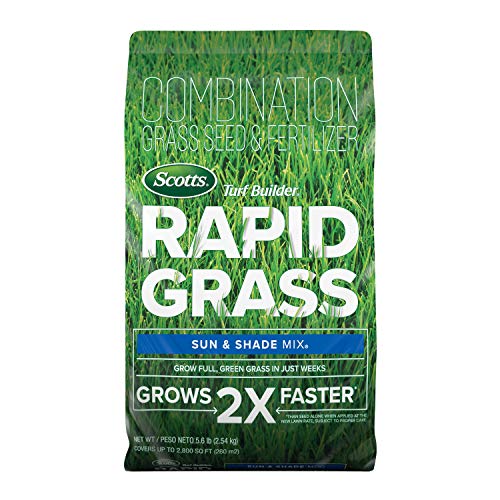
Best for patching and small new areas where one bag should do everything
- Grass seed and starter fertilizer combined
- Grows in weeks rather than months
- Sun and shade tolerant mix
- Covers about 1,555 sq ft when seeding new lawn
Why buy it: seed and starter feed in one bag removes the most common new-lawn error, which is forgetting the fertilizer entirely.
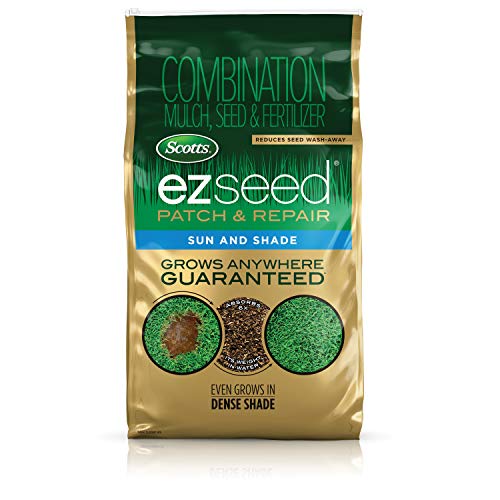
Best for bare patches, thin areas and repairs rather than whole lawns
- Combination mulch, seed and fertilizer
- Mulch expands and holds moisture around the seed
- Sun and shade tolerant
- Covers around 225 sq ft of bare repair
Why buy it: the water-holding mulch is what makes seed germinate on a bare patch that would otherwise dry out between waterings.

Best for follow-up feeding four to six weeks after germination
- Slow-release organic nitrogen — no burn risk on young grass
- 2.5% non-staining iron for color
- Zero phosphorus for ordinance compliance
- Safe in summer heat
Why buy it: young grass is far more sensitive to fertilizer burn than mature turf, and this removes the risk entirely.

Best for the second and third feeds as a new lawn fills in
- 16-4-8 NPK with 7% Humic DG
- Fine DG particles spread evenly with no striping
- High iron for color
- Covers 5,000 sq ft
Why buy it: once seedlings are established, the humic content keeps improving the poor soil a new lawn usually starts in.
Quick Comparison
| Product | Best for | Rating | Price | Buy |
|---|---|---|---|---|
| Scotts Turf Builder Starter Food for New Grass (15 lb) | Best Overall | — | Check (paid link) | |
| Simple Lawn Solutions Extreme Grass Growth Lawn Booster with Humic Acid (32 oz) | Best Liquid Starter | — | Check (paid link) | |
| Scotts Turf Builder Rapid Grass Sun and Shade Mix (5.6 lb) | Best Seed and Feed Combination | — | Check (paid link) | |
| Scotts EZ Seed Patch and Repair Sun and Shade (10 lb) | Best Bare-Spot Repair | — | Check (paid link) | |
| Milorganite 6-4-0 Slow-Release Nitrogen Fertilizer (32 lb) | Best Gentle Granular | — | Check (paid link) | |
| The Andersons PGF Complete 16-4-8 with Humic DG (5,000 sq ft) | Best Follow-Up Feed | — | Check (paid link) |
A Feeding Schedule for a New Lawn
Timing matters as much as product on a new lawn, and the most common failure is feeding too heavily too early.
| Stage | What to apply | Why |
|---|---|---|
| At seeding or sodding | Starter fertilizer at label rate | Phosphorus in the root zone as roots form |
| Weeks 1–3 (germination) | Nothing granular; light liquid starter optional | Seedlings are fragile and spreader wheels damage them |
| Week 4–6, after first mowing | Second starter or a gentle slow-release feed | Roots established enough to use nitrogen safely |
| After the third mowing | Switch to normal maintenance fertilizer | Lawn is now established turf, not seedlings |
| First fall | Fall lawn food | Builds root reserves before the first winter |
Two habits matter more than any product on this list. Water lightly and often in the germination window — the top half-inch of soil must stay moist, which usually means two or three short waterings a day, not one long one. And do not mow until the grass is around 3 inches tall, then take off only the top third, in line with the one-third rule from NC State Extension. Our guide to mowing after seeding covers the detail.
The Products, Reviewed
1. Scotts Turf Builder Starter Food — Best Overall
Covered above. Owners praise: visibly faster establishment, safety alongside seed, sensible coverage, availability everywhere, and results on sod as well as seed. Owners complain about: burn on seedlings from over-application, granule striping on thin new lawns, and confusion around local phosphorus rules.
2. Extreme Grass Growth Lawn Booster — Best Liquid Starter
Liquid has a specific advantage on a new lawn: you can apply it without walking a spreader over fragile seedlings, and you can do it repeatedly at a low rate rather than in one heavy hit. The humic acid content is the differentiator — humic substances improve nutrient availability in poor soil, which is the condition of nearly every yard that is being newly seeded. Owners praise: results on new seed and overseeding, the included sprayer, gentleness on seedlings, and improvement in thin patches. Owners complain about: a subtler response than granular on established grass, short duration requiring repeat applications, and label rates that could be clearer for seedlings versus mature turf.
3. Scotts Turf Builder Rapid Grass Sun and Shade Mix — Best Seed and Feed Combination
Seed and starter fertilizer in the same bag. That solves the single most common new-lawn mistake, which is buying seed and forgetting the fertilizer entirely — a large share of failed seeding projects come down to nothing more than that. The mix tolerates both sun and moderate shade, which suits most residential yards. Owners praise: genuinely fast germination, one-bag simplicity, tolerance across light conditions, and good results on patches. Owners complain about: a high cost per square foot compared with buying seed and fertilizer separately, coverage that runs out faster than expected, and results that depend heavily on watering discipline.
4. Scotts EZ Seed Patch and Repair — Best Bare-Spot Repair
A different problem to a new lawn: a bare patch has no surrounding turf to hold moisture, so seed on bare soil dries out between waterings and simply fails. The expanding mulch in EZ Seed holds water around the seed through the day, which is why it works where plain seed does not. Owners praise: results on genuinely bare spots, the visual moisture indicator as the mulch changes color, and simplicity. Owners complain about: a very high cost per square foot, coverage figures that assume a thin application, and failures that trace back to letting it dry out once during germination.
5. Milorganite 6-4-0 — Best Gentle Granular
The safest thing you can put on young grass. Slow-release organic nitrogen means essentially no burn risk, which matters far more on seedlings than on established turf, and the iron adds color without pushing the surge growth that makes young grass floppy. Use it for the week four to six feed rather than at seeding, because it is low in phosphorus. Owners praise: zero burn risk, gentle steady feeding, color, and low cost. Owners complain about: the smell for a day or two, modest coverage per bag, dusty granules, and a slower response than synthetic starters.
6. The Andersons PGF Complete 16-4-8 — Best Follow-Up Feed
Once the lawn has been mown two or three times it is turf rather than seedlings, and this is a strong product to transition to. Fine DG particles spread evenly on a thin new lawn where striping would show badly, and the 7% humic content continues improving the poor soil most new lawns start in. Owners praise: even spreading, color, humic soil benefit, no burn at label rate. Owners complain about: price per square foot, small coverage per bag, and fine granules that need accurate spreader calibration.
What Owners Actually Complain About
New-lawn fertilizer reviews have a distinctive pattern, and most of the failures are process rather than product. Seedling burn is the most serious and it is nearly always over-application or insufficient watering — young grass has no reserves to recover from a scorch. Poor germination blamed on the fertilizer is second, and in the overwhelming majority of cases the cause is the seedbed drying out during germination, not the feed. Striping on a thin lawn is third, and it shows far more on new grass than established turf. Cost per square foot is a legitimate complaint on the combination products, which are convenient and expensive. And phosphorus rule confusion is fifth, as more jurisdictions restrict P and buyers cannot tell whether the new-seeding exemption applies to them.
How to Choose and Apply
Two decisions. Granular or liquid? Granular at seeding, because you can spread it before the seed goes down and it stays put. Liquid for the follow-up applications, because you are not walking a spreader across fragile seedlings. Combination or separate? Combination bags are genuinely easier and genuinely more expensive; on anything larger than a patch, buying seed and starter fertilizer separately costs substantially less.
Then get the mechanics right. Prepare the seedbed properly — loose soil in the top half-inch, raked level, with no compaction. Spread the starter fertilizer first, then the seed, then rake lightly so seed makes soil contact. Water lightly two or three times a day until germination, then less often and more deeply. Keep foot traffic off entirely until the third mowing. And do not apply weed control of any kind until the lawn has been mown at least three or four times, because pre-emergents prevent grass seed germinating just as effectively as weed seed.
How We Rank Starter Fertilizers
We never buy or physically handle the products on this site. We read the owner-review record at scale, weighting four things. Establishment speed as owners describe it at two, four and eight weeks. Burn reports on seedlings, weighted very heavily because a burned new lawn usually has to be started again. Nutrient suitability for establishment rather than maintenance, checked against extension guidance rather than packaging. And cost per square foot, which varies enormously in this category between plain starter fertilizer and combination products. Prices and star ratings move; the complaint pattern does not.
The Verdict
Scotts Turf Builder Starter Food for New Grass is the fertilizer the owner-review record supports most strongly for a new lawn — the right nutrient balance, safe alongside seed, and cheap enough per square foot to use properly. Use the liquid Extreme Grass Growth for repeat feeding while seedlings are fragile, and switch to Milorganite or PGF Complete once the lawn has been mown a couple of times.
Next: choose the seed with best grass seed, get the timing right with the best time of year to plant grass seed, and troubleshoot with why is my grass seed not growing.