 Garden


Affiliate Disclosure
Some links on this page are affiliate links. As an Amazon Associate, we earn from qualifying purchases — at no extra cost to you. We do not buy, test, or physically handle the products we cover; our rankings come from aggregated owner reviews, ratings and expert consensus. Commissions never change our verdicts. How we rank · full disclosure.
Yes. A pressure washer is the most dangerous tool most households own, and the reason is not obvious from looking at it. The serious injury is not a cut or a bruise — it is a high-pressure injection injury, in which the stream breaks the skin and forces water, grit and bacteria deep into the tissue through a puncture that can look trivial. Consumer Reports, citing Consumer Product Safety Commission data, reported about 6,057 emergency room visits for pressure washer injuries in 2014, and roughly 14 percent of those patients were admitted to hospital. That admission rate is what separates this tool from a leaf blower.
This page explains what the real hazards are, in the order they actually send people to hospital, and what to do in the first hour if one of them happens to you. We do not buy or test the machines we write about; our product rankings come from aggregated owner reviews and published specifications, described in how we rank.
How dangerous is a pressure washer, really?
Dangerous enough that emergency medicine has a name for what it does, and a protocol for it. A domestic electric machine runs 1,600 to 2,300 PSI; a homeowner gas unit runs 3,000 to 4,000. The StatPearls review of hand high-pressure injuries notes that modern high-pressure cleaning tools "can reach up to 10000 psi and spray the contents at 400 mph" — and the injury threshold sits far below the top of that range. Water can break skin at around 100 PSI at point-blank range with a narrow tip. Every machine on the shelf is many times over that line.
The single most sobering figure in the literature concerns outcomes rather than incidence. StatPearls reports that "the incidence of amputation after any high-pressure injection injury has been reported in 30% - 40% of cases." That figure covers all injected materials, and it is driven hardest by paint and grease guns, which inject chemically destructive material at industrial pressures. Water injection injuries from consumer pressure washers carry meaningfully better odds, as the Emergency Medicine Residents' Association discussion of pressure washer injuries makes clear. But "better odds than a paint gun" is a low bar, and the mechanism — sealed, contaminated, expanding tissue damage in a closed compartment — is the same one.

The injury that ends in surgery
A high-pressure injection injury usually happens in a way the person barely registers. The wand kicks, or a hand steadies the lance in front of the tip, or someone spray-cleans mud off a boot without thinking. There is a small mark, often on a fingertip or the top of a foot. Bleeding is minimal. Pain is moderate and, for the first hour, entirely bearable.
What has actually happened is that a column of water carrying grit, algae, detergent and whatever was on the concrete has been driven along the path of least resistance under the skin — up a tendon sheath, along a fascial plane, sometimes from a fingertip to the forearm. The tissue then swells inside a compartment that cannot expand, which is how these injuries produce compartment syndrome, ischemia and infection. Nothing about the entry wound tells you any of that has occurred.
Three habits cause the overwhelming majority of these injuries, and all three are avoidable:
- Bracing a hand in front of the tip. People do this to steady the wand on a detailed job. The hand is already in the firing line when the trigger goes or the wand slips. Never put any part of you in front of the nozzle, ever, for any reason.
- Clearing a blocked nozzle with the machine running. Shut down, squeeze the trigger to bleed the line, then clear the orifice with the pin supplied.
- Spraying downward at close range in open shoes. Feet are the second most common injection site, because the stream ricochets off concrete straight back up.
What to say at the emergency room
This is the most useful paragraph on this page. If a pressure washer jet breaks your skin — even a pinprick, even if it stops bleeding immediately — go to an emergency department the same hour and say the words "high-pressure injection injury". Then say what was injected: water, and whatever was in it.
Those words matter because they change the pathway. A small puncture that is triaged as a laceration gets irrigated, dressed and sent home. The same puncture flagged as an injection injury gets imaging, urgent surgical consultation and, usually, exploration and debridement in an operating room. The clinical literature is consistent that delay to surgery is associated with higher rates of morbidity and amputation — StatPearls records that "delays in surgery have been reported by several authors to have a higher incidence of morbidity and amputation." Waiting overnight to see whether it swells is the single worst decision available to you.
Take the machine's pressure rating and the nozzle color with you if you can. Do not soak the wound, do not apply heat, and do not let anyone reassure you that it looks fine. It always looks fine.
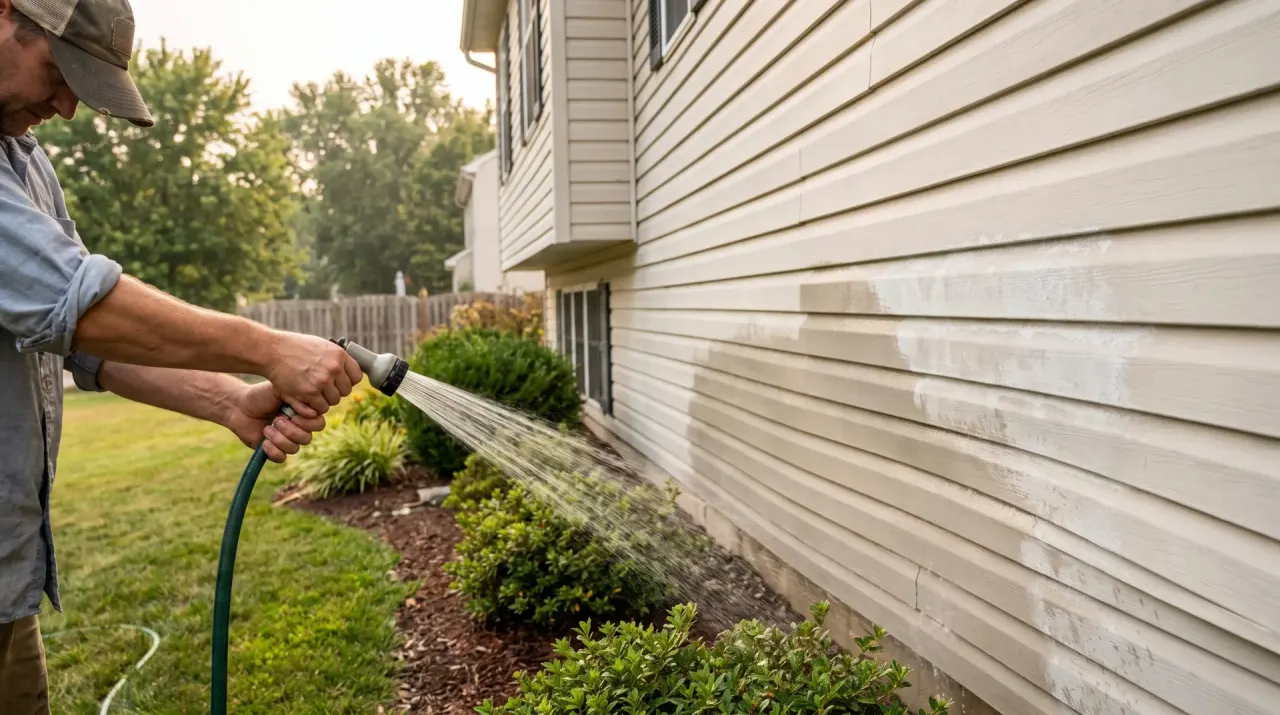
Why the red nozzle is the one to leave in a drawer
Every nozzle risk collapses into a decision about one tip. The 0-degree red nozzle takes the machine's full output and concentrates it into a jet about the width of a pencil lead. It is the configuration most often involved in injection injuries, and it is also what gouges concrete, blows mortar out of joints, strips paint and permanently furs a deck board.
Consumer Reports has taken the strongest position of any US test organization on this, declining to recommend pressure washers sold with any tip finer than 15 degrees. There is no domestic cleaning job whose correct answer is 0 degrees. If you need more bite on hard surfaces, a rotating turbo nozzle spreads a narrow jet in a cone and does the work without parking the full stream in one spot.
| Nozzle | Injury risk | Use it for |
|---|---|---|
| Red 0° | Highest — avoid entirely | Nothing a household needs |
| Yellow 15° | High | Stubborn grime on sound concrete |
| Green 25° | Moderate | General driveway, patio, brick |
| White 40° | Lower | Vehicles, siding, painted wood, windows |
| Black soap | Lowest | Applying detergent at low pressure |
| Turbo / rotary | Moderate | Concrete, when 25° is too slow |
The other four ways people get hurt
Injection is the headline, but it is not the only mechanism, and two of the others kill more reliably than they maim.
| Hazard | How it happens | What prevents it |
|---|---|---|
| Electric shock | Machine or cord without an integral ground-fault interrupter, standing water, a damaged extension cord | A GFCI module built into the plug, tested before every use; outdoor-rated cord; never an indoor power strip |
| Carbon monoxide | A gas engine run in a garage, carport, shed or breezeway — including with the door open | Gas machines outdoors only, well away from doors, windows and vents |
| Falls | Using a wand from a ladder. The recoil is continuous, and it changes suddenly when the spray catches an edge | Extension wand from the ground, or hire the job out. Never a running wand on a ladder |
| Eyes and debris | Grit, paint chips and mortar come back at close to the speed they left | Sealed eye protection, closed shoes, long pants |
The electrical hazard deserves a specific note because it has been an active enforcement problem rather than a historical one. Through 2026 the Consumer Product Safety Commission issued a run of recalls and stop-use notices covering imported electric pressure washers sold online that shipped without an integral GFCI, citing a serious risk of shock and electrocution. If your machine's plug does not carry a module with TEST and RESET buttons, that is a reason to stop using it, not a detail.
The fall risk is the one homeowners underestimate most, because a ladder feels familiar. Ladder falls are a well-documented category in their own right: CDC's analysis of occupational ladder fall injuries in the United States counted 113 work-related deaths and roughly 34,000 emergency-department-treated injuries in a single year, and that is among people who use ladders for a living. Add a wand that pushes back against you continuously and the arithmetic gets worse, not better.

Eight rules that remove most of the risk
- Never point the wand at a person or an animal, including yourself, even briefly, even with the machine off.
- Never steady the wand with a hand in front of the tip.
- Leave the red 0-degree nozzle out of the holder.
- Wear sealed eye protection, closed shoes and long pants. Not sandals, not sunglasses.
- Engage the trigger safety lock every time you set the wand down, and bleed the pressure before changing a tip.
- Test the GFCI before each use, and keep the cord connection out of standing water and uphill of the work.
- Never run a gas engine in any enclosed or partly enclosed space.
- Never operate a wand from a ladder. Use an extension wand from the ground, or hire the job out.
Does a less powerful machine make it safe?
It narrows the worst case rather than removing it. A 1,600 to 1,900 PSI electric is the right tool for cars, bikes, patio furniture and siding, and it is genuinely less likely to produce a deep injection injury than a 3,400 PSI gas unit. But 1,600 PSI still breaks skin at close range, still fires grit back at your face, and still involves mains electricity in a wet environment.
The more useful safety decision is not buying less pressure — it is buying the right nozzle discipline and using it. Matching the tip to the surface does more for both your safety and your results than any difference between two machines in the same class. If you are still choosing, our pressure washer rankings explain why the PSI badge on the box is the least useful number on it, and what size pressure washer you actually need works through it by job.
The short version
Pressure washers are dangerous in a specific, non-obvious way: the injury that puts people in an operating room looks like nothing when it happens. Keep every part of your body behind the nozzle, leave the red tip in a drawer, wear eye protection, keep gas engines outdoors and stay off ladders with a live wand. And if a jet ever breaks your skin, go straight to an emergency department and say "high-pressure injection injury" out loud. The rest of the risk in this category is ordinary; that one is not.
More from this hub: leaf blowers & yard cleanup · pressure washer safety tips · best pressure washer nozzles · how to use a pressure washer · what is soft washing · how we rank.