 Garden

Affiliate Disclosure
Some links on this page are affiliate links. As an Amazon Associate, we earn from qualifying purchases — at no extra cost to you. We do not buy, test, or physically handle the products we cover; our rankings come from aggregated owner reviews, ratings and expert consensus. Commissions never change our verdicts. How we rank · full disclosure.
An axial cam pump is sealed, cheap, spins at engine speed and is replaced when it fails. A triplex pump runs slower in an oil bath, has individually serviceable valves and seals, and is rebuilt rather than binned. That single difference — replaceable versus repairable — explains everything else about the two, including why almost every homeowner machine uses an axial and almost every contractor machine uses a triplex. Both clean identically at the same PSI and GPM. What differs is how many hours they survive and what happens at the end of them.
How an axial cam pump works
An axial pump converts rotation into reciprocation with a plate set at an angle to the shaft. As the shaft turns, the angled plate pushes a ring of small pistons back and forth in their bores, drawing water in on the return stroke and forcing it out through a check valve on the drive stroke. There is no crankshaft and no separate gearcase, so the whole assembly can be short, light and bolted straight onto the end of an engine or motor.
That directness is the design's virtue and its limitation. Because the pump is on the engine shaft, it turns at engine speed — roughly 3,400 rpm on a typical gas machine — so the pistons and seals cycle at that rate for every minute the machine runs. There is no crankcase of oil to change, and the seals run against surfaces that see engine heat conducted straight through the mounting flange.
The result is a pump that is inexpensive to make, entirely adequate for domestic use, and not economical to rebuild. When it fails, you unbolt it and fit another.

How a triplex pump works
A triplex pump is a small reciprocating engine in reverse. Three plungers — usually ceramic-coated — are driven by three throws on a crankshaft that runs in a sealed crankcase with its own oil. Each plunger has its own inlet and outlet valve assembly, and each of those valve assemblies can be pulled and replaced individually.
Two design consequences follow, and they are the whole reason triplex pumps last. First, the crankshaft is geared or belted down, so the pump typically runs at around half engine speed rather than the full 3,400 rpm — every component sees roughly half the cycles per hour of work. Second, the crankcase holds oil that you check and change, so the bearings and crank are properly lubricated rather than relying on a sealed-for-life arrangement.
Add serviceable valves, replaceable seal packings and plungers hard enough to resist the grit that inevitably passes the inlet screen, and the maintenance model changes completely: a triplex is something you keep going, not something you replace.
The comparison, plainly
| Axial cam | Triplex plunger | |
|---|---|---|
| Mechanism | Angled plate driving pistons | Crankshaft driving three plungers |
| Speed | Full engine speed, ~3,400 rpm | Typically geared or belted to about half |
| Lubrication | Sealed, no oil change | Crankcase oil you check and change |
| Typical service life | Hundreds of hours | Thousands of hours |
| Repairable | Effectively no | Yes — valve and seal kits |
| Replacement cost | ~$110–200 | ~$180–700 |
| Tolerance of running in bypass | Poor — heats quickly | Better, but still limited |
| Weight and size | Compact and light | Heavier, bulkier |
| Found on | Almost all consumer machines | Prosumer, rental and commercial |

Which one do you actually need?
The honest answer for most readers is that the axial pump on the machine you already own is fine, and the reason is arithmetic. A household that washes the car a few times, does the deck in spring and the driveway in autumn might put ten to fifteen hours a year on a pressure washer. Against a service life measured in hundreds of hours, that is decades — far longer than the motor, the hose fittings or the plastic chassis will last.
The calculus changes sharply once usage does.
| Use | Hours per year | Pump to buy |
|---|---|---|
| Occasional home use | Under 20 | Axial — the pump will outlive the machine |
| Keen homeowner, large property | 20–60 | Axial, but winterise religiously |
| Side work, several jobs a month | 60–150 | Triplex, direct drive |
| Full-time contracting | 150+ | Triplex, belt drive |
If you are choosing a machine rather than a pump, our best pressure washer guide explains why flow rate rather than PSI decides cleaning speed, and best pressure washer for driveways covers the case where sustained load actually matters.
Replacement pumps
We do not buy or install these ourselves; the notes below draw on the aggregated owner-review record and published specifications. Full method: how we rank.

Best for a homeowner gas machine whose original pump has failed
- 3/4-inch horizontal shaft — measure yours before ordering
- Includes thermal relief valve and chemical injector
- Bolts to most Honda-pattern and clone engines
- Sealed for life: replaced rather than rebuilt
Why buy it: when an axial pump fails, replacing it is the only realistic option, and a bolt-on kit is far cheaper than scrapping a perfectly good engine. Check the shaft diameter and orientation first — that is the mistake that gets these returned.
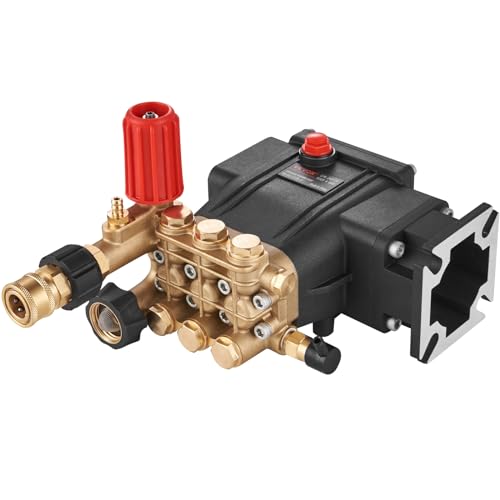
Best for a machine that gets used enough to justify a serviceable pump
- Three individual plungers driven by a crankshaft in an oil bath
- Serviceable valves and seals rather than a sealed assembly
- 3.0 GPM — enough flow to drive a full-size surface cleaner
- Adjustable unloader included on most listings
Why buy it: the whole argument for triplex is that it can be repaired. Valve and seal kits cost a fraction of a new pump, and the crankcase runs oil you actually change — which is why these pumps are measured in thousands of hours rather than hundreds.

Best for the vertical-shaft engines used on many big-box gas machines
- Vertical 7/8-inch shaft — the common big-box configuration
- Fits many Craftsman, Troy-Bilt and similar chassis
- 3000 PSI at 2.5 GPM
- Rear inlet and outlet layout
Why buy it: vertical-shaft machines are extremely common and the pump is the part that dies first, usually to frost. Matching shaft orientation and diameter matters more than brand here — a horizontal pump will not fit a vertical engine at any price.
The thing that kills both: bypass heat
Whichever pump you have, the fastest way to destroy it is to leave the machine running with the trigger released. In that state the unloader diverts flow back into the pump, which recirculates the same small volume of water and heats it — quickly. Hot water in a cold-water pump softens seals and destroys them, and axial pumps, being smaller and running at full engine speed, get there fastest.
Most machines fit a thermal relief valve that dumps water once it exceeds a set temperature, which is a safety net rather than a license. The rule of thumb worth adopting is simple: do not leave a running machine in bypass for more than a minute or two. Squeeze the trigger periodically to bring fresh water through, or shut it off between sections.

And the thing that actually kills most consumer pumps
Not wear. Frost. Water left in a pump through a hard freeze expands and cracks the head, and there is no repair — the pump is replaced. The pattern is entirely predictable: the machine worked in October and produces nothing in April.
Prevention takes five minutes at the end of the season. Disconnect the water, run the machine briefly to push out what remains, then introduce a few ounces of pump-saver antifreeze through the inlet and turn the pump over so it coats the internals. Store it somewhere that does not freeze if you can. It is the highest-value maintenance in pressure washer ownership by a wide margin — see how long pressure washers last and pressure washer no pressure for how the failure shows up.
Pump oil is not engine oil
On a triplex — and on the minority of axial pumps with a fill plug and a sight glass — the crankcase takes a dedicated non-detergent pump oil, not the multigrade oil in the engine. Detergent additives hold contaminants in suspension, which is what you want in an engine and precisely what you do not want in a pump crankcase where water intrusion is the failure to watch for. Milky oil in the sight glass means water has got past a seal and the pump needs attention before it is run again. The details are in what oil does a pressure washer take.
The verdict
Buy the machine on pressure and flow, because those determine how fast it cleans and the pump type does not. Then choose the pump on how many hours a year the machine will really see. Under twenty hours, an axial pump will outlast every other part of the machine and paying for a triplex buys nothing you will use. Past sixty or so, a triplex changes the ownership model from disposable to maintainable, and past a hundred and fifty a belt drive is what stops you replacing pumps annually. And whichever you own, winterise it — frost kills more consumer pumps than wear ever will.
More from this hub: leaf blowers & yard cleanup · how long do pressure washers last · pressure washer no pressure · best pressure washer · how we rank.