 Garden


Affiliate Disclosure
Some links on this page are affiliate links. As an Amazon Associate, we earn from qualifying purchases — at no extra cost to you. We do not buy, test, or physically handle the products we cover; our rankings come from aggregated owner reviews, ratings and expert consensus. Commissions never change our verdicts. How we rank · full disclosure.
The most useful thing on an electric pressure washer box is not the PSI number — it is whether that number was certified. An uncertified "3000 MAX PSI" badge describes a pressure the machine reaches momentarily at unloader bypass, with the trigger released. A CETA CPC-100 certified rating requires the measured pressure to be at least 90% of the advertised figure, and a PWMA certification means pressure and flow were tested to the PW101 standard by an independent lab. That is why two machines with identical badges can clean at visibly different speeds, and why a 1700 PSI certified Kärcher does not feel like half a 3000 PSI bargain machine.
For cars specifically this cuts both ways. You are not chasing the biggest number — the target is 1200 to 1900 PSI at the nozzle through a 40-degree tip, held two to three feet back. What you want from the machine is honest, consistent output and enough flow rate to rinse a whole car without creeping closer to make progress. Every machine below is electric, all are in the right output class, and none of them will hurt sound paint used correctly.
Top Picks at a Glance

Why electric is the right call for car work
This is one of the few jobs where electric is not a compromise — it is the better tool. Gas machines start around 2.3 GPM and 2800 PSI, which is more pressure than paint wants and more water than a driveway drain enjoys. They are also loud enough to make a Sunday-morning wash antisocial, must never run in a garage because of carbon monoxide, and demand fuel treatment and oil changes for a job you do for twenty minutes at a time.
An electric starts on a switch, weighs a third as much, and asks for nothing in the off-season but draining before the first freeze. The trade is flow rate: 1.1 to 1.8 GPM against 2.5, which matters on concrete and does not matter on a sedan. If you also have a long driveway, read electric vs gas before deciding.
Our #1 Pick: Westinghouse ePX3100v
The ePX3100v carries the strongest owner rating in this class and the most sensible pair of numbers for car work: 2100 max PSI at 1.76 max GPM. Through the 40-degree tip at a two-foot standoff, that lands squarely inside the safe window, and the 1.76 GPM flow is enough to sheet foam off a full-size SUV in one pass rather than three.
The v-model adds a built-in carry handle, which sounds trivial and is not — the reason pressure washers go unused is almost never power, it is the hassle of getting them out. It shares the anti-tipping base that Westinghouse put across the range, and that solves the genuinely irritating problem of a machine falling over every time you walk the hose around the car.
Owners consistently report two limitations. The power cord is short, as it is on nearly every machine in this class, and needs an outdoor-rated 12-gauge extension. And the onboard soap tank makes thin foam compared with a proper cannon — expected, since a tank-fed detergent system meters soap into a low-pressure stream while a cannon aerates it. If you want thick foam that dwells, budget thirty dollars for a cannon or buy the ePX3050 at rank six, which includes one.
Check price on Amazon → (paid link)
The Ranked Field

Best for the car owner who wants one machine and no thinking
- 2100 max PSI at 1.76 max GPM — inside the car window with a 40° tip
- Built-in carry handle and anti-tipping base
- Onboard soap tank and quick-connect nozzle set
- Total-stop system; the pump only runs on the trigger
Why buy it: the highest-rated machine in this class and the best-balanced set of numbers for car work — enough flow to rinse a whole car quickly, not enough pressure to get you in trouble.
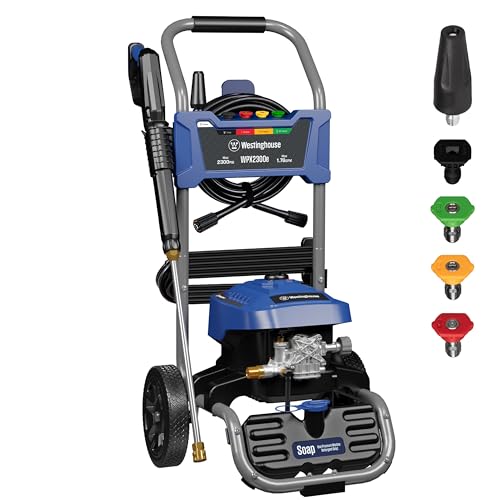
Best for buyers who want the machine to still work in five years
- Induction motor rather than a universal motor
- 2300 max PSI at 1.76 max GPM
- Metal quick-connect fittings on the pump side
- Onboard hose and cord storage
Why buy it: the induction motor is the upgrade that matters, because a universal motor running hot is how most electric washers die — this one runs cooler, quieter and far longer.

Best for a first machine that also has to do the driveway and the deck
- 2030 max PSI at 1.76 GPM
- Five quick-connect tips: 0°, 15°, 25°, 40° and soap
- Two 0.9-liter onboard detergent tanks
- Enormous spare-parts availability
Why buy it: the most-owned electric pressure washer in the country, which means its failure modes are documented rather than guessed at — and dual detergent tanks suit car work unusually well.

Best for anyone who wants a number they can actually trust
- CETA-certified performance rating, not a marketing maximum
- 1700 PSI class output — cannot over-pressure paint
- Vario power spray wand and onboard detergent tank
- Integrated hose storage on a compact upright chassis
Why buy it: a certified rating means the pressure was measured to a published test standard rather than at unloader bypass, and at this output the machine physically cannot damage sound paint.

Best for wrapped, ceramic-coated or freshly painted cars, and motorcycles
- 1800 PSI at 1.1 GPM, PWMA-certified to the PW101 test standard
- Light enough to carry one-handed
- 20-foot hose and a soap applicator
- Quiet enough for early-morning washing
Why buy it: PWMA certification plus modest flow makes this the safest machine here for delicate finishes — the low GPM costs you time on a driveway and buys you margin on paint.

Best for getting the whole correct car setup in one purchase
- 2100 max PSI at 1.76 max GPM
- Matched foam cannon included in the box
- Turbo nozzle included — for concrete, never the car
- Anti-tipping base and compact upright body
Why buy it: a matched cannon removes the two things that go wrong when you buy one separately: the wrong coupler size and foam too thin to dwell.

Quick Comparison
| Product | Best for | Rating | Price | Buy |
|---|---|---|---|---|
| Westinghouse ePX3100v Electric Pressure Washer, 2100 Max PSI, 1.76 Max GPM, Built-in Carry Handle | Best Overall | — | Check (paid link) | |
| Westinghouse WPX2300e Electric Pressure Washer, 2300 Max PSI, 1.76 Max GPM, Induction Motor | Best Motor | — | Check (paid link) | |
| Sun Joe SPX3000 Electric Pressure Washer, 2030 Max PSI, 1.76 GPM | Best Value | — | Check (paid link) | |
| Kärcher K1700 Electric Pressure Washer, CETA Certified, 3 Spray Nozzles, Detergent Tank | Best Certified Rating | — | Check (paid link) | |
| Greenworks 1800 PSI (1.1 GPM) Electric Pressure Washer, PWMA Certified | Gentlest on Paint | — | Check (paid link) | |
| Westinghouse ePX3050 Electric Pressure Washer, 2100 Max PSI, 1.76 Max GPM, with Foam Cannon | Best Foam Cannon Bundle | — | Check (paid link) |
Nozzles: the part that actually decides whether your paint survives
Machine choice sets the ceiling. Nozzle choice decides what happens. Every machine here ships with tips color-coded to a fan angle, and the rule for vehicles is short:
| Tip | Fan angle | On a car |
|---|---|---|
| Black | Soap / 65° | Yes — detergent application |
| White | 40° | Yes — the default for paint and glass |
| Green | 25° | Wheels, tires, arches and sills only |
| Yellow | 15° | No |
| Red | 0° | Never — will cut clearcoat and remove badges |
| Turbo / rotary | Spinning 0° | Never on paint; concrete only |
Release the trigger and squeeze it once with the power off before changing a tip, so the trapped pressure bleeds out. And keep the standoff at two to three feet: pressure at the surface falls off quickly with distance, which is why the same nozzle that is safe at three feet can lift a decal at three inches.
How We Rank
We do not buy, run or test these machines. Rankings come from aggregated owner ratings across the most-owned electric pressure washers, weighted toward long-ownership reviews where motor and pump failures appear, and cross-checked against published and — where available — independently certified specifications. Four things carry the weight here: output inside the car-safe window rather than the largest badge; rating honesty, with certified figures preferred over marketing maximums; motor and pump durability, since that is what actually ends these machines; and ease of getting it out of the garage, because a machine that stays put washes nothing. Prices were checked at the time of writing. Full method: how we rank.
The Field, Reviewed
1. Westinghouse ePX3100v — Best Overall
Covered above. Owners praise: the carry handle, the stable base, quiet running for the class, and strong results on winter road salt. Owners gripe about: a short cord, a soap tank that foams thinly, and plastic inlet fittings. Check price (paid link).
2. Westinghouse WPX2300e — Best Motor
The durability pick. An induction motor is heavier and pricier than the universal motors in cheaper machines, and it runs cooler, quieter and considerably longer — which addresses the way most electric pressure washers actually die. If you wash cars every weekend and expect to keep the machine, this is where the money goes.
Owners praise: noticeably lower noise, metal fittings on the pump side, and untroubled long sessions. Owners gripe about: weight, price against the ePX range, and a cord that is still short. Check price (paid link).
3. Sun Joe SPX3000 — Best Value
The most-owned electric pressure washer in the United States, which matters because it produces something no spec sheet can: a reliable picture of how the machine behaves in year three. For car work the dual detergent tanks are genuinely useful — a wheel cleaner in one, a pH-neutral shampoo in the other.
Owners praise: price, parts availability, the two tanks, and how quickly it clears salt from arches. Owners gripe about: weeping plastic hose fittings, a hose that coils badly in cold weather, and pressure loss after a freeze if stored undrained. Check price (paid link).
4. Kärcher K1700 — Best Certified Rating
The machine for anyone who would rather remove the possibility of over-pressuring a car than remember the rule. Kärcher publish a CETA-certified figure rather than a marketing maximum, and at this output the machine simply does not have the capacity to damage sound paint.
Owners praise: fast setup, integrated hose storage, and complete confidence around paint. Owners gripe about: it is slow on driveways and old concrete, plastic inlet fittings, and a price that looks high beside bigger badges. Check price (paid link).
5. Greenworks 1800 PSI — Gentlest on Paint
PWMA-certified, deliberately modest, and the right answer for a wrap, a ceramic coating, a fresh respray or a motorcycle. 1.1 GPM makes rinsing slower and makes the machine essentially incapable of the damage a bigger one can do.
Owners praise: light weight, quiet running, and confidence on delicate finishes. Owners gripe about: genuinely low flow, which shows up immediately on anything larger than a car. Check price (paid link).
6. Westinghouse ePX3050 — Best Foam Cannon Bundle
Same output class as the ePX3100v with a matched foam cannon in the box. Buying a cannon separately means checking coupler sizes and often adding an adapter, and a mismatched cannon makes thin foam that owners then blame on the soap.
Owners praise: genuinely thick foam out of the box and good value against buying the parts separately. Owners gripe about: the included turbo nozzle tempts people to use it on a car — do not — and the same short-cord complaint. Check price (paid link).
What Owners Actually Complain About
The cord, on nearly every machine. Almost every electric in this class ships with a cord too short to reach the driveway, and household extension leads are frequently too thin for the draw. Use 12-gauge outdoor-rated cord and keep it under 25 feet, or extend on the water side with a longer garden hose instead.
Thin foam blamed on the machine. An onboard soap tank cannot make cannon-grade foam; it is not designed to. Thin foam from a cannon is usually dish soap, cold water, or a machine below about 1.4 GPM.
Plastic inlet fittings. Across the class the leading hardware complaint is a weeping connection rather than a failed motor. Brass replacements cost a few dollars.
Pressure loss after winter. Water left in a pump through a freeze cracks it. Ten minutes in the fall prevents it — see how to winterize a pressure washer.
The Verdict
Buy the Westinghouse ePX3100v if you want the best-rated, best-balanced machine for washing cars and nothing more complicated than that. Pay up for the WPX2300e if you wash often and want the induction motor to still be running in year five. Take the Greenworks 1800 PSI if your paint is wrapped, coated or new and you would rather have margin than speed. Then spend thirty dollars on a foam cannon, fit the 40-degree tip, stand two to three feet back, and never let the red nozzle near the car. Check price on Amazon → (paid link)
More from this hub: leaf blowers & yard cleanup · best pressure washer for cars · best electric pressure washers · best foam cannons · how to pressure wash a car · how we rank.