 Garden

Affiliate Disclosure
Some links on this page are affiliate links. As an Amazon Associate, we earn from qualifying purchases — at no extra cost to you. We do not buy, test, or physically handle the products we cover; our rankings come from aggregated owner reviews, ratings and expert consensus. Commissions never change our verdicts. How we rank · full disclosure.
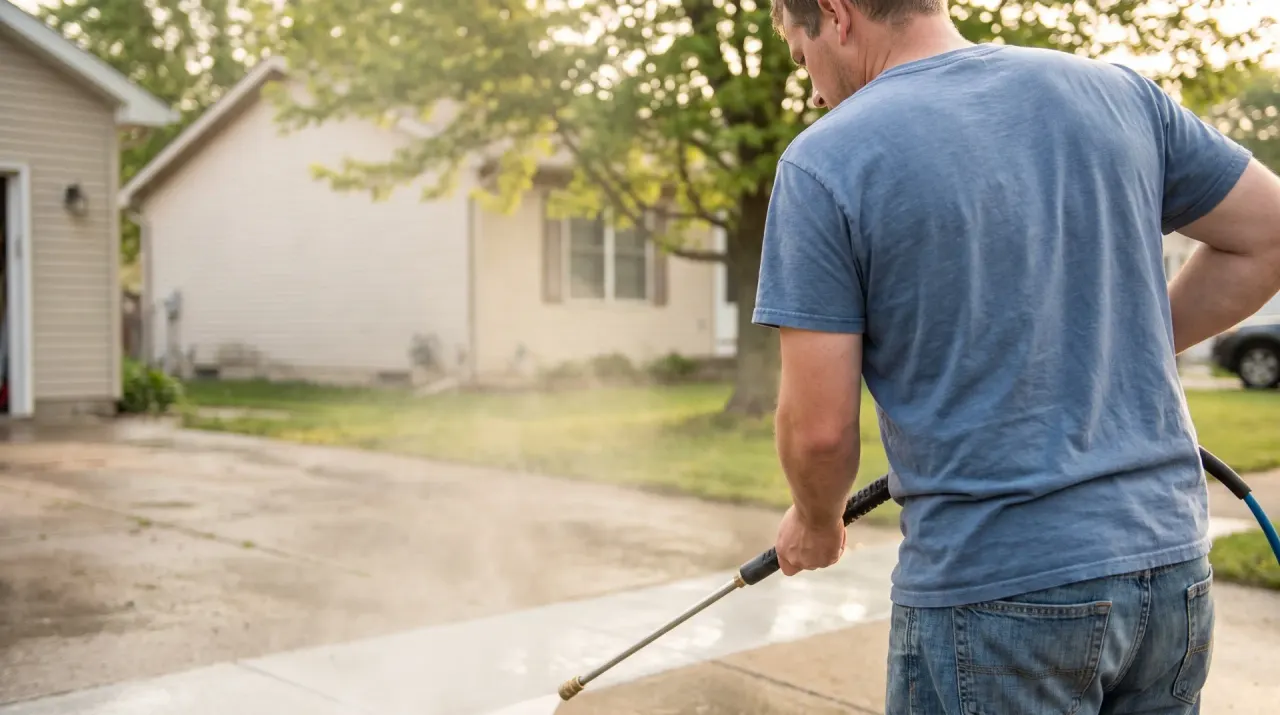
A deck is the one job where the danger is having too much pressure, not too little. Softwood decking — pine, cedar, redwood, most pressure-treated lumber — starts to fur above roughly 1200 to 1500 PSI at the surface. The water lifts the wood fibers, and the fuzzy texture that leaves behind is permanent unless you sand every board. It looks fine while it is wet. It looks terrible a week later.
So the machine matters less here than almost anywhere else. What matters is the nozzle you fit, the distance you hold it at, and whether you let a deck cleaner do the chemical work instead of trying to strip weathered gray with force. A $12 tip set has more influence on the outcome than the difference between any two machines on this page.
Top Picks at a Glance
Pressure Limits by Decking Material
| Material | Working pressure | Nozzle | Tip distance |
|---|---|---|---|
| Cedar and redwood | 500–800 PSI | 40° | 12+ inches |
| Pine and pressure-treated softwood | 800–1200 PSI | 40°, 25° for stains | 8–12 inches |
| Hardwood (ipe, cumaru) | 1200–1500 PSI | 25° | 8–10 inches |
| Composite decking | Check the maker — often 1500–3100 PSI | 40° | Per the care guide |
| Painted or stained deck | Below 800 PSI | 40° | 12+ inches |
| Deck railings and spindles | Below 800 PSI | 40° | 12+ inches |
Note that every figure in that table is below what a typical electric pressure washer produces at the tip with a narrow nozzle. You reduce pressure at the surface in two ways: by fitting a wider fan, which spreads the same energy over more area, and by backing off. Both are free, and both are more reliable than trying to find a machine whose maximum happens to be safe.
Our #1 Pick: Westinghouse ePX3100
The ePX3100 is the sensible single machine for a house with a deck. At 2300 max PSI and 1.76 GPM it has the flow to work at a reasonable pace — flow is what carries dirt away, and a low-flow machine makes a deck job take twice as long — while its peak pressure is low enough that a 25° or 40° tip at a normal working distance keeps you comfortably inside the safe range for softwood.
The induction motor is the reason to choose it over cheaper machines at similar numbers. Universal motors, which is what most sub-$150 washers use, run hot and are the usual cause of an electric pressure washer dying in year two or three. A deck is a long job — a 400 square foot deck is an hour or more of continuous trigger time — and that is exactly the duty cycle that kills a cheap motor.
What owners consistently report is the same story as the rest of the class: the machine is fine and the fittings are the weak point. Plastic quick connects weep before anything else does, and brass replacements are a few dollars. The supplied hose is short for working around a deck, and a 50-foot replacement is the upgrade most people make first.
Check price on Amazon → (paid link)
The Ranked Field

Best for a homeowner who wants one machine for the deck, the siding and the driveway
- 2300 max PSI at 1.76 max GPM
- Four quick-connect nozzles plus a low-pressure soap tip
- Induction motor for longer life and lower noise
- Compact upright body that stores on a shelf
Why buy it: enough flow to work quickly and low enough peak pressure that a 25° tip held at a sensible distance will not fur the timber — the balance decks actually need.

Best for older pine and cedar decking where damage is the real risk
- 1800 PSI at 1.1 GPM — hard to damage wood with
- PWMA certified, so the figures are independently verified
- Very light and easy to move around furniture
- Onboard soap tank for deck cleaner
Why buy it: the machine least likely to ruin a deck, which on soft old pine is worth more than speed — you cannot sand the fuzz back out once it is raised.

Best for a first pressure washer that will also handle the deck twice a year
- 2030 max PSI at 1.76 GPM
- Two onboard 0.9-liter detergent tanks — one for deck cleaner, one for degreaser
- Five nozzles including 25°, 40° and soap
- Total stop system cuts the pump when the trigger is released
Why buy it: the most-owned pressure washer in America, and the twin detergent tanks are genuinely useful on a deck job where you want cleaner and brightener loaded at once.
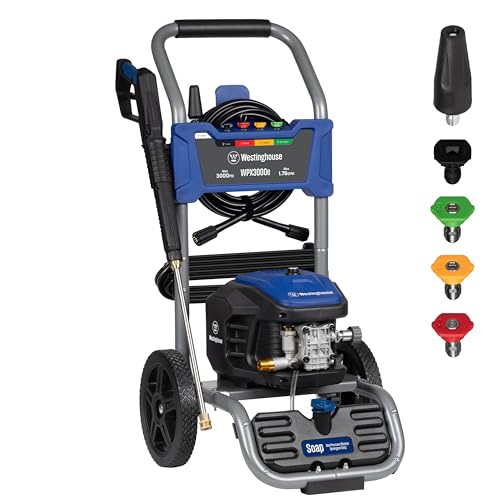
Best for big multi-level decks, and owners who also have a driveway to do
- 3000 max PSI at 1.76 max GPM from an induction motor
- Rolling frame with onboard hose and cord storage
- Five quick-connect nozzles plus soap
- Highest owner rating of the electrics here
Why buy it: the extra pressure is for the concrete, not the deck — on timber you throttle it back with the nozzle, and having the headroom means one machine covers everything.

Best for gray, weathered timber where pressure alone leaves it looking worse
- Oxygen-bleach concentrate designed for wood and composite
- Siphons through a pressure washer soap injector
- EPA Safer Choice recognized formulation
- Covers a large deck from one gallon of concentrate
Why buy it: the chemistry does the work that pressure should not — this is what lets you clean a deck at 1200 PSI instead of gouging it at 2500.

Best for anyone whose machine came with only two tips
- 0°, 15°, 25°, 40° and low-pressure soap tips
- Standard 1/4-inch quick connect
- Stainless inserts in brass bodies
- Rated to 2.5 GPM machines
Why buy it: the single cheapest thing on this page and the one that decides whether your deck survives — the 40° white tip is the one that should live on the wand.

Quick Comparison
| Product | Best for | Rating | Price | Buy |
|---|---|---|---|---|
| Westinghouse ePX3100 Electric Pressure Washer, 2300 Max PSI, 1.76 Max GPM | Best Overall for Decks | — | Check (paid link) | |
| Greenworks 1800 PSI (1.1 GPM) Electric Pressure Washer, PWMA Certified | Safest for Softwood | — | Check (paid link) | |
| Sun Joe SPX3000 Electric Pressure Washer, 2030 Max PSI, 1.76 GPM | Best Value | — | Check (paid link) | |
| Westinghouse WPX3000e Electric Pressure Washer, 3000 Max PSI, 1.76 Max GPM, Induction Motor | Best for Large Decks | — | Check (paid link) | |
| Simple Green Oxy Solve Deck and Fence Pressure Washer Cleaner, 1 Gallon Concentrate | Best Deck Cleaner | — | Check (paid link) | |
| Twinkle Star Pressure Washer Nozzle Tips, 1/4-Inch Quick Connect, 2.5 GPM Set | The Part That Saves Your Deck | — | Check (paid link) |
How to Wash a Deck Without Ruining It
- Clear and sweep. Furniture off, planters off, debris out of the board gaps with a putty knife or a gap tool. Anything left behind becomes a clean rectangle.
- Wet the plants around the deck and keep them wet. Even oxygen-bleach cleaners will scorch foliage at concentration.
- Apply the deck cleaner with the black soap nozzle. Work in sections you can finish in ten minutes, and do not let it dry on the boards.
- Let it dwell 10 to 15 minutes. This is where the gray is lifted. Skipping it is why people end up using too much pressure.
- Fit the 40° tip and rinse with the grain, board by board, running the full length of each board rather than crossing them. Cross-grain passes leave visible stripes.
- Keep the tip 8 to 12 inches off and keep it moving. Never stop with the trigger held; a stationary jet cuts a mark in under two seconds.
- Do the railings and spindles last, at lower pressure and greater distance — they are thinner stock and mark more easily.
- Let it dry 48 hours of decent weather before sealing. Test by sprinkling water on a board: it should soak in, not bead.
If a section still looks gray after cleaning and rinsing, the answer is a second application of cleaner or a wood brightener — not more pressure. That decision is the whole difference between a deck that looks new and one that looks chewed.
When Not to Use Pressure at All
If the deck is painted, badly weathered or over 15 years old with soft, splintering boards, consider skipping the pressure washer entirely and cleaning it by hand with the same oxygen-bleach product and a stiff brush. The same logic applies to the siding above the deck and to any shingle roof over it — those want soft washing, where chemistry does the work at under 500 PSI. Pressure is the wrong tool on anything porous or fragile, and a deck at the end of its life is both.
Safety
Even at deck-appropriate pressure, the stream can break skin. A high-pressure injection injury looks like a small puncture and is a surgical emergency; both the CDC's pressure washer safety guidance and Mississippi State University Extension's safety bulletin stress that the visible wound badly understates the damage. Wear closed shoes and eye protection, because a deck throws grit and old finish straight back at you, and never work from a ladder with a live wand — the kickback moves you.
Wet decking is extremely slippery, particularly once cleaner is on it. Work backwards toward the steps rather than painting yourself into a corner. And before you open any fitting or change a nozzle, shut the machine down, turn off the water and squeeze the trigger to bleed the pressure trapped in the hose.

How We Rank
We do not buy or test these machines. Rankings come from aggregated owner ratings across the most-owned pressure washers used for deck work, weighted toward long-ownership reviews where motor and fitting failures surface, and cross-checked against published pressure and flow specifications and manufacturer care guidance for decking materials. Four things carry weight for this job specifically: controllability, meaning whether the machine can comfortably work in the 800 to 1200 PSI band; flow rate, because it sets how long a large deck takes; detergent handling, since chemistry does most of the real work here; and motor durability, because a deck is a long continuous run. Prices were checked at the time of writing. Full method: how we rank.
The Field, Reviewed
1. Westinghouse ePX3100 — Best Overall for Decks
Covered above. Owners praise: value, quiet induction motor, quick nozzle changes, and a compact body that stores easily. Owners gripe about: plastic fittings that weep, a soap tank that is fiddly to fill, and a short hose and cord. Check price (paid link).
2. Greenworks 1800 PSI — Safest for Softwood
If the deck is old pine and you are nervous about damaging it, this removes most of the risk. At 1800 PSI with a 40° tip you would have to work at it to fur a board. The trade is time: 1.1 GPM makes a big deck a long afternoon.
Owners praise: how hard it is to damage anything with, light weight, and PWMA-certified figures. Owners gripe about: slow going on large areas, a short hose, and no chance of driving accessories. Check price (paid link).
3. Sun Joe SPX3000 — Best Value
The most-owned pressure washer in the country, and for deck work the two detergent tanks are genuinely useful — cleaner in one, brightener or a general degreaser in the other, without stopping to decant.
Owners praise: price, the twin tanks, how quickly it strips a season of green off a fence, and easily found spare parts. Owners gripe about: leaking plastic hose fittings, a hose that coils badly in the cold, and pressure loss after a few seasons if stored wet through a freeze. Check price (paid link).
4. Westinghouse WPX3000e — Best for Large Decks
The highest-rated electric here and the one to buy if the deck is only part of the list. The 3000 PSI ceiling is for the driveway; on timber you simply do not use it, throttling back with the 40° tip.
Owners praise: build quality, the induction motor, onboard storage, and enough headroom to do concrete properly. Owners gripe about: the price against the ePX3100, size on a small deck, and the same short-cord complaint that affects the whole class. Check price (paid link).
5. Simple Green Oxy Solve Deck and Fence — Best Deck Cleaner
The product that lets you use less pressure. Oxygen bleach lifts weathered gray and mildew chemically rather than mechanically, and it is far gentler on the planting around a deck than chlorine-based cleaners.
Owners praise: visible improvement on gray timber before any rinsing, plant safety, and coverage from one gallon of concentrate. Owners gripe about: needing a proper dwell time rather than instant results, and being less aggressive than chlorine on heavy black mildew. Check price (paid link).
6. Twinkle Star Nozzle Tip Set — The Part That Saves Your Deck
Twelve dollars, and more consequential than any machine choice on this page. Many washers ship with only two tips, neither of which is the 40°. Buying a full set means the right nozzle is always available rather than making do with a narrower one.
Owners praise: fit, build, and having the full 0° through 40° range plus a soap tip. Owners gripe about: tips that can be tight in some quick connects at first, and a 2.5 GPM rating that is not ideal on very high-flow gas machines. Check price (paid link).
What Owners Actually Complain About
Furred boards. The signature deck-washing regret, and it is nearly always a 15° tip or a machine held too close. It cannot be rinsed out; it has to be sanded.
Stripes across the boards. Caused by working across the grain or by inconsistent distance. Run the full length of each board in one continuous pass.
Grey that will not come off. Usually a cleaner problem, not a pressure problem. Reach for a second application or a wood brightener, never a narrower nozzle.
Sealer peeling weeks later. Almost always sealing a deck that had not fully dried inside. Wait 48 hours of dry weather and do the water-drop test.
Dead plants along the deck edge. Preventable by soaking the beds before you start and rinsing them after. Nobody remembers this the first time.
The Verdict
For most homes the Westinghouse ePX3100 is the right machine — enough flow to work at a sensible pace, low enough pressure to stay safe on timber with the correct tip. Choose the Greenworks 1800 if the deck is old softwood and damage worries you more than time, and the WPX3000e if you also have a driveway to do. Then spend twelve dollars on a full nozzle set and leave the 40° tip on the wand, because that is the decision that actually determines how the deck looks in a month. Check price on Amazon → (paid link)
More from this hub: leaf blowers & yard cleanup · best pressure washer · what is soft washing · best surface cleaner · how we rank.