 Garden

Affiliate Disclosure
Some links on this page are affiliate links. As an Amazon Associate, we earn from qualifying purchases — at no extra cost to you. We do not buy, test, or physically handle the products we cover; our rankings come from aggregated owner reviews, ratings and expert consensus. Commissions never change our verdicts. How we rank · full disclosure.
For home use, the honest answer is that almost everyone buys too much machine. A 2000 to 2500 PSI electric handles the driveway, the deck, the fence, the siding, the patio set and the car, and it does it without fuel, oil, exhaust, pull-starting or a winterizing routine. The machines that sell on a 4000 PSI badge are not better at domestic work; they are better at removing timber, mortar and paint you meant to keep.
The number that actually predicts how fast a surface gets clean is not PSI at all. It is PSI multiplied by flow rate — pressure loosens the dirt, water volume carries it away — and manufacturers quietly call the product cleaning units. That is the figure we rank on, alongside the two things owners tell us decide whether a pressure washer earns its shelf space: whether it survives more than three seasons, and whether it is light enough that you actually get it out.
Top Picks at a Glance
The Number That Ranks These Honestly
Cleaning units are simply PSI × GPM. Every manufacturer knows the figure and almost none of them lead with it, because it flattens the marketing gap between models. Here is what the machines above actually produce:
| Machine | Max PSI | GPM | Cleaning units | Realistic use |
|---|---|---|---|---|
| CRAFTSMAN lightweight | ~1700 | 1.2 | ~2,040 | Cars, furniture, bikes |
| Westinghouse ePX3100v | 2100 | 1.76 | ~3,700 | Everything domestic |
| Sun Joe SPX3000 | 2030 | 1.76 | ~3,570 | Everything domestic |
| Westinghouse ePX3500 | 2500 | 1.76 | ~4,400 | Old concrete, hard grime |
| Westinghouse WPX3400e | 3400 | 2.0 | ~6,800 | Large paved areas |
| Westinghouse WPX3200 (gas) | 3200 | 2.5 | ~8,000 | Acreage, no outlet |
Read that once and the category makes sense. The three mainstream electrics sit within about 20 percent of each other and any of them will clean a suburban house. The brushless WPX3400e is genuinely a step up because it raises flow, not just pressure. And the gas machine is roughly double — which is the honest case for spending twice as much and accepting an engine.
Our #1 Pick: Westinghouse ePX3100v
On raw specification this is not the strongest machine in the list, and that is deliberate. Its 2100 PSI at 1.76 GPM is squarely in the range that does every household job without threatening the surfaces it is pointed at, and it carries one of the highest owner ratings in the entire electric category.
The feature that matters is the least glamorous one: a built-in carry handle on an upright body that stores on a garage shelf. Ask owners why a pressure washer stops getting used and the answer is never that it lacked power — it is that hauling a wheeled unit out from behind the mower, uncoiling everything and putting it away is a forty-minute commitment for a ten-minute job. A machine you can pick up with one hand changes that calculation.
Underneath, it uses an induction motor rather than the universal motor found in the cheapest electrics. Induction motors run cooler and quieter and last considerably longer, which is exactly where budget machines fail. Owners consistently report it running season after season with nothing more than a pump drain before winter.
Check price on Amazon → (paid link)
The Ranked Field

Best for the household that wants one machine for the driveway, the siding and the car
- 2100 max PSI at 1.76 max GPM
- Induction motor rather than a universal motor
- Built-in carry handle and an upright body that stores on a shelf
- Onboard soap tank with four quick-connect nozzles
Why buy it: the highest-rated machine in this class and the one built around the thing that actually decides whether a pressure washer gets used — how easy it is to pick up and put away.

Best for buyers who want the machine with the deepest ownership record in America
- 2030 max PSI at 1.76 GPM from a 14.5-amp motor
- Five quick-connect nozzles: 0°, 15°, 25°, 40° and soap
- Two onboard detergent tanks
- Total stop system cuts the pump when the trigger is released
Why buy it: not the strongest machine here, but by a wide margin the best understood — its failure modes are documented by an enormous body of long-term owners rather than a handful of reviewers.

Best for older concrete, algae-black fences and ground-in driveway grime
- 2500 max PSI at 1.76 max GPM
- Induction motor that runs cooler and quieter
- Onboard soap tank and five nozzles
- Anti-tipping base with a wide stance
Why buy it: the extra 400 PSI is not the reason to buy it — the induction motor is, because universal motors are where cheap electrics die and this one is built to outlast them.
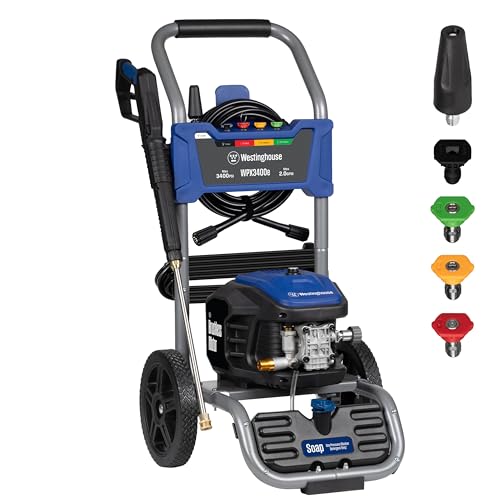
Best for long driveways and big patios without the fuel, oil and noise of an engine
- 3400 max PSI at 2.0 max GPM
- Brushless motor with a substantially longer service life
- Around 6,800 cleaning units — close to entry gas territory
- Onboard hose reel and soap tank
Why buy it: the only electric here that meaningfully closes the gap to gas, because it raises flow as well as pressure — which is the half of the equation the marketing never mentions.

Best for cars, patio furniture, bikes and anyone carrying it up steps
- Compact corded body built to be carried one-handed
- Quick-connect nozzles including a soap tip
- Short footprint for apartment and garage storage
- Gentle enough for vehicle paint with the right tip
Why buy it: the machine people actually keep using, because the reason a pressure washer sits unused is almost never power — it is the hassle of dragging it out.

Best for acreage, farm buildings and anywhere without a convenient outdoor outlet
- 3200 PSI at 2.5 GPM — roughly double the throughput of a standard electric
- Axial cam pump with a 212cc engine
- Five quick-connect nozzles plus a soap applicator
- Never-flat wheels and onboard storage
Why buy it: gas is a different class of tool rather than a bigger version of the same one — 2.5 GPM strips a long driveway in a fraction of the time, and no cord decides where you can go.
Quick Comparison
| Product | Best for | Rating | Price | Buy |
|---|---|---|---|---|
| Westinghouse ePX3100v Electric Pressure Washer, 2100 Max PSI, 1.76 Max GPM, Built-in Carry Handle | Best for Most Homes | — | Check (paid link) | |
| Sun Joe SPX3000 Electric Pressure Washer, 2030 Max PSI, 1.76 GPM | Best Known Quantity | — | Check (paid link) | |
| Westinghouse ePX3500 Electric Pressure Washer, 2500 Max PSI, 1.76 Max GPM | Best for Stubborn Jobs | — | Check (paid link) | |
| Westinghouse WPX3400e Electric Pressure Washer, 3400 Max PSI, 2.0 Max GPM, Brushless Motor | Best Near-Gas Electric | — | Check (paid link) | |
| CRAFTSMAN Electric Pressure Washer, Cold Water, Lightweight Corded Power Washer | Best Lightweight | — | Check (paid link) | |
| Westinghouse WPX3200 Gas Pressure Washer, 3200 PSI, 2.5 GPM | Best Gas for a Large Property | — | Check (paid link) |
Matching the Machine to the House
Buy for the property you have, not the one in the advertisement. This is the mapping owner reports support:
| Your situation | What to buy | Why |
|---|---|---|
| Apartment, patio, one car | Compact 1500–1800 PSI electric | Storage and weight decide everything at this scale |
| Standard suburban lot, two-car driveway | 2000–2500 PSI electric at 1.76 GPM | Covers every surface on the property |
| Old, heavily stained concrete | 2500 PSI electric plus a surface cleaner | The attachment matters more than the extra pressure |
| Long driveway, large patio, pool deck | Brushless electric at 2.0 GPM, or gas | Flow rate is what saves hours on big areas |
| Acreage, barn, no outdoor outlet | Gas at 2.5 GPM or more | No cord, and throughput you cannot get from 120 volts |
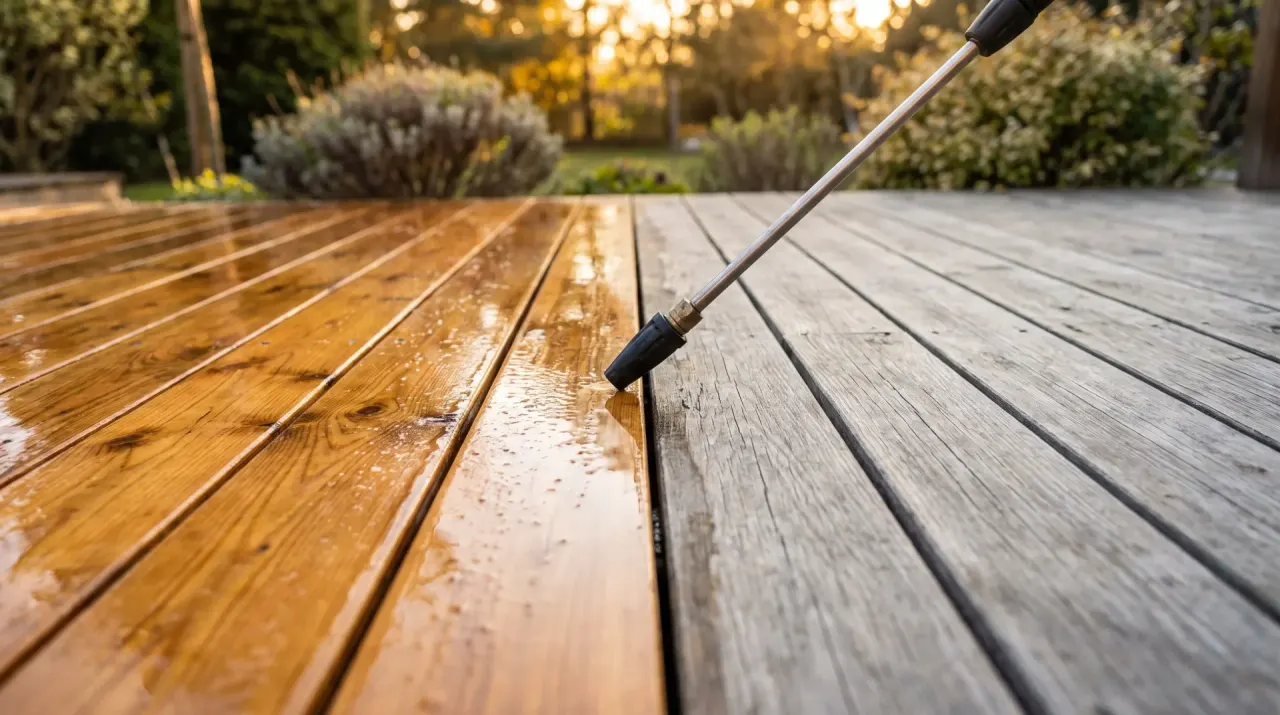
| Wood deck and painted trim only | 1500–1800 PSI electric | More pressure is a liability, not a feature |
The Mistake That Gets Blamed on the Machine
A pressure washer is a pump, and a pump can only move the water it is given. Manufacturers typically specify an inlet supply of at least twice the machine's rated flow — so a 1.76 GPM unit wants a faucet delivering roughly 3.5 GPM or better through a 5/8-inch hose, with the valve fully open.
Starve it and the symptoms look exactly like a defective machine: pressure that surges and drops, a motor that cycles on and off, and a spray that pulses instead of holding steady. Before you conclude a new washer is faulty, time how long your faucet takes to fill a five-gallon bucket. Under 90 seconds is fine. Then check the inlet screen for grit, straighten every kink, and use the shortest garden hose that reaches. A large share of one-star reviews in this category describe this problem rather than a broken pump.
The Injury Nobody Warns You About
Pressure washers are sold as garden equipment and treated accordingly, but the stream from a narrow nozzle carries enough energy to break skin. A high-pressure injection injury forces water, grit and bacteria into the tissue beneath through a puncture that can look trivial. It is a surgical emergency, and the visible wound badly understates the damage.
The scale is not trivial either. A 2024 analysis of the CPSC's National Electronic Injury Surveillance System data estimated 15,307 high-pressure injection hand injuries in the United States between 2012 and 2021, and pressure washers accounted for about 90 percent of them — far more than paint or grease guns. Emergency medicine reporting notes the injuries peak in late spring and summer and on weekends, which is to say they happen to homeowners on a Saturday, not to industrial workers. The CPSC has issued its own warning that power washers can cause serious injuries.
The rules are short. Never point a wand at a person or a pet, and never steady the spray by bracing your other hand in front of the tip. Treat the red 0° nozzle as one you almost never fit — it concentrates the entire output into a pencil-width jet and is the tip most often involved in both injuries and accidental damage. Wear closed shoes and eye protection, because grit returns at the speed it left. Release the trigger, kill the power and bleed the hose before changing a nozzle. If a jet does break skin, go to an emergency department immediately and say explicitly that it was a pressure washer injection injury.
How We Rank
We do not buy, run or test these machines. Rankings come from aggregated owner ratings across the most-owned home pressure washers, weighted toward long-ownership reviews where pump and fitting failures actually show up, and cross-checked against published specifications for pressure and flow. Four things carry the weight: real throughput, computed as cleaning units rather than taken from the PSI badge; durability, especially motor type and the plastic fittings that fail first; usability, because the machine you can carry out in one trip is the machine you will use; and serviceability, since a sealed pump turns a repairable tool into a disposable one. Prices were checked at the time of writing. Full method: how we rank.
The Field, Reviewed
1. Westinghouse ePX3100v — Best for Most Homes
Covered above. Owners praise: the carry handle and small footprint, quiet operation for an electric, and results on siding and decks that they expected to need a bigger machine for. Owners gripe about: a power cord too short to be useful without an outdoor-rated extension, a soap tank that is fiddly to fill, and a hose that coils stiffly in cold weather. Check price (paid link).
2. Sun Joe SPX3000 — Best Known Quantity
The most-owned electric pressure washer in the country, and the reason it stays in this list is that its behavior in year three is genuinely documented rather than guessed at. Two dual detergent tanks let you keep a wood cleaner and a degreaser loaded at once, and the total-stop system means the motor only runs while the trigger is held.
Owners praise: the price, the twin soap tanks, easy availability of spare parts, and how quickly it takes a season of green off a fence. Owners gripe about: plastic hose fittings that weep before anything else fails, and pressure loss after a winter if it was stored without draining. Check price (paid link).
3. Westinghouse ePX3500 — Best for Stubborn Jobs
The strongest of the standard-flow electrics, and the induction motor is the real upgrade rather than the extra 400 PSI. If your concrete is old, north-facing and green every spring, this is the electric to take.
Owners praise: noticeably quieter running, a stable base that does not tip when the hose is pulled, and real progress on stains a smaller machine left behind. Owners gripe about: weight, the short cord, and the price gap to the ePX3100 given identical flow. Check price (paid link).
4. Westinghouse WPX3400e — Best Near-Gas Electric
The interesting machine in the category right now. At 2.0 GPM it moves meaningfully more water than the 1.76 GPM standard, and the brushless motor removes the wear item that kills cheaper electrics. On cleaning units it lands closer to an entry gas unit than to its own siblings.
Owners praise: genuine speed on large paved areas, the onboard hose reel, and no fuel or oil routine. Owners gripe about: the price against a gas machine of similar output, bulk, and a draw that wants a dedicated circuit rather than a shared garage outlet. Check price (paid link).
5. CRAFTSMAN Lightweight Electric — Best Lightweight
The honest answer for anyone whose real obstacle is effort rather than power. Light enough to carry one-handed up steps, small enough for an apartment, and correctly matched to cars, bikes and patio furniture.
Owners praise: how quickly it comes out and goes away, and output gentle enough for vehicle paint. Owners gripe about: being outclassed on driveways and old concrete, and a short hose. Check price (paid link).
6. Westinghouse WPX3200 — Best Gas for a Large Property
Where the category changes character. At 2.5 GPM this moves roughly 40 percent more water than a standard electric, and on a long driveway that is the difference between an afternoon and a morning.
Owners praise: speed on large concrete areas, never-flat wheels that survive gravel, and freedom from cords. Owners gripe about: noise, pull-starting after winter storage, and the oil-change and fuel-stabilizer routine electric owners never think about. Check price (paid link).
What Owners Actually Complain About
Fittings and hoses, not motors. The single most common complaint across every brand is a leaking connection. Plastic quick-connects weep first, and brass replacements are inexpensive and fix most of it.
Pump failure after winter. Water left in a pump through a freeze cracks it. The machine that "lost pressure over the winter" is almost always this. Draining and adding pump antifreeze prevents it entirely.
The cord. Nearly every electric ships with a cord too short to reach anything useful, and many owners find their household extension lead is not rated for the draw.
Expecting gas performance from electric. A large share of one-star reviews describe a machine performing exactly to specification while the buyer expected roughly double the throughput.
The Verdict
For most American homes the Westinghouse ePX3100v is the sensible buy: enough pressure for every domestic surface, an induction motor that will outlast the cheap competition, and a carry handle that is the reason it will still be in use in five years. Step up to the ePX3500 if your concrete is old and stained, take the WPX3400e if you have real square footage to cover and want to stay electric, and only go to gas if you have acreage or no outdoor outlet. Whatever you buy, shop on cleaning units rather than the PSI badge, check your faucet flow before you blame the pump, and fit the 0° nozzle roughly never. Check price on Amazon → (paid link)
More from this hub: leaf blowers & yard cleanup · best pressure washer overall · best portable pressure washer · what pressure washing costs · is it worth buying one · how we rank.