 Garden


Affiliate Disclosure
Some links on this page are affiliate links. As an Amazon Associate, we earn from qualifying purchases — at no extra cost to you. We do not buy, test, or physically handle the products we cover; our rankings come from aggregated owner reviews, ratings and expert consensus. Commissions never change our verdicts. How we rank · full disclosure.
The nozzle, not the machine, decides what happens to the surface. A 2000 PSI washer with a 0-degree tip will cut wood and lift paint; a 3200 PSI machine with a 40-degree tip washes a car safely. Everything a pressure washer does well or badly runs through a five-dollar piece of stainless steel, and most owners treat the set as accessories that came in the box rather than the control system they actually are.
Two things follow. First, nozzles are consumable — the orifice erodes, the fan pattern degrades, and the machine feels weak while nothing is actually wrong with the pump. Second, orifice size has to match your machine's flow rate, and almost nobody checks. Both are covered below, along with the honest case for and against turbo nozzles and how to clear a clogged tip without ruining it.
Top Picks at a Glance

What the colors actually mean
| Color | Fan angle | Use it for | Never use it on |
|---|---|---|---|
| Black | 65° (soap) | Applying detergent at low pressure | Nothing — it is the gentle one |
| White | 40° | Cars, painted surfaces, siding, windows | — |
| Green | 25° | Concrete, decking, general dirt, wheel arches | Fresh paint, soft wood |
| Yellow | 15° | Stubborn concrete stains, paint prep | Wood, siding, vehicles |
| Red | 0° | Almost nothing; spot-removing a stubborn mark on hard concrete | Vehicles, wood, siding, masonry, people |
| Turbo / rotary | Spinning 0° in a 25° cone | Ground-in concrete grime | Everything softer than concrete |
The soap tip needs one note that surprises people: a chemical injector only draws detergent at low pressure, which is why soap will not come through a 25-degree tip. If your machine refuses to pull detergent, the black tip being in the wand is the first thing to check.
Orifice sizing: the part that is never explained
A nozzle's fan angle is only half of its specification. The other half is the orifice size, which sets how much water passes at a given pressure — and it must be matched to your machine. Nozzle sets are stamped with a four-digit code where the first two digits are the angle and the last two are the orifice number: a "2540" is a 25-degree tip with a 4.0 orifice.
| Your machine | Typical orifice | Sets are labeled |
|---|---|---|
| 1.2–1.5 GPM compact electric | 2.0–2.5 | "2.0 GPM" or by machine model |
| 1.6–2.0 GPM standard electric | 3.0–3.5 | "2.5 GPM" sets often work; check pressure |
| 2.0–2.5 GPM gas or premium electric | 3.5–4.0 | "2.5 GPM" — the standard consumer set |
| 2.5–3.5 GPM consumer gas | 4.0–5.0 | "3.0–3.5 GPM" |
| 4.0 GPM and above | 5.5+ | Commercial sets |
Get it wrong and two things happen. Too small an orifice restricts flow and drives system pressure above what the pump and unloader were designed for, which stresses the machine and can cause the unloader to chatter. Too large an orifice drops the pressure and produces the "my new nozzles made it weaker" complaint that appears regularly in the ownership record. When in doubt, buy the set labeled for your machine's GPM rather than the one with the biggest pressure number on the packet.
Turbo nozzles: the honest case, both ways
A turbo nozzle takes a 0-degree jet and spins it in a cone, typically about 25 degrees. The result is 0-degree impact force delivered across a 25-degree footprint, and on stained concrete it is genuinely transformative — owners routinely describe it as the difference between a driveway that looks washed and one that looks new.
The same physics is why it is the wrong tool nearly everywhere else. It will fur wood permanently, cut through vinyl siding, blow mortar out of joints, strip paint you meant to keep, and take a badge off a car in an instant. It is also, along with the red 0-degree tip, the nozzle most associated with high-pressure injection injuries, because there is no fan spread to reduce the energy near the tip.
The practical rule: a turbo belongs in the box for concrete and comes out for nothing else. If you use one, keep it moving constantly — the spinning jet dwells long enough on one spot to cut a groove if you pause. And retire it when the bearing starts to wobble or the pattern goes lopsided; a worn turbo sprays unpredictably, which is exactly when accidents happen. For large concrete areas a surface cleaner is faster still, and safer, because the head is shrouded.

How to unclog a nozzle without ruining it
A blocked tip usually announces itself as a fan that has gone crooked, a jet that splits into two streams, or a machine that suddenly builds far more pressure than usual. Grit from a garden hose, sediment from well water, and dried detergent are the three causes.
- Shut off the machine and the water, then bleed the pressure. Squeeze the trigger until nothing comes out. This is not optional — trapped pressure releases suddenly when the tip is pulled.
- Pull the tip out of the quick-connect. Slide the collar back and it comes free.
- Push the cleaning wire through backward. Most machines ship with a thin wire for this; a paperclip or the wire from a bread-bag tag also works. Insert from the outlet side and push back through, so debris exits the way it came in rather than being driven deeper.
- Flush it backward. Hold the tip under a running tap, outlet-end into the flow, for thirty seconds. On a stubborn one, soak in warm water with a little vinegar for an hour first — mineral scale is a common cause on hard water.
- Refit and test at low pressure. Check the fan is even edge to edge before going back to work.
What not to do: never poke with a drill bit, nail, needle file or anything harder than the nozzle insert. A scarred orifice sprays crooked forever, and a slightly enlarged one drops your working pressure permanently. If a genuinely clean tip still sprays badly, it is worn out — buy another. That is a five-dollar fix, and it is worth trying before diagnosing a pump problem.
Prevention is straightforward: fit an inline inlet filter if your water carries sediment, check the machine's inlet screen at the start of each session, and run clean water through the soap line for a minute after using detergent so nothing dries in the injector.
The Ranked Field

Best for replacing a lost or worn set on any consumer machine
- Five tips: 0°, 15°, 25°, 40° and soap
- Sized 2.5 GPM — check this matches your machine
- Stainless steel with a 1/4-inch quick-connect plug
- Rated to 4000 PSI
Why buy it: the most-owned replacement set there is, and the honest reason to buy it is that worn tips are the commonest undiagnosed cause of "my pressure washer got weak".

Best for anyone who has already lost a nozzle in the grass
- Seven tips including 65° soap and a rotating option
- Magnetic or clip-on holder that mounts to the wand
- Stainless steel bodies with brass inserts
- Color-coded to the standard angle scheme
Why buy it: the holder is the feature — tips get changed mid-job, put in a pocket, and lost, and a wand-mounted holder is the only thing that reliably stops it.

Best for ground-in concrete grime, and nothing softer
- Rotating 0° jet described in a 25° cone
- Rated to 3600 PSI, hot-water capable
- Ceramic seat for a longer service life
- Standard 1/4-inch quick-connect plug
Why buy it: a turbo nozzle is a spinning 0° jet — it clears concrete dramatically faster and it belongs nowhere near wood, siding, paint or anyone’s hands.
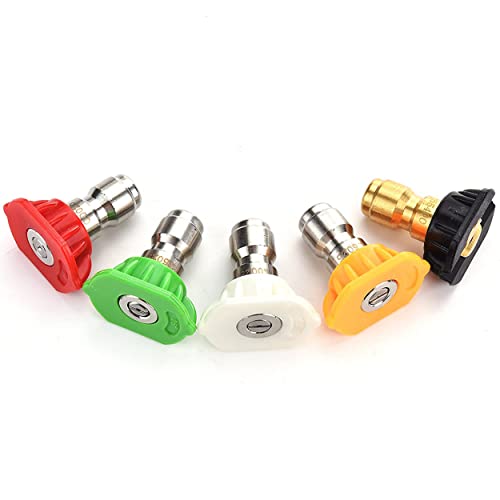
Best for a spare set to keep in the box
- Standard five-angle set including soap
- 2.5 GPM orifice sizing, 4000 PSI rated
- Stainless steel construction
- Fits any 1/4-inch quick-connect wand
Why buy it: nozzles are consumable — the orifice erodes and the fan pattern degrades long before anything visibly breaks, so a cheap spare set is sensible rather than indulgent.

Best for people who will not stop to change tips
- Seven patterns selected by twisting a collar
- No loose tips to drop or lose
- 1/4-inch quick-connect plug
- Includes a soap setting
Why buy it: a compromise on ultimate spray quality that buys a real behavioral change — the correct nozzle actually gets used, because switching costs nothing.

Best for occasional heavy concrete work on a budget
- Rotating jet rated to 4000 PSI
- 1/4-inch quick-connect plug
- Ceramic nozzle seat
- Works on gas and electric machines
Why buy it: does the same job as pricier turbos at a fraction of the cost; the trade is bearing life, and a turbo that has begun to wobble should be retired rather than nursed.
Quick Comparison
| Product | Best for | Rating | Price | Buy |
|---|---|---|---|---|
| Twinkle Star Pressure Washer Nozzle Tips, 5 Degrees, 1/4-Inch Quick Connect, 2.5 GPM | Best Overall Set | — | Check (paid link) | |
| Hourleey Pressure Washer Tips with Holder, 7 Nozzle Tips, 1/4-Inch Quick Connect | Best with a Holder | — | Check (paid link) | |
| Simpson Cleaning 80143 Universal Turbo Pressure Washer Nozzle, 3600 PSI, 1/4-Inch Quick Connect | Best Turbo Nozzle | — | Check (paid link) | |
| Tool Daily Pressure Washer Nozzle Tips, Multiple Degrees, 1/4 Inch, 2.5 GPM | Best Value Set | — | Check (paid link) | |
| MEKOH 7-in-1 Quick Changeover Pressure Washer Nozzle, Adjustable | Best Adjustable | — | Check (paid link) | |
| AURORA CAR Turbo Nozzle, 4000 PSI Max, 360° Rotating Pressure Washer Nozzle | Best Budget Turbo | — | Check (paid link) |

The injury nobody warns you about
This is the page where it matters most, because the nozzle is the variable. The stream from a 0-degree or turbo tip carries enough energy to break skin at close range. A high-pressure injection injury forces water, grit and bacteria into the tissue underneath through a puncture that can look trivial, and it is a surgical emergency — the visible wound badly understates the internal damage, and delay makes outcomes substantially worse.
A 2023 analysis in the journal Hand reviewing a decade of US emergency-department records (NEISS, 2012–2021) estimated roughly 15,300 high-pressure injection hand injuries, of which about 90% involved pressure washers; the index finger was the most common site and injuries peaked in late spring and summer. You can read the study directly, and there is a clinical overview in StatPearls.
The rules: never point a wand at a person or pet, never brace a hand in front of the tip to steady it, always bleed the pressure before changing a nozzle, wear closed shoes and eye protection, and treat the red tip as one you almost never fit. If a jet breaks the skin, go to an emergency department and say explicitly that it was a pressure washer injection injury — that phrase changes how the wound is triaged. Full explainer: pressure washer injection injuries.
How We Rank
We do not buy or test these nozzles. Rankings come from aggregated owner ratings across the most-owned pressure washer tips and turbo nozzles, weighted toward reviews describing use over a season or more, and cross-checked against published pressure and flow specifications. Four things carry the weight: fit and sizing clarity, since a mismatched orifice is the leading source of disappointment; material and seat quality, because stainless bodies and ceramic seats outlast brass; pattern consistency over time; and whether the set includes what you actually need rather than five tips you already own. Prices were checked at the time of writing. Full method: how we rank.
What Owners Actually Complain About
Sizing confusion. The leading complaint is a set that fits the wand mechanically but is wrong for the machine's flow, producing either too much or too little pressure. Check the GPM on the packet.
Lost tips. Second most common by a distance. Loose nozzles get put in a pocket and end up in the lawn; a wand-mounted holder solves it and is worth the few extra dollars.
Turbo bearings. Rotary nozzles wear at the bearing and start to wobble, spraying unevenly. It is a consumable part, not a defect, though budget models get there faster.
Ruined orifices. Owners who cleared a clog with a drill bit or a nail report a permanently crooked fan afterward. Use the wire, backward, or replace the tip.
The Verdict
Most people need one thing: a fresh, correctly sized set of standard tips, because the ones in the box are probably older and more worn than they look. The Twinkle Star set is the most-owned and the safe default; the Hourleey set with a holder is worth a few dollars more purely because you will stop losing them. Add a Simpson turbo nozzle only if you have concrete, keep it away from everything else, and remember that the tip you almost never fit is the red one. Check price on Amazon → (paid link)
More from this hub: leaf blowers & yard cleanup · best pressure washer · best pressure washer wands · pressure washer with no pressure · best surface cleaners · how we rank.