 Garden


Affiliate Disclosure
Some links on this page are affiliate links. As an Amazon Associate, we earn from qualifying purchases — at no extra cost to you. We do not buy, test, or physically handle the products we cover; our rankings come from aggregated owner reviews, ratings and expert consensus. Commissions never change our verdicts. How we rank · full disclosure.
Professional pressure washing in the United States runs about $0.15 to $0.50 per square foot, which works out at roughly $180 to $450 to wash a typical single-story house and $100 to $250 for a two-car driveway. Hourly rates, where they are quoted at all, sit between $50 and $160. Those are national ranges as of July 2026; coastal metros run high, rural markets run low, and every one of them moves with spring demand. A capable DIY machine costs about the same as one professional visit.
We do not sell services and we do not take referral fees from contractors. The figures below are compiled from published US contractor pricing and homeowner-reported quotes, and are stated as ranges because that is what they honestly are. Get three local quotes before you plan around any number on any website, including this one.
What each job costs
| Job | Typical US range (2026) | Usual basis | What moves it |
|---|---|---|---|
| House exterior, single story | $180–$450 | $0.15–$0.40 / sq ft | Siding type, algae load, landscaping access |
| House exterior, two story | $350–$700 | $0.20–$0.50 / sq ft | Ladder or lift work, extension pole time |
| Driveway, two-car (600–800 sq ft) | $100–$250 | $0.15–$0.35 / sq ft | Oil, rust, age of the concrete |
| Sidewalk and path | $60–$150 | $0.15–$0.30 / sq ft | Often bundled free with a driveway |
| Wood deck (300–500 sq ft) | $150–$400 | $0.30–$0.80 / sq ft | Whether stripping and brightening is included |
| Patio or pavers | $120–$350 | $0.20–$0.45 / sq ft | Weeds in joints, re-sanding afterwards |
| Roof soft wash | $350–$900 | Per roof, by pitch | Pitch, height, shingle condition |
| Gutter exterior brightening | $100–$250 | $1–$3 / linear ft | Tiger striping needs a separate cleaner |
| Fence | $150–$400 | $0.15–$0.35 / sq ft | Both sides doubles it |
| Whole-house package | $400–$900 | Bundle | Nearly always cheaper than separate visits |
Two structural points about that table. Bundling is real: a contractor already on site with hoses run will do the walkways for a fraction of a standalone visit, so ask for the package price even if you only think you need the driveway. And a roof is not a pressure washing job at all — it is a soft wash, a low-pressure chemical soak, and any bidder proposing to pressure wash asphalt shingles is proposing to strip the granules that make the roof work. That quote should be rejected regardless of price.
Where you live changes the number
Regional spread on the same job is routinely 40 to 60 percent. As a rough guide for 2026:
- Northeast metros and coastal California: top of every range, sometimes above it. Higher labor costs, more insurance, and short seasons that concentrate demand.
- Southeast and Gulf Coast: middle of the range, but far more frequent work — heat and humidity mean algae and mildew return annually rather than every three years, so the effective annual cost is higher even where the per-visit price is not.
- Midwest and Mountain West: generally the lowest per-visit pricing, with a compressed spring-to-fall season.
- Anywhere rural: lower rates, but expect a travel charge or a minimum call-out of $150 to $250 that makes a small single job uneconomic.
Timing moves it too. April through June is the industry's rush, and quotes are firmest then. Late autumn work, where the weather allows it, is often 10 to 20 percent cheaper simply because crews want to fill the calendar.
What it costs to do it yourself
| Route | Up-front | Per use | Break-even vs hiring |
|---|---|---|---|
| Buy a mid-range electric | $140–$220 | $5–$15 detergent, a little water | One professional visit |
| Buy electric plus a surface cleaner | $220–$300 | $5–$15 | One to two visits |
| Buy gas, 2.5 GPM or more | $380–$600 | $5–$20 plus fuel and oil | Two visits, if the area justifies it |
| Rent for a day | $0 | $40–$100 per day, plus deposit | Never, past the second rental |
| Hire a contractor | $0 | $180–$450 per house wash | — |
The arithmetic is unusually clear for a home purchase: a machine that handles every domestic surface costs roughly what one professional driveway-and-walkway visit costs. Two evenings of your own time replaces it. If you own the house for a decade and wash the exterior every second or third year, buying is the cheaper route by a very wide margin.

Best for paying for itself against a single professional visit
- 2030 max PSI at 1.76 GPM
- Five quick-connect nozzles and two detergent tanks
- Total stop system so the pump only runs on the trigger
- The most-owned electric pressure washer in the United States
Why buy it: costs roughly what one professional driveway-and-walkway visit costs, which is the entire financial argument for owning rather than hiring.
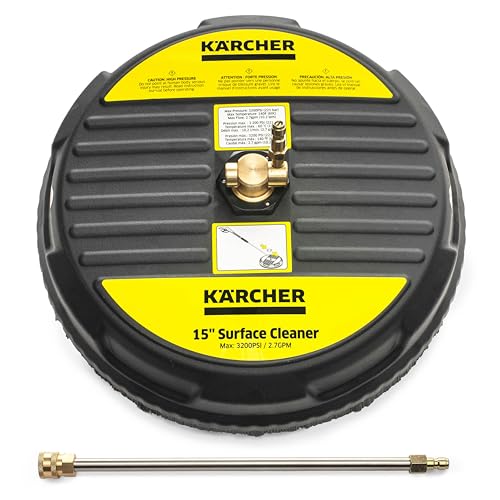
Best for getting a professional-looking driveway finish from a domestic machine
- 15-inch enclosed head with two rotating jets
- Even coverage with no wand stripes
- Splash guard keeps slurry off siding and windows
- Cuts driveway cleaning time by roughly two thirds
Why buy it: the single accessory that separates a DIY driveway from a professional one — wand stripes are the giveaway, and this removes them entirely.
What the table does not price is your time and your risk. Washing a two-story wall from a ladder, one-handed, holding a wand that recoils, is how people fall. Anything at height is worth paying for, and an insured contractor's liability cover is worth real money the day water gets behind the siding.
How to read a quote without getting burned
Ask what pressure they will use on each surface. A competent contractor will answer immediately and differently for concrete, siding and a deck. The correct answer for vinyl siding is a soft wash at low pressure with a cleaner, and the Vinyl Siding Institute's own cleaning guidance warns against aiming a power washer upward, because water gets driven behind the siding.
Get the scope in writing. Which elevations, which paved areas, whether soffits, gutter faces and window frames are included, and whether they will re-sand paver joints afterwards. "Wash the house" means whatever the contractor decides it means once they are on site.
Confirm insurance. Ask for a certificate, not a verbal assurance. The realistic failure modes here — water inside a wall, a stripped deck, a shattered window, a killed shrub bed — all cost more than the job.
Beware the very low bid. Under about $0.12 per square foot on a house, something is being skipped: usually the chemical dwell time that actually kills the mildew, which is why the green comes back in eight weeks.
Ask about water. Most residential contractors use your outdoor faucet, which is normal and costs you a few dollars. Ask whether they bring their own tank if your supply is a low-flow well.
Legitimate ways to pay less
- Bundle. House, driveway and walkways in one visit is materially cheaper than three visits.
- Book off-season. Autumn scheduling in temperate markets, midwinter in the South.
- Split the work. Hire out the two-story elevations and the roof, do the driveway and fence yourself.
- Do the prep. Move furniture and planters, cut back shrubs against the wall, and clear the drive. Some contractors discount for it and all of them work faster.
- Get three quotes and compare scopes, not headline prices. The spread between local bidders on identical work is routinely 40 percent.
A note on these figures
Everything above is a range compiled from published US contractor pricing and homeowner-reported quotes, current as of July 2026. Pricing in this trade is local, seasonal and highly variable, and there is no national rate card. Treat these numbers as a way to tell a reasonable quote from an unreasonable one, not as a price you are entitled to. Local regulations also vary — some municipalities restrict wash-water discharge to storm drains, which changes how a contractor works and what it costs.
Where to go next
If you have decided to buy, the best pressure washers for home use covers the machines worth owning, and is a pressure washer worth it works through the case against. For the specific jobs, see how to pressure wash vinyl siding and how to remove rust stains from concrete.
More from this hub: leaf blowers & yard cleanup · best pressure washer · what leaf removal costs · how we rank.