 Garden

Affiliate Disclosure
Some links on this page are affiliate links. As an Amazon Associate, we earn from qualifying purchases — at no extra cost to you. We do not buy, test, or physically handle the products we cover; our rankings come from aggregated owner reviews, ratings and expert consensus. Commissions never change our verdicts. How we rank · full disclosure.
The sequence that matters is water first, air out, motor last. Connect the garden hose, turn the water fully on, and squeeze the trigger with the nozzle removed until a steady stream runs. That purges air from the pump. Only then do you start the motor. Running a pressure washer pump dry, even briefly, is the fastest way to wreck one, and it is the most common thing new owners do wrong in the first sixty seconds.
Everything after that is nozzle choice, distance and patience. Below is the full sequence, the nozzle-by-surface table that prevents most damage, and a safety warning that pressure washers genuinely deserve and rarely get.
Setting Up: The Five Minutes That Prevent Most Problems
- Check the inlet filter. Pop the small screen out of the water inlet and rinse it. A blocked screen starves the pump, and pump starvation causes the pulsing that owners usually blame on low water pressure.
- Use a full-bore garden hose. A 5/8-inch hose, as short as practical, kept uncoiled. A 50-foot 1/2-inch hose lying in a coil can fail to supply a 1.76 GPM machine, which makes it surge.
- Turn the water fully on before anything else. Not halfway. The pump can only pressurise water it actually receives.
- Purge the air. With no nozzle fitted and the motor off, squeeze the trigger until water runs steadily for ten to fifteen seconds.
- Check the oil, if it is a gas machine. Most residential gas units have no low-oil cutout on the pump. Ten seconds now saves a pump.
- Plug into a GFCI-protected outlet if it is electric, and confirm the GFCI module on the cord itself has not tripped.

Match the Nozzle to the Surface
Nozzle angle, not machine power, is what decides whether a surface gets clean or gets damaged. The colors are an industry convention and are consistent across brands.
| Nozzle | Angle | Use it on | Never use it on |
|---|---|---|---|
| Red | 0° | Effectively nothing domestic — a pinpoint jet | Any surface you care about, ever |
| Yellow | 15° | Ground-in grime on sound concrete, rust, paint stripping | Wood, siding, vehicles, mortar joints |
| Green | 25° | General default: concrete, brick, patios, garden furniture | Paint, soft timber, windows |
| White | 40° | Vehicles, painted surfaces, vinyl siding, windows, decks | Nothing — this is the safe tip |
| Black | 65° (soap) | Applying detergent; the only tip that will siphon it | Rinsing — it has almost no cleaning force |
If you only remember one thing: the black soap tip is the only nozzle that will draw detergent. Downstream injectors siphon by suction created at low pressure, so with a green or white tip fitted no soap comes through at all. A large share of "the detergent tank does not work" complaints are this, not a fault.
The Technique Itself
- Wet the surface first with the wide tip. Dry dirt scours; wet dirt lifts.
- Apply detergent bottom-up. Working upward stops clean streaks running down through dirty areas, which set as tiger stripes.
- Let it dwell five to ten minutes and do not let it dry. This is where the actual chemistry happens. Re-wet if the sun is on it.
- Rinse top-down with the correct tip. Now gravity works for you.
- Keep the wand moving, and keep the angle consistent. Pausing burns a mark into concrete in under two seconds. Holding the wand at a changing distance produces the wavy shading people mistake for uneven dirt.
- Overlap each pass by about half. Under-overlapping is what creates stripes on a driveway; a surface cleaner attachment removes the problem entirely.
- Spray downward on siding, never up. Lap siding, weatherboard and shingles are all designed to shed water from above. Aim upward and you drive water behind them.
- Shut down in reverse. Release trigger → stop the motor → turn off the water → squeeze the trigger to bleed the pressure → disconnect.

What Pressure Each Surface Actually Wants
| Surface | Working pressure | Nozzle | The mistake that ruins it |
|---|---|---|---|
| Concrete driveway | 2500–3500 PSI | 25° or surface cleaner | Pausing, or under-overlapping into stripes |
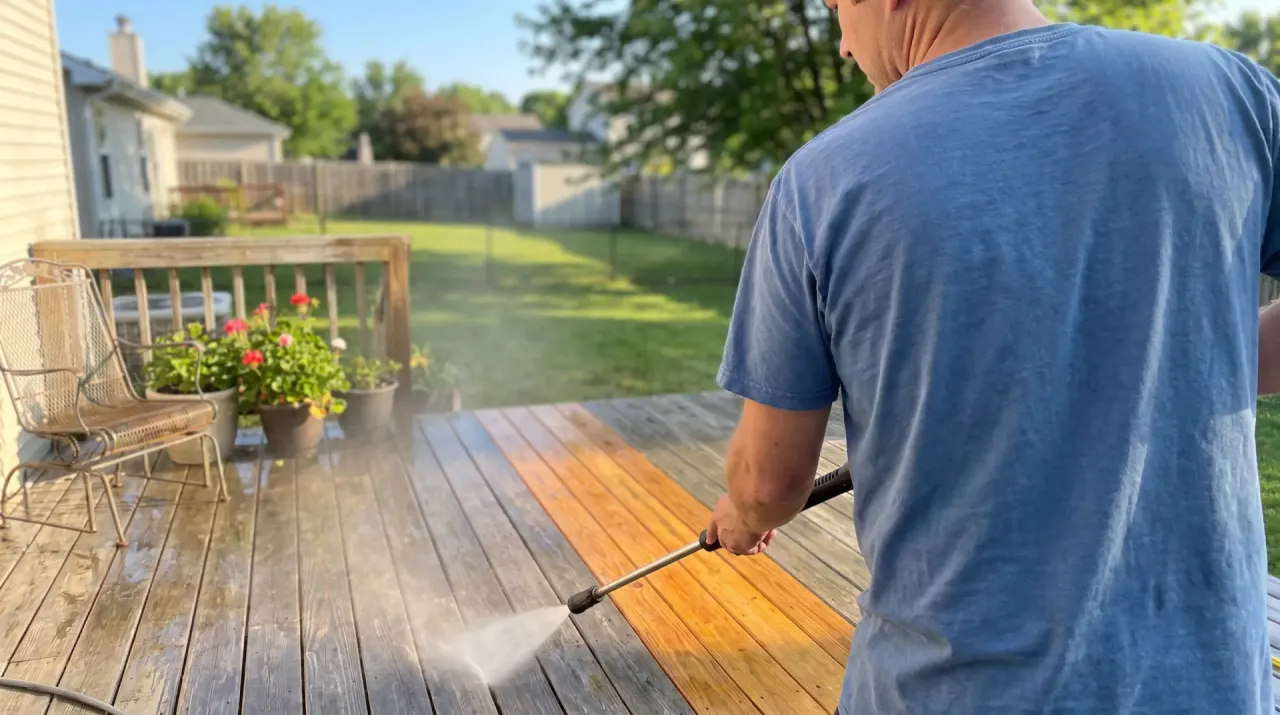
| Wood deck | 500–1200 PSI | 40°, held well back | Raising the grain — the fuzz is permanent |
| Vinyl siding | 1300–1600 PSI | 40°, angled downward | Spraying upward under the laps |
| Car or truck | 1200–1900 PSI | 40°, three feet back | Any narrow tip near paint, trim or badges |
| Brick and masonry | 1500–3000 PSI | 25° | Blasting out old lime mortar |
| Painted surfaces | Below 1200 PSI | 40° | Stripping the paint you meant to wash |
| New concrete (under 28 days) | Do not wash | — | Concrete is still gaining strength; you will etch it |
| Roof shingles | Do not pressure wash | — | Soft washing is the correct method |
The Injury Nobody Warns You About
Pressure washers are sold beside garden hoses and treated with the same casualness, and the stream from a narrow tip carries enough energy to break skin. A high-pressure injection injury forces water, grit and bacteria into the tissue underneath through a puncture that can look trivial — often a small mark on a finger or a foot, with little bleeding. The clinical literature is unambiguous about why this matters: the StatPearls review of hand high-pressure injuries notes that these injuries "appear to be benign puncture wounds at initial presentation" while the zone of injury can extend well up the limb, carrying risk of infection, compartment syndrome and limb loss. They are treated as surgical emergencies, not as wounds to clean and dress at home.
The practical rules are short. Never point a wand at a person or pet, including yourself. Never brace a hand in front of the tip to steady the spray. Treat the red 0° nozzle as one you essentially never fit. Wear closed shoes and eye protection, because grit returns at the speed it left. Never operate from a ladder — the recoil will move you. And if a jet does break the skin, go to an emergency department immediately and say the words "high-pressure injection injury", because the visible wound will badly understate the damage.
Electric machines carry a second hazard. The Consumer Product Safety Commission recalled a long list of imported electric pressure washers through 2026 for shipping without an integral ground-fault circuit interrupter. Check that your cord has a GFCI module with TEST and RESET buttons near the plug, and test it before each use.

The Three Accessories Worth Owning
You do not need a shelf of attachments. These three change outcomes.
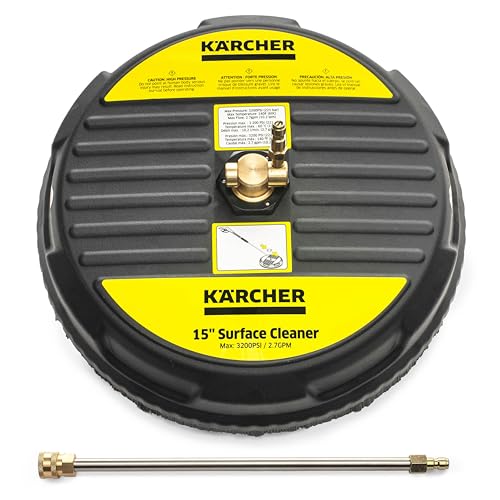
Best for driveways, patios and sidewalks without wand stripes
- Two spinning jets under a splash-guard housing
- Covers a 15-inch swath in one pass
- Standard 1/4-inch quick-connect
- Rated for 2600–3200 PSI machines
Why buy it: the single accessory that changes how long a driveway takes, and the only reliable way to avoid the zebra striping a bare wand leaves on concrete.

Best for replacing lost tips and getting the right angle for each surface
- 0°, 15°, 25°, 40° and soap tips
- Standard 1/4-inch quick-connect fitting
- Colour-coded to the industry convention
- Rated to 4000 PSI at 2.5 GPM
Why buy it: nozzle choice controls damage more than machine choice does, and a full color-coded set costs less than a single mistake on siding or a deck board.

Best for oil shadows, algae and tire marks that pressure alone will not shift
- Oxygenated concentrate for the detergent tank or a downstream injector
- Formulated for concrete, driveways and masonry
- Dilutes for a large area from one bottle
- Rinses without the film some degreasers leave
Why buy it: dwell time does the work that pressure cannot — most "the stain would not come off" complaints are really "I did not let a detergent sit for ten minutes first".
The Mistakes That Cause Most Damage
Starting close. Almost every ruined deck board and every etched patio started with someone testing at six inches. Start at three feet.
Washing siding upward. Water driven behind cladding does not dry, and the mold appears months later inside the wall.
Using the 0° tip because it "cuts through". It also cuts through paint, wood, mortar and skin.
Skipping detergent and adding pressure instead. Chemistry removes what pressure cannot, and pressure removes the surface when chemistry is missing.
Letting it freeze with water in the pump. The most common cause of a machine that "lost pressure over winter". Drain it and run pump antifreeze through before storage.
Ignoring where the runoff goes. Wash water carrying detergent, oil or paint residue that reaches a storm drain is a discharge, and municipalities regulate it under the EPA’s municipal stormwater program. On a driveway, keep the runoff on grass or gravel where soil can filter it.
Where to Go Next
If your machine will not start, or starts and then dies, see how to start a pressure washer. If it is dripping, pressure washer leaking water works through it by leak location. Buying rather than troubleshooting? Start with the best pressure washers or the electric-only rankings, and read can a pressure washer damage concrete before you point one at a new slab. Everything sits under the leaf blowers and yard cleanup hub.
We never buy or physically run the machines and accessories we recommend — rankings come from aggregated owner reviews and published specifications, and the method is on how we rank.