 Garden


Affiliate Disclosure
Some links on this page are affiliate links. As an Amazon Associate, we earn from qualifying purchases — at no extra cost to you. We do not buy, test, or physically handle the products we cover; our rankings come from aggregated owner reviews, ratings and expert consensus. Commissions never change our verdicts. How we rank · full disclosure.
Soft washing cleans with chemistry instead of force: a low-pressure spray, under 500 PSI and usually nearer 100, that carries a diluted sodium hypochlorite and surfactant solution onto the surface, kills the algae, mildew and lichen living there, and is then rinsed off. Pressure washing removes what it can knock loose. Soft washing kills the organism, so the result lasts one to three years rather than one season, and it does no damage to shingles, siding, screens or soffits — the surfaces a 3000 PSI wand ruins.
We never buy, test or physically handle the products we mention; recommendations come from aggregated owner reviews and published guidance, described in how we rank. More at the leaf blowers and yard cleanup hub.
How is it different from pressure washing?
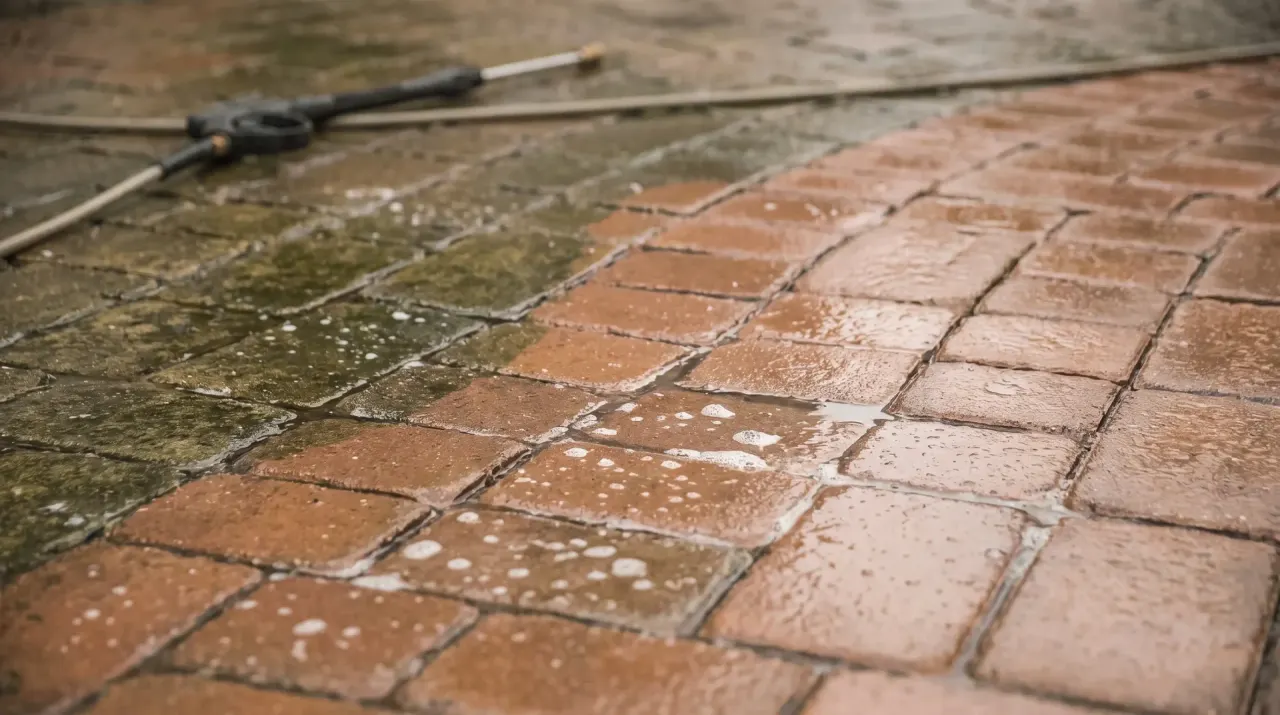
The two methods solve the problem in opposite directions. Pressure washing applies mechanical energy — a lot of it — and relies on that energy to break the bond between the dirt and the surface. Soft washing applies almost no mechanical energy and relies on a biocide to kill what is growing there, then lets a gentle rinse take the dead material away.
That difference decides which surfaces each is suited to. Concrete can absorb the energy; an asphalt shingle cannot, and a 3000 PSI stream strips the mineral granules that are the shingle's UV protection.
| Soft washing | Pressure washing | |
|---|---|---|
| Working pressure | 100–500 PSI | 1,500–4,000 PSI |
| What does the work | Sodium hypochlorite and surfactant | Mechanical force |
| Kills the organism | Yes | No — removes the visible layer |
| Typical result lasts | 1–3 years | Often under a year |
| Risk to the substrate | Very low | High on shingles, siding, wood, mortar |
| Water used | Less | More |
| Risk to plants | Real — needs pre-soaking and rinsing | Low |
Which surfaces need soft washing?
The short version: anything porous, painted, coated or fragile. If the surface can be damaged by force, or if the stain is biological rather than mechanical, soft washing is the correct method.
| Surface | Method | Why |
|---|---|---|
| Asphalt shingle roof | Soft wash only | Pressure strips granules and shortens roof life |
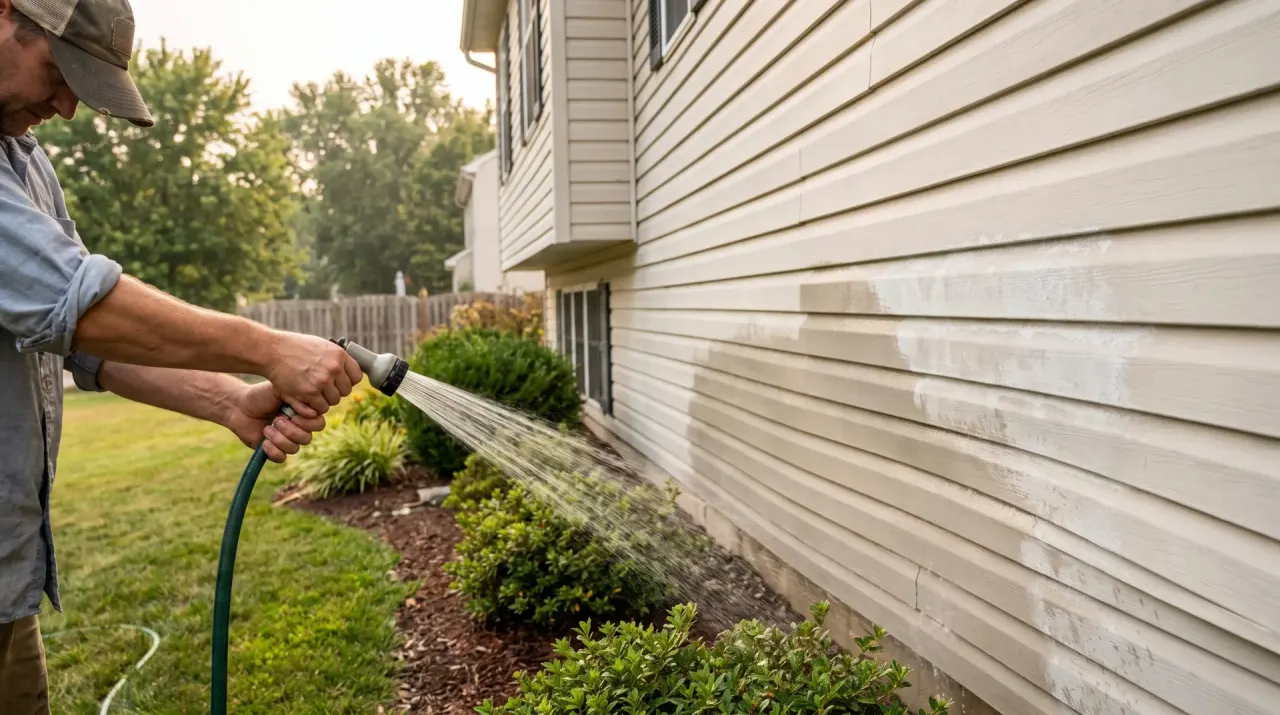
| Vinyl siding | Soft wash | Pressure drives water up under the laps into the wall |
| Painted wood siding | Soft wash | Pressure lifts paint and raises the grain |
| Stucco and EIFS | Soft wash | Pressure cracks the finish coat and forces water in |
| Screens, soffits, gutters | Soft wash | Thin material deforms and tears |
| Composite decking | Soft wash | Most makers set a pressure limit in the warranty |
| Concrete driveway | Pressure wash | Durable, and force is the efficient answer |
| Brick and block | Either, carefully | Soft wash for growth; low pressure only near mortar |
Roofs are the clearest case. The Asphalt Roofing Manufacturers Association's technical bulletin on algae discoloration is blunt about it: never use a pressure washer on an asphalt shingle roof, because it causes granule loss and very likely premature failure of the roof system. ARMA's recommended method is a 50:50 mix of laundry-strength chlorine bleach and water, applied with a sprayer, left to dwell for 15 to 20 minutes, then rinsed with low-pressure water — which is soft washing, described in a roofing standard rather than a marketing brochure. ARMA also warns against scrubbing, because the friction alone loosens granules.
What are the black streaks on a roof?
They are a living organism, not dirt, which is exactly why scrubbing and pressure never fix them for long. The usual culprit on asphalt shingles is Gloeocapsa magma, a blue-green algae that feeds partly on the limestone filler used in modern shingles and spreads as dark streaks running down the slope. It arrives as airborne spores, colonises the shaded and north-facing planes first, and holds moisture against the shingle surface.
Moss and lichen are a bigger structural problem than algae. Moss holds water directly against the shingle and lifts its edges as it thickens; lichen bonds into the surface and takes granules with it when it is pulled off. Both are killed by the same chemistry and both need the dead material left to weather away over a few rainfalls rather than being scraped.
What goes in a soft wash mix?
Three components, in this order of importance.
- Sodium hypochlorite. The active biocide. Professionals buy it at 10 to 12.5% and dilute to somewhere between 0.5% and 3% at the surface depending on the substrate and the severity. Household bleach is around 6%, so ARMA's 50:50 roof mix lands near 3%.
- A surfactant. Without it the solution runs straight off a vertical wall in seconds and never dwells long enough to work. Any dedicated house-wash concentrate includes one; a small amount of dish soap is the field improvisation.
- Water. Not just as a diluent — pre-soaking and post-rinsing the landscaping is what keeps your shrubs alive.
For homeowners, a pre-blended concentrate removes the arithmetic and the risk of mixing something dangerous. Two sensible routes:
- Simple Green Oxy Solve House and Siding cleaner (paid link) — an oxygen-bleach (sodium percarbonate) formula rather than chlorine. Gentler on planting and safe around most finishes, though slower on established algae. This is the one to choose if your beds run right up to the wall.
- Zep House and Siding wash concentrate (paid link) — a conventional house-wash concentrate designed to be siphoned through a pressure washer's soap injector.
Never mix bleach with ammonia or with any acid-based cleaner. Chlorine bleach plus ammonia produces chloramine gas; bleach plus an acidic descaler produces chlorine gas. Both are genuinely dangerous in the volumes people mix in a five-gallon bucket. The EPA's mold cleanup guidance carries the same warning for indoor work, and it applies just as much outdoors.
Do you need special equipment?
Not for a house. A standard pressure washer will soft wash perfectly well if you use it correctly: fit the black low-pressure soap nozzle, which is the only tip that opens the detergent siphon and drops the working pressure into soft-wash territory. Most machines ship with one in the nozzle set; if yours is missing, a standard 1/4-inch quick-connect tip set (paid link) includes it along with the 0°, 15°, 25° and 40° tips.
Contractors use dedicated soft-wash systems — a 12-volt diaphragm pump, a batch tank and a long hose — because they need to apply a fixed mix at a controlled rate over a whole roof without the detergent being diluted by the machine's flow. That is a production tool, not a requirement. For one house, once a year, the black nozzle and a bucket of concentrate does the job.
If you are choosing a machine to do both jobs, our pressure washer picks cover the field, and a surface cleaner handles the concrete that soft washing is not for.
How to soft wash a house, step by step
- Pick the weather. Overcast, still, above 50°F. Direct sun dries the solution before it can work; wind puts it on your neighbor's car.
- Soak the landscaping. Every plant and the soil around it, thoroughly, with plain water. Keep a hose running on them during the job.
- Cover what matters. Light fixtures, outlets, air conditioning units, and anything unpainted metal.
- Mix and load. Follow the concentrate's dilution. Fit the black soap nozzle and confirm the siphon is drawing before you point it at the wall.
- Apply bottom to top. Working upward stops clean streaks appearing through the dirt. Overlap each pass.
- Let it dwell five to fifteen minutes. Do not let it dry. Re-wet if it starts to.
- Rinse top to bottom with the 40° nozzle at low pressure, and always spray downward on siding so water is not driven up under the laps.
- Rinse the plants again. Then rinse the driveway, the windows and yourself.
Safety
Two hazards, and neither is the pressure. Chemical: wear eye protection and chemical-resistant gloves, keep the mix off skin, and never work with sodium hypochlorite in a confined space or overhead without a face shield. Height: a treated roof is slippery, and ARMA's guidance to hire a professional for shingle cleaning is about falls more than technique. Work from the ground with an extension wand wherever you can, and do not run a pressurised wand from a ladder — the kickback moves you.
If you are using a pressure washer to apply the mix, the ordinary rules still stand: the stream can cause an injection injury even at moderate pressure, and before you open any fitting you should shut the machine down, disconnect the water supply and squeeze the trigger to bleed the pressure trapped in the hose. Gas machines must stay fully outdoors — the exhaust contains carbon monoxide, and running one in a garage or under a covered porch while you work is genuinely dangerous.
What does it cost?
Doing it yourself, a house wash costs roughly $20 to $50 in concentrate for a typical two-story home, assuming you already own a pressure washer. Professional soft washing in the US generally runs somewhere between $0.15 and $0.40 per square foot of wall area for a house wash, and $0.20 to $0.60 per square foot of roof for a roof treatment, with wide regional variation and premiums for steep pitches and difficult access. Prices as of mid-2026; get two quotes, and be wary of anyone quoting a roof clean who mentions pressure.
The short version
Soft washing is the right method for roofs, siding, stucco, screens and anything else that force would damage — which is most of a house. It works because a biocide kills the algae rather than the water knocking it loose, and that is why it lasts years instead of months. You almost certainly already own the equipment: it is the black nozzle in the box, a bottle of house-wash concentrate, and the patience to let it dwell.
More from this hub: leaf blowers & yard cleanup · best pressure washer · best pressure washer for decks · best gutter guards · how we rank.