 Garden


Affiliate Disclosure
Some links on this page are affiliate links. As an Amazon Associate, we earn from qualifying purchases — at no extra cost to you. We do not buy, test, or physically handle the products we cover; our rankings come from aggregated owner reviews, ratings and expert consensus. Commissions never change our verdicts. How we rank · full disclosure.
Use a detergent that says "for pressure washers" on the label, and pick it by surface: an oxygen-based all-purpose cleaner for concrete and fencing, a house and siding cleaner for mold and algae on walls, and a pH-balanced car shampoo for vehicles. Dish soap works in a pinch but foams too much and strips car wax. Chlorine bleach must never go through the pump. And if no soap is coming out, you almost certainly have the wrong nozzle fitted.
We never buy or test the products we recommend; every verdict is drawn from aggregated owner reviews and manufacturer guidance, described in how we rank.
What makes a pressure washer detergent different
Three things, and none of them is marketing. First, it is low-foaming. A chemical injector is a venturi that draws detergent into a low-pressure water stream, and a foam-heavy hand soap overwhelms it, rinses slowly and streaks. Second, it is free of chlorine and of aggressive solvents, both of which attack the elastomer seals, o-rings and light alloys inside a pump. Third, it is formulated to dilute at the ratio the injector actually delivers, which is typically somewhere between 10:1 and 20:1 — a product designed to be used neat by hand will be far too weak once the machine has diluted it again.
There is a fourth point that matters more than any of them. Detergent is not there to make the wash look nicer. It is there to make the wash last. Water alone removes the visible layer of algae and mildew and leaves the biology behind, which is why an untreated fence or north-facing slab is green again within a couple of months. A cleaner with oxygen or biocidal chemistry, given real dwell time, is what buys you a season.
Which soap for which job
| Surface | Use | Avoid |
|---|---|---|
| Concrete, driveway, path | Oxygen-based all-purpose or a concrete-specific degreaser | Bleach through the pump; acid unless treating rust |
| Vinyl or painted siding | House and siding cleaner, applied low pressure, left to dwell | High pressure of any kind; upward spray |
| Wood deck or fence | Deck and fence cleaner, then a brightener if stripping | Anything chlorine-based — it grays and furs the timber |
| Cars, trucks, motorcycles | pH-balanced car shampoo, in a foam cannon | Dish soap; anything degreasing on a coated car |
| Patio furniture, plastic, bins | All-purpose outdoor cleaner | Solvents on plastic resin |
| Roof shingles | Professional soft-wash chemistry, no pressure at all | A pressure washer, entirely |
| Grease and oil on concrete | Dedicated degreaser with a long dwell | Expecting general cleaner to touch it |

Best for one bottle that covers concrete, siding, fencing and furniture
- Peroxide-based oxygen chemistry rather than chlorine bleach
- Formulated for pressure washer injectors and manual use
- Concentrate that dilutes a long way
- Safe on the pump seals and aluminum a bleach solution attacks
Why buy it: the sensible default — oxygen chemistry does most of what people reach for bleach to do, without the chemistry that eats pump seals and o-rings.

Best for green and black growth on vinyl, painted wood and stucco
- Targeted at mold, mildew and algae staining on wall surfaces
- Designed to be applied at low pressure and left to dwell
- Concentrate for pressure washer downstream use
- Rinses without a separate neutraliser
Why buy it: the right chemistry for siding, where the correct technique is a low-pressure soak and a rinse rather than pressure — a point almost every homeowner gets backwards.
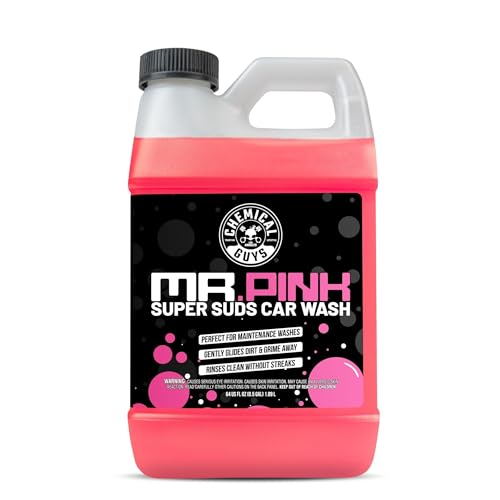
Best for vehicles, in a foam cannon, without stripping wax or sealant
- pH-balanced so it does not strip wax, sealant or ceramic coating
- Formulated to foam thickly in a cannon
- High dilution ratio, so a bottle lasts many washes
- Safe on paint, glass, plastic and trim
Why buy it: dish soap strips whatever protection is on the paint; a pH-balanced car shampoo does not, and that difference shows up as a dull car by August.
Can you use dish soap in a pressure washer?
Yes, for one job, with caveats — and no, as a habit. Dish soap is engineered to foam vigorously in a sink, and a pressure washer injector is engineered around detergents that do the opposite. The practical results owners report are consistent: excessive suds that take a long time to rinse, streaking on glass and paintwork, and a job that needs more water than it should.
The car-specific problem is worse. Dish detergent is a degreaser, and the thing it degreases first is whatever wax, sealant or coating is protecting your paint. A car washed with dish soap looks clean and is measurably less protected afterwards, which is the whole reason detailers are so insistent about it.
The pump concern is real but modest. Household dish soap contains salts and is not formulated for the alloys and elastomers in a pump; occasional use is not going to destroy a machine, but there is no upside to making it routine when a bottle of proper concentrate costs less than twenty dollars and dilutes many times further.
If you are going to do it anyway: use a small amount, dilute it heavily, put it in the detergent tank rather than neat down the siphon, rinse far more thoroughly than you think you need to, and do not do it on a car you care about.

Can you put bleach in a pressure washer?
Not through the pump. This is the one rule in this article that is not a preference.
Sodium hypochlorite — household bleach — is corrosive to the seals, o-rings, brass fittings and aluminum components inside a pressure washer pump. Drawing it through a soap tank or an upstream injector puts it in direct contact with all of them, and the damage is cumulative rather than immediate, which is exactly why so many people believe it is fine. The machine fails a season later and the cause is never connected back.
Professionals do use bleach constantly, for soft washing siding, fencing and roofs. The difference is where it enters the system. A downstream injector sits after the pump, so chemical never passes through it, and dedicated soft-wash rigs use a separate low-pressure chemical pump entirely. If you want to soft wash with bleach at home, a downstream injector or a simple pump sprayer plus a rinse is the correct approach, not the detergent tank.
The safety point is not optional either: never mix bleach with an acidic cleaner, including rust removers and many "concrete brighteners". The reaction releases chlorine gas. Do not mix it with ammonia-based products either. Read both labels before anything shares a bucket.
Why your pressure washer soap is not coming out
This is the single most common support question in the category, and it has one dominant answer.
| Check | What is happening | Fix |
|---|---|---|
| Nozzle fitted | The injector only siphons at low pressure. A 15° or 25° tip creates back-pressure that stops the venturi dead. | Fit the black or white low-pressure soap tip. This solves most cases. |
| Detergent too thick | Neat concentrate is too viscous to be drawn up the siphon tube. | Dilute per the label before it goes in the tank. |
| Clogged siphon filter | The small filter on the end of the pickup tube blocks with dried detergent. | Pull the tube, rinse the filter in warm water. |
| Tube not seated or kinked | Air is being drawn instead of liquid. | Push the tube fully home, straighten it, keep the bottle upright. |
| Selector valve closed | Many machines have a soap on/off dial that resets. | Open it, or set the dial to the maximum chemical position. |
| Extension wand fitted | Long lances and some short guns raise pressure at the injector. | Remove the extension while soaping, refit it to rinse. |
| Air lock after storage | The injector has dried out over winter. | Run clear water with the soap tip on for a minute to prime it. |

Applying it properly
- Wet the surface first with plain water on a wide tip. Detergent applied to a dry surface starts drying immediately and does nothing.
- Apply from the bottom up. Soap running down over dry material leaves streaks that are difficult to remove; running down over already-wet surface does not.
- Give it dwell time. Five to ten minutes is the working range for most outdoor cleaners. This is the step that decides whether the green comes back in two months or two years.
- Do not let it dry. Work in shade or on a cool, overcast day, and re-wet any area that starts to dry before you rinse.
- Rinse top down, on a 25° or 40° tip, so the dirty water always runs over surface you have not cleaned yet.
- Flush the machine. Run clear water through the detergent circuit for a minute at the end. Dried detergent in the injector is the reason it will not siphon next spring.
Plants, run-off and the neighbors
Everything you spray ends up somewhere. Wet down plantings before you start and rinse them again afterwards — dilution is the entire defense. Cover anything sensitive with sheeting, and never let bleach-based or acid run-off reach a garden bed, a pond or a storm drain that discharges to open water. Oxygen-based cleaners are considerably gentler here, which is one of the better arguments for choosing them. Some municipalities regulate wash-water discharge, so check local rules if you are cleaning a large area.
Where to go next
For the machine itself, see our pressure washer picks and the best pressure washers for home use. For job-specific technique, read how to pressure wash a car and how to pressure wash vinyl siding. If the stain is rust rather than dirt, no detergent will touch it — how to remove rust stains from concrete covers the chemistry that will.
More from this hub: leaf blowers & yard cleanup · best pressure washer gun · how we rank.