 Garden
Affiliate Disclosure
Some links on this page are affiliate links. As an Amazon Associate, we earn from qualifying purchases — at no extra cost to you. We do not buy, test, or physically handle the products we cover; our rankings come from aggregated owner reviews, ratings and expert consensus. Commissions never change our verdicts. How we rank · full disclosure.
A meat thermometer is the only piece of grilling equipment that is not optional. Everything else on a patio is a preference — this one is the difference between a safe dinner and a guess. USDA Food Safety and Inspection Service is unambiguous on the point: color, firmness, clear juices and elapsed time do not tell you whether food has reached a safe internal temperature, and the only reliable check is a thermometer. About one hamburger in four browns through the middle before it hits the 160°F it needs, and plenty of poultry is still faintly pink at a perfectly safe 165°F.
So the question is not whether to own one but which kind. There are three genuinely different tools sold under the same name, and buying the wrong one is the usual mistake.
Top Picks at a Glance
The Temperatures, First
Every recommendation below exists to hit these numbers. They come from the USDA FSIS safe minimum internal temperature chart, and they are measured with a thermometer in the thickest part of the food, away from bone and fat.
| Food | Safe minimum internal temperature | Rest |
|---|---|---|
| All poultry — chicken, turkey, duck, ground or whole | 165°F | None required |
| Ground beef, pork, veal, lamb | 160°F | None required |
| Whole cuts of beef, pork, veal, lamb — steaks, chops, roasts | 145°F | 3 minutes |
| Fish and shellfish | 145°F | None required |
| Egg dishes | 160°F | None required |
| Leftovers and casseroles reheated | 165°F | None required |
The three-minute rest on whole cuts is part of the standard, not a chef's flourish — the temperature continues to rise and holds long enough to do the work. Note also what is not on the list: a burger cooked to 145°F is not safe, because grinding distributes surface bacteria through the whole patty. That single distinction is why a thermometer matters more on burger night than on steak night.
The Three Tools Sold as One
Instant-read. A handheld probe you insert for a second or two and remove. This is the tool for steaks, chops, burgers, chicken pieces and fish — anything you check repeatedly and quickly. Speed matters because the lid is open while you use it.
Corded leave-in probe. A stainless probe stays in the meat and a thin cable runs out under the lid to a display that alarms at your target. This is the tool for roasts, brisket, pork shoulder and turkey, where the point is to stop opening the cooker at all.
Wireless. Either a fully wire-free probe (MEATER) or a radio transmitter feeding a receiver or phone (TempPro TP829, most multi-probe sets). Same job as the corded probe, minus the cable through the lid gasket, plus the ability to walk away from the cooker entirely.
Our #1 Pick: Alpha Grillers Instant Read
Ratings this high are common on products with a few hundred reviews and rare on products with tens of thousands. The Alpha Grillers instant-read holds 4.8 stars across an enormous ownership base, and that combination is the whole argument for it: the failure modes of this thermometer are extremely well documented, and there are not many of them.
What owners return to is the read speed relative to the price. One to two seconds is fast enough that you can check four burgers without meaningfully cooling the grill, which is the practical test an instant-read has to pass. The stepped thin tip matters more than the spec sheet suggests — it leaves a smaller hole, so a steak loses less juice to being checked, and it reaches temperature faster than a fat probe.
The recurring complaints are mundane and worth knowing. The magnet is strong enough to hold the unit on a hood but not strong enough to survive a slammed lid, so several owners have found theirs on the patio. The probe hinge loosens over years of use. And, as with every folding thermometer, it will not survive being left probe-out on a hot grate.
If you cook a lot of money — prime rib, a big brisket, a whole tenderloin — the ThermoWorks Thermapen ONE is the upgrade that is actually worth the gap, because it publishes a real accuracy figure (±0.5°F) rather than a marketing adjective, and it is the instrument other thermometers get checked against.
Check price on Amazon → (paid link)
The Ranked Field

Best for the one thermometer a household should own
- 1–2 second read from a thin stepped probe
- Backlit display with hold and auto-off
- Magnetic back and a bottle opener built into the body
- Calibration function and a 4.4-inch folding probe
Why buy it: the highest-rated instant-read at any volume this large — a rare combination, because most thermometers with tens of thousands of owners sit at 4.4 to 4.5.

Best for anyone cooking expensive cuts, or cooking to a target rather than a range
- One-second reading with a stated ±0.5°F accuracy
- Auto-rotating backlit display, wakes when you open it
- IP67 waterproof body, replaceable AAA battery
- NIST-traceable calibration available
Why buy it: the reference instrument in this category — the thermometer other thermometers are checked against, and the reason its owners describe replacing nothing else for a decade.
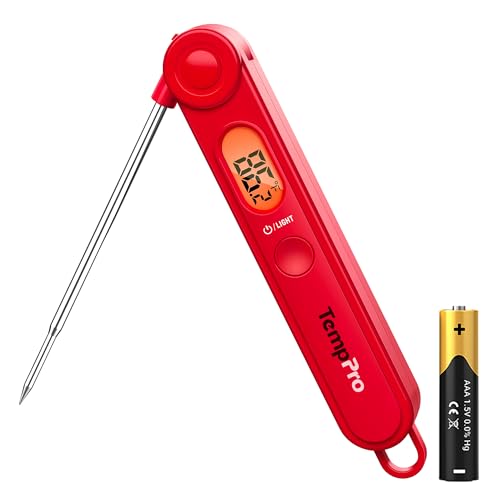
Best for a second thermometer for the kitchen drawer, or a first one on a tight budget
- Folding probe with a magnetic back for the fridge or hood
- Backlit screen readable at dusk
- Auto-off to protect the battery
- Reads across the full grilling and candy range
Why buy it: one of the most-owned cooking thermometers in America, and the honest entry point — slower than the picks above, still fast enough to keep the lid down.
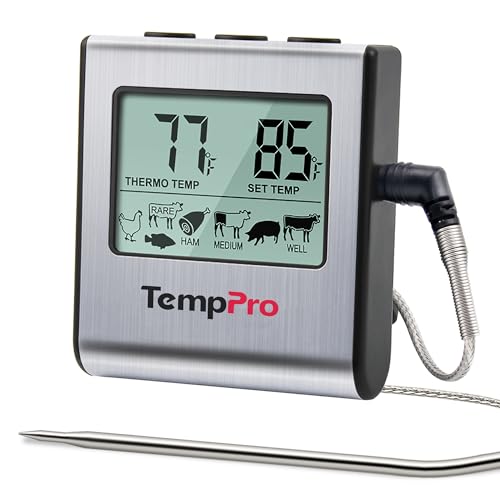
Best for brisket, pork shoulder and anything that cooks for hours
- Wired stainless probe rated to 572°F with a 40-inch braided cable
- Programmable target temperature with an audible alarm
- Large LCD readable across the yard
- Magnetic base and a fold-out stand
Why buy it: the cheapest way to stop opening the lid — a corded probe that alarms at your target does more for a long cook than any amount of guessing.

Best for rotisserie, deep-fry, and anyone tired of trapping a cable in the lid
- Fully wireless probe — no cable through the lid gasket
- Dual sensors read internal and ambient temperature at once
- App estimates finish time and manages the rest period
- Bamboo charging block doubles as a range repeater
Why buy it: the only design here that survives a rotisserie or a closed kamado without a cable, and the ambient sensor tells you what the cooker is doing as well as the meat.

Best for tracking several cuts plus the pit temperature from indoors
- Four color-coded probes on one 1000 ft radio-frequency link
- No phone or app required — a real handheld receiver
- Preset temperatures by meat and doneness, plus custom alarms
- Timer and high/low pit alarms
Why buy it: radio frequency rather than Bluetooth, which is why it actually reaches the couch — four probes means the pit and three cuts on one screen.
Quick Comparison
| Product | Best for | Rating | Price | Buy |
|---|---|---|---|---|
| Alpha Grillers Instant Read Meat Thermometer Digital, 1–2 Second Read | Best Overall | — | Check (paid link) | |
| ThermoWorks Thermapen ONE Instant-Read Thermometer | Best Accuracy | — | Check (paid link) | |
| TempPro TempSwift Digital Meat Thermometer with Backlight | Best Budget | — | Check (paid link) | |
| TempPro TP16 Large LCD Digital Meat Thermometer for Smoker, Oven and Grill | Best Leave-In Probe | — | Check (paid link) | |
| MEATER Plus Smart Wireless Meat Thermometer, 165 ft Bluetooth Range | Best Wire-Free | — | Check (paid link) | |
| TempPro TP829 Wireless Meat Thermometer, 4 Probes, 1000 ft Range | Best for Smoking | — | Check (paid link) |

What "Accurate" Means, and How to Check Yours
Most cheap thermometers claim ±1°F and most of them are honest enough for cooking, because the tolerances that matter are wider than the marketing suggests. The risk is drift: a thermometer that was accurate in year one and reads 6°F low in year three is worse than no thermometer at all, because you trust it.
Check it with the ice-water method, which costs nothing and takes two minutes. Fill a glass to the brim with crushed ice, top with cold water, stir, and let it sit 30 seconds. Insert the probe into the middle without touching the sides or bottom. It should read 32°F. Anything more than 2°F off means recalibrate if the unit allows it, or replace it if it does not. Boiling water works too, but only at sea level — the boiling point drops roughly 1°F per 500 feet of elevation, so a reading of 208°F in Denver is correct, not broken.
One more habit worth building: check the thermometer against the thickest part of the cut, then check a second spot. On a whole bird or a thick roast, the spread between two readings is often 10°F or more, and the number that matters is the lowest one.
How We Rank
We do not buy, run or test these thermometers. Rankings come from aggregated owner ratings across the most-owned models in the category, weighted toward long-ownership reviews where drift, battery doors and cable failures appear, and cross-checked against published accuracy and response-time specifications. Four things carry the weight: read speed, because a slow instant-read means a long-open lid; stated accuracy, preferring manufacturers who publish a tolerance; durability, especially the probe cable strain relief and the battery compartment seal, which is where these die; and fitness for purpose, since a leave-in probe and an instant-read are not competitors. Prices were checked at the time of writing. Full method: how we rank.
The Field, Reviewed
1. Alpha Grillers Instant Read — Best Overall
Covered above. Owners praise: the read speed for the money, the backlight, the calibration function, and that it survives being dropped on concrete. Owners gripe about: a magnet that is not strong enough for a hood that gets slammed, a hinge that loosens with age, and batteries drained by an auto-off that occasionally does not trigger. Check price (paid link).
2. ThermoWorks Thermapen ONE — Best Accuracy
The professional reference, and priced like it. One-second readings at a published ±0.5°F, a display that rotates to whichever hand you are holding it in, and an IP67 body you can rinse under a tap. It is the thermometer that competition cooks and test kitchens use, and its owners tend to describe it in terms of years rather than seasons.
Owners praise: genuinely instant readings, the auto-wake and auto-rotate display, waterproofing that survives a sink, and build quality that justifies the price over a decade. Owners gripe about: the price, full stop — several owners note the cheaper ThermoPop from the same company covers most home cooking. Check price (paid link).
3. TempPro TempSwift — Best Budget
One of the most-owned cooking thermometers in the country and the honest floor of the category. It is a second or two slower than the picks above and the display is smaller, but it reads accurately, it costs less than a pack of steaks, and it is the reason there is no excuse for cooking by color.
Owners praise: the price, the fridge magnet, the backlight for evening cooks, and how many of them keep a second one in the kitchen. Owners gripe about: read speed against premium units, a probe that is short for deep roasts, and a battery door that is fiddly. Check price (paid link).
4. TempPro TP16 — Best Leave-In Probe
The cheapest genuine upgrade to a long cook. The probe stays in the meat, the braided cable runs out under the lid, and the base unit alarms when you hit target. For a pork shoulder that needs eight hours, this changes the day: you stop opening the cooker, and the cook finishes when the meat says so rather than when the recipe guessed.
Owners praise: a display readable from across the yard, a loud alarm, the magnetic base, and the price against wireless systems. Owners gripe about: cable failure at the strain relief if it gets pinched in the lid repeatedly — the near-universal complaint about every corded probe on the market — and a probe that must not go in the dishwasher. Check price (paid link).
5. MEATER Plus — Best Wire-Free
The only design here with no cable at all, which solves the one problem corded probes cannot: a rotisserie, a tightly gasketed kamado, or a deep fryer where a wire is impossible. Two sensors in one probe read the meat and the ambient air, so the app knows what the cooker is doing as well as the roast.
Owners praise: the freedom from cables, the ambient reading, the finish-time estimator, and the charging block that stores and protects the probe. Owners gripe about: Bluetooth range that falls well short of the advertised figure through masonry walls, occasional app pairing frustration, and a probe that is expensive to replace if it is left in a fire. Check price (paid link).
6. TempPro TP829 — Best for Smoking
Four probes, a real handheld receiver rather than a phone, and a radio-frequency link instead of Bluetooth. That last point is the reason to buy it: RF actually carries through a house, so you can watch the pit temperature and three cuts from the sofa without a dropped connection.
Owners praise: range that lives up to the claim, no app dependency, per-probe presets, and the pit high/low alarms that catch a fire going out. Owners gripe about: bulk on the counter, a learning curve on the preset menus, and the same cable strain-relief weakness that affects all corded probes. Check price (paid link).
What Owners Actually Complain About
Cables, not sensors. Across every corded probe on the market, the failure is the same: the cable breaks where it enters the probe, usually because it has been crushed in the lid a hundred times. Route it through a vent or over the gasket at a corner, and coil it loosely for storage rather than wrapping it tight.
Battery doors and water. The second most common failure is a thermometer that stopped working after being rinsed. Only the waterproof-rated units survive a tap; everything else wants a wipe.
Bluetooth expectations. A large share of one-star reviews on wireless models describe a range problem that is a physics problem. Bluetooth does not go through brick, and the advertised figure is line-of-sight.
Probes left in the fire. Leave-in probes are rated for the oven or smoker, not for direct flame. A probe laid across a hot grate while you plate up is a dead probe.
The Verdict
Buy the Alpha Grillers instant-read first — it is the cheapest thing you can do that measurably improves both the safety and the quality of everything you cook outdoors. Add a TempPro TP16 leave-in probe the day you cook your first pork shoulder, and step up to the Thermapen ONE if you cook expensive cuts often enough that ±0.5°F is worth the money. Whatever you buy, check it in ice water twice a year, and stop cooking to time. Check price on Amazon → (paid link)
More from this hub: outdoor living & grills · best grill thermometer · best gas grill · best pellet grill · controlling charcoal temperature · how we rank.