 Garden

Affiliate Disclosure
Some links on this page are affiliate links. As an Amazon Associate, we earn from qualifying purchases — at no extra cost to you. We do not buy, test, or physically handle the products we cover; our rankings come from aggregated owner reviews, ratings and expert consensus. Commissions never change our verdicts. How we rank · full disclosure.
The number that decides whether a portable grill works for you is square inches, not BTUs. Small fireboxes with tight lids concentrate heat well, so almost every grill here gets hot enough. What they cannot do is get bigger. A 150-square-inch tabletop grill takes about six burger patties; a 285-square-inch stand-up model takes twelve. If you know how many people you feed, that single figure narrows the field faster than any other spec.
The second decision is fuel, and it is less about flavor than logistics. Propane lights in seconds, turns off in seconds, and is accepted at many campgrounds during burn bans when open charcoal is not. Charcoal needs 20 to 30 minutes of lead time and leaves you holding a container of hot ash at the end of a day at the beach. Both cook well. Only one of them fits neatly into a two-hour tailgate.
Top Picks at a Glance
How Much Grill You Actually Need
| Cooking area | Feeds | Typical format | What it struggles with |
|---|---|---|---|
| ~150 sq in | 2–3 people | 14 in tabletop charcoal | Anything needing a two-zone fire |
| ~200 sq in | 3–4 people | Tabletop gas, infrared | Cooking sides alongside the main |
| ~268 sq in | 4–5 people | 17 in griddle | Nothing that needs grate marks |
| ~285 sq in | 5–6 people | Stand-up folding gas | Fitting in a small trunk when folded |
Our #1 Pick: Coleman RoadTrip 285
Most portable grills are one burner with one knob, which means one temperature across the whole surface. That is fine for burgers and hopeless for anything that needs to finish gently while something else sears. The RoadTrip 285 gives you three burners with independent control, and that single design decision is why it outranks smaller, lighter, cheaper grills here.
The stand is the other reason. It collapses like a folding cart and rolls on two wheels, so moving it from a car to a campsite is a one-handed job rather than a two-person carry. Cast-iron grates hold heat better than the thin wire grates on cheaper portables, which shows up as proper sear marks rather than gray stripes.
Owners consistently report that it behaves like a small full-size grill rather than a camping accessory, and that the 20-pound-tank adapter is worth buying immediately — running it on 1-pound canisters is convenient once and expensive forever. The recurring criticisms are honest ones: it is heavy for a portable at over 45 pounds, the folded footprint is larger than people expect, and the swappable griddle and stove tops sold for it are extra.
Check price on Amazon → (paid link)
The Ranked Field

Best for tailgates, campsites and anyone who wants a real grill that folds
- 3 independently controlled burners, 20,000 BTU total
- 285 sq in of cast-iron cooking surface
- Collapsible stand with wheels — rolls like luggage
- Runs on 1 lb canisters or a 20 lb tank with an adapter hose
Why buy it: the only portable here with three separate burners, which means you can run a hot zone and a warm zone — the thing every other portable grill gives up.

Best for real charcoal flavor away from home
- 18.5 in porcelain-enameled bowl and lid
- Lid lock that doubles as a carry handle
- Rust-resistant aluminum dampers top and bottom
- Removable ash catcher
Why buy it: the highest-rated portable grill of any fuel type here, and it is essentially a full Weber kettle with the legs cut off — the same airflow control, the same results.

Best for a picnic table, a truck bed or a small balcony
- Two independently controlled stainless burners
- Folding lid that latches for transport
- Porcelain-coated cast-iron grates
- Runs on 1 lb canisters, adapter available
Why buy it: two burners in a tabletop footprint is unusual, and it is what lets you sear on one side while something finishes on the other.
Best for a beach day, a first apartment or a spare grill in the trunk
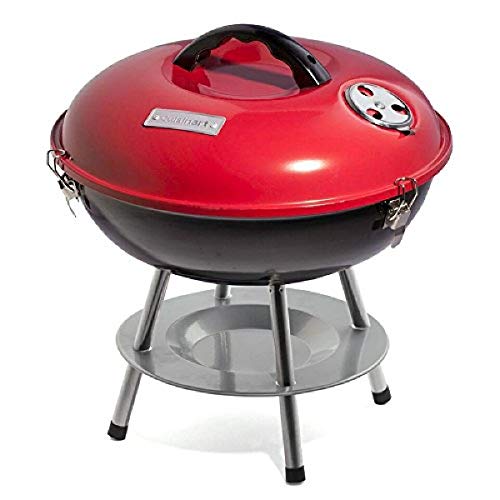
- 14 in enameled steel bowl, 150 sq in of grate
- Lid locks down and the handle carries it
- Dual venting for basic airflow control
- Weighs about 12 lb
Why buy it: the most-owned portable grill in the country at this price, and the review record is clear that it does exactly what a small charcoal grill should — nothing more, nothing surprising.

Best for wind, rough handling and cooking in a parking lot
- TRU-Infrared cooking system rather than open flame
- Cast aluminum body with a steel roll cage
- Latching lid and a carry handle built into the frame
- 200 sq in cooking surface, runs on 1 lb canisters
Why buy it: infrared cooking puts a heat-diffusing plate between the burner and the food, which is why this one still works in wind that makes an open-flame portable useless.

Best for smash burgers, eggs, onions and anything that falls through grates
- 17 in rolled-steel flat top, 268 sq in of surface
- H-shaped burner for even heat across the plate
- Rear grease management channel and cup
- Runs on 1 lb canisters, adapter available
Why buy it: a flat top does everything a grate cannot — fish, eggs, chopped onions, smash burgers — and at this size it fits on a tailgate or a camp table.
Quick Comparison
| Product | Best for | Rating | Price | Buy |
|---|---|---|---|---|
| Coleman RoadTrip 285 Portable Stand-Up Propane Grill, 3 Adjustable Burners | Best Overall | — | Check (paid link) | |
| Weber Jumbo Joe Charcoal Grill, 18-Inch, Black, Portable Kettle BBQ | Best Charcoal | — | Check (paid link) | |
| Pit Boss Grills 75275 Stainless Steel Two-Burner Portable Gas Grill | Best Tabletop Gas | — | Check (paid link) | |
| Cuisinart Portable Charcoal Grill, Tabletop Design with Locking Lid, 14-Inch | Best Budget | — | Check (paid link) | |
| Charbroil Grill2Go X200 Portable Gas Grill, Dark Gray | Best for Tailgating | — | Check (paid link) | |
| Blackstone 1814 Propane Gas Griddle, 17-Inch, Portable Tabletop Flat Top | Best Portable Griddle | — | Check (paid link) |
The Field, Reviewed
1. Coleman RoadTrip 285 — Best Overall
Covered above. Owners praise: three-zone control, the rolling stand, cast-iron grates and genuine grill performance. Owners gripe about: weight, folded size, and canister cost until you buy the tank adapter. Check price (paid link).
2. Weber Jumbo Joe 18-inch — Best Charcoal
The highest-rated grill in this entire roundup, and the explanation is that it is not really a portable design at all — it is a Weber kettle bowl with a lid lock and no legs. The dampers work the same way, so you get the same airflow control that makes kettle grills capable of both searing and indirect cooking. At 18.5 inches it is also considerably larger than most things called portable.
Owners praise: proper charcoal results, the lid lock that turns it into a carry handle, and Weber build quality at a modest price. Owners gripe about: no leg stand, so it needs a table or the ground; ash management away from home; and the same 20-minute lighting wait every charcoal grill has. Check price (paid link).
3. Pit Boss 75275 Two-Burner — Best Tabletop Gas
Two independently controlled burners in a tabletop grill is genuinely uncommon, and it gives a small grill the one thing small grills usually lack: the ability to move food off direct heat without turning everything off. Stainless construction and cast-iron grates put it above the thin-steel tabletop crowd.
Owners praise: two-zone cooking in a small package, solid build, and a lid that latches properly for transport. Owners gripe about: weight for a tabletop unit, and heat loss in wind because the body is fairly open at the sides. Check price (paid link).
4. Cuisinart 14-inch Portable Charcoal — Best Budget
The one to buy when the grill is an occasional convenience rather than a hobby. It is small, it is light, the lid locks for carrying, and it costs less than a bag of good steaks. Owner reviews are notable mainly for how unsurprising they are: at this price nobody expects airflow precision, and nobody reports being let down.
Owners praise: price, weight, and that it heats fast because the bowl is tiny. Owners gripe about: thin steel that discolors quickly, limited vent control, and a grate that only realistically feeds two or three. Check price (paid link).
5. Charbroil Grill2Go X200 — Best for Tailgating
Infrared is the differentiator and it is not marketing. Instead of flame reaching the food directly, the burner heats a metal plate that radiates upward, which does two useful things: it eliminates flare-ups from dripping fat, and it makes the grill far less sensitive to wind. In an exposed parking lot that is the difference between cooking and waiting.
Owners praise: wind performance, the cast aluminum body surviving rough transport, and even heat with no hot spots. Owners gripe about: a smaller usable surface than the numbers imply, slower preheat than an open-flame grill, and the infrared plate needing careful cleaning. Check price (paid link).
6. Blackstone 1814 17-inch Griddle — Best Portable Griddle
Not a grill, and that is the point. A flat top holds fat and juice against the food instead of letting it drip away, which is why smash burgers, eggs, pancakes, chopped onions and fish all work on it and none of them work on grates. For camping breakfasts it is arguably the more useful appliance.
Owners praise: versatility, even heat from the H-burner, and that the steel plate seasons into a genuinely non-stick surface over time. Owners gripe about: the seasoning and rust-prevention routine, which is real work, and that it cannot produce grill marks or smoke flavor. Check price (paid link).
Portable Grill Safety
Never grill in or store a lit grill in a garage, a carport, a tent, a camper, an RV interior or on a covered balcony. This is the one rule with a body count behind it. Charcoal and propane both produce carbon monoxide, which is colorless and odorless, and the CPSC records roughly 20 deaths and about 400 emergency-room-treated injuries in the United States each year from carbon monoxide produced by charcoal (CPSC, Carbon Monoxide Information Center). The agency states plainly that opening a window or running a fan does not make it safe. Portable grills make this risk worse, not better, because they are the grills most likely to end up under an awning, in a tent vestibule, or in the back of a van in bad weather.
Propane. Check connections with soapy water and look for bubbles — never test with a flame. Close the cylinder valve before you disconnect anything. Do not store spare 1-pound canisters or 20-pound tanks indoors, in a basement, or in an attached garage, and never leave a canister in a hot car.
Placement and clearance. The NFPA's grilling safety guidance is to set any grill well away from the house, siding, deck railings and overhanging branches, and to keep children and pets away from the cooking area. Tabletop grills radiate heat downward — put them on stone, metal or a purpose-made mat, not directly on a plastic folding table.
Charcoal disposal. Coals stay hot for hours. Close the vents and let the grill go out completely, or douse the coals with water and stir until nothing steams, before the ash goes anywhere near a trash can. Warm coals in a bin or dumped on the ground are a recognized wildfire and structure fire cause.
Cook to temperature. Small grills run hot and uneven, which makes the outside look finished before the inside is. The USDA safe minimums are poultry 165F, ground meat 160F, and whole cuts of beef, pork, veal and lamb 145F with a three-minute rest (USDA FSIS Safe Minimum Internal Temperature Chart). A thermometer is the only reliable check.

What Owners Actually Complain About
Wind. The single most common complaint about small gas grills. A low firebox with open sides loses heat sideways, and on a breezy day an open-flame portable can struggle to hold 350F. Infrared models and enclosed charcoal kettles are far less affected.
Canister economics. One-pound canisters are convenient and expensive per BTU. Regular users buy an adapter hose and run from a 20-pound tank, and mention it in reviews as the thing they wish they had done on day one.
Latches, legs and hinges. Portables live in trunks and get dropped. Where these grills fail, it is almost always a plastic latch or a folding leg rather than a burner.
Overstated cooking area. Manufacturers sometimes include warming racks in the headline figure. Look for the primary grate area, which is the number that decides how many burgers fit.
How We Rank
We do not buy or test these grills. Rankings come from aggregated owner ratings and review volume across the most-owned portable grills, weighted toward reviews written after a season or more of transport and use, and cross-checked against published specifications for cooking area and burner output. What carries the weight: usable cooking area, since it is the hard limit; heat control, especially whether two zones are possible; transport durability, because latches and legs are what break; and fuel practicality, including whether the grill can run from a standard tank. Prices were checked at the time of writing. Full method: how we rank.
The Verdict
The Coleman RoadTrip 285 is the portable grill to buy if you want to cook properly away from home — three-zone control and a rolling stand put it in a different class. Take the Weber Jumbo Joe if charcoal flavor is the whole point and you are willing to manage ash, the Pit Boss 75275 if it has to fit on a table, and the Cuisinart 14-inch if it is going in the trunk for occasional use. If you cook breakfast outdoors, the Blackstone 17-inch griddle is more useful than any of them. Check price on Amazon → (paid link)
More from this hub: outdoor living & grills · best portable propane grill · best gas grill · best charcoal grill · how to clean a grill · how we rank.