 Garden

Affiliate Disclosure
Some links on this page are affiliate links. As an Amazon Associate, we earn from qualifying purchases — at no extra cost to you. We do not buy, test, or physically handle the products we cover; our rankings come from aggregated owner reviews, ratings and expert consensus. Commissions never change our verdicts. How we rank · full disclosure.
Choose by what you cook, not by which side you are supposed to be on. Gas wins for weeknight cooking, held temperatures and delicate food: lit in seconds, cooking in 10 to 15 minutes, and controllable to a dial setting. Charcoal wins for steak, for hard searing and for low-and-slow barbecue: it runs 200°F to 400°F hotter at the grate and produces smoke flavor a gas burner physically cannot. Frequency is the tiebreaker — if you cook outdoors more than twice a week, convenience decides it, and that is gas.
This page compares the two by food and by number. If you want the broader ownership and lifestyle comparison, our gas vs charcoal overview covers that ground.
Which foods actually come out better on each?
This is the comparison that matters and the one most guides skip. The differences are not subtle, and they follow directly from how hot each fuel gets and how the heat is delivered.
| Food | Better on | Why |
|---|---|---|
| Thick steak, 1.5 in+ | Charcoal | Crust forms before the middle overcooks; gas rarely gets hot enough |
| Burgers | Either | Charcoal for crust, gas for consistency across a full grate |
| Chicken pieces, bone-in | Gas | Needs a held 350–400°F for 35–45 minutes without flare-ups |
| Fish and delicate vegetables | Gas | Precise low-to-medium heat; charcoal is hard to hold gentle |
| Ribs, pork shoulder, brisket | Charcoal | Smoke is the point, and a kettle holds 250°F for hours with vents |
| Pizza on a stone | Charcoal | Needs 600°F+ ambient, which most gas grills cannot sustain |
| Weeknight sausages and kebabs | Gas | The cook that only happens if it is quick |
| Whole chicken or turkey | Either | Indirect setup works on both; gas is easier to hold overnight-steady |
Read that list and the answer for your household usually falls out. A house that eats grilled chicken and vegetables on Tuesdays wants gas. A house that cooks two ribeyes and a rack of ribs on a Saturday wants charcoal.
How hot does each one really get?
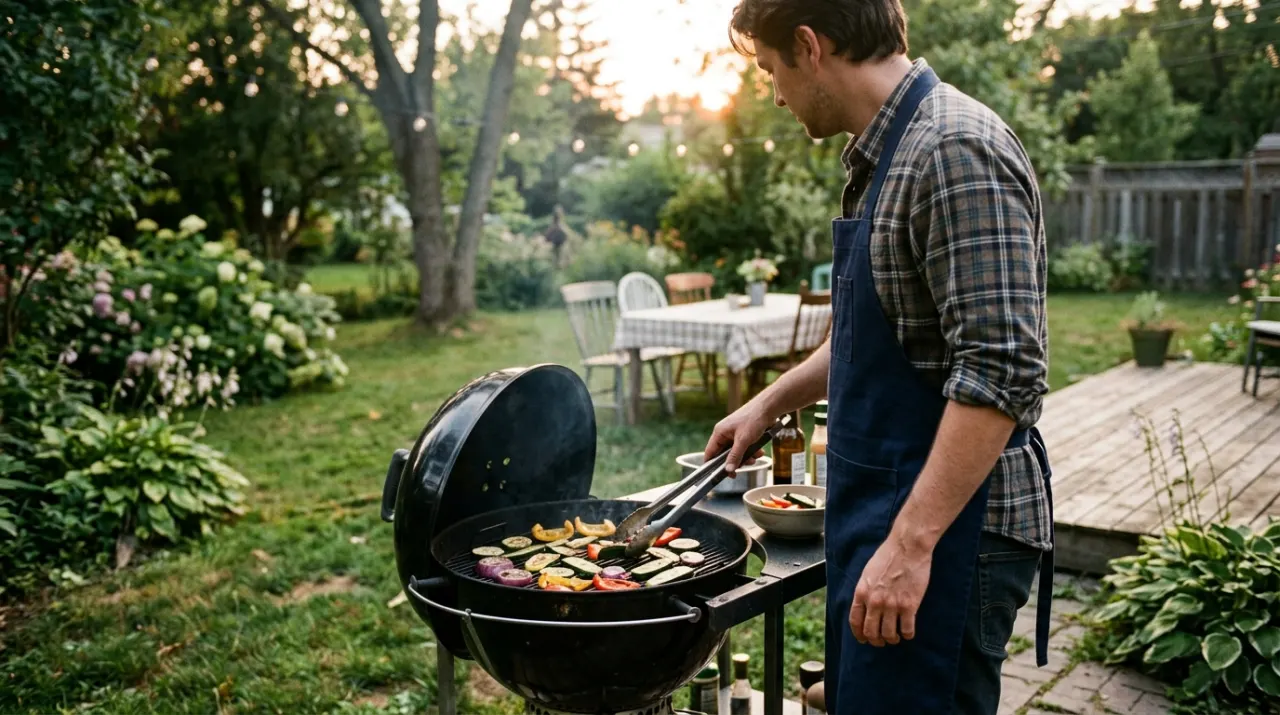
A lit charcoal bed sits around 700°F to 900°F at grate level, and lump charcoal with the vents wide open can exceed 1,000°F directly over the coals. A consumer gas grill typically maxes out between 500°F and 600°F with the lid down, less with it open. That gap is the entire flavor argument, because browning reactions accelerate sharply with temperature — more heat means a deeper crust in the same number of seconds, which is exactly what you want on a thick steak and exactly what you do not want on a fillet of sole.
The corollary is that gas is better at being gentle. Turning a burner to medium-low and holding 325°F for forty minutes is trivial on gas and genuinely fiddly on charcoal, where you are managing airflow, fuel quantity and a fire that is slowly dying the whole time.
How long from cold to cooking?
| Stage | Gas | Charcoal |
|---|---|---|
| Ignition to flame | Seconds | 1–2 min to light a chimney |
| Ready to cook | 10–15 min preheat | 25–35 min (chimney burn plus grate preheat) |
| Adjusting temperature | Immediate, by dial | 3–10 min, by vents and coal position |
| Shutting down | Turn the knobs off | Close vents; coals stay dangerously hot for hours |
| Cleanup after | Brush the grate | Brush the grate plus ash removal |
The half hour is what kills charcoal on a Tuesday. It is also, for a lot of people, the whole appeal on a Saturday.
What does each cost to run?
Charcoal is cheaper to buy and dearer per cook. A 22-inch kettle runs $100 to $200; a comparable three-burner gas grill runs $400 to $700. But a typical charcoal cook burns 4 to 6 pounds of briquettes, roughly $2 to $4 at 2026 prices, while the same cook on propane uses a small fraction of a tank that costs about $20 to refill — call it a dollar. Grill weekly for five years and the two totals converge; grill three times a week and gas pulls ahead on running cost while still costing more up front.
Two hidden costs worth naming. Gas grills need a tank exchange or refill trip, and a spare tank effectively costs $50 to $60 the first time. Charcoal needs dry storage — a bag left in a damp garage is a bag that will not light — and a metal ash can, because ash goes out warm and stays hot far longer than people expect.
The safety rules are identical, and one of them kills people every year
Never grill in a garage, under a carport, on a covered balcony, or in any enclosed or partly enclosed space — with either fuel. Charcoal and propane both produce carbon monoxide, which the CPSC Carbon Monoxide Information Center describes as colorless and odorless — there is no warning before symptoms start. Charcoal is the more lethal of the two because a bed of coals keeps producing CO long after cooking finishes, and every year people are killed bringing a still-warm grill inside or into a garage to keep it out of the rain. An open garage door does not make a garage outdoors.
Propane adds its own enclosed-space hazard: leaked propane is heavier than air and pools at floor level rather than dispersing, so a garage or a screened porch collects it. Our garage grilling page covers this in detail, and how far a grill should be from the house covers clearances.
Food safety does not care which fuel you chose
Whichever grill you buy, the internal temperatures are the same and they are not optional. USDA FSIS sets safe minimum internal temperatures at 165°F for all poultry, 160°F for ground meats, and 145°F with a three-minute rest for whole cuts of beef, pork, veal and lamb. Fish is 145°F.
The critical point is how you check. Time, color, firmness and clear juices are all unreliable — USDA is explicit that a food thermometer is the only way to know. Charcoal makes this more important, not less, for two reasons: its higher surface heat produces food that looks finished on the outside long before it is done in the middle, and smoked meat keeps a pink smoke ring well past a safe temperature. Measure in the thickest part, away from bone and fat. See our meat thermometer picks.
What each one asks of you over ten years
Gas. Burner tubes clog with grease and corrode; most owners replace them once somewhere between year five and year eight, which is a $40 part and a twenty-minute job on a good grill. Igniters fail. Regulators occasionally trip into low-flow mode and need resetting. Grease trays must be emptied or you will eventually have a grease fire. See replacing gas grill burners.
Charcoal. Almost nothing to break. A kettle is a bowl, a lid and a grate, and the common failures are a rusted-through bowl after a decade uncovered and a seized vent damper. Ash must be cleared after every few cooks or airflow suffers and the bottom of the bowl corrodes faster. This mechanical simplicity is why twenty-year-old kettles are still in service and twenty-year-old gas grills mostly are not.
So which should you buy?
Buy gas if you cook outdoors on weeknights, you cook a lot of chicken, fish and vegetables, you want to control temperature by turning a knob, or the half-hour startup would mean you simply do not bother.
Buy charcoal if steak is the point, you want to try real low-and-slow barbecue, you have a small budget for a large cooking surface, or you enjoy the process as much as the food.
Buy both if you can — and note that a good kettle plus a mid-range gas grill often costs less than one premium gas grill, and covers far more ground. That is the setup most experienced grillers end up with, and it is not a failure to decide.
Next: best gas grills · best charcoal grills · best pellet grills (the third option, if you want smoke without the babysitting) · outdoor living & grills · how we rank.