 Garden
Affiliate Disclosure
Some links on this page are affiliate links. As an Amazon Associate, we earn from qualifying purchases — at no extra cost to you. We do not buy, test, or physically handle the products we cover; our rankings come from aggregated owner reviews, ratings and expert consensus. Commissions never change our verdicts. How we rank · full disclosure.
The short answer: choose natural gas if you grill often and can run a gas line — it costs less per cook, never runs out mid-meal and means no tanks to swap. Choose propane for flexibility, portability and low up-front cost — no installation, higher heat output and the freedom to move the grill anywhere. Natural gas wins on long-term convenience and running cost; propane wins on install cost and mobility. Your yard and how much you grill decide it more than the grills themselves.
We never buy or physically test the grills mentioned; rankings elsewhere come from aggregated owner reviews and expert consensus, described in how we rank. Browse the wider category at the outdoor living and grills hub.
What Is the Difference?
Both fuels burn cleanly and cook nearly identically at the grate. The difference is delivery. A natural gas grill connects by a fixed hose to your home gas line, drawing an unlimited supply at low pressure. A propane grill runs off a portable 20-pound tank you buy, refill or exchange. That one structural difference — plumbed-in versus portable tank — drives cost, convenience and where the grill can live.
| Factor | Natural gas | Propane |
|---|---|---|
| Fuel cost per cook | Lower | Higher |
| Up-front / install cost | High (gas line) | Very low |
| Runs out mid-cook | Never | Possible |
| Heat output | Good | Slightly higher |
| Portability | Fixed to the line | Move anywhere |
| Installation | Licensed plumber, often a permit | Screw on the regulator |
| Cold-weather behavior | Unaffected | Tank pressure falls in severe cold |
| Taste of the food | Identical | Identical |
| Best for | Frequent grillers, permanent patio | Renters, tailgates, occasional use |

Which Is Cheaper to Run?
Natural gas is the cheaper fuel over time. Measured by energy content, it usually costs a third to a half of what propane costs for the same amount of heat, so a household grilling several nights a week sees real savings across a season. But the up-front math flips: a natural gas grill needs a line run to the patio, and depending on distance, trenching and local permits that can range from a few hundred dollars for a short run near an existing line to well over a thousand for a longer trenched job. Propane has essentially no installation cost — you buy the grill and a tank and you are cooking the same afternoon, and a 20-pound tank costs roughly $20 to $25 to refill. Refilling by weight at a propane station is usually cheaper per pound than swapping at an exchange cage, and you keep your own tank rather than trading it for whatever is in the rack. The break-even depends entirely on how often you grill and how expensive your gas-line install is: the fuel saving is real but modest in absolute terms, so a $1,000 install repays itself over years rather than months. It is an easy call if you already have a gas stub near the patio or a trench going in for other work, and a much harder one as a standalone project.
Which Is More Convenient?
Natural gas is more convenient day to day for one simple reason: it never runs out. There is no tank to monitor, refill, exchange or store, and no dreaded empty-tank moment with guests waiting on burgers. Turn the valve and cook. Propane trades that for freedom of placement — a tank grill can sit anywhere, move for a party, come to a tailgate or a campsite, and follow you when you move house. If you rent, or you grill occasionally, or your patio is far from a gas line, propane portability is worth more than natural gas convenience.
Which Grills Hotter?
Propane packs more energy per cubic foot, so at maximum a propane burner can run a touch hotter than the same burner on natural gas unless the grill is engineered or converted with larger orifices for gas flow. For everyday cooking the difference is small and both reach proper grilling temperatures. If you are a dedicated high-heat searer chasing steakhouse crust, propane holds a slight edge; for most families it will not be noticeable. Note that you cannot swap fuels freely — the two run at different pressures and need different orifices, so conversion requires a model-specific kit and, ideally, a professional. See can you convert a propane grill to natural gas before assuming it is an option.
One more difference worth knowing: propane tank pressure falls in severe cold, so output drops in deep winter. Natural gas is unaffected. Neither fuel changes how the food tastes — that is a myth. A natural gas model and its propane twin from the same manufacturer are built identically, and any difference in the published BTU rating comes from orifice sizing, not cooking ability.
Converting Between the Fuels: Read This Carefully
This is the part where people get hurt, so it is worth spelling out. Propane is denser in energy and arrives at higher pressure, so it flows through a smaller burner orifice. Natural gas is less dense and arrives at lower pressure, so it needs a larger one to deliver comparable heat. The regulator differs too. That is why you cannot simply attach a different hose and cook.
- A grill can only be converted if the manufacturer says that model is convertible and sells a kit for it. Many models are not convertible at all. Check the manual or contact the manufacturer with the model number before buying anything.
- Use the manufacturer's own kit for your exact model. Generic aftermarket orifice sets and universal hoses are not equivalent, and a kit for a similar-looking grill from the same brand is not the same kit.
- Never drill out an orifice, never fit a natural gas hose to a propane-configured grill, and never run a grill on a fuel it is not currently configured for.
- An improper conversion produces an incorrect air-fuel mixture. Too much gas gives an oversized, unstable flame and a fire or explosion risk; incomplete combustion produces carbon monoxide, which is odorless. Both are genuine hazards, not theoretical ones.
- Have the work done by a licensed gas fitter where local rules require it — and in many jurisdictions they do. Permit and inspection requirements are jurisdiction-specific, so check with your building department.
- Leak-test every joint with soapy water afterward, before the first cook. Bubbles mean a leak; shut the supply off and do not light the grill.
- Yellow, lazy or sooty flames after a conversion mean stop. A correct gas flame is mostly blue and stable. Shut it down and get it checked.
The clean way to avoid all of this is to buy the grill in the configuration you need, or to buy a model the manufacturer explicitly supports on both fuels with its own hardware.
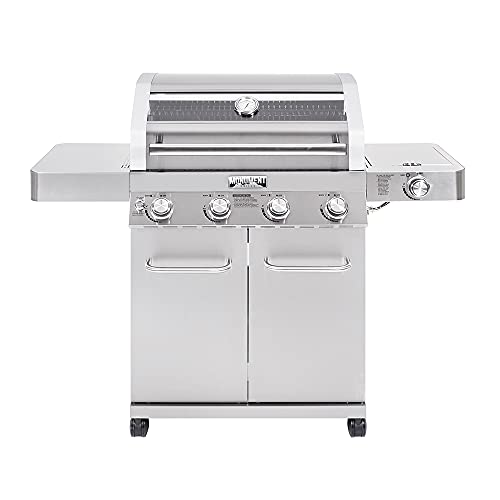
Best for a household that has a gas line, or expects to add one
- Ships configured for natural gas with the manufacturer’s own conversion hardware
- Four main burners plus a side burner
- Stainless cabinet-style cart with LED control knobs
- Built-in lid thermometer
Why buy it: buying a grill the manufacturer itself supports on both fuels removes the entire risk of an improvised aftermarket conversion.
The wider ranked field for the piped-in option is in the best natural gas grills.

Safety Rules for Either Fuel
- Never operate a grill indoors, in a garage, on a covered porch, in a breezeway or in any partially enclosed space — with a door open or not. Grills produce carbon monoxide, it is odorless, and enclosed spaces let it reach lethal concentrations. This applies to gas and charcoal alike.
- Keep the grill well clear of the house, deck railings, siding and anything overhanging. Local clearance requirements vary; check yours.
- Leak-test connections with soapy water at the start of every season and after any hose, tank or regulator change.
- Open the lid before you light it. Gas pools under a closed lid and ignites as a flashback.
- If a burner will not light, turn the gas off, leave the lid open and wait five minutes before trying again.
- Store propane tanks outdoors and upright, away from heat sources, never in a garage, shed or basement — propane is heavier than air and a slow leak in an enclosed space pools rather than dispersing. Never transport a tank lying down in a closed vehicle.
- Replace cracked or perished hoses rather than taping them, and never leave a lit grill unattended.
- Keep the grease tray clean — accumulated grease is the leading cause of grill fires.
Which Should You Buy?
Buy natural gas if you own your home, grill frequently, have a permanent patio spot, and can absorb the one-time install cost — the running savings and never-empty convenience pay off. Buy propane if you rent, grill occasionally, want the grill to be movable, or simply do not want to pay for a gas-line install. Whichever fuel you land on, the build quality of the grill itself matters more than the fuel for how long it lasts and how evenly it cooks — see our best gas grill picks. Weighing charcoal instead? Compare lump charcoal vs briquettes and the 2-burner vs 4-burner gas grill question.