 Garden

Affiliate Disclosure
Some links on this page are affiliate links. As an Amazon Associate, we earn from qualifying purchases — at no extra cost to you. We do not buy, test, or physically handle the products we cover; our rankings come from aggregated owner reviews, ratings and expert consensus. Commissions never change our verdicts. How we rank · full disclosure.
The short version: the best paint for a ceiling is INSL-X Color-Changing Ceiling Paint, because it goes on pink and dries flat white, which is the only reliable way to see where you have already rolled when you are painting white over white with your neck bent back. If your ceiling carries old water rings, smoke haze or nicotine bleed, KILZ Stainblocking Ceiling Paint is the smarter buy because it seals as it covers. For a big ceiling on a budget, a plain dead-flat latex like Diamond Brite Brite White is all most rooms need.
Ceiling paint is not a marketing invention. It is thicker than wall paint so it spatters less overhead, and deader flat so it scatters light instead of spotlighting every seam and nail pop. Those two properties are why a $40 gallon of ceiling paint outperforms a $60 gallon of premium wall paint on the same surface. For technique, our guide to painting a ceiling without drips covers the roller work, and the paint and walls hub maps out the whole job.
Top Picks at a Glance

Our #1 Pick: INSL-X Color-Changing Ceiling Paint
Every ceiling job runs into the same problem about twenty minutes in. You are looking straight up at a white surface, a work light is glaring off the wet paint, and you genuinely cannot tell which two-foot square you already covered. So you overlap wildly in some places, miss patches in others, and discover the misses the next morning when the paint has dried flat and the light has changed. That is where almost all bad ceiling jobs come from — not from bad paint, but from not being able to see your own work.
INSL-X solves it with a tinted carrier: the paint rolls on a distinct pink and fades to flat white as it dries, over roughly an hour. While you are working, the wet pink area is unmistakable against the old white ceiling. You roll to the edge of the pink, keep a wet edge, and the coverage map draws itself. Owners consistently report that the color change is obvious rather than subtle, which is the whole point, and that it fades to a genuinely neutral white rather than leaving a pink cast.
Underneath the trick it is a competent dead-flat ceiling paint: thick enough to resist the fine spatter that ordinary paint throws off an overhead roller, flat enough to swallow drywall seams and old repairs, and covering somewhere around 350 square feet per gallon on a sealed ceiling.
Consensus Score █████████░ 8.7 — built from aggregated verified owner ratings, weighted for review volume.
The honest weaknesses: it costs more than a plain flat white, the pink takes a full hour to fade so you should not judge coverage too early, and it is only sold in white, so it is no help if you want a color on the ceiling. It also does not block stains — if you have a water ring, spot-prime it first.
Check price on Amazon → (paid link)
The Ranked Field
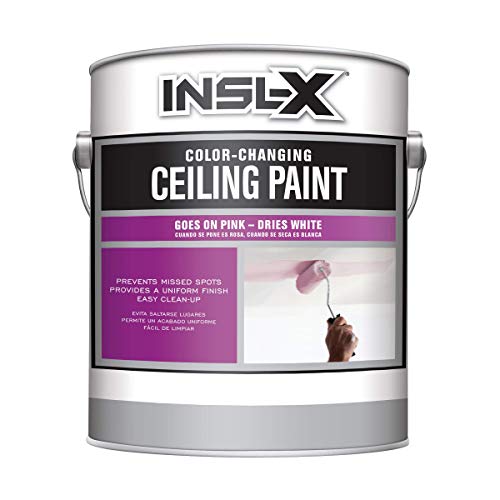
Best for seeing exactly where you have already rolled on a white-on-white ceiling
- Rolls on pink, dries flat white
- Dead-flat sheen hides drywall flaws
- Spatter-resistant thick body
- Covers roughly 350 sq ft per gallon
Why buy it: the color-changing formula solves the single hardest part of ceiling painting — knowing which patch of white you already covered while standing under a glare with your neck bent back.

Best for ceilings with old water rings, smoke haze or nicotine bleed
- Stain-blocking resin holds back old water rings
- Also applies pink and dries white
- Flat finish for maximum flaw-hiding
- Low-odor water-based formula
Why buy it: it seals and covers in one product, so a faint water ring from a long-fixed roof leak does not ghost back through two coats a week later.

Best for large ceilings where you need several gallons without a premium price
- Dead-flat latex, no sheen to catch light
- Bright white with no yellow cast
- Made in Columbus, Ohio
- Sprays, brushes and rolls
Why buy it: a plain, honest flat white at a fair gallon price, which matters when a great room ceiling needs three gallons and the fancy stuff would cost you an extra fifty dollars.
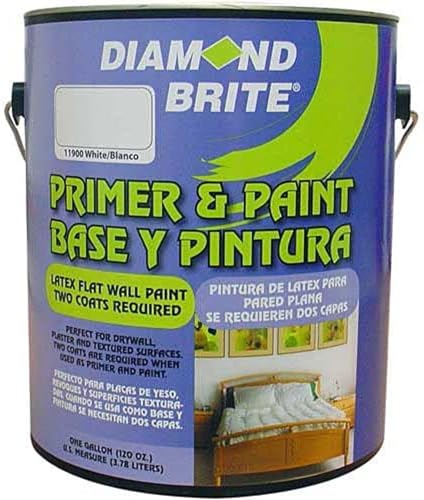
Best for previously painted ceilings that just need a refresh, not a rescue
- Primer built into the paint film
- Flat, low-sheen finish
- Interior walls and ceilings
- Self-leveling body reduces roller marks
Why buy it: on a sound, previously painted ceiling it genuinely saves a separate priming day, which is the difference between a Saturday job and a weekend job.

Best for a soft off-white ceiling on a tight budget
- Flat sheen with primer included
- Soft off-white rather than stark white
- Low VOC, low odor
- Thick enough to resist spatter
Why buy it: a soft white reads warmer than builder-grade brilliant white and is far more forgiving of a ceiling that is not perfectly flat, all at a budget gallon price.

Best for killing a water ring or smoke stain before you paint over it
- Shellac base seals what latex cannot
- Dries to recoat in about 45 minutes
- Blocks water, smoke, tannin and marker
- Sticks to glossy and chalky surfaces
Why buy it: nothing stops a stubborn water ring like shellac — one spot-primed patch saves you from three coats of ceiling paint that still ghost by spring.
Quick Comparison
| Product | Best for | Rating | Price | Buy |
|---|---|---|---|---|
| INSL-X Color-Changing Ceiling Paint, White, 1 Gallon | Best Overall Ceiling Paint | — | Check (paid link) | |
| KILZ Stainblocking Ceiling Paint, Interior, White, 1 Gallon | Best Stain-Blocking | — | Check (paid link) | |
| Diamond Brite Flat Latex Paint, Brite White, 1 Gallon | Best Value Flat | — | Check (paid link) | |
| Diamond Brite Paint and Primer in One, White, 1 Gallon | Best Paint & Primer in One | — | Check (paid link) | |
| PRESTIGE Interior Paint and Primer in One, Moon, Flat, 1 Gallon | Best Budget Flat | — | Check (paid link) | |
| Zinsser B-I-N Pigmented Shellac Primer-Sealer & Stain Killer, White, 1 Quart | Best Spot Primer for Water Stains | — | Check (paid link) |
How We Rank
We do not buy, test or physically handle these products. For ceiling paint we weight flaw-hiding flatness, spatter resistance overhead, stain-blocking ability, coverage per gallon and price, then read the aggregated owner-review record for each product — ratings weighted by review volume, plus the complaints that repeat across hundreds of reviews rather than the one-off horror stories. Prices were current at the time of writing and move around. Our full method is on how we rank.
The Ceiling Paints, Reviewed
1. INSL-X Color-Changing Ceiling Paint — Best Overall
Covered above. What owners praise: the pink-to-white change is genuinely visible, the flat finish hides drywall imperfections well, and there is noticeably less spatter than a thin wall paint. What owners complain about: the price per gallon, the hour it takes for the pink to clear, and that it will not hide a water stain on its own. The pick for anyone who has ever missed a patch.
2. KILZ Stainblocking Ceiling Paint — Best Stain-Blocking
KILZ combines the same color-change trick with a stain-blocking resin, which makes it the right buy for a ceiling with history. Old water rings from a since-repaired roof leak, smoke haze above a woodstove and nicotine bleed in a house with a former smoker are all things that latex paint alone will simply let through, no matter how many coats you apply. What owners praise: that it holds back light-to-moderate stains in one or two coats and the flat finish looks clean. What owners complain about: heavy stains still need a dedicated shellac spot primer first, and coverage per gallon is on the low side over porous surfaces. The best all-in-one for a ceiling with a past.
3. Diamond Brite Flat Latex, Brite White — Best Value Flat
Sometimes you have a clean, sound, previously painted ceiling and you just need white paint that goes flat and stays flat. This is that. A dead-flat latex in a genuinely bright white with no yellow cast, at a gallon price that makes doing a great room ceiling three-gallons-deep a reasonable proposition. What owners praise: the price, the clean white tone and that it brushes, rolls and sprays without fuss. What owners complain about: it is thinner than a purpose-made ceiling paint so it spatters more overhead, and it offers no stain blocking and no coverage indicator. Wear a hat.
4. Diamond Brite Paint and Primer in One — Best Paint & Primer
The paint-and-primer version of the same family, worth the small premium on a ceiling that has been painted before and is in reasonable shape. The built-in primer gives you better adhesion over a slightly chalky old coat and levels a little better, which shows up as fewer roller marks. What owners praise: good hide in two coats and a smooth, even flat film. What owners complain about: “paint and primer” does not mean it replaces a real primer over bare drywall or a stain, which catches people out. Solid for a refresh, not a rescue.
5. PRESTIGE Interior Paint and Primer, Moon Flat — Best Budget
A soft off-white flat rather than a stark builder white, which is a genuinely good look on a ceiling: brilliant white can read cold and, oddly, shows unevenness more than a soft white does, because the eye has more contrast to work with. What owners praise: the price, the low odor and that the flat finish covers well — though low odor is not the same as no emissions, and the EPA advises maximum ventilation during painting regardless of the product. What owners complain about: it is a wall paint pressed into ceiling duty, so it is thinner overhead and drips more, and the off-white will not match an existing bright-white ceiling if you are only doing one room. Best when the whole ceiling is going the same color.
6. Zinsser B-I-N Shellac Primer-Sealer — Best Spot Primer
Not a ceiling paint, but the product that saves the most ceiling paint jobs, which is why it earns a place here. Shellac seals what water-based products cannot: a water ring, a smoke stain, a marker line, cedar or redwood tannin bleeding through. It dries to recoat in about 45 minutes, so spot-priming three water rings costs you an hour, not a day. What owners praise: that it genuinely stops stains dead where three coats of latex failed, and the fast recoat. What owners complain about: the alcohol smell is strong, it requires denatured alcohol rather than water for cleanup, and it will ruin a brush if you let it dry. Use a cheap brush and throw it out.

What Owners Actually Complain About
Ceiling paint attracts a very consistent set of gripes, and almost all of them are technique problems dressed up as product problems.
“It dried patchy.” This is the most common complaint on every ceiling paint ever made, and it is nearly always a one-coat job. Flat paint dries back without any sheen to smooth over unevenness, so a coat that looked complete while wet reveals thin spots the next morning. Two coats fix it. The color-changing paints exist specifically to reduce the second cause, which is missed patches you could not see.
“The stain came back.” Water rings, smoke and tannin do not get covered, they get sealed. Latex paint is porous enough that the stain wicks through the film over weeks. Owners who spot-prime with a shellac primer first do not report this; owners who apply three coats of ceiling paint and hope do.
“It spattered everywhere.” Overhead rolling throws paint down at you, and thin paint throws more. Loading the roller lighter, using a 1/2-inch nap rather than a 3/4-inch on a smooth ceiling, and rolling slower all reduce it more than any paint choice does. Our guide on choosing roller nap covers the sizing, and our roller roundup covers the frames and covers worth buying.
“It sagged and left drips.” Usually a too-heavy coat applied in one pass to try to get one-coat coverage. Two thin coats beat one thick one every time overhead, because gravity is working against you the entire cure.
“The white did not match my trim.” Ceiling whites vary from cool blue-white to warm cream. Owners who buy a gallon based on the word “white” alone are frequently surprised. If the ceiling meets crisp white crown molding, a bright white ceiling reads better; if it meets warm trim or a cream wall, a soft white does.
How to Choose a Ceiling Paint
Start with the ceiling’s condition, not the brand. A clean, sound, previously painted ceiling needs nothing more than two coats of a decent flat. A ceiling with stains needs a stain-blocking product or a spot primer. Bare or freshly patched drywall needs a real primer, because raw drywall paper and joint compound absorb paint at completely different rates and the difference shows as flashing. If the ceiling is old enough to be original, check before sanding it back: the EPA notes that lead dust forms when lead-based paint is scraped, sanded or heated, and paid work on a pre-1978 ceiling falls under the EPA Renovation, Repair and Painting Rule.
Insist on flat. This is the single most consequential choice. Ceilings are lit from below by lamps and from the side by windows, which is the worst possible lighting for showing surface texture. Any sheen at all — even eggshell — turns every drywall seam, screw dimple and old repair into a visible ridge. Flat scatters that light. The only real exception is a bathroom ceiling, where mildew resistance and washability are worth the trade, and for that a mildew-resistant coating like the products in our interior paint roundup makes more sense.
Think about spatter. Purpose-made ceiling paint is thicker than wall paint, and that thickness is not marketing. It is the difference between a fine mist of white dots on your face, your glasses and the floor, and a job you can do in a ball cap. If you are using a thinner wall paint on a ceiling, drop the roller nap and slow down.
Buy enough in one go. Most ceiling paints cover roughly 250 to 400 square feet per gallon depending on how porous the surface is. Two coats on a 15 by 20 foot room is 600 square feet of coverage, so a single gallon is marginal. Buying two gallons at once also means one batch, one tint lot, and no risk of a slightly different white halfway across the room.
Consider spraying a large or textured ceiling. A knockdown or popcorn ceiling drinks paint and fights a roller. If you are doing a whole floor of a house, a sprayer pays for itself in time and finish quality — see our paint sprayer picks, and be aware that removing a popcorn ceiling is sometimes the better answer than painting it.
The Verdict
For most ceilings, INSL-X Color-Changing Ceiling Paint is the pick, because seeing your own coverage overhead is worth more than any other feature a ceiling paint can offer. If your ceiling carries old water or smoke stains, buy KILZ Stainblocking Ceiling Paint instead, or spot-prime the marks with Zinsser B-I-N first and then use whatever flat white you like. And if the ceiling is clean, sound and simply tired, a plain dead-flat gallon such as Diamond Brite Brite White costs less and does the job. Whatever you choose: flat sheen, two coats, and prime the stains. Check price on Amazon → (paid link)