 Garden

Affiliate Disclosure
Some links on this page are affiliate links. As an Amazon Associate, we earn from qualifying purchases — at no extra cost to you. We do not buy, test, or physically handle the products we cover; our rankings come from aggregated owner reviews, ratings and expert consensus. Commissions never change our verdicts. How we rank · full disclosure.
The short version: the best wasp spray is the one that reaches the nest from where you are standing, because distance is the safety feature. Our #1 pick is Spectracide Wasp & Hornet Killer, whose jet is rated to about 27 feet — the longest reach among the mainstream consumer cans, in the largest can, at the lowest price. Raid reaches roughly 22 feet and is on almost every shelf in America, which matters when a nest appears on a Sunday. For a nest inside a wall, a soffit or a hole, a jet is the wrong tool entirely: use the foaming Ortho product, which expands to fill the cavity.
Two rules apply regardless of what you buy. Treat after dark or just before dawn, when the whole colony is home and largely inactive. And know when to stop: a nest in a wall void, a large ground nest, a nest near electrical service, or any nest at all if someone in the household has a sting allergy, is a job for a professional. A wasp callout costs less than an emergency room visit.
Top Picks at a Glance

Our #1 Pick: Spectracide Wasp & Hornet Killer
This is a pyrethroid aerosol in a 20 oz can with a jet nozzle rated to roughly 27 feet. That figure is the reason it leads. Every other consideration in wasp control — knockdown speed, residual, price — is secondary to whether you can treat the nest without standing under it.
Owners describe the pattern consistently: a thorough soaking of an exposed paper wasp or bald-faced hornet nest at dusk drops the visible wasps within seconds and the nest is dead by morning. The residual left on the nest surface handles foragers that were out at the time and return the next day, which is why leaving the nest in place for 24 hours before removing it is standard advice.
Two limitations worth naming. It is a jet, not a foam, so it is poorly suited to nests inside wall voids or soffits, where most of the spray passes through the opening and out of reach. And the oily carrier can stain siding, painted trim and decking — spray from below at an angle where you can, and rinse treated surfaces once the job is finished.
Check price on Amazon → (paid link)
The Ranked Field
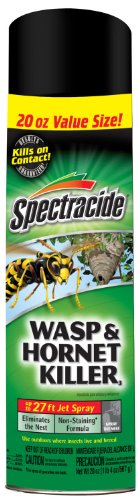
Best for nests under eaves and in trees, treated from a safe distance
- Jet spray rated to about 27 feet — the longest here
- Kills on contact and leaves residual on the nest
- 20 oz can, the largest in this lineup
- Very low price for the volume
Why buy it: reach is the whole safety argument with wasps, and this can puts more distance between you and the nest than anything else on the shelf.

Best for nests you must treat while wasps are active and flying
- Professional pest-control product, prallethrin based
- Near-instant knockdown of flying wasps
- Chills and drops insects on contact
- Shorter range than consumer jet cans
Why buy it: the can professional technicians reach for when a nest has to come down in daylight rather than at dusk.

Best for the can most people can buy locally in the next twenty minutes
- Jet spray to roughly 22 feet
- Kills the nest, including wasps returning later
- Stocked in almost every grocery and hardware store
- Electrically non-conducting per the label rating
Why buy it: availability is a real feature when a nest appears over the back door on a Sunday afternoon.
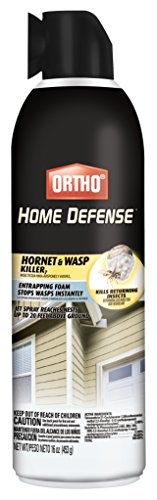
Best for nests in wall voids, soffits and holes where a jet just passes through
- Entrapping foam plus a jet spray mode
- Foam expands to fill and seal a cavity
- Also kills yellow jackets and mud daubers
- Residual action on treated surfaces
Why buy it: a jet stream fired into a hole mostly misses; foam expands into the void and coats what is inside it.

Best for ground nests and repeat work around a property
- Professional-grade formulation
- Jet spray to about 20 feet
- Fast knockdown with residual on the nest surface
- Sold through pest-control channels rather than grocery stores
Why buy it: a professional can at roughly twice the price of a consumer one, which is cheap against a single wasp callout.

Best for nests near vegetable gardens, patios or where synthetics are unwanted
- Peppermint, wintergreen and other plant essential oils
- No synthetic pyrethroid active
- Jet spray to roughly 18 feet
- Strong minty smell rather than a chemical one
Why buy it: weaker and shorter-lived than the pyrethroids, but the only entry here you would happily spray above a herb bed.
Quick Comparison
| Product | Best for | Rating | Price | Buy |
|---|---|---|---|---|
| Spectracide Wasp & Hornet Killer Spray, Sprays Up To 27 Feet, 20 Ounce | Best Overall | — | Check (paid link) | |
| PT Wasp Freeze II 14oz - Pressurized Insecticide | Best Instant Knockdown | — | Check (paid link) | |
| Raid Wasp & Hornet Killer Spray, Kills the Entire Nest, 17.5 oz | Best Widely Available | — | Check (paid link) | |
| Ortho Home Defense Hornet and Wasp Killer7, 16 oz | Best Foaming Action | — | Check (paid link) | |
| CSI 15 oz Stryker Wasp & Hornet Killer | Best Pro Alternative | — | Check (paid link) | |
| EcoSMART Organic Wasp and Hornet Killer, 14 oz Aerosol Spray Can | Best Plant-Based | — | Check (paid link) |

Specifications Side by Side
| Product | Can size | Stated reach | Spray type | Best nest type |
|---|---|---|---|---|
| Spectracide Wasp & Hornet | 20 oz | About 27 ft | Jet | Exposed, high up |
| PT Wasp Freeze II | 14 oz | Shorter, professional | Jet, instant knockdown | Active nests treated in daylight |
| Raid Wasp & Hornet | 17.5 oz | About 22 ft | Jet | Exposed nests |
| Ortho Home Defense Hornet & Wasp7 | 16 oz | About 20 ft | Foam plus jet | Voids, soffits, holes |
| CSI Stryker | 15 oz | About 20 ft | Jet | Ground nests, repeat work |
| EcoSMART Organic | 14 oz | About 18 ft | Jet | Nests near gardens and patios |
How We Rank
We do not buy or use these products, and with stinging insects we are particularly glad to say so plainly. The ranking is built from aggregated owner ratings, weighted toward reviews that describe the nest type treated, because an exposed paper wasp nest and an in-ground yellow jacket colony are different problems and the same can earns very different verdicts on each. Four factors carry the weight. Effective reach, since standing further away is the whole safety proposition. Knockdown speed, which determines how many wasps are in the air while you retreat. Delivery format matched to nest type — foam for voids, jet for exposed nests. And residual activity on the nest surface, which decides whether returning foragers rebuild. Prices were checked at the time of writing. Full method: how we rank.
Before You Spray Anything
This is the part of the page that matters most, and it is short:
- Treat at night or just before dawn. The colony is home and inactive. Daytime treatment leaves foragers in the field and puts you among returning wasps.
- Do not hold the flashlight. Wasps orient to light. Set it on the ground aimed at the nest, or use a red filter.
- Plan the retreat first. Know where you are walking before you press the nozzle. Never treat a nest from a ladder — a sting reflex on a ladder is how this goes badly wrong.
- Cover up. Long sleeves, long pants, closed shoes, gloves, eye protection. Aerosol falls back down.
- Wait 24 hours before removing the nest. Returning foragers hit the residual over the following day.
- Stop and call a professional if anyone in the household has a sting allergy, if the nest is inside a wall or roof void, if it is a large ground nest, if it is near electrical service or a meter, or if it is out of comfortable reach from the ground. Penn State Extension takes the same line: aerosol jet sprays suit small exposed paper wasp nests, while the large enclosed nests of yellowjackets and bald-faced hornets are best left to a professional.
It is also worth identifying what you have, and Penn State Extension’s guide to social and solitary stinging insects is the quick way to do it — the social species are the ones that sting repeatedly to defend a nest. Paper wasps build the open, umbrella-shaped comb under eaves and railings and are comparatively docile. Bald-faced hornets build the large enclosed gray football-shaped nest and defend it aggressively. Yellow jackets nest in the ground or in cavities, are the most aggressive of the three, and are behind most stings — and they are also the nests most likely to survive a DIY jet-spray treatment.

The Wasp Sprays, Reviewed
1. Spectracide Wasp & Hornet Killer — Best Overall
Covered above. Owners praise: the reach, instant drop of wasps on contact, the large can for the price, and nests dead by morning. Owners gripe about: real-world range falling short of 27 feet in any breeze, staining on siding and decking, and poor results when used on ground nests. Check price (paid link).
2. PT Wasp Freeze II — Best Instant Knockdown
A professional pest-control product, and the difference from a consumer can is knockdown speed. Wasps drop essentially on contact rather than flying erratically for a few seconds first, which is precisely the difference that matters if a nest has to be treated while the colony is active — an unavoidable situation when a nest is found over a doorway at midday with children about.
Owners praise: immediate knockdown, professional-grade reliability, and confidence when treating an active nest. Owners gripe about: price, shorter range than consumer jets, and availability through pest-control suppliers rather than local stores. Check price (paid link).
3. Raid Wasp & Hornet Killer — Best Widely Available
The default American wasp spray, and the ratings say it deserves the position. Roughly 22 feet of jet, fast knockdown, residual that kills wasps returning to a treated nest, and a dielectric rating printed on the can for use near outdoor fixtures. Performance is close enough to our top pick that the deciding factor is usually which one you can get today.
Its reach is genuinely shorter than the Spectracide can, which is the one substantive difference, and the same caveats apply about breeze and about void nests.
Owners praise: availability everywhere, fast knockdown, killing returning wasps, and low price. Owners gripe about: shorter reach than advertised in wind, staining painted surfaces, and ineffectiveness on ground nests. Check price (paid link).
4. Ortho Home Defense Hornet & Wasp Killer7 — Best Foaming Action
The specialist on this page, and the right buy for a specific and common problem: a nest inside a wall void, a soffit, a vent, a downspout or a hole in a fence post. A jet stream fired into an opening travels straight through and coats the far side of a cavity you cannot see. Foam expands, clings, fills the space and seals the entrance, which is a completely different mechanism and a much better fit.
It also has a jet mode for exposed nests, so it is the most versatile single can here. Reach is shorter than the pure jet products — about 20 feet — because foam simply does not throw as far.
Owners praise: foam filling cavities and sealing entrances, versatility between foam and jet, residual killing returning wasps, and effectiveness on yellow jackets in wall voids. Owners gripe about: shorter range than jet-only cans, foam residue on siding, and the can emptying quickly in foam mode. Check price (paid link).
5. CSI Stryker Wasp & Hornet Killer — Best Pro Alternative
A professional-channel product with fast knockdown, about 20 feet of jet, and residual on the treated surface. It sits between the consumer cans and Wasp Freeze II on both performance and price, and it is a sensible standing purchase for a property that deals with nests every season — a barn, an orchard, a place with a lot of eaves and fence posts.
Owners praise: professional performance at a moderate price, fast knockdown, and useful residual. Owners gripe about: availability, range shorter than the long-jet consumer cans, and incomplete results on established ground nests. Check price (paid link).
6. EcoSMART Organic Wasp and Hornet Killer — Best Plant-Based
Peppermint, wintergreen and related plant essential oils instead of a synthetic pyrethroid. There is a real use case: a nest directly above a vegetable bed, over a patio table, near a fish pond, or in a household that will not use synthetic insecticides. It smells strongly of mint rather than of solvent, which owners consistently mention as a genuine advantage when spraying near a door.
Be clear about the trade. Knockdown is slower than the pyrethroid cans, range is shorter at roughly 18 feet, and residual activity is much shorter-lived, so returning foragers are more likely to survive and rebuild. For a small paper wasp nest treated thoroughly at night it is adequate. For a large hornet nest or a yellow jacket colony it is not the right tool, and choosing it there is a safety decision rather than an environmental one.
Owners praise: no synthetic insecticide, a pleasant smell, comfort using it near food gardens and pets, and effectiveness on small nests. Owners gripe about: slower knockdown, shorter range, weaker residual, wasps returning, and higher price than the mainstream cans. Check price (paid link).
What Owners Actually Complain About
The range is not what it says. The most common complaint across every brand, and largely legitimate. Stated distances are measured in still air with a full, warm can. In a light breeze, or with a can that has been sitting in a cold garage, expect meaningfully less. Treat the number as a maximum, not a working distance.
They came back. Almost always a ground or void nest treated as though it were an exposed one. The visible opening is one end of a cavity that can hold thousands of insects, and a jet reaches very little of it. Foam, dust, or a professional is the answer — not a second can of the same thing.
It stained the house. The oily carrier in most aerosols marks siding, painted trim, decking and stone. Where you can, spray from an angle that keeps the fallout off finished surfaces, and rinse the area down once the nest is dead.
Nests rebuilt in the same spot. Wasps return to the same sheltered locations year after year. After removing a nest, wash the site down and consider a residual barrier spray under the eaves in early spring — our roundup of yard insect killers covers perimeter products, and the Ortho Home Defense review looks at one in detail.
How to Choose a Wasp Spray
Start with where the nest is. Exposed and high — buy for reach, which means the Spectracide can. Inside a void, a soffit or a hole — buy foam. In the ground — expect an aerosol to underperform and consider a dust or a professional.
Then think about when you have to treat. If you can wait for dark, a standard consumer can is fine. If a nest is over a doorway and has to come down now, knockdown speed is worth paying for and Wasp Freeze II is what professionals use for exactly that reason.
Finally, know the limits. The CDC and allergy organizations are consistent that insect sting anaphylaxis is a genuine medical emergency, and stinging insects account for a substantial share of serious insect-related incidents in the US each year. If anyone in the house has a known sting allergy, do not treat a nest yourself at any price. Likewise for nests in wall cavities, large ground colonies, and anything near a meter box or service entrance. A professional visit is inexpensive relative to what can go wrong. For the wider pest picture around a yard, our pest & weed control hub covers the rest, and fire ant control deals with the other stinging insect most American homeowners meet.
The Verdict
Spectracide Wasp & Hornet Killer is the can we would keep in the garage: the longest reach in the mainstream category, the biggest can, the lowest price, and a strong owner record on the exposed paper wasp and hornet nests most households actually encounter. Raid is close behind and available everywhere. If the nest is in a wall void or a hole, buy the foaming Ortho product instead — it is a different tool for a different problem. PT Wasp Freeze II is what to buy if you have to treat a live nest in daylight. And EcoSMART is the honest plant-based option for small nests where synthetics are unwelcome. Whatever you choose, spray at night, do not hold the flashlight, and know when the job belongs to somebody with a bee suit. Check price on Amazon → (paid link)
More from this hub: pest & weed control · best yard insect killers · best fire ant killers · best mosquito yard sprays · best gopher traps · how we rank.