 Garden

Affiliate Disclosure
Some links on this page are affiliate links. As an Amazon Associate, we earn from qualifying purchases — at no extra cost to you. We do not buy, test, or physically handle the products we cover; our rankings come from aggregated owner reviews, ratings and expert consensus. Commissions never change our verdicts. How we rank · full disclosure.
To treat downy mildew, act before it takes hold and protect the leaves you still have: strip infected foliage, open up airflow, water only at the soil line early in the day, and apply a protectant such as copper, a phosphonate, or an oomycete-targeted product like mancozeb. Downy mildew is a water mold, not a true fungus, so ordinary fungicides often fail — you have to match the product to it and get ahead of the wet, cool conditions it loves. There is no spray that reverses leaves that are already infected.
We do not test or physically handle the plants and products we cover; our guidance draws on horticultural extension research and the aggregated experience in thousands of owner reviews, as explained in how we rank.
What downy mildew is and how to confirm it
Downy mildew is a group of diseases caused by oomycetes — water molds in genera such as Peronospora, Plasmopara and Pseudoperonospora. They are not fungi, even though they behave a little like them, and that biological fact is the single most useful thing to know because it changes which products work.
The classic sign is a patchwork of pale yellow or light green patches on the upper surface of a leaf, sharply angular because the mold is walled in by the leaf veins. Turn the leaf over and look at the underside beneath those patches: in humid mornings you will see a fine gray, downy, or purplish fuzz — the spore-bearing growth that gives the disease its name. As it advances, the yellow patches turn brown and die, and heavily hit leaves drop. On basil the yellowing can be mistaken for a nutrient problem until you check the underside; on grapes, cucurbits and roses the angular, vein-bounded pattern is the tell.
It is a cool, wet disease. Extended leaf wetness — overnight dew, fog, overhead watering, crowded humid canopies — plus mild temperatures give the spores the several hours they need to germinate and infect. Common hosts include basil, cucumbers, melons, squash, grapes, spinach, lettuce, brassicas, impatiens, roses and snapdragons, each with its own host-specific strain.
Telling it apart from look-alikes
Before you spend money on a product, confirm what you actually have, because the two mildews and a couple of other problems get confused constantly.
| Problem | Top of leaf | Underside | Conditions |
|---|---|---|---|
| Downy mildew | Angular yellow patches bounded by veins | Gray/purple downy fuzz | Cool, wet, long leaf wetness |
| Powdery mildew | White talc-like coating on the surface | Usually clear | Warm, humid, dry leaves |
| Nutrient deficiency | Uniform yellowing, often between veins | Nothing | Any |
| Spider mites | Fine stippling, bronzing | Tiny webbing, moving specks | Hot, dry |
If the underside fuzz is there, you have downy mildew and should treat it as an oomycete. If the coating is on top and looks like flour, it is powdery mildew and a different plan applies.
The treatment path, least-toxic first
Work down this list in order. Most gardeners stop well before the last step.
- Sanitation — Pick off and bag every infected leaf, and remove badly hit plants entirely. Do not compost the material where spores can wash back into beds, and never work among wet plants, which spreads spores on your hands and tools.
- Cultural correction — Fix the moisture. Thin crowded plants, prune for airflow, switch to drip or base watering, and water in the early morning so leaves dry within an hour or two. This alone can stall a mild outbreak.
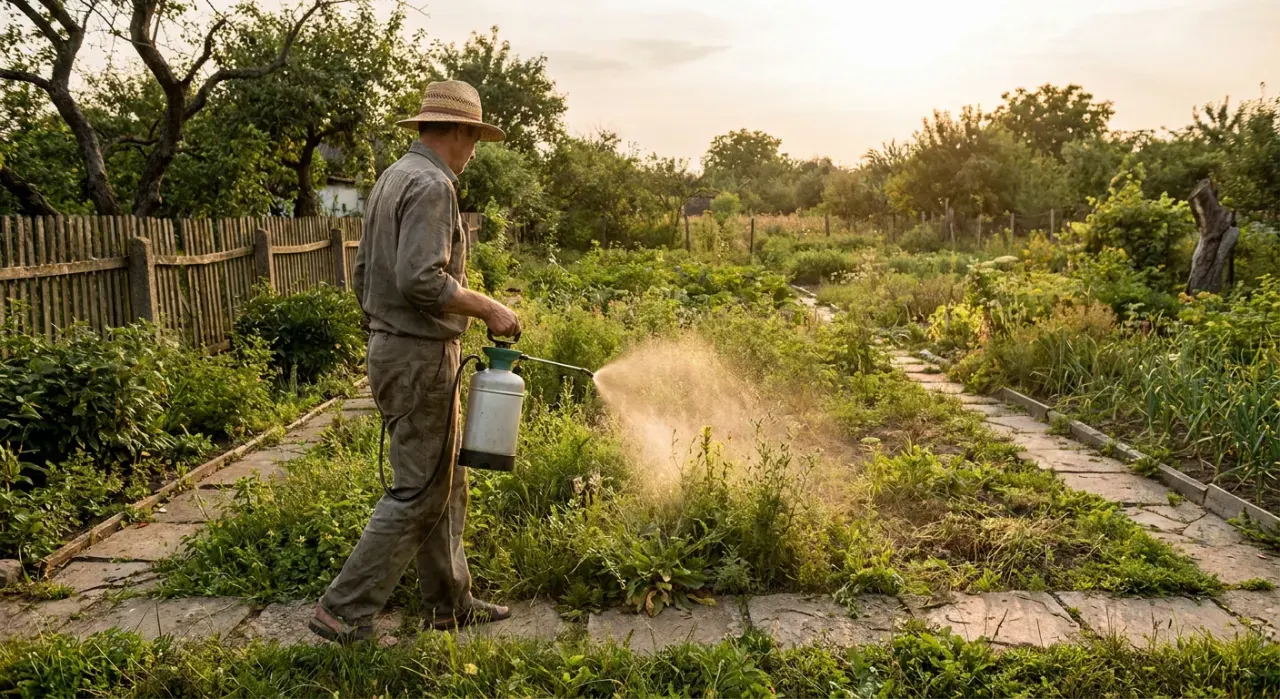
- Organic protectants — Apply copper (copper hydroxide or copper octanoate) or a phosphonate (phosphorous acid) product to the healthy tissue you want to protect. These are protectant, not curative, so coverage on undersides and timing before heavy infection are what make them work. Some biofungicides based on Bacillus species are also labeled for suppression.
- Broad protectant fungicides — On higher-value crops, chlorothalonil or mancozeb give stronger protection and are specifically effective against oomycetes. Rotate actives to avoid resistance.
- Systemic oomycete-specific actives as a last resort — Products with mefenoxam or other oomycete-targeted systemics exist for serious pressure, but resistance is a real problem and these belong at the end of the list, used strictly to label.
Whatever you reach for, read the label first. In the United States the pesticide label is the law under FIFRA, and using a product against a target or on a crop it does not list is a federal violation — so confirm the label names downy mildew and your specific plant.
Why copper works and some fungicides do not
This is the part that saves money and frustration. Because downy mildews are water molds rather than true fungi, several popular fungicide chemistries that target true-fungal biology simply do not affect them — a gardener can spray faithfully and watch the disease march on. Copper is a broad-spectrum protectant that disrupts the spores on the leaf surface regardless of whether the pathogen is a fungus or an oomycete, which is why it stays useful here. Phosphonates and the oomycete-specific actives work because they were designed with this group in mind.
The practical rule: match the product to the pathogen. If a label does not mention downy mildew, assume it will not control it, no matter how good it is against other leaf diseases. This same logic runs through late blight, which is also an oomycete — see how to treat tomato blight.
Managing it on the crops that get it most
Basil collapses fast; grow resistant varieties, keep leaves dry, harvest often, and treat as soon as you see the first underside fuzz. Cucumbers, melons and squash benefit from resistant cultivars, wide spacing and a preventive protectant program once nights turn cool and damp. Grapes need airflow through the canopy and a protectant schedule in wet springs. Impatiens — the older bedding types are so susceptible that downy mildew reshaped the market; plant downy-resistant impatiens or switch to New Guinea types. Spinach and lettuce reward resistant varieties and morning watering more than any spray.
Preventing it next season
Prevention is where downy mildew is actually won, because a protectant only ever holds a line you have already set up well.
- Resistant cultivars — the highest-leverage choice for basil, cucumber, spinach and impatiens.
- Spacing and airflow — the less time leaves stay wet, the fewer infections start.
- Water management — drip or soaker lines, watering the soil not the foliage, and watering early so leaves dry by mid-morning.
- Crop rotation — move susceptible families so the same crop is not in the same bed year after year.
- Sanitation — clear and dispose of infected debris at the end of the season rather than leaving it to overwinter.
- Preventive protectant — on high-value plants, begin a copper or phosphonate program when conditions first turn cool and damp, before symptoms appear.
For related leaf diseases that share this sanitation-and-airflow approach, see how to treat septoria leaf spot and how to treat rust on plants.
Related: Pest & Weed Control hub and how we rank.