 Garden


Affiliate Disclosure
Some links on this page are affiliate links. As an Amazon Associate, we earn from qualifying purchases — at no extra cost to you. We do not buy, test, or physically handle the products we cover; our rankings come from aggregated owner reviews, ratings and expert consensus. Commissions never change our verdicts. How we rank · full disclosure.
Carbon monoxide. A portable generator emits as much CO as hundreds of cars, and the CPSC links more than 100 US deaths a year to generator carbon monoxide. It is colorless and odorless — there is no warning. Run it outdoors only: never in a garage, basement, shed, breezeway or under a carport, and an open garage door does not make an enclosed space safe. Site it at least 20 feet from the house with exhaust pointed away from doors, windows and vents, and fit CO alarms on every level indoors. See the CPSC Carbon Monoxide Information Center.
Backfeeding. Never plug a generator into a wall outlet to power the house. It energizes the utility line through your transformer and can electrocute a line worker who has confirmed the line is dead. A transfer switch or interlock installed by a licensed electrician is the only correct method.
Home backup is the one generator application where reliability beats every other specification. A camping generator that will not start is an inconvenience. A backup generator that will not start is a basement full of water, a freezer full of spoiled food, or a house at 40°F in January. And the thing that determines whether it starts is not the brand on the tank — it is whether there was stale gasoline in the carburetor.
That single fact shapes this whole ranking. Dual fuel machines rank highly not because propane is cheap but because propane does not degrade, and a generator that has sat untouched for a year will start on it. Machines with a fuel shut-off valve rank above those without, because running the bowl dry is what prevents the varnish. And the most-owned models rank above better-specified newcomers, because a decade of documented owner experience is worth more than a slightly larger number on the carton.
Top Picks at a Glance
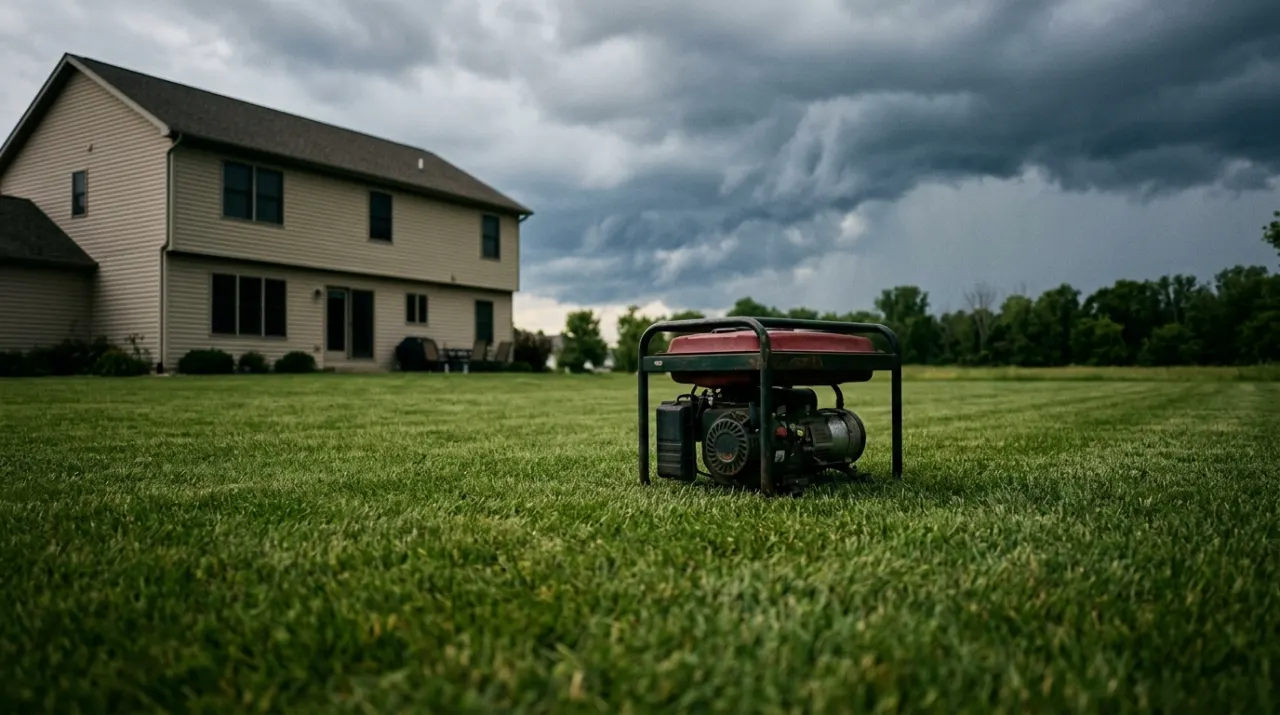
Our #1 Pick: Westinghouse 12500 Watt Dual Fuel
At 9,500 running watts this is the point where a portable generator stops being a compromise. Fed through a transfer switch it runs the furnace, the refrigerator, the chest freezer, a 3/4 hp well pump, a sump pump, the lighting circuits and a kitchen outlet — simultaneously, with headroom left for a window air conditioner. That is a genuinely comfortable outage rather than a survivable one.
It ranks first because of the size of its ownership record. Tens of thousands of American households have run this machine through consecutive storm seasons, and that produces something a specification sheet cannot: a clear picture of how it behaves in year four. What the record shows is consistent. Owners who run it on propane and exercise it monthly report years of reliable starts. Owners who left gasoline in it over a summer report the carburetor problem that afflicts every machine in this category.
Remote electric start matters more here than on anything smaller. This is a 250-pound object, and the difference between pressing a key fob from the back door and pulling a recoil cord in freezing rain at 2 a.m. is not a luxury feature.
The honest limitations: it is heavy enough that moving it up a step needs two people, propane output drops to roughly 8,500 running watts, and it is an open-frame machine at 70 to 74 dBA under load — loud enough that the 20-foot CO clearance is also a neighbor-relations measure.
Check price on Amazon → (paid link)
The Ranked Field

Best for covering an entire normal house through a multi-day outage
- 12500 peak / 9500 running watts on gasoline
- Transfer-switch-ready 50A and 30A 240V outlets
- Dual fuel — propane does not go stale in storage
- Remote electric start with a key fob
Why buy it: the most-owned large home-backup generator in the country, which means a decade of documented real-world behavior rather than a spec sheet and a hope.

Best for homes with a natural gas line, where refueling should never be a problem
- 14500 peak watts on gasoline, plus propane and natural gas modes
- Natural gas hookup gives effectively unlimited runtime
- Transfer-switch-ready 240V outlets
- Remote electric start
Why buy it: a natural gas connection makes the fuel problem disappear, which is the single hardest part of getting through an outage that lasts longer than a tank.

Best for whole-home capacity in a neighborhood where an open-frame machine is a problem
- 12000 peak / 9500 running watts on gasoline
- True inverter output — clean sine wave at whole-home capacity
- Transfer-switch-ready 50A and 30A 240V outlets
- Dual fuel with remote electric start
Why buy it: inverter output at this size is still unusual, and it matters in a house full of variable-speed motors, control boards and electronics.

Best for rural properties, farms and anyone who wants a serviceable engine
- 13000 peak / 10500 running watts on gasoline
- 500cc OHV engine, heavy steel frame, copper windings
- CO shutdown sensor built in
- Full outlet panel including a 50A 240V receptacle
Why buy it: built to be repaired rather than replaced, with a CO shutdown sensor that is a genuine safety feature rather than a marketing bullet.
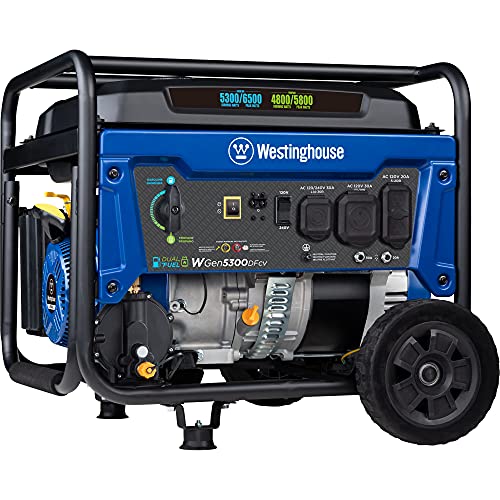
Best for a transfer-switch panel of eight to ten essential circuits including a well pump
- 6500 running watts on gasoline, around 5800 on propane
- Transfer-switch-ready L14-30R 240V outlet
- Dual fuel with an RV-ready 30A outlet as well
- Clears a 3/4 hp well pump surge with the furnace running
Why buy it: the least you can spend and still cover a well pump starting while the furnace is already on — the exact arithmetic that defeats 5,000-watt machines.
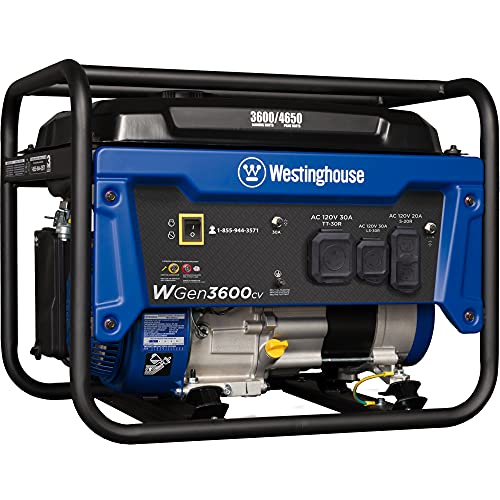
Best for keeping food cold and the furnace running without spending four figures
- 4650 peak / 3600 running watts
- Built-in carbon monoxide sensor with automatic shutdown
- RV-ready 30A TT-30R outlet
- Compact enough for one person to move
Why buy it: a CO shutdown sensor at this price is unusual and genuinely worth having, since the cheap end of the market is where the safety features normally disappear.

Quick Comparison
| Product | Best for | Rating | Price | Buy |
|---|---|---|---|---|
| Westinghouse 12500 Watt Dual Fuel Home Backup Portable Generator, Remote Electric Start, Transfer Switch Ready | Best Overall | — | Check (paid link) | |
| Westinghouse 14500 Peak Watt Tri-Fuel Home Backup Portable Generator, Remote Electric Start, Transfer Switch Ready | Best Fuel Flexibility | — | Check (paid link) | |
| Westinghouse 12000 Peak Watt Dual Fuel Portable Inverter Generator, Remote Electric Start, Transfer Switch Ready | Best Quiet Backup | — | Check (paid link) | |
| DuroMax XP13000HX 13,000-Watt Dual Fuel Portable Generator, Gas and Propane, Electric Start | Best Heavy Duty | — | Check (paid link) | |
| Westinghouse 6500 Watt Dual Fuel Home Backup Portable Generator, Transfer Switch Ready 30A Outlet, RV Ready | Best Mid-Size | — | Check (paid link) | |
| Westinghouse 4650 Peak Watt Portable Generator, RV Ready 30A Outlet, Gas Powered, CO Sensor | Best Budget | — | Check (paid link) |
Matching the machine to your house
| Running watts | What it covers | Suits |
|---|---|---|
| 3,500–4,000 | Fridge, freezer, furnace blower, lights, devices — carefully staged | Apartments, short outages, gas heat and city water |
| 5,000–6,500 | All of the above plus a well pump or sump pump, through a transfer switch | The mainstream home-backup buy |
| 7,500–9,500 | Most of the panel, including a window AC or a soft-started central AC | Larger homes, hot climates, long outages |
| 10,500 and up | Central AC without a soft-start, electric water heater, effectively grid replacement | All-electric homes, rural properties, farms |
The load that most often decides the answer is the well pump. Households on a well plan around the refrigerator and the furnace, then discover the pump is the largest single draw in the house — a 3/4 hp pump can demand 3,000 to 4,500 watts for the instant it starts. Full arithmetic is in what size generator do I need.
How We Rank
We do not buy, run or physically handle these machines. Rankings come from aggregated owner ratings across the most-owned home-backup generators, weighted heavily toward reviews written after two or more storm seasons — because in backup service the failure that matters is the one that happens after eleven months of standing still. Those are cross-checked against published specifications for running and surge watts, outlet configuration, tank capacity and engine displacement, and against manufacturer service documentation. What carries the weight: starting reliability after long storage, which is the dominant real-world failure mode; running capacity on the fuel you will actually use; transfer-switch-ready 240V outlets, without which the machine cannot do home backup at all; and serviceability and parts availability, because a backup generator has to be repairable in year eight. Prices were checked at the time of writing. Full method: how we rank.

The Field, Reviewed
1. Westinghouse 12500 Watt Dual Fuel — Best Overall
Covered above. Owners praise: capacity that covers a real house, remote start in bad weather, propane reliability after long storage, and a complete 240V outlet set. Owners gripe about: weight, open-frame noise, the propane output drop, and an oil drain that needs a ramp or a pan with a low profile. Check price (paid link).
2. Westinghouse 14500 Tri-Fuel — Best Fuel Flexibility
The natural gas mode is the reason to choose this over our top pick. Connected to a house gas line by a licensed gas fitter it never needs refueling — which removes the hardest part of a long outage, when the pumps are down and every gas can in the county is spoken for.
Owners praise: unlimited runtime on natural gas, the highest aggregated owner rating in this field, and remote start. Owners gripe about: the gas hookup being licensed work with its own permit, roughly 15% lower output on natural gas, and substantial weight. Check price (paid link).
3. Westinghouse 12000 Peak Watt Inverter — Best Quiet Backup
Whole-home output with inverter power quality, which is still rare at this size. Worth the premium in two situations: a neighborhood close enough that open-frame noise causes real friction, and a house full of variable-speed HVAC motors and electronics that behave badly on approximate sine waves.
Owners praise: the combination of capacity and clean output, remote start, and transfer-switch-ready outlets. Owners gripe about: price, weight that makes the wheel kit essential, and that "quiet" is relative — under heavy load it is quieter than open-frame rivals, not actually quiet. Check price (paid link).
4. DuroMax XP13000HX — Best Heavy Duty
Job-site construction in a home-backup machine, with a built-in CO shutdown sensor that kills the engine if carbon monoxide accumulates around it. That feature is not a substitute for the 20-foot rule, but it is a real backstop.
Owners praise: build quality, the CO sensor, copper windings, and sustained output under load. Owners gripe about: weight that is genuinely difficult on soft ground, noise, and a price above the Westinghouse equivalents. Check price (paid link).
5. Westinghouse 6500 Watt — Best Mid-Size
The size most households land on once the circuits are counted. 6,500 running watts absorbs a well pump surge with the furnace already running, and it is small enough that one person can move it.
Owners praise: the balance of price and capability, transfer-switch-ready outlet, dual fuel, and manageable weight. Owners gripe about: recoil start on some configurations, open-frame noise, and a hard-to-read fuel gauge. Check price (paid link).
6. Westinghouse 4650 Peak Watt — Best Budget
Essentials only, and honest about it. 3,600 running watts covers a refrigerator, a chest freezer, a furnace blower and lighting — not simultaneously with a well pump. The built-in CO shutdown sensor is unusual at this price and is the reason it ranks over cheaper rivals.
Owners praise: the CO sensor, the price, and a size one person can move without help. Owners gripe about: 120V-only output on some configurations, a small tank, and noise typical of the open-frame class. Check price (paid link).
What Owners Actually Complain About
It would not start when the power went out. The defining complaint of this category, and almost always stale fuel rather than a defect. Ethanol-blended pump gas degrades within about 30 days and the varnish blocks the carburetor jets. Stabilizer at every fill, fuel shut-off run dry before storage, and a monthly 20-minute exercise run under load prevent the great majority of what people pay small-engine shops to repair.
Buying the generator and not the connection. A large number of owners buy a transfer-switch-ready machine and then run extension cords, because they never budgeted the $500 to $1,500 for a licensed electrician to fit the switch. The furnace, the well pump and the ceiling lights all have no plug.
Underestimating weight. A 9,500-watt open-frame generator with a full tank weighs 250 to 300 pounds. Owners consistently report being surprised by what it takes to move it across a wet lawn.
Skipping the first oil change. Small air-cooled engines specify an oil change at 20 to 25 hours. In a long outage that is two days, and running past it is the second most common route to a dead generator.
Noise and neighbors. Open-frame machines run 70 to 78 dBA. In a dense neighborhood during a multi-day outage this becomes a genuine social problem, and it is the strongest argument for the inverter option.
The Verdict
For most households the Westinghouse 12500 Watt dual fuel is the buy — the best-documented machine in the class, enough output to cover a real house, and a propane option that means it starts after a year of standing still. Add the tri-fuel 14500 to the shortlist if a natural gas line reaches your property, and take the 6500 Watt if your list is essentials plus a well pump. Then spend the money on a transfer switch, keep stabilizer in the fuel, and run it once a month. That routine, far more than the model on the tank, is what determines whether it works when it matters. Check price on Amazon → (paid link)
More from this hub: power tools & workshop · how to connect a generator to your house · what size generator do I need · best dual fuel generators · whole house generator cost · how we rank.