 Garden


Affiliate Disclosure
Some links on this page are affiliate links. As an Amazon Associate, we earn from qualifying purchases — at no extra cost to you. We do not buy, test, or physically handle the products we cover; our rankings come from aggregated owner reviews, ratings and expert consensus. Commissions never change our verdicts. How we rank · full disclosure.
A whole-house standby generator costs $7,000 to $20,000 installed in the United States as of mid-2026, and the generator itself is often less than half of that. A 14 to 18 kW air-cooled unit sized for an average home typically lands at $8,000 to $13,000 all in; a 22 to 26 kW unit for a large or all-electric home runs $12,000 to $20,000. The rest of the money goes on the concrete pad, the automatic transfer switch, the gas line, the electrical work and the permits — none of which are optional, and all of which are professional-install-only work.
Where the money actually goes
The single most misleading thing about shopping for a standby generator is the price on the box. Homeowners see a 22 kW unit listed at $5,500 and budget accordingly, then get a quote for $16,000. Here is what fills the gap, with national ranges as of 2026.
| Line item | Typical cost | Notes |
|---|---|---|
| Generator unit, 14–18 kW air-cooled | $3,500–$6,000 | The number you see advertised |
| Generator unit, 22–26 kW air-cooled | $5,000–$8,500 | Large or all-electric homes |
| Automatic transfer switch | $500–$2,000 | Whole-panel switches cost more than load-shedding models |
| Concrete or composite pad | $250–$1,200 | Composite is cheaper; poured concrete is often required by code |
| Electrical labor and materials | $1,500–$4,000 | Feeder run, panel work, bonding, inspection |
| Gas line — natural gas | $800–$3,500 | Depends on distance from the meter and whether the meter must be upsized |
| Gas line and tank — propane | $1,500–$5,000 | A 250–500 gallon tank, buried or above ground |
| Permits and inspections | $100–$500 | Electrical, mechanical, sometimes zoning |
| Site work, trenching, landscaping repair | $0–$2,500 | Rocky ground and long runs are the expensive case |
Two line items surprise people most. The first is upsizing the gas meter — a 22 kW generator can demand more natural gas than an existing residential meter and service can deliver alongside the furnace and water heater, and the utility upgrade is a separate job on a separate schedule. The second is trenching, because the distance from the meter and the panel to a legal pad location is the variable nobody estimates from a photograph.

What size, and what it costs
| Size | Covers | Installed cost (2026) |
|---|---|---|
| 10–13 kW | Essential circuits — furnace, fridge, well pump, some lighting | $6,000–$10,000 |
| 14–18 kW | Most of an average 2,000–2,500 sq ft home including one AC unit | $8,000–$13,000 |
| 22–26 kW | Large or all-electric homes, two AC units, electric range | $12,000–$20,000 |
| 30 kW and up (liquid-cooled) | Estates, multi-unit properties, heavy loads | $20,000–$40,000+ |
Regional variation is large and it is mostly labor. The same 18 kW install that runs $9,000 in the rural Southeast commonly quotes $14,000 to $16,000 in the Northeast metro corridor or coastal California. Coastal and hurricane-prone counties often add wind-rated mounting requirements; cold-climate installs may need a cold-weather kit with a battery warmer and oil heater, typically $200 to $500.

What it costs to run
The purchase is the visible cost; fuel is the one that surprises people during a genuinely long outage.
- Natural gas. A 20 kW unit at half load burns roughly 200 cubic feet per hour. At typical 2026 residential rates that is around $2 to $4 an hour, or $50 to $95 a day. The line never runs out, which is the main reason natural gas is the preferred fuel where it is available.
- Propane. The same unit burns roughly 2.5 to 3.5 gallons an hour at half load — $8 to $10 an hour at $3 per gallon, or $180 to $250 a day. A 500-gallon tank, filled to the usual 80%, lasts about five days at half load. Budget for a refill mid-outage, and expect delivery delays when the whole county is out.
- Maintenance. Air-cooled units want an oil and filter change roughly every 100 to 200 running hours or annually, plus plugs, an air filter and a battery every three to five years. A dealer maintenance contract typically runs $200 to $500 a year.
- Exercise cycles. Standby units self-test weekly, usually 5 to 20 minutes. Over a year that is a small but non-zero fuel cost, and in some neighborhoods a noise complaint.
The honest alternative: a portable and a transfer switch
Before spending $12,000, it is worth being precise about what the standby unit buys you that a portable does not. It starts automatically when the power fails, whether or not you are home. It never needs refueling if it runs on natural gas. And it is quieter and permanently installed.
What it does not buy you is more capacity than a large portable. A 9,500-running-watt portable generator covers substantially the same loads as a 12 kW standby unit. Paired with a manual transfer switch installed for $500 to $1,500, the whole setup costs roughly $2,000 to $3,000 — about a fifth of the standby figure. The difference you are paying for is automation and convenience, and for a household that loses power twice a year for four hours, that is a very expensive convenience.
Where the standby genuinely wins: frequent multi-day outages, a household where somebody depends on powered medical equipment, a sump pump that must not stop, a seasonal or remote property nobody is at when the power fails, and homes where the owner physically cannot wheel out and start a 250-pound machine.

Best for covering the same loads as a small standby unit for a fifth of the installed cost
- 12500 peak / 9500 running watts on gasoline
- Transfer-switch-ready 50A and 30A 240V outlets
- Dual fuel — gasoline or propane
- Remote electric start with a key fob
Why buy it: a 9,500-running-watt portable plus a $600 transfer switch install covers most of what a 14 kW standby unit does, for roughly $2,000 instead of $10,000 — the trade is that you go outside and start it.
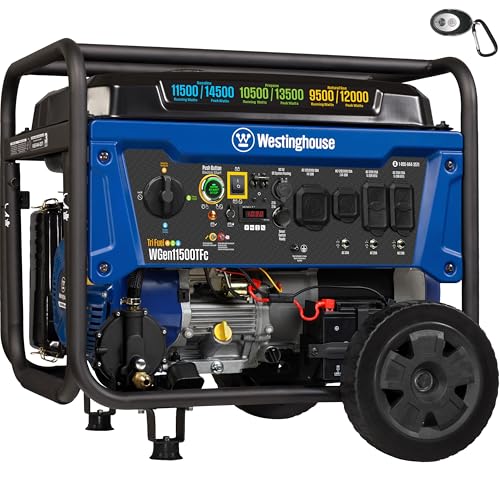
Best for homes with a natural gas line that still want the option of gasoline or propane
- 14500 peak watts, running on gasoline, propane or natural gas
- Transfer-switch-ready 240V outlets
- Remote electric start
- Natural gas connection removes the refueling problem entirely
Why buy it: connected to a house gas line by a licensed plumber it never needs refueling, which is the one genuine advantage a standby generator has — obtained here for a fraction of the price.
If you take the portable route, the connection method is not optional either — see how to connect a generator to your house. Never plug a generator into a wall outlet: backfeeding energizes the utility line and can electrocute a line worker.

How to read a quote without getting taken
- Insist the quote is itemized. Unit, transfer switch, pad, electrical, gas, permits, site work. A single lump sum hides where the margin is.
- Ask what size transfer switch is included. A whole-panel automatic switch costs meaningfully more than a load-shedding model that only manages selected circuits, and the difference matters in an all-electric house.
- Confirm who pulls the permits. If the answer is "you do", the price is not comparable to a quote where the contractor handles it.
- Ask whether the gas meter needs upsizing and who pays for the utility's work. This is the most common change order.
- Check the warranty terms against the installer. Most manufacturers require an authorized dealer install for full warranty coverage, and many dealers will not service a unit they did not sell.
- Check setbacks and your HOA before signing. Local zoning ordinances govern how close a generator may sit to a property line and a window, and HOA rules on screening and noise vary widely.
Cost figures on this page are national estimates as of July 2026, compiled from published manufacturer pricing, contractor quote ranges and utility rate data. They will differ in your market — sometimes by thousands. Local electrical and mechanical codes, permit requirements and zoning setbacks are set by your jurisdiction; verify with your building department, and see NFPA 70 for the national electrical code your state adopts and amends.
Where to go next
Work out what you actually need to power in what size generator do I need, compare portable machines in best generators for home backup, and understand the fuel choice in best dual fuel generators. Running costs are broken down further in how much gas a generator uses. Everything sits under the power tools and workshop hub.
We never buy or install the equipment we write about — our verdicts come from aggregated owner reviews, published specifications and manufacturer documentation. The method is on how we rank. Product links are affiliate links; they earn us a small commission at no cost to you and never change a recommendation.