 Garden

Affiliate Disclosure
Some links on this page are affiliate links. As an Amazon Associate, we earn from qualifying purchases — at no extra cost to you. We do not buy, test, or physically handle the products we cover; our rankings come from aggregated owner reviews, ratings and expert consensus. Commissions never change our verdicts. How we rank · full disclosure.
Most American homes need 5,000 to 7,500 running watts to cover the essentials, and 10,000 watts or more if you want central air conditioning during an outage. A single RV or a camper trailer runs comfortably on 3,000 to 4,000 watts. The number that matters is not your monthly electricity use but your simultaneous peak — everything you plan to have switched on at the same moment, plus the surge of whichever motor starts last. Add those up, add 20% headroom, and that is your generator.
Running watts vs starting watts — the number that trips people up
Every generator carries two ratings. Running watts (sometimes "rated watts") is what it can produce continuously. Starting watts (or "peak" or "surge") is a much larger figure it can hold for a few seconds. The gap exists because anything with an electric motor — a refrigerator compressor, a well pump, a furnace blower, an air conditioner — draws a large inrush current in the instant it spins up, then settles to a fraction of that.
The practical rule: your total running load must fit inside the running rating, and the single largest starting surge must fit inside the surge rating on top of everything already running. A 5,000/6,250-watt generator running 4,200 watts of household load has only 2,050 watts of surge headroom left, which is not enough to start a 1/2 hp well pump. That is how people end up tripping a breaker on a generator that "should" be big enough.
Resistive loads — incandescent bulbs, coffee makers, toasters, space heaters, electric kettles — have no surge at all. Their running and starting watts are identical. Motors and compressors are where the arithmetic gets interesting.

What common household loads actually draw
Nameplate figures vary by model, and the only authoritative number is the one on your own appliance's data plate. These are typical US household values to build a first estimate from.
| Appliance | Running watts | Starting surge |
|---|---|---|
| Refrigerator / freezer | 150–200 | 800–1,200 |
| Chest freezer | 100–150 | 600–1,000 |
| Gas furnace blower (1/2 hp) | 600–800 | 1,500–2,300 |
| Well pump, 1/2 hp | 800–1,000 | 2,000–3,000 |
| Well pump, 3/4 hp | 1,000–1,500 | 3,000–4,500 |
| Sump pump, 1/3 hp | 600–800 | 1,300–2,000 |
| Central AC, 3 ton | 3,000–3,800 | 7,000–12,000 |
| Window AC, 10,000 BTU | 900–1,200 | 1,800–2,500 |
| Electric water heater | 4,000–4,500 | 4,500 |
| Electric range, one element | 1,500–2,500 | 2,500 |
| Microwave, 1,000 W output | 1,200–1,700 | 1,700 |
| Coffee maker | 800–1,200 | 1,200 |
| Washing machine | 500–1,200 | 2,300 |
| Electric dryer | 5,000–5,500 | 6,500 |
| Dishwasher (with heat dry) | 1,200–1,500 | 1,800 |
| LED lighting, whole house | 100–300 | — |
| TV, router, laptops, phones | 200–400 | — |
| Garage door opener | 500–800 | 1,400–2,200 |
| Space heater | 1,500 | 1,500 |
A worked example: sizing a real house
Take an ordinary three-bedroom house on a well, with a gas furnace and no central air, and the goal of getting through a two-day winter outage in reasonable comfort.
- Refrigerator — 180 W running
- Chest freezer in the garage — 130 W running
- Furnace blower — 700 W running
- Well pump, 3/4 hp — 1,200 W running
- LED lights through the house — 200 W
- Router, TV, laptops, phone chargers — 300 W
- Coffee maker, on and off — 1,000 W
Total running load: about 3,710 watts. Now find the largest single surge, which is the well pump at roughly 3,500 starting watts against its 1,200 running watts — a 2,300-watt spike on top of everything else. Peak demand is therefore around 6,010 watts for a moment.
Add 20% headroom and you want roughly 4,500 running watts and 6,500 to 7,000 surge watts. A 5,000-watt running / 6,250-watt surge machine is marginal; a 6,500-watt unit is comfortable. That is the reasoning behind the 6,500 to 7,500-watt class being the most common home-backup purchase in the country.
Add a 3-ton central air conditioner to that same list and the arithmetic changes entirely: +3,500 running watts and a starting surge that can hit 12,000. You are now shopping at 10,000 to 12,000 running watts, and you should look seriously at a soft-start kit on the AC condenser, which cuts the compressor's inrush by half or more and often saves you a whole generator size.

The four sizing tiers, plainly
| Running watts | What it genuinely covers | Typical buyer |
|---|---|---|
| 1,600–2,400 | Fridge OR a few lights and devices, one at a time. Camping and tailgating. | Campers, tent sites, quiet-hours campgrounds |
| 3,000–4,000 | Fridge, freezer, lights, devices, a furnace blower. RV with one air conditioner. | RVs, apartments, short outages, essentials only |
| 5,000–7,500 | Everything above plus a well pump or sump pump, through a transfer switch. No central AC. | The mainstream home-backup buy |
| 9,500–14,000 | Central AC, electric water heater, most of the panel. Effectively grid replacement. | Hot-climate homes, all-electric homes, long outages |
Three machines that match the tiers
These are chosen to illustrate the sizing bands rather than to be an exhaustive field — our full rankings live in best generators for home backup and best inverter generators.

Best for fridge, freezer, furnace fan, lights, well pump run one or two at a time
- 3600 surge watts, 3000 running watts
- Inverter output safe for computers and modern furnace boards
- Fuel shut-off to run the carburetor dry before storage
- Roughly 100 lb, movable by one person
Why buy it: the honest size for a house that needs the food cold and the heat on, and nothing else — most people who buy 9,000 watts are paying for capacity they will never draw.
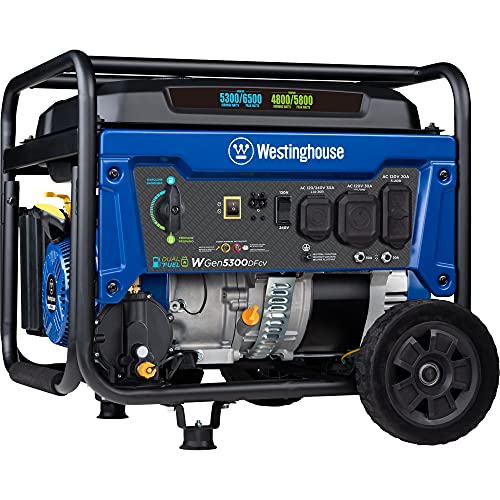
Best for a transfer-switch panel running eight to ten circuits at once
- 6500 running watts on gasoline, slightly less on propane
- Transfer-switch-ready L14-30R 240V outlet
- Dual fuel — gasoline or propane from a standard tank
- Runs a 3/4 hp well pump plus the usual essentials
Why buy it: the size most homes actually land on once a licensed electrician has counted the circuits, because it covers a well pump surge without forcing you into a 400 lb machine.

Best for homes that will not compromise: central AC, electric water heater, well pump, the lot
- 12500 peak / 9500 running watts on gasoline
- Remote electric start with a key fob
- Transfer-switch-ready 50A and 30A 240V outlets
- Dual fuel, with a large steel frame and never-flat wheels
Why buy it: the point at which a portable generator genuinely replaces the grid for a normal house — and also the point at which weight, fuel burn and noise stop being trivial.

The four sizing mistakes people actually make
Sizing on the surge number. The big figure on the carton is the surge rating, and it is the one advertised. A "12,500-watt" generator is usually a 9,500-watt machine. Compare running watts to running watts or you will systematically overestimate every unit you look at.
Forgetting the well pump. Households on a well often plan around the fridge and the furnace and then discover the pump is the largest single load in the house. If you have a well, size around it first.
Ignoring 120V vs 240V. A well pump, an electric water heater, a dryer and a central AC condenser are 240-volt loads. A generator has to have a 240V outlet — usually L14-30R or 14-50R — to feed them, and a small inverter generator with only 120V receptacles cannot run them at any wattage. Check the outlets, not just the watts.
Buying far too much. An oversized conventional generator spends its life lightly loaded, which causes carbon deposits and wet stacking, burns fuel out of proportion to the work done, and is heavy enough that it stays where it was delivered. Twenty-five percent of headroom is prudent; one hundred percent is a worse machine.
One thing you must not do with any size
Never plug a generator into a wall outlet to power the house. This practice — backfeeding — energizes your home wiring and pushes power back through the utility transformer onto the distribution line, where it can electrocute a line worker who has every reason to believe the line is dead. It also bypasses your main breaker, so nothing protects the circuits. The only correct method is a transfer switch or a generator inlet with an interlock, installed by a licensed electrician to the National Electrical Code (NFPA 70) and permitted by your local jurisdiction. We walk through the options in how to connect a generator to your house.
Where to go next
If you have a wattage figure and now need a machine, start with best generators for home backup or, for quiet running and sensitive electronics, best inverter generators. The difference between those two designs is explained in inverter vs conventional generators, and the runtime side of sizing is covered in how much gas a generator uses. For the specific case of the 5,000-watt class, see what a 5,000-watt generator can run. Everything sits under the power tools and workshop hub.
We never buy or physically handle the machines we rank — every verdict comes from aggregated owner reviews, published specifications and manufacturer data. The method is on how we rank. The links above are affiliate links; buying through them earns us a small commission at no cost to you, and it never changes a ranking.