 Garden


Affiliate Disclosure
Some links on this page are affiliate links. As an Amazon Associate, we earn from qualifying purchases — at no extra cost to you. We do not buy, test, or physically handle the products we cover; our rankings come from aggregated owner reviews, ratings and expert consensus. Commissions never change our verdicts. How we rank · full disclosure.
Inverter generators are sold on noise, and that undersells them. The quiet is real — a good one at quarter load sits around 50 to 58 dBA, roughly the level of ordinary conversation, against 70 to 78 dBA for an open-frame machine. But the noise is a side effect of the actual engineering: an inverter generator produces raw AC, rectifies it to DC, and rebuilds a clean sine wave electronically. Because output frequency no longer depends on engine speed, the engine is free to throttle down when the load is light instead of grinding away at a fixed 3,600 rpm.
That single design change delivers three things at once. Power quality good enough for laptops, TVs and modern furnace control boards. Fuel consumption at light load that can be a third of a conventional machine's. And a weight saving large enough that a 2,000-watt inverter fits in one hand while a 2,000-watt conventional generator does not.
What it costs you is watts per dollar. At any given price, a conventional open-frame generator will produce meaningfully more power. The judgment is whether quiet, clean and light are worth that premium for how you will actually use the machine.
Top Picks at a Glance

Our #1 Pick: Westinghouse 5000 Peak Watt Dual Fuel Inverter
This is the machine that resolves the usual inverter compromise. Small inverters are quiet but cannot run a well pump; large open-frame generators run everything but are too loud to sleep beside and produce power you would not want near a variable-speed furnace board. At 4,500 running watts with a genuine inverter output stage, this one covers a real home-essentials load and still sits in the low fifties of decibels at light throttle.
The dual fuel capability matters more for a backup generator than for anything else in this category, and for a reason that has nothing to do with cost. Gasoline in a rarely used generator is the single most common cause of failure, because ethanol-blended pump fuel degrades within weeks. Propane does not degrade at all. A 20 lb tank stored in the yard for two years will start this machine on the first pull of the season. Owners consistently report exactly that pattern — the gasoline side needing attention after long storage, the propane side simply working.
Remote electric start is the other feature owners keep mentioning, and not as a luxury. When the power goes out at 2 a.m. in freezing rain, the difference between a key fob and repeatedly pulling a recoil cord in the dark is not trivial.
The honest limitations: at around 100 pounds this is no longer a machine you carry one-handed, the propane output is roughly 10% below the gasoline figure as it is on every dual fuel unit, and it costs roughly double a conventional generator of the same wattage.
Check price on Amazon → (paid link)
The Ranked Field

Best for the household that wants one quiet machine for outages, the RV and the job site
- 5000 peak / 4500 running watts on gasoline
- Dual fuel — gasoline or propane from a standard 20 lb tank
- Remote electric start with a key fob, plus recoil backup
- Rated around 52 dBA at quarter load, with a 30A RV outlet
Why buy it: the rare inverter that covers a real home-essentials load and still runs quietly enough to sleep near — the highest-rated machine of its size in the aggregated owner record.
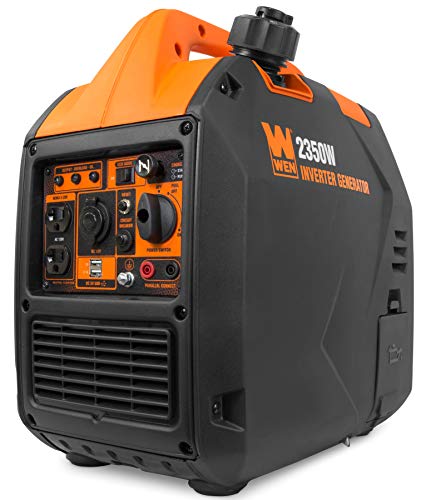
Best for camping, tailgating and keeping a refrigerator alive on a small budget
- 2350 surge / 1900 running watts
- About 39 lb — genuinely one-hand portable
- Fuel shut-off runs the carburetor dry before storage
- Rated around 51 dBA at quarter load
Why buy it: the machine that made quiet inverter power affordable, and the fuel shut-off is the single feature that prevents the stale-fuel carburetor failure that kills most small generators.

Best for RV owners and anyone who wants propane as a storage-proof backup fuel
- 4000 peak / 3500 running watts on gasoline
- Runs on propane with no carburetor gumming in storage
- Remote electric start, 30A RV-ready outlet
- Parallel-capable for a second unit
Why buy it: propane never goes stale, so a dual fuel inverter left untouched for a year will still start — which is exactly the situation most backup generators find themselves in.

Best for buyers who care more about long-term support than headline specs
- 4000 starting / 3500 running watts
- Three-year warranty with lifetime technical support
- RV-ready 30A TT-30R outlet
- Economy mode throttles the engine down at light load
Why buy it: Champion runs its own US service network and parts supply, and the aggregated owner record shows far fewer orphaned-machine complaints than the budget import brands.

Best for running a single RV air conditioner without stepping up to an open-frame machine
- 3600 surge / 3000 running watts
- 30A TT-30R RV outlet plus two 120V household outlets
- Fuel shut-off and a low-oil shutdown
- About 100 lb with a telescoping handle
Why buy it: the cheapest way to reliably start a 13,500 BTU rooftop RV air conditioner, which is the whole reason most RV owners shop this category.

Best for whole-home backup where clean power and lower noise still matter
- 12000 peak / 9500 running watts on gasoline
- Transfer-switch-ready 50A and 30A 240V outlets
- Dual fuel with remote electric start
- Inverter output at a size normally served by open-frame machines
Why buy it: inverter output at whole-home capacity is still unusual, and it means a house full of variable-speed motors and control boards gets clean power rather than an approximation.
Quick Comparison
| Product | Best for | Rating | Price | Buy |
|---|---|---|---|---|
| Westinghouse 5000 Peak Watt Super Quiet Dual Fuel Portable Inverter Generator, Remote Electric Start | Best Overall | — | Check (paid link) | |
| WEN Super Quiet 2350-Watt Portable Inverter Generator with Fuel Shut Off, Gasoline Power, Ultra Lightweight | Best Value | — | Check (paid link) | |
| Westinghouse 4000 Peak Watt Super Quiet Dual Fuel Portable Inverter Generator, Remote Electric Start | Best Dual Fuel | — | Check (paid link) | |
| Champion Power Equipment 4000-Watt RV Ready Portable Inverter Generator with Quiet Technology | Best Warranty | — | Check (paid link) | |
| WEN 3600-Watt Portable Inverter Generator, RV-Ready, Quiet and Lightweight with Fuel Shut Off (56360i) | Best for RVs | — | Check (paid link) | |
| Westinghouse 12000 Peak Watt Dual Fuel Portable Inverter Generator, Remote Electric Start, Transfer Switch Ready | Best High Output | — | Check (paid link) |
What the decibel numbers actually mean
Manufacturers quote noise at 25% load measured at 23 feet, which is a generous standard, and the decibel scale is logarithmic — an increase of 10 dBA is perceived as roughly twice as loud. That is why the gap between an inverter and an open-frame machine feels far larger than the numbers suggest.
| Sound level | Comparable to | Typical source |
|---|---|---|
| 50–55 dBA | A quiet conversation | Small inverter, quarter load, economy mode |
| 56–62 dBA | Normal conversation at 3 feet | Mid-size inverter, moderate load |
| 63–68 dBA | A dishwasher running | Large inverter under load |
| 70–78 dBA | A vacuum cleaner | Conventional open-frame generator |
| Above 78 dBA | A gas lawnmower | Large open-frame under heavy load |
Most national parks and private campgrounds that permit generators at all set a limit around 60 dBA and enforce quiet hours regardless. An open-frame machine is effectively banned from those sites, which is why the camping market is almost entirely inverter.
How We Rank
We do not buy, run or physically handle these generators. Rankings come from aggregated owner ratings across the most-owned inverter models, weighted toward reviews written after a season or more of ownership — because starting problems, carburetor failures and warranty experience only surface with time. Those are cross-checked against published specifications for running watts, surge watts, weight, tank capacity and rated noise, and against manufacturer service documentation. Four things carry the weight: real running capacity rather than the surge figure on the carton; starting reliability after storage, which is the dominant real-world failure mode; output quality and outlet configuration, since a machine without the right receptacle cannot do the job at any wattage; and serviceability and parts support. Prices were checked at the time of writing. Full method: how we rank.

The Field, Reviewed
1. Westinghouse 5000 Peak Watt Dual Fuel — Best Overall
Covered above. Owners praise: genuinely low noise for the output, remote start in bad weather, propane reliability after long storage, and enough capacity to cover essentials through a multi-day outage. Owners gripe about: weight once you have to move it up steps, an oil fill port that is awkward to reach, and the price premium over a conventional machine of the same size. Check price (paid link).
2. WEN 2350-Watt Super Quiet — Best Value
The entry point that made the category mainstream. At about 39 pounds it is a genuinely one-hand machine, and 1,900 running watts is enough for a refrigerator, lights, devices and a small power tool — not simultaneously with a coffee maker.
Owners praise: the weight, the price, how quiet it is in economy mode, and the fuel shut-off valve that lets you run the carburetor dry. Owners gripe about: a small tank that limits runtime at load, no electric start, and 120V-only output. Check price (paid link).
3. Westinghouse 4000 Peak Watt Dual Fuel — Best Dual Fuel
The size most RV owners and essentials-only households land on, with the same propane advantage as our top pick in a lighter package. 3,500 running watts starts a 13,500 BTU rooftop air conditioner and still has room for a fridge.
Owners praise: starting on propane after months idle, remote start, and the 30A RV outlet. Owners gripe about: the drop in output on propane, a fuel selector that needs a firm hand, and noise that rises noticeably above half load. Check price (paid link).
4. Champion 4000-Watt RV Ready — Best Warranty
Marginally behind on features and ahead where it counts over ten years. Champion operates its own US service network and parts supply, and the aggregated owner record for the brand shows notably fewer complaints about unobtainable parts and unanswered support than the budget import brands that dominate the low end of this category.
Owners praise: the three-year warranty and reachable technical support, economy mode behavior, and a stable RV-ready outlet set. Owners gripe about: a heavier body than the specification suggests, and a price that sits above equivalent-wattage rivals. Check price (paid link).
5. WEN 3600-Watt RV-Ready — Best for RVs
The cheapest dependable route to starting a rooftop RV air conditioner, which is the specific job most RV buyers are shopping for. 3,000 running watts with a 3,600-watt surge clears a 13,500 BTU unit with headroom for a fridge and lights.
Owners praise: the price against the output, the fuel shut-off, and the TT-30R outlet that needs no adapter. Owners gripe about: recoil start only, an oil-change routine that is messier than it should be, and a machine that is heavy enough at 100 pounds to want two people on a tailgate. Check price (paid link).
6. Westinghouse 12000 Peak Watt Dual Fuel Inverter — Best High Output
Whole-home capacity with inverter output, which is still rare. At 9,500 running watts it does the job of an open-frame machine while producing power clean enough for a house full of electronics, and it is transfer-switch ready out of the box.
Owners praise: the combination of output and power quality, remote start, and 240V outlets that feed a transfer switch directly. Owners gripe about: the weight — this is a two-person or wheel-kit machine — the price, and fuel consumption that is only quiet-ish relative to open-frame rivals, not actually quiet at heavy load. Check price (paid link).
What Owners Actually Complain About
Stale fuel, by an enormous margin. The overwhelming majority of "will not start" reports across every brand in this category trace to gasoline left in the carburetor. Pump gas in the US is typically E10, and the ethanol absorbs water and begins separating within about 30 days. In a carburetor with jets measured in thousandths of an inch, the varnish left behind blocks fuel completely. A stabilizer at every fill, the fuel shut-off run dry before storage, and a 20-minute monthly exercise run under load prevent nearly all of it — and prevent most of what people pay a small-engine shop to fix.
The propane output drop. Every dual fuel machine produces roughly 10% less on propane than on gasoline, because propane carries less energy per unit. Buyers who size on the gasoline figure and then run on propane find themselves short.
Weight versus the marketing. "Portable" and "lightweight" are used across a range from 39 to 200 pounds. Check the shipping weight, not the adjective.
Outlets that do not match the job. A small inverter with only 120V receptacles cannot run a 240V well pump or water heater no matter how many watts it makes. Confirm the receptacle types before you buy.
Oil-change intervals that people skip. Small air-cooled engines specify a first oil change at 20 to 25 hours. During a long outage that is two days. Ignoring it is the second most common route to a dead generator after fuel.
The Verdict
For most households, the Westinghouse 5000 Peak Watt dual fuel inverter is the buy — enough capacity to matter, quiet enough to live with, and a propane option that means it will still start after a year in the garage. Take the WEN 2350-watt if your real need is camping and a refrigerator, and the Westinghouse 12000 if you want whole-home backup without giving up clean power. Whichever you choose, the thing that determines whether it works when you need it is not the model — it is a stabilizer in the fuel and a monthly exercise run. Check price on Amazon → (paid link)
More from this hub: power tools & workshop · inverter vs conventional generator · best generators for home backup · best generators for camping · what size generator do I need · how we rank.