 Garden


Affiliate Disclosure
Some links on this page are affiliate links. As an Amazon Associate, we earn from qualifying purchases — at no extra cost to you. We do not buy, test, or physically handle the products we cover; our rankings come from aggregated owner reviews, ratings and expert consensus. Commissions never change our verdicts. How we rank · full disclosure.
A 5,000-watt generator burns about 0.6 to 0.75 gallons of gasoline an hour at half load; a 7,500-watt machine burns around 0.95; a 10,000-watt unit burns 1.2 to 1.4. Double those figures at full load, and halve them at a quarter load if — and only if — the machine is an inverter that can throttle its engine. Over a three-day outage a mid-size generator running most of the time consumes 35 to 60 gallons, which is more gasoline than most US fire codes allow you to store at home.
Consumption by size and load
These are gasoline figures for typical air-cooled portable generators. Actual consumption varies with engine design, altitude, ambient temperature and how well the machine is maintained, but the shape of the table is consistent across brands.
| Generator size | Quarter load | Half load | Full load | Typical tank | Runtime at half load |
|---|---|---|---|---|---|
| 2,000 W inverter | 0.13 gal/hr | 0.25 gal/hr | 0.45 gal/hr | 1.0 gal | ~4 hours |
| 3,500 W inverter | 0.20 gal/hr | 0.38 gal/hr | 0.70 gal/hr | 2.2 gal | ~6 hours |
| 5,000 W conventional | 0.45 gal/hr | 0.70 gal/hr | 1.25 gal/hr | 4.0 gal | ~6 hours |
| 5,000 W inverter | 0.25 gal/hr | 0.60 gal/hr | 1.10 gal/hr | 3.4 gal | ~6 hours |
| 7,500 W conventional | 0.60 gal/hr | 0.95 gal/hr | 1.70 gal/hr | 6.6 gal | ~7 hours |
| 9,500 W conventional | 0.75 gal/hr | 1.20 gal/hr | 2.10 gal/hr | 6.6 gal | ~5.5 hours |
| 12,000 W conventional | 0.95 gal/hr | 1.45 gal/hr | 2.60 gal/hr | 8.0 gal | ~5.5 hours |
Two things jump out of that table. First, tank sizes are chosen so machines run roughly overnight at half load — that is a design target, not a coincidence. Second, the inverter advantage is enormous at light load and modest at heavy load, because an inverter can only save fuel by slowing the engine, and at full output it cannot.
Why the inverter difference is so large at low load
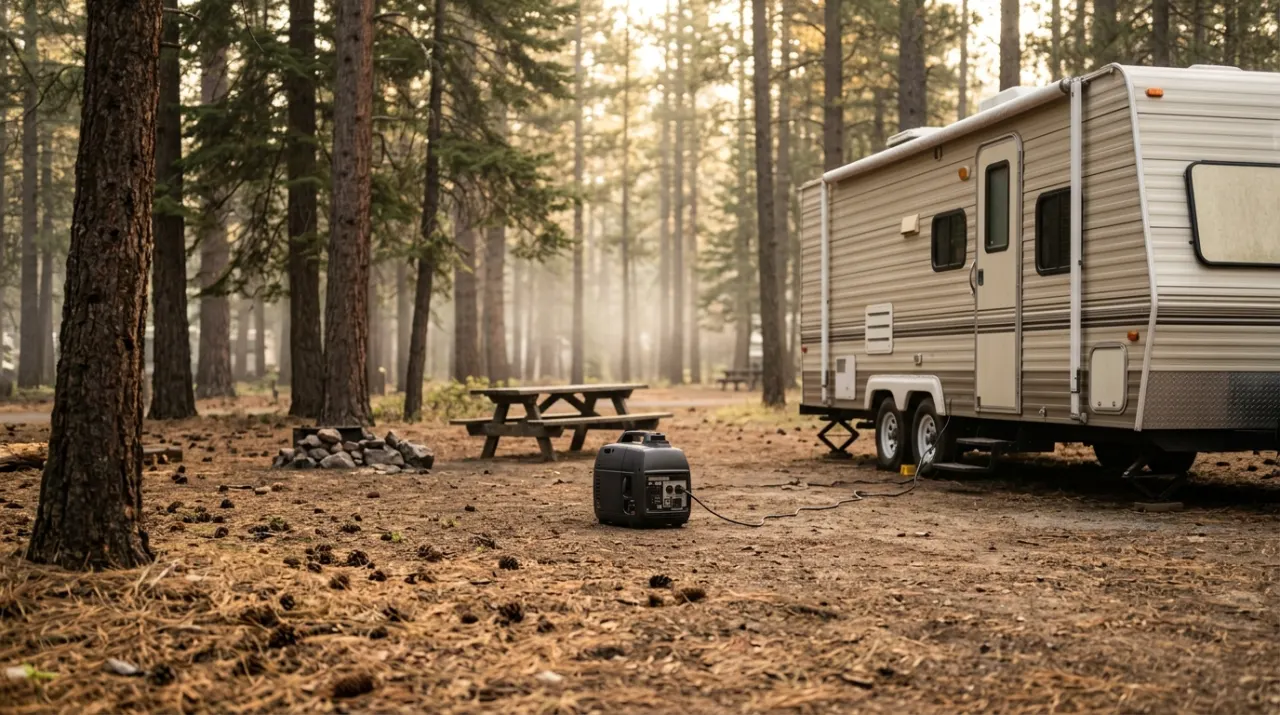
A conventional generator produces 60 Hz AC by spinning its alternator at a fixed 3,600 rpm. Frequency depends directly on engine speed, so the engine cannot slow down no matter how little is plugged in. A generator supplying 300 watts to a refrigerator is turning as fast as one supplying 4,000 watts, and burning a substantial fraction of the same fuel.
An inverter generator produces raw AC, converts it to DC, and rebuilds a clean 60 Hz sine wave electronically. Output frequency no longer depends on engine speed, so the engine is free to drop to idle when demand is light. In economy mode a 5,000-watt inverter supplying a refrigerator and some lights may idle at a fraction of full speed and burn a quarter of a gallon an hour.
Over a three-day outage where the average load is light — which describes most outages, because the fridge cycles and everything else is intermittent — that difference is 20 to 30 gallons. That is not a rounding error when the gas stations in your county have no power to run their pumps.
How much fuel to store, and the legal limit
Fuel planning is where most households get caught out, because the arithmetic scales faster than expected.
| Outage length | 5,000 W at half load | 7,500 W at half load | 9,500 W at half load |
|---|---|---|---|
| 12 hours | ~8 gal | ~11 gal | ~14 gal |
| 24 hours | ~17 gal | ~23 gal | ~29 gal |
| 3 days | ~50 gal | ~68 gal | ~86 gal |
| 7 days | ~118 gal | ~160 gal | ~202 gal |
Those figures assume continuous running, which is the pessimistic case — cycling the generator off for eight hours overnight roughly cuts them by a third and is what most households actually do. Even so, the numbers make the point: gasoline is not a practical medium for storing more than a day or two of generator fuel at home.
Most US jurisdictions adopt fire code provisions limiting residential gasoline storage to around 25 gallons in approved containers, and many limit how much may be kept in an attached garage. Rules differ by state and municipality — check with your local fire marshal rather than assuming. This is the practical reason dual fuel generators dominate the home-backup market: propane stores safely in far larger quantities, does not degrade, and is available in exchange tanks when gas stations are dark.

Propane and natural gas consumption
| Generator size | Propane at half load | 20 lb tank (4.7 gal) lasts | Natural gas at half load |
|---|---|---|---|
| 3,500 W | 0.55 gal/hr | ~8.5 hours | ~50 cu ft/hr |
| 5,000 W | 0.85 gal/hr | ~5.5 hours | ~75 cu ft/hr |
| 7,500 W | 1.30 gal/hr | ~3.6 hours | ~115 cu ft/hr |
| 9,500 W | 1.65 gal/hr | ~2.8 hours | ~145 cu ft/hr |
The 20 lb barbecue tank column is the one that surprises people. A grill tank runs a mid-size generator for an evening, not a night and a day. For genuine multi-day backup on propane you want a 100 lb tank, or a pair of 40 lb tanks with a changeover regulator, or a permanent 250 to 500 gallon tank. Note also that propane vaporization slows sharply below about 20°F, and a small tank in severe cold may not deliver enough vapor to sustain a heavy load.
Natural gas, where a house has a line and a licensed gas fitter has made the connection, removes the problem entirely — supply is continuous and there is nothing to store. The trade-off is roughly 15% less output than gasoline and a professional installation with its own permit.
Six ways to cut fuel consumption
- Load the machine properly. A conventional generator at 50–75% of rating is at its most efficient point per watt delivered. Lightly loaded, it burns fuel producing nothing.
- Use economy mode on an inverter. It is the single biggest lever available and it costs nothing.
- Cycle the generator rather than run it continuously. A well-packed refrigerator holds temperature for several hours with the door shut, so many households run the generator four hours on, four hours off, and cut consumption nearly in half.
- Shed the heating elements. Kettles, coffee makers, space heaters, hair dryers and toasters are 1,200 to 1,800 watts each, and they dominate fuel burn while contributing nothing to keeping the house habitable.
- Keep the air filter clean. A clogged filter richens the mixture and wastes fuel measurably. It is a five-minute check.
- Change the oil on schedule. Degraded oil increases internal friction and consumption, and skipping the change is also how bearings fail.

The fuel problem that costs more than fuel
Consumption is the visible cost of gasoline. The invisible one is what stored gasoline does to the machine. US pump gas is typically E10, containing up to 10% ethanol — a policy consequence of the federal Renewable Fuel Standard, described by the EPA and in the EIA's biofuels explainer. Ethanol is hygroscopic: it absorbs water out of the air, and once enough water is present the mixture separates. Untreated, this begins within about 30 days.
In a carburetor with pilot jets measured in thousandths of an inch, the varnish left behind blocks the fuel path completely. The engine cranks and never fires, and the owner concludes the generator has failed. It has not — it needs a carburetor clean, which is what small-engine shops spend most of hurricane season doing at $90 to $200 a time.
Preventing it costs almost nothing: add a stabilizer at every fill, close the fuel shut-off valve and let the engine run until it stops so the float bowl is empty before storage, and start the machine under load for 20 minutes once a month.

Best for long outages where fuel supply, not capacity, is the real constraint
- 5000 peak / 4500 running watts on gasoline
- Inverter design throttles the engine to match the load
- Dual fuel — propane never goes stale between outages
- Rated around 52 dBA at quarter load
Why buy it: an inverter running at a quarter load can use roughly a third of the fuel a fixed-speed machine burns doing the same work, which over three days is gallons rather than percentages.

Best for every gas can and every generator tank you do not empty immediately
- Treats up to 40 gallons per 16 oz bottle
- Keeps fuel usable for up to 24 months
- Formulated to resist ethanol-related corrosion
- Add at fill time, before the fuel begins to degrade
Why buy it: untreated ethanol-blended gasoline starts breaking down in about 30 days, and the varnish it leaves in a carburetor is the single most common reason a generator will not start.
Where to go next
Size the machine to the load in what size generator do I need, or check the specific case in what a 5,000-watt generator can run. The efficiency difference explained above is covered fully in inverter vs conventional generators, the propane case in best dual fuel generators, and the storage routine in how to store a generator long term. Everything sits under the power tools and workshop hub.
We never buy or physically handle the equipment we write about — verdicts come from aggregated owner reviews, published specifications and manufacturer data. The method is on how we rank. Product links are affiliate links; they earn us a small commission at no cost to you and never change a recommendation.