 Garden


Affiliate Disclosure
Some links on this page are affiliate links. As an Amazon Associate, we earn from qualifying purchases — at no extra cost to you. We do not buy, test, or physically handle the products we cover; our rankings come from aggregated owner reviews, ratings and expert consensus. Commissions never change our verdicts. How we rank · full disclosure.
Most portable generators do not need a ground rod. If the machine is powering tools and appliances through the receptacles on its own control panel — the way essentially every homeowner uses one — both the National Electrical Code and OSHA accept the factory bonding of the frame as the required grounding, and driving a rod adds nothing. The rules change only when the generator feeds a building's wiring through a transfer switch, and at that point the grounding decision belongs to the licensed electrician doing the installation.
What grounding is actually for
Grounding and bonding get conflated constantly, and the distinction is the whole subject.
Bonding means connecting all the metal parts that are not supposed to carry current — the generator frame, the engine, the alternator housing, the ground pin in every receptacle, the metal case of the tool at the end of the cord — into one common conductive path. Its job is to give fault current a low-resistance route back to the source so that a breaker or a GFCI trips fast. This is what protects you from a shock when a hot wire inside a drill touches the drill's metal housing.
Grounding, in the sense of a rod driven into the earth, connects that system to the ground itself. Its job is stabilizing voltage relative to earth and handling lightning and high-voltage surges — not clearing ordinary faults. The earth is a poor conductor compared with a copper wire, and fault current does not preferentially flow into a rod.
That distinction explains the rule. A stand-alone generator is a complete, self-contained electrical system: the source, the conductors and the loads are all bonded together, so a fault has a path and the protective device operates. There is no other system for it to be at a different potential from. Adding a rod does not improve that.

What the codes actually say
Two documents govern this in the United States, and they agree.
The National Electrical Code (NFPA 70), in Article 250, permits the frame of a portable generator to serve as the grounding electrode for a system supplied by that generator, provided the generator supplies only equipment mounted on it and cord-and-plug-connected equipment through receptacles on the generator, and provided the non-current-carrying metal parts of that equipment and the equipment grounding conductor terminals are bonded to the generator frame.
OSHA takes the same position for construction sites in 29 CFR 1926.404(f)(3), which sets out when a portable generator frame may serve as the grounding electrode rather than requiring a separate electrode.
Note that the NEC is a model code. Your state, county or city adopts it — often an older edition, often with local amendments — so the version that legally applies to you is the locally adopted one. Check with your building department when the answer matters.
The situations where it genuinely changes
| How the generator is used | Separate ground rod? | Who decides |
|---|---|---|
| Cords from the generator panel to tools and appliances | No — factory frame bonding is sufficient | Manufacturer manual |
| Camping, RV shore cord, tailgating | No | Manufacturer manual |
| Job site, cord-connected tools only | No | OSHA 1926.404(f)(3) |
| Feeding a house through a transfer switch that does not switch the neutral | No new rod — the building's grounding electrode system serves | Licensed electrician |
| Feeding a house through a transfer switch that does switch the neutral | Treated as a separately derived system — grounding per NEC 250 | Licensed electrician |
| Generator mounted on a vehicle or trailer | Usually bonded to the vehicle frame — follow the manual | Manufacturer manual |

The bonded-neutral question, which matters more
The specification that trips up real installations is not the rod — it is whether the generator's neutral is bonded to its frame.
A bonded-neutral generator connects the neutral conductor to the frame inside the machine. A floating-neutral generator does not. When a generator is used stand-alone with cord-connected loads, bonded neutral is what you want, and it is what most portable generators ship with — it is also what makes the onboard GFCI receptacles function.
When the same generator feeds a house through a typical residential transfer switch, the neutral is not switched: the house neutral and the generator neutral become one conductor, and that neutral is already bonded to ground at the main service panel. A second bond inside the generator creates a parallel path, so normal neutral current returns partly through the equipment grounding conductors — objectionable current that the code specifically prohibits and that can defeat GFCI protection.
The resolution is one of three things, and all of them belong to the electrician: use a floating-neutral generator, remove the generator's bonding jumper per the manufacturer's instructions, or use a transfer switch that switches the neutral. What you can usefully do as the owner is find out which type your generator is — it is in the manual, and often on a label near the panel — and tell your electrician before the transfer switch is selected.
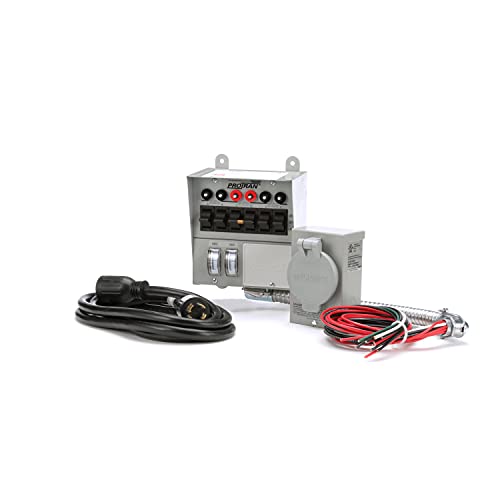
Best for connecting a portable generator to house wiring, installed by a licensed electrician
- 30 amp, six circuits, rated for generators up to 7,500 watts
- Includes the weatherproof power inlet box and a 10-foot cord
- Watt meters so you can balance the load across both legs
- UL listed and NEC compliant when installed correctly
Why buy it: when a generator feeds house wiring, the grounding and neutral-bonding questions are answered by the transfer switch installation — which is precisely why it is licensed work.
What actually protects you, in order
- GFCI protection on the outlets you use. This is the single most effective protection against electrocution from a portable generator, and modern machines increasingly ship with GFCI receptacles. Test them with the test button before relying on them.
- Undamaged, outdoor-rated cords with intact ground pins. The equipment grounding conductor is what carries fault current back to the machine. A cord with a broken ground pin, or a cheater adapter that removes it, disables the protection entirely.
- Dry siting and dry hands. Wet conditions turn a marginal fault into an electrocution, which is covered in can you run a generator in the rain.
- A transfer switch or interlock installed by a licensed electrician, if the generator ever feeds house wiring.
- The factory bonding, left alone. Do not remove or modify the internal bonding jumper except on the instruction of the electrician doing your installation, and per the manufacturer's procedure.
Carbon monoxide. A portable generator emits as much CO as hundreds of cars, and the CPSC links more than 100 US deaths a year to generator carbon monoxide. It is colorless and odorless. Run it outdoors only — never in a garage, basement, shed or under a carport, and an open door does not make it safe — at least 20 feet from the house with exhaust pointed away from doors, windows and vents, and fit CO alarms on every level indoors. See the CPSC Carbon Monoxide Information Center.
Backfeeding. Never plug a generator into a wall outlet to power your house. It energizes the utility line through your transformer and can electrocute a line worker who has confirmed the line is dead. No amount of grounding makes backfeeding safe.

Three grounding myths worth retiring
"A ground rod makes any generator safe." It does not. A rod does not clear faults; the bonded equipment grounding path and the overcurrent device do. A rod on a machine that is already correctly bonded changes nothing, and on a machine feeding house wiring an isolated rod can make the system worse.
"Grounding to a metal water pipe or a fence post works." Modern water services are often plastic for part of their run, and a fence post is not a grounding electrode. Improvised electrodes give a false sense of protection.
"If my generator has a grounding lug, I am required to use it." The lug is provided for the installations that require it. Whether yours does is determined by how the machine is used, and the manufacturer's manual states the condition explicitly. Read the manual for your model — the answer for your machine is in it.
Where to go next
The connection question this most often accompanies is answered in how to connect a generator to your house. Wet-weather operation is in can you run a generator in the rain, cords and their ratings in best generator extension cords, and machine selection in best generators for home backup. Everything sits under the power tools and workshop hub.
This page is general information, not electrical design advice. Grounding and bonding requirements depend on your specific installation and on the code edition your jurisdiction has adopted — consult a licensed electrician. We never buy or physically handle the equipment we write about; the method is on how we rank.