 Garden

Affiliate Disclosure
Some links on this page are affiliate links. As an Amazon Associate, we earn from qualifying purchases — at no extra cost to you. We do not buy, test, or physically handle the products we cover; our rankings come from aggregated owner reviews, ratings and expert consensus. Commissions never change our verdicts. How we rank · full disclosure.
To use a circular saw safely, set the blade depth so only about a quarter inch shows below the wood, support the workpiece so the offcut falls away freely, clamp everything down, wear eye and ear protection, and keep both hands on the saw while it reaches full speed before it touches the material. The single biggest hazard is kickback, the saw lurching backward when the blade pinches, and nearly all of it is prevented by correct support and a sharp blade. Get those habits right and a circular saw is a safe, versatile tool.
We do not physically operate the saws we cover; our guidance draws on manufacturer safety instructions, OSHA and CPSC guidance, and the consensus of experienced tradespeople, consistent with how we rank. Read the setup and technique sections before your first cut.
Protective gear and workspace setup
Before the saw ever spins, get yourself and your space ready. This part takes two minutes and prevents the injuries that cannot be undone.
- Safety glasses or goggles, always. A circular saw throws chips and dust straight up and back.
- Hearing protection. These saws routinely exceed 100 decibels; the CPSC and NIOSH treat sustained exposure at that level as hazardous.
- A dust mask for MDF, treated lumber, or long sessions.
- No loose clothing, gloves, jewelry, or dangling sleeves. Gloves are debated, but loose fabric that can catch a spinning blade is not; keep it clear.
- A stable, uncluttered work area with the cut fully supported and the cord routed behind you so you cannot cut it or trip on it.
- Good light so you can see the cut line clearly.
Understanding and preventing circular saw kickback
Kickback is the reason to take this tool seriously. It happens when the blade binds and the saw's own power drives it violently back toward the operator, often in a fraction of a second. It is the leading cause of serious circular saw injuries, and it is almost entirely preventable.
| Cause of kickback | Prevention |
|---|---|
| Offcut cannot fall away, so the kerf pinches the blade | Support the piece so the waste side is free to drop |
| Board supported only at the ends and it sags in the middle | Never bridge a cut between two sawhorses; support close to both sides of the line, or cut on foam |
| Warped or wet lumber closes the kerf | Use a thin-kerf blade, insert a shim in the kerf, or make relief cuts |
| Dull or dirty blade forces the saw | Keep a sharp, clean blade; let the saw do the work |
| Twisting the saw off the cut line | Keep the saw straight; do not force a curved correction |
Modern saws include a lower blade guard and often an electric brake; never wedge the guard open, and let the brake stop the blade before you set the saw down.
Setting the circular saw blade depth correctly
Blade depth is a safety setting, not just a preference. The goal is for the blade to protrude only about a quarter inch, roughly one full tooth, below the material.
- Unplug the saw or remove the battery. Every blade adjustment starts here.
- Rest the saw alongside the board with the blade next to the edge and the guard retracted by hand.
- Loosen the depth-adjustment lever and pivot the shoe until the lowest tooth sits about a quarter inch below the bottom face.
- Lock the lever and confirm it is tight.
A shallow blade exposes less of the spinning edge, produces less kickback energy, and cuts cleaner. For how deep various saws can cut and blade-change steps, see how deep can a circular saw cut and how to change a circular saw blade.
Supporting and clamping the workpiece
How you hold the wood matters more than how you hold the saw. The workpiece must be stable and set up so the offcut falls away. Two approaches cover almost everything.
- For boards: clamp the piece to a workbench or a pair of sawhorses so the offcut hangs off the far edge and drops free. Do not support the board only at both ends with the cut in the middle, since the two halves sag and pinch the blade.
- For sheet goods (plywood, OSB): lay the full sheet on a sheet of rigid foam insulation on the floor and cut right through into the foam with a shallow blade. The whole sheet is supported, nothing can pinch, and there is nothing to shift.
Clamping frees both hands for the saw and keeps your fingers away from the blade path.
Making a clean, safe cut
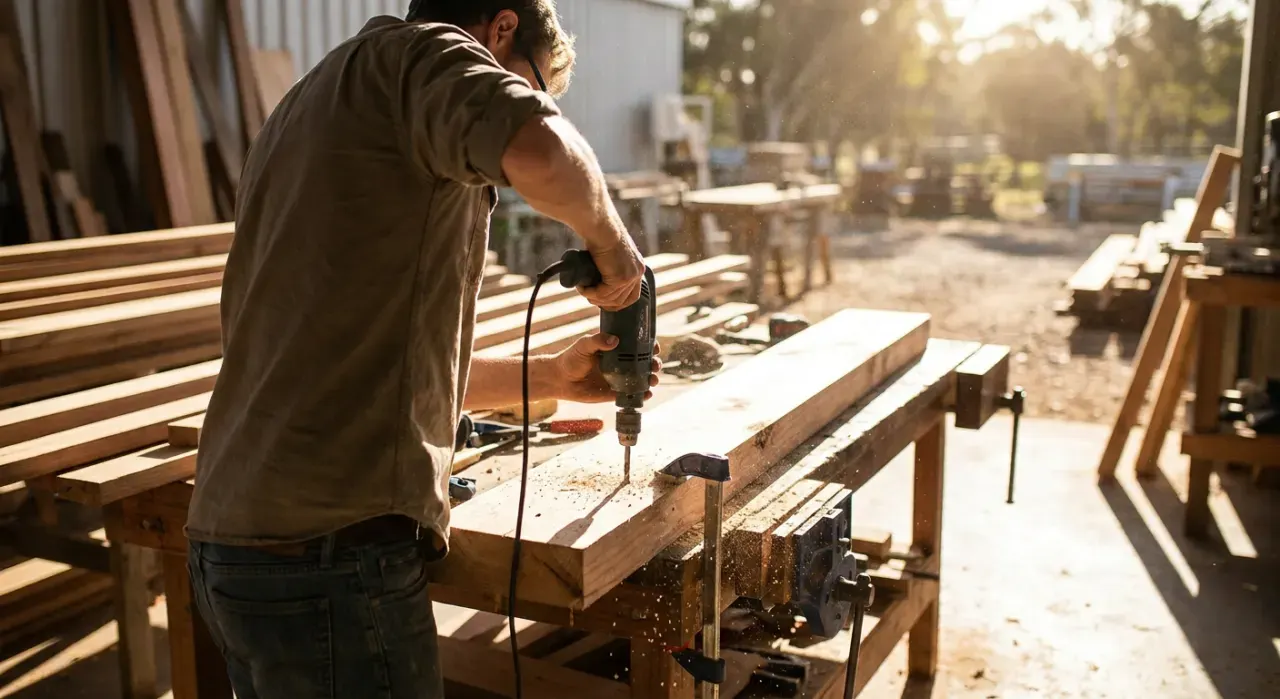
With the setup right, the cut itself is straightforward. Rushing is the enemy; a steady pace at full blade speed gives the safest and cleanest result.
- Mark your line and align the saw's baseplate notch or line indicator to it. For straight cuts, clamp a straightedge as a guide; see how to cut a straight line with a circular saw.
- Put the good face down, because tear-out happens on the top.
- Rest the front of the shoe on the board with the blade clear of the wood, and grip firmly with both hands.
- Squeeze the trigger and let the blade reach full speed before advancing it into the wood.
- Push at a steady, moderate pace, following the line without forcing or twisting. If the motor bogs down, ease off; do not shove.
- Keep the shoe flat on the surface through the whole cut.
- Release the trigger at the end, let the blade and brake stop completely, and only then lift the saw.
Common circular saw mistakes to avoid
Most first-timer trouble comes from a short list of avoidable errors. Know them and you skip the hard lessons.
- Bridging the cut between two supports so the board pinches the blade. The most common kickback setup.
- Setting the blade too deep, exposing more blade and increasing kickback force.
- Not letting the blade reach full speed before it enters the wood, which bogs the motor and can bind.
- Wedging the blade guard open for convenience, leaving the blade exposed when you set the saw down.
- Reaching under the saw or across the blade path mid-cut.
- Cutting freehand when accuracy matters; a clamped guide is safer and straighter. A speed square helps with short crosscuts, see how to square cuts with a speed square.
Pick the right saw for the work in best circular saw, weigh the power options in corded vs cordless circular saw, and browse more guides at the power tools and workshop hub. Our recommendations come from owner-review analysis and expert consensus, never bench testing, as explained in how we rank.