 Garden


Affiliate Disclosure
Some links on this page are affiliate links. As an Amazon Associate, we earn from qualifying purchases — at no extra cost to you. We do not buy, test, or physically handle the products we cover; our rankings come from aggregated owner reviews, ratings and expert consensus. Commissions never change our verdicts. How we rank · full disclosure.
The short version: the best chainsaw for firewood is the Husqvarna 455 Rancher — a 55cc engine and a 20 in. bar, which is what repetitive full-depth cutting actually demands. If you burn one or two cords a year and would rather not maintain a two-stroke, the Greenworks 80V or the EGO CS1804 both buck rounds properly. The 16 in. saw you already own will do it too — slowly, hot, and with a chain you will be sharpening constantly.
Firewood is a different job from yard cleanup and it is worth being clear why. Limbing means short cuts with the bar partly loaded. Bucking means hundreds of cuts with the bar completely buried in the wood, one after another, often in seasoned hardwood that is far harder than the green limbs a saw is happiest in. That sustained, full-depth load is the hardest thing you can ask a chainsaw to do, and it is where the difference between a 38cc saw and a 55cc saw stops being a number on a box.
The whole field is at best chainsaw, and if you are still deciding on power source read battery vs gas chainsaw. Everything else is at the pruning, trimming and hedges hub.
Top Picks at a Glance
Our #1 Pick: Husqvarna 455 Rancher
The 455 Rancher has been the default homeowner-to-semi-pro firewood saw for two decades, and the reason is the class it sits in. Fifty-five cubic centimeters producing around 3.5 HP is enough displacement to hold chain speed with the bar fully buried in a seasoned oak round — the point where a 38cc saw is audibly struggling and a 40V battery saw has slowed to a crawl. A 20 in. bar handles rounds to roughly 18 in. in one pass, which covers most of what a woodlot produces.
Consensus Score ████████░░ 8.6 — the reference firewood saw, with a very deep review history
Two features earn their place on a firewood saw specifically. Air Injection centrifugal air cleaning flings the bulk of the sawdust out before it reaches the filter, which matters when you are producing dust continuously for hours rather than in short bursts — a clogged filter is what makes a saw run rich and lose power mid-afternoon. And the side-mounted chain tensioner means adjustments take seconds, which you will do repeatedly, because firewood cutting stretches chains.
The recurring criticisms are consistent and mostly about ownership rather than cutting. Starting after storage dominates the negative reviews, and stale ethanol fuel is behind nearly all of it. Carburetor adjustment and fuel-line degradation appear in years two and three. It is heavy at roughly 13 lb dry and noticeably front-biased with a 20 in. bar, which tells over a long session. It is loud enough that hearing protection is not optional. And owners report the oiler needing adjustment upward for the 20 in. bar.
Check price on Amazon → (paid link)
Best Firewood Chainsaws 2026: The Ranked Field

Best for several cords a year, bucking rounds all day without a charging break
- 55cc X-Torq two-stroke producing around 3.5 HP
- 20 in. bar handling rounds to roughly 18 in.
- Inertia-activated chain brake and side-mounted chain tensioner
- Air Injection centrifugal air cleaning for long filter intervals
Why buy it: firewood is repetitive full-depth cutting, and only a 55cc-class engine holds chain speed through hundreds of buried-bar cuts.

Best for one to three cords a year with a lighter saw than the 455
- 50.2cc X-Torq engine, around 3.2 HP
- 20 in. bar with an automatic oiler
- Inertia chain brake and combined choke and stop control
- Lighter in the hand than the 455 for the same bar length
Why buy it: it gives you the same 20 in. reach with a few pounds less to carry, which matters over an afternoon of bucking.

Best for a cord or two a year without a two-stroke engine to maintain
- 80V brushless motor for torque in thick timber
- 18 in. bar for larger diameter rounds
- Rapid charger to reduce the gap between packs
- Tool-free chain tensioning
Why buy it: the 80V platform holds torque through a full-depth cut in seasoned hardwood, which is precisely where 40V saws stall.

Best for modest firewood plus everything else a property needs cutting
- 18 in. bar on a brushless 56V motor rated near a 45cc gas saw
- Chain speed around 11,000 RPM
- Tool-free tensioning and an automatic oiler
- 5.0Ah battery and charger included
Why buy it: it does real firewood work and still starts instantly for the storm limb in March, which a dedicated gas saw often will not.
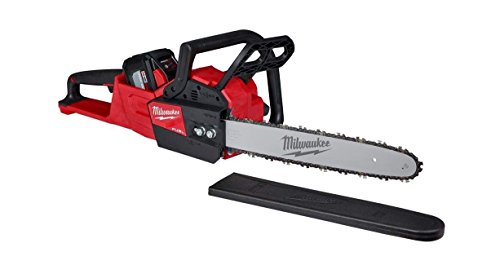
Best for bucking smaller rounds on an existing Milwaukee battery platform
- 16 in. Oregon bar and chain, brushless POWERSTATE motor
- Rated by Milwaukee against gas engines up to around 40cc
- Variable-speed trigger and automatic oiler
- Bare tool — uses existing M18 high-output packs
Why buy it: the variable-speed trigger gives real control starting a cut on a round that wants to roll, which is where saws skate.

Best for occasional firewood and general property cutting on a budget
- 38cc X-Torq two-stroke, around 1.8 HP
- 16 in. bar with an automatic oiler
- Inertia-activated chain brake
- Combined choke and stop control to simplify starting
Why buy it: it is the cheapest route into gas endurance, and endurance is the whole reason to use gas for firewood.
Quick Comparison
| Product | Best for | Rating | Price | Buy |
|---|---|---|---|---|
| Husqvarna 455 Rancher Gas Chainsaw 55-cc 3.5-HP 2-Cycle X-Torq Engine 20 Inch with Automatic Oiler | Best Overall | — | Check (paid link) | |
| Husqvarna 450 Rancher 20 Inch Gas Chainsaw 50.2-cc 3.2-HP 2-Cycle X-Torq Engine | Best Mid-Size Gas | — | Check (paid link) | |
| Greenworks 80V 18 in Brushless Cordless Chainsaw with 2.0Ah Battery and Rapid Charger | Best Cordless for Firewood | — | Check (paid link) | |
| EGO POWER+ Chain Saw 18 in Battery Powered Cordless with 56V 5.0Ah Battery and Charger CS1804 | Best All-Rounder | — | Check (paid link) | |
| Milwaukee 2727-20 M18 FUEL 16 in Cordless Chainsaw Bare Tool | Best for M18 Owners | — | Check (paid link) | |
| Husqvarna 120 Gas Powered Chainsaw 38-cc 2-Cycle X-Torq Engine 16 Inch | Best Budget Gas | — | Check (paid link) |
How We Rank
We do not buy or physically handle these saws. Rankings come from aggregating star ratings and review volume across large owner-review sets, weighting recent reviews above launch-window ones, checking displacements, bar lengths, weights, chain speeds and safety features against manufacturer documentation, and reading negative reviews closely — with particular attention to reviews that describe firewood volume rather than occasional yard use, since those are the ones that reveal how a saw behaves under sustained load.
Four factors set the order. Sustained torque with the bar buried, the defining demand of bucking. Endurance — how long you can work before refuelling, recharging or letting the tool cool. Bar length matched to round diameter. And owner satisfaction weighted by review volume. Prices were checked at the time of writing. Full method: how we rank.
The Saws, Reviewed
1. Husqvarna 455 Rancher — Best Overall
Covered above. Consensus Score ████████░░ 8.6. Strengths: 55cc of displacement that does not fade under sustained load; a 20 in. bar; Air Injection filtration built for dusty continuous work; a side-mounted tensioner; and an inertia chain brake. Recurring complaints: starting after storage on stale fuel; carburetor and fuel-line issues in years two and three; heavy and front-biased; very loud; and an oiler needing adjustment for the long bar.
2. Husqvarna 450 Rancher — Best Mid-Size Gas
The saw for people who want the 20 in. reach without the 455's weight. Fifty cubic centimeters and around 3.2 HP is a small step down on paper and a noticeable one in the hand, and for one to three cords a year the difference in cutting speed is smaller than the difference in how tired you are at the end. Same X-Torq engine family, same inertia brake, same combined choke and stop control.
Consensus Score ████████░░ 8.3 — strong ratings, often chosen over the 455 on weight
Recurring complaints: it is working harder than the 455 in large hardwood rounds and owners cutting big timber notice. The same stale-fuel starting complaints appear. Several report the chain oiler being marginal for a 20 in. bar. Vibration is high over long sessions. And it is only modestly cheaper than the 455, which makes the choice genuinely about weight rather than money.
3. Greenworks 80V 18 in — Best Cordless for Firewood
The battery saw that can actually do this work. Voltage is a proxy for available torque, and 80V is what keeps the chain moving when the bar is fully buried in a hardwood round rather than bogging into a polish. An 18 in. bar handles most firewood diameters, and the rapid charger narrows the gap between packs — though it does not close it.
Consensus Score ████████░░ 8.0 — good ratings, with battery capacity the hard constraint
Recurring complaints: the 2.0Ah pack supplied is badly undersized for firewood work and owners consistently report very short runtimes, so a larger battery is effectively part of the purchase. The 80V range is narrow, so battery sharing is limited. It is heavy. Several rate the supplied bar and chain below the saw. And 80V packs are expensive to replace.
4. EGO POWER+ CS1804 — Best All-Rounder
The compromise that suits most properties. It is not the fastest firewood saw here, but it bucks rounds properly with an 18 in. bar and a 56V brushless motor owners repeatedly compare to a 45cc gas machine — and then it starts instantly in March for the storm limb, which a gas saw stored badly very often will not. If firewood is part of what you do rather than all of it, this is the sensible saw.
Consensus Score ████████░░ 8.8 — the highest-rated saw in this list, within its endurance limits
Recurring complaints: runtime is the limit for firewood volume and a second 5.0Ah pack is close to essential. It is heavy at arm's length. Owners report the oiler over-delivering and pooling in storage. New chains need frequent early tensioning. And it costs gas-saw money without gas-saw endurance.
5. Milwaukee M18 FUEL 2727-20 — Best for M18 Owners
The right answer if your shop already runs on M18. Milwaukee rates it against gas engines up to roughly 40cc, and the variable-speed trigger is the feature that matters for firewood specifically: starting a cut gently on a round that wants to roll, then bringing the chain up to speed, is far more controlled than a saw with only on and off.
Consensus Score ████████░░ 8.7 — excellent ratings, sold as a bare tool
Recurring complaints: the 16 in. bar limits it on larger rounds. It drains smaller M18 packs very quickly under bucking loads, so high-output batteries are effectively required. It is a bare tool, so the real cost includes battery and charger. Several owners describe the oiler as over-generous. And it is expensive for a 16 in. saw if you own no M18 tools.
6. Husqvarna 120 — Best Budget Gas
Included because endurance is the reason to buy gas, and this is the cheapest way to get it. A 38cc X-Torq engine with a 16 in. bar is not a serious firewood machine, but it refuels in fifteen seconds and will keep going all afternoon, which no battery saw at this price will. For a homeowner cutting a cord a year from smaller wood, that trade is defensible.
Consensus Score ████████░░ 8.1 — solid ratings, held back by maintenance and power
Recurring complaints: it is underpowered for large seasoned rounds and owners who bought it for serious firewood rate it poorly. Starting problems after storage dominate the negative reviews. Carburetor and fuel-line issues appear early. It is loud and vibrates heavily. And the 16 in. bar means repositioning constantly on anything substantial.
How to Choose a Firewood Chainsaw
Count your cords honestly. Under two cords a year, a good battery saw with two packs is the easier tool and you will use it more. Above two cords, the charging cycle becomes the bottleneck and gas is both faster and cheaper. Above four or five cords, you want a 55 to 60cc saw and a proper log stand.
Match the bar to your rounds, plus two inches. Most firewood is under 16 in. across, so an 18 in. bar covers it in one pass. Twenty inches is for larger rounds. Do not buy 24 in. for the occasional big log — cut those from two sides or hire it done. Sizing detail is in what size chainsaw do I need.
Weigh torque above chain speed. Headline chain speeds are measured unloaded. What matters for bucking is whether the saw holds that speed with the bar buried, which comes from engine displacement or motor voltage, not from RPM claims.
Budget for chains and sharpening. Firewood dulls chains faster than any other work, because rounds sit on the ground and the last inch of every cut reaches dirt. Buy two or three spare chains, learn to file, or get a bench sharpener — see how to sharpen a chainsaw chain and best chainsaw sharpener.
Bucking safely: technique that prevents the common injuries
Get the wood off the ground. A sawhorse or a log stand keeps the bar out of the soil, which saves your chain, and it lets you control how the round moves as it separates. Cutting rounds lying loose on the ground is how bars get pinched and how saws end up in the dirt.
Read the tension before every cut. A log supported at both ends is in compression on top and tension underneath — cut about a third from the top, then finish from below, or the kerf closes and pinches the bar. A log supported at one end only is the reverse: cut a third from underneath, then finish from the top. A pinched bar in a log under load is one of the most common ways a saw gets thrown.
Never cut a round that can roll toward you, never stand downhill of the piece you are cutting, and never hold or steady a piece with your foot or your free hand. Chock rounds on a slope before touching them.
Safety: Volume Work Multiplies Every Risk
Firewood cutting is where fatigue, repetition and complacency all compound, and it produces a disproportionate share of chainsaw injuries. Kickback remains the mechanism: when the upper quadrant of the bar nose contacts wood or any solid object — including the ground, another round, or a limb you did not see — the chain cannot pull through and drives the bar back and up toward the operator's head and shoulder in a fraction of a second. Never cut with the nose; keep the tip in view; wrap the thumb of your leading hand fully under the front handle; stand slightly to the side of the cutting line; and keep the chain sharp and correctly tensioned, because a dull or slack chain grabs. Confirm the chain brake works before every session. See what causes chainsaw kickback.
OSHA lists a hard hat, safety glasses, hearing protection, heavy gloves, cut-resistant chaps and boots covering the ankle as standard chainsaw kit, and a full day of bucking is exactly when all of it earns its keep — see best chainsaw chaps. Gas saws in this class exceed NIOSH's 85-decibel eight-hour exposure limit immediately, so hearing protection is mandatory rather than advisable. Never cut from a ladder or above shoulder height. Stop when you are tired — the last cut of the day is a common injury. And leave standing timber alone unless you know how to fell: leaning, split, hollow or storm-loaded trees and anything within 10 feet of a power line belong to a certified arborist, where OSHA bars unqualified people entirely. If you do fell small trees yourself, read how to fell a small tree first.
The Verdict
If firewood is a real part of your year, buy the Husqvarna 455 Rancher and accept the fuel routine that comes with it — 55cc and a 20 in. bar is the class this work wants. Take the 450 Rancher if the weight of the 455 puts you off and your rounds are moderate. If you burn a cord or two and would rather never touch a carburetor, the Greenworks 80V and the EGO CS1804 both do the job, with a second battery and realistic expectations about session length. Milwaukee owners should look at the M18 FUEL before buying into anything new, and the Husqvarna 120 is the cheapest honest route to gas endurance for smaller wood.
Then spend the next hundred dollars on chaps, hearing protection and a helmet with a face screen. Firewood days are long, and long days are when people get hurt.
Check price on Amazon → (paid link)
Next: compare the power sources at battery vs gas chainsaw, choose brands at Stihl vs Husqvarna, keep the fuel fresh with how to mix 2-stroke fuel, or browse more at tools.