 Garden
Affiliate Disclosure
Some links on this page are affiliate links. As an Amazon Associate, we earn from qualifying purchases — at no extra cost to you. We do not buy, test, or physically handle the products we cover; our rankings come from aggregated owner reviews, ratings and expert consensus. Commissions never change our verdicts. How we rank · full disclosure.
The short version: the best chainsaw sharpener for most people is the Oregon 410-120 bench grinder. It sets the same angle on every cutter, which is what makes a chain pull straight and cut fast, and it restores a chain that has been rocked far quicker than any file. For field touch-ups the STIHL 2-in-1 Easy File is the better tool and costs a quarter as much — it sharpens the cutter and lowers the depth gauge in one guided stroke, which is the step nearly everyone skips.
Most people who think their chainsaw is worn out have a blunt chain and uneven depth gauges. A properly sharpened chain pulls itself into the wood and throws chips; a dull one produces dust, needs pushing, overheats the bar and burns through fuel. That difference is worth more than any upgrade to the saw itself — see best chainsaw for home use for the tools themselves. The same principle applies across the shed, from loppers to hedge trimmer blades. Everything else is at the pruning, trimming and hedges hub.
Top Picks at a Glance
Our #1 Pick: Oregon 410-120 Bench Grinder
The problem with freehand filing is not that a file cannot sharpen a tooth — it is that a chain has sixty or seventy teeth and a human hand will not put the identical angle on all of them. Cutters that end up longer on one side make the saw curve. Cutters at inconsistent top-plate angles make it cut slowly and vibrate. A bench grinder solves both by mechanically enforcing the same three angles on every cutter and grinding each one to the same length.
Consensus Score ████████░░ 8.6 — owners consistently report chains cutting better than new after learning the setup
This model mounts to a bench or a wall, adjusts for top-plate angle and tilt, and takes chains up to .404 inch pitch from any manufacturer — Oregon, STIHL, Husqvarna and the rest. The chain vice indexes each cutter against a stop so you are not eyeballing depth, and a built-in light means you can actually see what the wheel is doing. Grinding wheels for common pitches are included, with others available separately.
The practical gain is speed on a damaged chain. A chain that has touched dirt or a fence staple has a few badly rounded cutters, and restoring those by file means many minutes of work per tooth and then filing every other tooth back to match. A grinder takes the whole chain down to the shortest cutter in a few minutes, which is the difference between fixing a chain and buying a new one.
The recurring criticisms are worth knowing. The learning curve is real, and owners consistently report their first two or three chains being worse than before they started — this is a tool that rewards reading the manual properly. Over-grinding is easy and burns the temper out of the cutter, leaving a blue tooth that goes dull almost immediately; light passes and a cool chain are the fix. The included wheels wear and need dressing and replacing. The vice is described as having some flex under pressure. And the mounting is only as rigid as the bench you put it on.
Check price on Amazon → (paid link)
Best Chainsaw Sharpeners 2026: The Ranked Field

Best for anyone sharpening more than a couple of chains a season and wanting repeatable angles
- Bench or wall mounted with adjustable top-plate and tilt angles
- Sharpens chains up to .404 in. pitch from any manufacturer
- Built-in light and a chain vice that indexes each cutter
- Ships with grinding wheels for common chain pitches
Why buy it: a bench grinder sets the same angle on every tooth, which is the one thing hand filing almost never achieves across a whole chain.

Best for touching up a chain in the field, on the bar, in two minutes
- Sharpens the cutter and lowers the depth gauge in one stroke
- Two round files and one flat file in a guided holder
- Sets the correct top-plate angle automatically
- Works with the bar mounted on the saw
Why buy it: doing the cutter and the depth gauge in one pass is what keeps a chain cutting properly, and almost nobody files depth gauges otherwise.
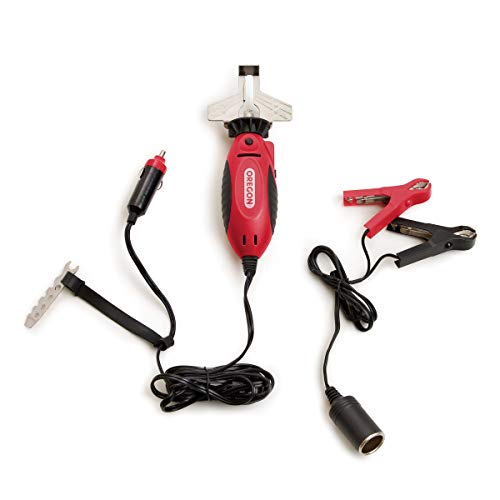
Best for sharpening in the field from a vehicle battery
- Runs from a 12V vehicle battery via a 16 ft cable
- Handheld grinder with a guide for consistent angles
- Sharpens and dresses depth gauges
- Compact enough for a truck toolbox
Why buy it: a powered grinder that runs off a truck battery means a blunted chain does not end the day in the woods.

Best for sharpening precisely without removing the chain from the saw
- Clamps to the bar and indexes along the chain
- 12V motor running at high grinding speed
- Repeatable angle settings for every cutter
- Works on chain still fitted to the saw
Why buy it: mounting to the bar gives you grinder precision without breaking the chain off the saw every time it dulls.

Best for a home workshop sharpening a few chains a year
- 230-watt motor with three grinding wheels included
- Bench or wall mounting
- Adjustable chain vice and angle settings
- Covers the common home-user chain pitches
Why buy it: it brings bench-grinder consistency within reach of a homeowner budget, which is the main barrier to sharpening properly.
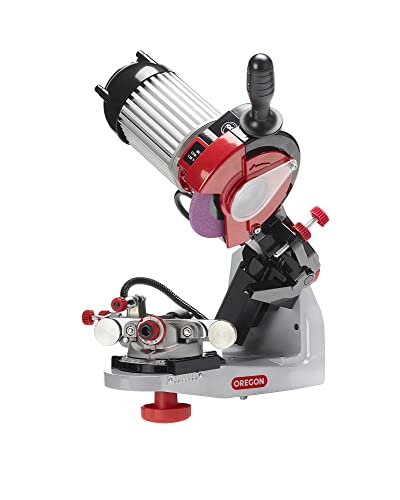
Best for high-volume sharpening where setup speed per chain matters
- Hydraulic chain clamping for fast, secure indexing
- Full angle adjustment on all three planes
- Heavy cast construction that resists flex under load
- Handles the full range of chain pitches
Why buy it: hydraulic clamping removes the fiddliest part of grinding, which is what makes sharpening a dozen chains an afternoon rather than a day.

Quick Comparison
| Product | Best for | Rating | Price | Buy |
|---|---|---|---|---|
| Oregon Professional Compact 120-Volt Bench Grinder Universal Saw Chain Sharpener 410-120 | Best Overall | — | Check (paid link) | |
| Stihl 2 in 1 Easy File Chainsaw Chain Sharpener 3/8 | Best Value | — | Check (paid link) | |
| Oregon 12V Sure Sharp Handheld Electric Chainsaw Chain Grinder Sharpener 575214 | Best Portable | — | Check (paid link) | |
| Granberg G1012XT Chainsaw Sharpener 12V Electric Bar-Mounted Grinder | Best Bar-Mounted | — | Check (paid link) | |
| Timber Tuff Electric Chainsaw Sharpener Upright Bench and Wall Mount CS-BWM | Best Budget Bench | — | Check (paid link) | |
| Oregon Professional 120-Volt Bench Grinder with Hydraulic Clamping Saw Chain Sharpener 620-120 | Best Premium | — | Check (paid link) |
How We Rank
We do not buy or physically handle these tools. Rankings come from aggregating star ratings and review volume across large owner-review sets, weighting recent reviews above older ones, checking stated chain pitch compatibility, angle adjustment ranges, motor specifications and included wheels against manufacturer documentation, and reading negative reviews closely. In this category the negative reviews split usefully into genuine build problems and technique problems, and the technique problems tell you a great deal about how steep a tool's learning curve is.
Four factors set the order. Angle repeatability, since consistency across every cutter is the entire point of a sharpener. Speed of restoring a damaged chain, which is where grinders separate from files. Whether the tool handles depth gauges, because a sharpener that ignores them leaves the job half done. And owner satisfaction, weighted by review volume and read with attention to how much chainsaw experience the reviewer describes. Prices were checked at the time of writing. Full method: how we rank.
The Sharpeners, Reviewed
1. Oregon 410-120 Bench Grinder — Best Overall
Covered above. Consensus Score ████████░░ 8.6. Strengths: repeatable angles on every cutter; grinds all cutters to a common length so the saw cuts straight; handles chains to .404 in. from any brand; indexed chain vice and integral light; and it restores a rocked chain in minutes. Recurring complaints: a genuine learning curve with the first chains often coming out worse; easy to over-grind and burn the temper out of a cutter; wheels wear and need dressing; some flex in the vice; and it needs a rigid bench to perform.
2. STIHL 2-in-1 Easy File — Best Value
The most useful forty-five dollars in this list, and the highest-rated product in the roundup. It holds two round files against the cutters and a flat file against the depth gauge simultaneously, so a single stroke sharpens the tooth and takes the raker down proportionally. That is the whole trick: depth gauges are what most people never touch, and a chain with high rakers stops cutting even when the teeth are razor sharp.
Consensus Score █████████░ 9.0 — the best-rated item here, and widely described as transformative by first-time filers
Recurring complaints: it is pitch-specific, and buying the wrong version for your chain makes it useless — check whether you need 3/8, 3/8 P or .325 before ordering. The files wear and are consumable. Owners report it being slow on a badly damaged chain, where a grinder is the right tool. Several describe the guide as awkward on tight bars. And it is expensive for what is fundamentally a file holder.
3. Oregon 12V Sure Sharp — Best Portable
The field solution. It runs off a 12V vehicle battery through a 16 ft lead, so you can sharpen at the truck rather than driving home, and it grinds rather than files, which means it handles a rocked chain far better than a hand file would. It sharpens cutters and dresses depth gauges, and it packs into a toolbox.
Consensus Score ███████░░░ 7.5 — good ratings for portability, weaker on precision
Recurring complaints: as a handheld it is far less precise than a bench grinder, and owners report struggling to keep angles consistent. The 12V motor is described as underpowered on hard chain. Several reviewers report the grinding stones wearing quickly. And it needs a vehicle battery, so it is genuinely portable only in the sense that a truck is.
4. Granberg G1012XT — Best Bar-Mounted
An interesting middle path. It clamps to the bar and indexes along the chain, so you get mechanically repeatable angles without removing the chain from the saw. For anyone who dislikes breaking a chain off, wrestling it into a grinder vice and refitting it, that saved step is the whole appeal, and Granberg has been making versions of this design for decades.
Consensus Score ███████░░░ 7.9 — well regarded, with setup time the main criticism
Recurring complaints: setup is fiddly and owners report the first few uses taking far longer than expected. The clamp does not fit every bar shape. Several reviewers describe the 12V motor as slow compared with a mains bench grinder. Grinding stones are consumable and small. And it still needs a power source, which limits genuine field use.
5. Timber Tuff CS-BWM — Best Budget Bench
The cheapest route to bench-grinder consistency, and for a homeowner sharpening three or four chains a year that is a reasonable trade. A 230-watt motor with three grinding wheels included, an adjustable chain vice and angle settings, and bench or wall mounting. It covers the common home-user pitches and does the fundamental job of setting every tooth the same.
Consensus Score ███████░░░ 7.3 — decent ratings for the money, with build quality the compromise
Recurring complaints: build quality is the theme — owners report flex in the vice and the arm, plates that will not stay in adjustment, and plastic components where the Oregon uses metal. The included wheels are described as low quality and many owners replace them. Several reviewers report the angle markings being inaccurate out of the box. And it is noticeably slower than the professional grinders.
6. Oregon 620-120 Hydraulic — Best Premium
The volume tool. Hydraulic clamping grips and releases the chain quickly, which removes the fiddliest and slowest part of bench grinding, and full adjustment on all three planes means you can dial in any chain geometry precisely. Heavy cast construction resists the flex that makes cheaper grinders inconsistent under pressure.
Consensus Score ████████░░ 8.5 — excellent ratings, justified only by volume
Recurring complaints: price is the obvious barrier, and for a homeowner sharpening a handful of chains it is not defensible. It is heavy and needs a permanent bench position. Owners report the hydraulic clamp needing occasional adjustment. And the same over-grinding risk applies — a more capable grinder removes metal faster, which cuts both ways.
How to Choose a Chainsaw Sharpener
Start by matching the tool to how you actually work. If you cut a cord of firewood a year and touch the chain up between tanks, a guided hand file is the right answer and a bench grinder will sit unused. If you cut regularly, hit dirt occasionally, or own several saws and multiple chains, a bench grinder pays for itself in chains you did not have to replace. Many people sensibly own both.
Check the chain pitch before you buy anything. Chain pitch — commonly 3/8 inch, 3/8 low profile, .325 inch or .404 inch — determines the file diameter and the grinding wheel width you need, and a guide bought for the wrong pitch is worthless. The pitch is stamped on the drive links or printed on the chain packaging, and it is also in the saw manual.
Do not ignore depth gauges. Every sharpening shortens the cutter slightly, which raises the depth gauge relative to it and reduces the bite. After roughly every third sharpening, check the gauges with a proper depth-gauge tool, file them down flush and round the leading edge so they do not catch. Filing them too low is genuinely dangerous — it makes the chain grab and dramatically increases kickback, which OSHA describes as the chain catching at the tip of the bar.
Finally, work safely. Wear eye protection and gloves whenever you handle or grind a chain, since cutters are sharp enough to open a finger and grinding throws hot particles — the CDC sets out the full protective kit for chain saw work. Disconnect the spark plug on a gas saw or remove the battery on a cordless one before touching the chain. Take light grinding passes and keep the cutter cool — a cutter that turns blue has lost its temper and will go dull almost immediately. And follow your saw manufacturer's specified angles rather than a generic setting, because chain geometry varies by chain type and using the wrong angle produces a chain that cuts poorly and behaves unpredictably.
What Owners Actually Complain About
The learning curve is the loudest complaint about every grinder in this category, and it is legitimate. Owners consistently describe ruining a chain or two while working out angles, depth stops and how light a pass should be. Practising on an old chain before touching a good one saves real money.
Over-grinding and burnt cutters is the specific failure that follows. Too much pressure or too long on the wheel overheats the cutter, turns it blue, and destroys the hardness — the chain then dulls within minutes of cutting. Light passes, and letting the chain cool, prevent it entirely.
Wrong pitch purchases generate a steady stream of one-star reviews on the file guides, which are pitch-specific. This is a buying error rather than a product fault, and checking the drive-link stamp before ordering avoids it.
Flex and inaccurate adjustment is the recurring criticism of the budget grinders — vices that move under pressure and angle scales that do not correspond to reality. And wheel and file wear catches people out across the category; both are consumables, and both cost money over a season of sharpening.
The Verdict
For anyone sharpening chains regularly, the Oregon 410-120 is the sharpener to buy — consistent angles, fast recovery of a damaged chain, and a design that has been refined over many years. If you cut occasionally and want one thing that makes an immediate difference, buy the STIHL 2-in-1 Easy File in the right pitch for your chain; it is the highest-rated item here and it handles the depth gauges that almost everyone forgets. The Timber Tuff brings bench grinding within a homeowner budget with the compromises you would expect, the Granberg suits anyone who hates breaking a chain off, and the Oregon 620-120 only makes sense if you sharpen chains by the dozen.
Check price on Amazon → (paid link)
Next: match it to the saw with best chainsaw for home use, sharpen the rest of the shed using how to sharpen a pole saw chain and how to sharpen loppers, or read hedge trimmer blade care.