 Garden

Affiliate Disclosure
Some links on this page are affiliate links. As an Amazon Associate, we earn from qualifying purchases — at no extra cost to you. We do not buy, test, or physically handle the products we cover; our rankings come from aggregated owner reviews, ratings and expert consensus. Commissions never change our verdicts. How we rank · full disclosure.
The short version: fruit trees need two things from a pruning saw — clean cuts that heal well, and a way to reach the high branches. A curved, impulse-hardened blade that cuts on the pull stroke gives the smooth cut fruit wood needs. After weighing six saws on cut quality and reach, our #1 pick is the Corona RazorTOOTH 10-inch folding saw, which handles branches up to about 5 inches with a clean, fast cut. For the canopy of a mature tree, add the Fiskars extendable pole saw so you prune high wood from the ground, not a ladder.
The saw matters, but so does the cut: prune at the right season, cut just outside the branch collar, and use the three-cut method on heavy limbs — UW-Madison Extension sets out where the cut belongs and why stubs and flush cuts are wrong.
Top Picks at a Glance
Our #1 Pick: Corona RazorTOOTH 10 in.
For fruit-tree pruning, cut quality is everything — a ragged, crushed cut heals slowly and invites disease into the wood, while a clean, smooth cut calluses over quickly. The Corona RazorTOOTH delivers the clean cut because of how it is built: a curved blade that pulls itself into the cut, impulse-hardened teeth that stay sharp far longer than ordinary steel, and an aggressive tri-edge tooth pattern that slices green fruit wood fast on the pull stroke. At 10 inches it handles branches up to about 5 inches thick, which covers the large majority of orchard cuts.
It is the saw the reviews back most consistently for exactly this work — fast through fresh wood, durable season after season, and safe to carry, folding down with a locking blade. For a home orchard, it is the one saw that does most of the job.
Honest caveats: for branches thicker than about 6 inches, a rigid fixed-blade saw like the Corona AC7672 has more power, and for the high canopy you still need the pole saw. The impulse-hardened blade cannot be resharpened at home and is replaced rather than sharpened when it eventually dulls. And a curved pull saw takes a moment to get used to if you have only used a straight push saw. But for clean cuts on the wood most fruit-tree pruning involves, it is the pick. Check price on Amazon → (paid link)
The Ranked Field
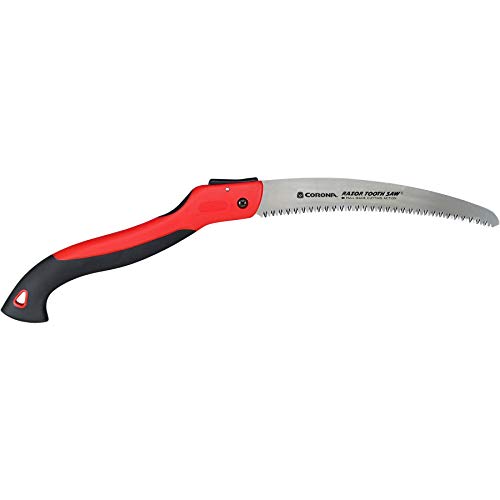
Best for clean cuts on fruit-tree branches up to about 5 inches thick
- Curved, impulse-hardened blade cuts fast on the pull stroke
- Aggressive tri-edge teeth for green fruit wood
- 10 in. blade handles most orchard branches
- Folds safely and locks open
Why buy it: the orchard workhorse — a curved pull-cut blade that leaves the clean, fast cut fruit-tree wounds need to heal well.

Best for the high branches of a mature fruit tree, from the ground
- Extends to about 12 ft to reach the canopy
- Both a pole saw blade and a bypass pruner head
- Cut high branches without a ladder
- Rotating head for awkward angles
Why buy it: the tool for the top of the tree — prune high fruiting wood from the ground instead of balancing on a ladder with a saw.

Best for thinner fruit-tree shoots and general orchard work
- Compact 7.5 in. blade for smaller wood
- Cuts on push and pull for control
- Legendary durability and value
- Fits a jacket pocket
Why buy it: the pocket saw that lasts a decade — ideal for thinning cuts and the finer fruit wood the big saw is overkill for.

Best for heavy orchard pruning and thicker scaffold limbs
- Rigid fixed blade for maximum cutting power
- Scabbard for safe carry on the belt
- Handles the thickest fruit-tree limbs
- Pro-grade durability
Why buy it: the saw for the big cuts — a rigid fixed blade powers through thick scaffold limbs a folding saw struggles with.
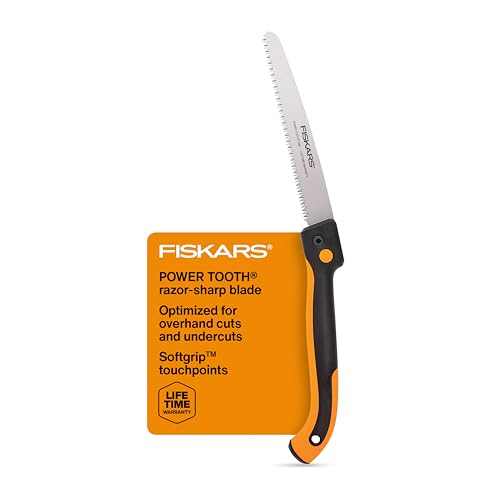
Best for the undercut on a heavy limb to stop bark tearing
- Aggressive teeth for fast cutting
- 10 in. blade with a comfortable grip
- Good for the three-cut method on big limbs
- Locks open and closed
Why buy it: the saw that makes the undercut easy — the first cut in the three-cut method that stops a falling limb tearing the bark.

Best for detailed thinning cuts and tight spaces in the canopy
- Short 7 in. blade for control in tight spots
- Curved impulse-hardened teeth
- Light and pocketable
- Cheap and dependable
Why buy it: the precision saw for reaching into a crowded canopy — short and controllable for the fine thinning cuts fruit trees need.
Quick Comparison
| Product | Best for | Rating | Price | Buy |
|---|---|---|---|---|
| Corona RS 7265D RazorTOOTH Folding Pruning Saw, 10 in. | Best Overall | — | Check (paid link) | |
| Fiskars 2-in-1 Extendable Tree Pruner & Pole Saw (12 ft) | Best for High Branches | — | Check (paid link) | |
| Bahco 396-LAP Laplander Folding Saw, 7.5 in. | Best Value | — | Check (paid link) | |
| Corona AC7672 Professional Arborist Razor Tooth Saw | Best Fixed-Blade | — | Check (paid link) | |
| Fiskars Power Tooth Folding Saw, 10 in. | Best for Undercuts | — | Check (paid link) | |
| Corona RS 7245 Razor Tooth Folding Saw, 7 in. | Best Compact | — | Check (paid link) |
How We Rank
We do not buy or use these saws. We read the owner-review record at volume, weighting reviews that describe fruit-tree and orchard pruning specifically — cut quality, blade durability, and reach. Four factors carry the weight. Cut quality, the clean, healing cut fruit wood needs. Blade durability, since impulse-hardened teeth hold an edge far longer. Reach, for the high branches of a mature tree. And value and safety, including a secure fold or scabbard. Prices were checked at the time of writing. Full method on how we rank.
The Pruning Saws, Reviewed
1. Corona RazorTOOTH 10 in. — Best Overall
Covered above. What owners like: the fast, clean pull-cut, long-lasting impulse-hardened teeth, and safe folding. Recurring complaints: the blade cannot be resharpened at home, it is limited on very thick limbs, and a pull saw takes a moment to adjust to. The orchard workhorse. Check price (paid link).
2. Fiskars 2-in-1 Extendable Pole Saw — Best for High Branches
The tool for the top of the tree. It extends to about 12 feet and carries both a pole-saw blade for thicker high branches and a bypass pruner head for smaller ones, so you prune the canopy of a mature fruit tree from the ground instead of balancing on a ladder with a saw — which is both easier and considerably safer.
Recurring complaints: it is heavier and less precise than a hand saw at full extension, the pruner mechanism needs occasional maintenance, and overhead cutting is tiring. For high fruiting wood you otherwise could not reach safely, it is close to essential. Check price (paid link).
3. Bahco 396-LAP Laplander — Best Value
The pocket saw that lasts a decade. A compact 7.5-inch blade that cuts on both push and pull for control, legendary durability, and a price that makes it an easy second saw — ideal for the thinner shoots and thinning cuts where the big RazorTOOTH is overkill.
Recurring complaints: the shorter blade limits it on thick limbs, and it is a general-purpose saw rather than a fruit-wood specialist. For finer cuts and all-round orchard work, the value is unbeatable. Check price (paid link).
4. Corona AC7672 Arborist Saw — Best Fixed-Blade
The saw for the big cuts. A rigid fixed blade transmits more power than any folding saw, powering through the thick scaffold limbs a home orchard occasionally needs removed, and it carries safely in a belt scabbard. Pro-grade durability.
Recurring complaints: a fixed blade is less convenient to carry and store than a folder, and it is more saw than most routine fruit pruning needs. For heavy renovation cuts on an old tree, the extra power earns its place. Check price (paid link).
5. Fiskars Power Tooth 10 in. — Best for Undercuts
The saw that makes the undercut easy. Aggressive teeth and a comfortable 10-inch blade make quick work of the first cut in the three-cut method — the undercut on the underside of a heavy limb that stops the bark tearing when it falls.
Recurring complaints: the blade is not impulse-hardened to quite the standard of the Corona, and the aggressive teeth can be grabby in small wood. As a capable, comfortable all-rounder and undercut saw, it delivers. Check price (paid link).
6. Corona RS 7245 Razor Tooth 7 in. — Best Compact
The precision saw for the crowded canopy. A short 7-inch curved, impulse-hardened blade gives control in tight spaces, making it the tool for the fine thinning cuts that open up a fruit tree's interior to light and air. Light, pocketable and cheap.
Recurring complaints: the short blade is limited to smaller wood, so it is a complement to a bigger saw rather than a stand-alone. For detailed thinning inside the canopy, the control is exactly right. Check price (paid link).
What Owners Actually Complain About
Across fruit-tree pruning saw reviews, the recurring themes are about matching the tool and the technique.
Ragged, slow-healing cuts. A dull or wrong-type saw. Use a sharp impulse-hardened blade and cut just outside the branch collar.
Blade dulled quickly. Cutting dirty or dead wood, or a non-hardened blade. Impulse-hardened teeth last far longer; keep the blade clean and out of the soil.
Could not reach the top. A hand saw on a mature tree. Add a pole saw and prune from the ground rather than a ladder.
Bark tore when the limb fell. Skipping the undercut. Always use the three-cut method on any limb heavy enough to tear.
How to Choose and Use a Fruit-Tree Saw
Match the saw to the wood. Most orchard cuts? The Corona RazorTOOTH 10-inch. High canopy? The Fiskars pole saw. Fine thinning and thin shoots? The Bahco Laplander or the 7-inch Corona. Thick scaffold limbs? The rigid Corona AC7672. Undercuts on heavy limbs? The Fiskars Power Tooth.
Then prune well: cut in the right season for your fruit type — late-winter dormancy for most, summer for stone fruits and size control, and University of Minnesota Extension puts apples and crabapples specifically in February through early April to reduce the risk of fire blight — cut just outside the branch collar without leaving a stub or cutting flush, use the three-cut method on anything heavy, and leave the cuts to heal on their own rather than sealing them. Keep the blade clean and sharp. For the wider craft of it, see what month to prune fruit trees, how to prune shrubs, and the full saw field in best pruning saws.
The Verdict
For fruit trees, the Corona RazorTOOTH 10-inch is what the owner-review record supports — a curved, impulse-hardened blade that leaves the clean cut fruit wood needs to heal. Add the Fiskars extendable pole saw for the high canopy, and the pocket Bahco Laplander for the fine cuts, and a home orchard is covered. Prune at the right season, cut at the collar, and use the three-cut method on heavy limbs. Check price on Amazon → (paid link)
Next: the full pruning and hedges hub · best pruning saws · what month to prune fruit trees · best pole saws · how we rank.