 Garden

Affiliate Disclosure
Some links on this page are affiliate links. As an Amazon Associate, we earn from qualifying purchases — at no extra cost to you. We do not buy, test, or physically handle the products we cover; our rankings come from aggregated owner reviews, ratings and expert consensus. Commissions never change our verdicts. How we rank · full disclosure.
Short answer: the mistakes that actually kill or ruin plants are topping, cutting conifers back into bare brown wood (it never regrows), flush cuts and long stubs, removing more than a third at once, and pruning at the wrong time of year, which quietly removes flower buds set the previous summer. Wound paint is a mistake too, just a less dramatic one.
Below is what each one does to the plant, why it is worse than it looks, and what to do instead.
The Short Version
| Mistake | What actually happens | Do this instead |
|---|---|---|
| Topping a tree | Stored reserves burned, dozens of weakly attached sprouts, decay from stub wounds, shorter life, greater hazard | Reduction cuts to a lateral at least a third the diameter of the removed stem — or remove and replant something the right size |
| Cutting a conifer into brown wood | No dormant buds there; the section stays bare permanently | Cut only within the green. Renovate over years, or replant. Yew is the exception |
| Flush cut against the trunk | Removes the branch collar — the tissue that seals the wound. Decay enters the trunk | Cut just outside the collar, leaving the swollen ring intact |
| Leaving a long stub | The stub dies, decays, and the decay travels back into the stem | Cut to the collar, or to a bud within about 1/4 inch |
| Pruning at the wrong season | Removes flower buds set last summer; or drives soft fall growth that winter kills | Old wood — prune after flowering. New wood — prune in late winter |
| Removing too much at once | Stress response: water sprouts, dieback, vulnerability to pests | One third of a shrub, a quarter of a mature tree, per season |
| Shearing everything into balls | Dense outer shell shades the interior; the inside dies and hollows out | Thin as well as head; take some whole stems out from inside |
| Wound paint | Traps moisture, no measurable benefit | Leave the cut open to air |
| Dull or dirty blades | Crushed tissue closes slowly; disease travels between plants | Sharpen; wipe with 70% isopropyl between plants |
| Wrong tool for the stem | Torn wood, bent teeth, burnt gearboxes | Pruners to 1/2 in., loppers to 1 1/2 in., saw beyond |
1. Topping — The Worst Thing Done to Trees
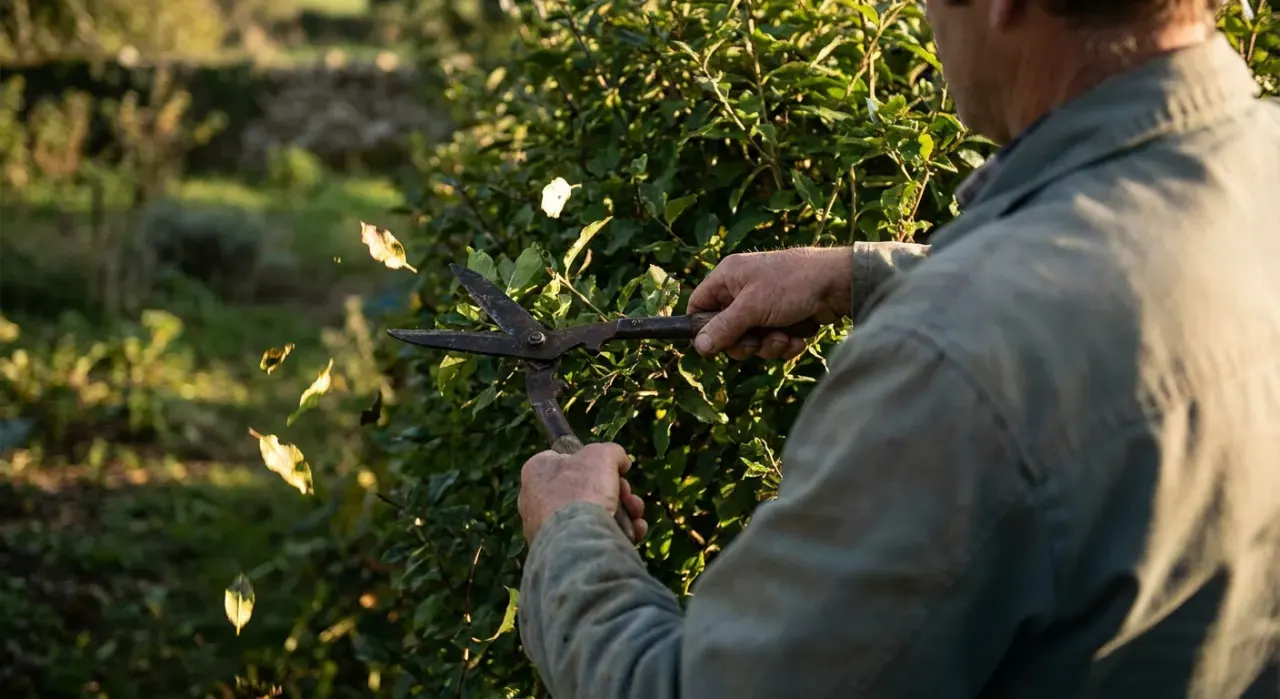
Topping means cutting the main stems of a tree back to stubs to reduce its height. It is common, it is usually done with good intentions, and it damages the tree in four ways at once.
First, it removes a large share of the leaves the tree uses to feed itself, forcing it to draw on stored energy just as it also has to defend a set of large wounds. Second, those wounds are in the middle of stems, where the tree has no branch collar and therefore no defense boundary — decay enters and spreads down the trunk. Third, the tree responds to the emergency by pushing out dozens of fast, upright water sprouts below each cut. Those sprouts are attached only to the outer layers of the stub rather than anchored in the wood, so they are far weaker than the branches they replace, and they grow back to the original height within a few years. Fourth, the tree that was supposedly made safer is now a tall stub carrying heavy, poorly attached limbs over decayed wood.
Instead: if a tree genuinely must be reduced, use proper reduction cuts — shorten a stem back to a lateral branch that is at least one third the diameter of the part removed, so that lateral can take over as the new leader. Keep the total removal under about a quarter of the live canopy in a season. And be honest about the underlying problem: a tree fifteen feet too big for its spot will need this every few years forever. Replacing it with a species suited to the space is usually the better decision, and it is what most experienced gardeners eventually conclude.
The same logic applies to crape myrtles, which are topped so routinely in the South that the practice has its own nickname. Thin them instead — remove crossing branches and seedy twigs, and let the trunks develop.
2. Cutting Conifers Into Old Wood — The Irreversible One
This is the mistake most likely to permanently ruin a hedge, and it cannot be undone.
Most conifers — Leyland cypress, arborvitae and thuja, juniper, spruce, pine, fir — carry live buds only in the green, needled outer shell. The brown wood inside has essentially no dormant buds. Cut back past the green into bare wood and there is nothing there to grow: the face stays brown for the rest of the plant's life. One afternoon with a trimmer can permanently strip a face off a hedge that took fifteen years to grow.
Yew (Taxus) is the notable exception. It regenerates freely from old wood, which is exactly why yew has been the classic formal hedge in temperate gardens for centuries and why renovation stories that end well are almost always yew. Boxwood, privet, holly, hornbeam, beech and hawthorn also break from old wood.
Instead: identify the species before any hard cut. On non-regenerating conifers, keep the hedge inside its intended dimensions by cutting little and often, always within the green. If a conifer hedge has already outgrown its space, the honest options are to reduce only the top (which conifers tolerate better than the sides), to accept the size, or to replace. The full method for the species that can be renovated is in renovating an overgrown hedge.
3. Flush Cuts and Stubs — The Two Placement Errors
Where a cut lands matters as much as whether it should have been made.
The branch collar is the slightly swollen ring of tissue where a branch meets its parent stem. It contains the chemical and physical machinery a woody plant uses to wall off a wound — a process arborists call compartmentalization. A cut just outside that collar lets the plant seal itself, and callus tissue closes over the wound in a season or two.
A flush cut slices the collar off along with the branch. The plant now has a wound with no defense boundary, in direct contact with the trunk's conductive tissue. Decay moves inward. The wound often never closes properly, and the vertical crack of dieback above and below a flush cut is one of the recognizable signatures of bad pruning.
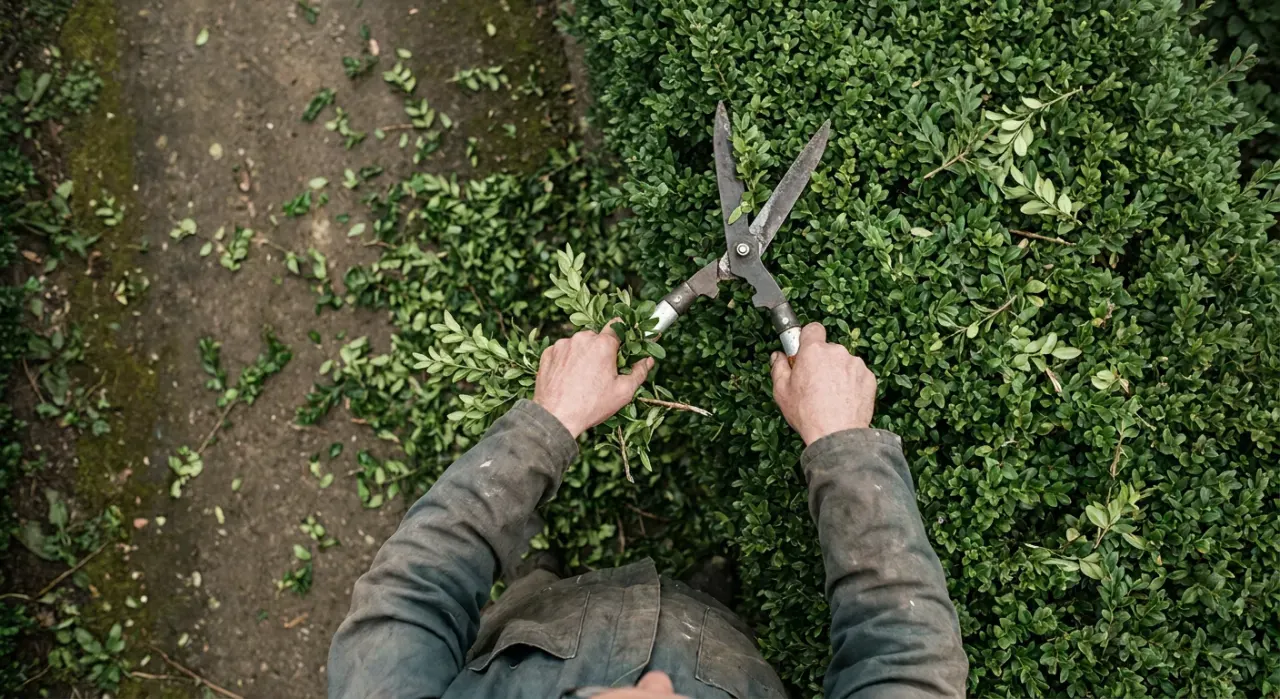
A stub is the opposite error and nearly as bad. The remaining length has no source of new growth and no way to seal, so it dies, and the decay in the dead stub travels back into living wood. Stubs on shrubs also look terrible — a shrub that has been headed back with no regard for buds becomes a thicket of dead pegs.
Instead: cut just outside the collar for a branch removal, and about a quarter inch above an outward-facing bud at roughly 45 degrees for a heading cut. On anything thicker than about an inch and a half, use the three-cut method — an undercut a foot out, a top cut just beyond it to drop the weight, then a final cut at the collar — so the falling branch cannot tear a strip of bark down the trunk. Details are in how to prune shrubs properly.
4. Pruning at the Wrong Time of Year
This one does not kill plants; it quietly removes a season of flowers, and it is the most common complaint in the whole subject.
Spring-flowering shrubs form their buds during the previous summer. Forsythia, lilac, azalea, rhododendron, weigela, mock orange, bridalwreath spirea, most viburnums and bigleaf hydrangea all carry next spring's display on the plant through the winter. A tidy-up in fall or a "clean-up" in March removes all of it. The safe window for those plants is four to six weeks immediately after the flowers fade.
Summer bloomers are the reverse: panicle and smooth hydrangea, butterfly bush, crape myrtle, rose of Sharon, Japanese spirea and most roses flower on shoots grown in the current year, so cutting them hard while dormant costs nothing and usually improves the display.
There is a second timing error with real consequences. Pruning in late summer and early fall — roughly August through September — stimulates a flush of soft growth that has no time to harden before frost. That growth dies, and the dieback can carry into older wood. Stop shaping cuts by late summer and resume once plants are fully dormant.
Three disease-driven exceptions are worth memorizing: do not prune oaks from about April through July (oak wilt), do not prune elms during beetle flight from roughly April through October (Dutch elm disease), and prune stone fruit — cherry, plum, apricot — in dry summer weather rather than winter (silver leaf and bacterial canker). The full year is mapped in our when to prune calendar.
5. Taking Too Much at Once
Leaves are how a plant makes its food. Remove a large share of them in one go and the plant has to fund its recovery from stored reserves at exactly the moment it also has wounds to defend.
The response is predictable and unwelcome: a flush of vigorous, upright, weakly attached water sprouts, produced at the expense of root growth and flower production. The plant looks busier and is in fact weaker, and it is more susceptible to borers and canker diseases for a season or two afterward.
The limits: no more than about one third of a shrub's living growth in a season, and no more than a quarter of a mature tree's live canopy. When a plant needs more reduction than that, do it over two or three consecutive years using renewal pruning — remove the oldest third of the stems at ground level each year. The shrub is fully rebuilt in three seasons and never looks butchered in the meantime.
The Smaller Mistakes That Add Up
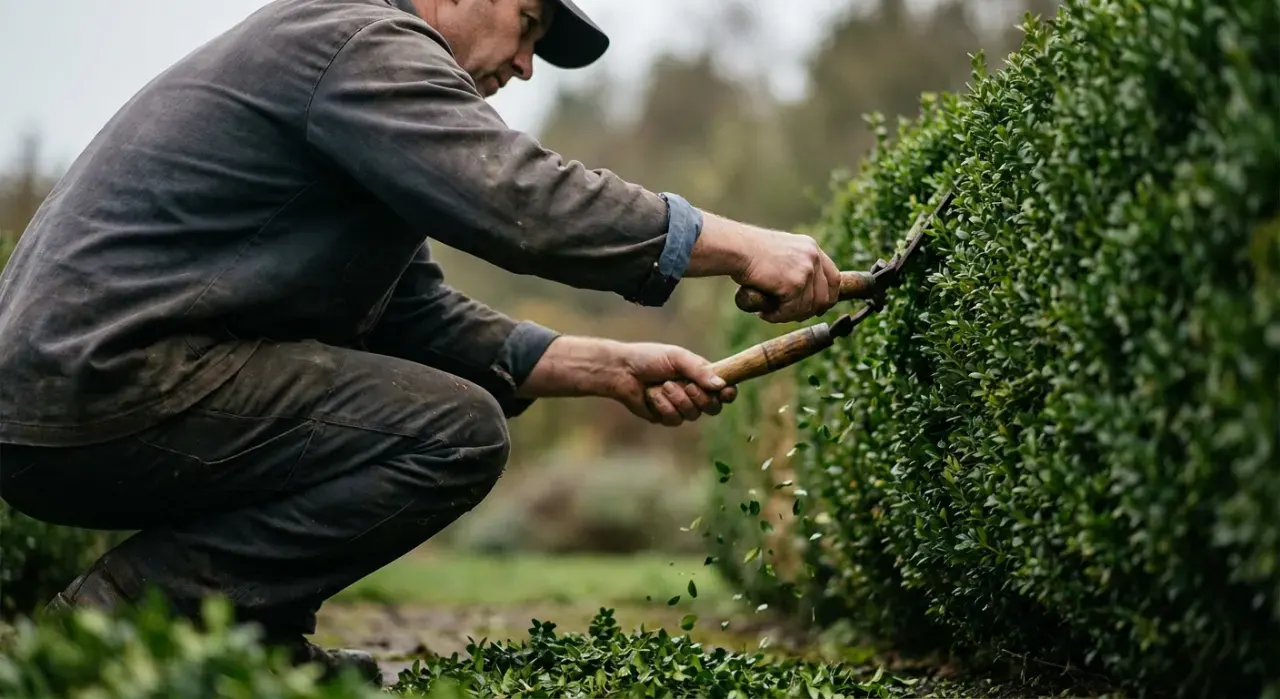
- Shearing every shrub into a ball. Shearing is a heading cut applied to an entire surface, so it makes the outside denser and the inside darker. Over a few years the interior dies out and you are maintaining a hollow shell. Thin some whole stems out from inside each year alongside any shearing.
- Lion-tailing. Stripping the interior branches off a limb and leaving foliage only at the tip. It looks tidy and it concentrates weight at the end of a lever, which is a genuine failure risk in wind. Keep interior foliage.
- Wound paint. Traps moisture, no measurable benefit against decay. Leave cuts open — except an oak or elm cut in high-risk season, which should be sealed immediately.
- Dull and dirty blades. A crushed cut closes slowly and invites infection, and unsterilized blades carry disease from plant to plant. Wipe with 70% isopropyl alcohol between plants; on obviously diseased wood, disinfect between every cut and cut 8 to 12 inches back into clean tissue. Blade routine for powered trimmers is in hedge trimmer blade care.
- Forcing the wrong tool. Hedge trimmers are rated for soft stems roughly 3/8 to 3/4 inch; loppers reach about an inch and a half; beyond that it is a saw. Forcing thick wood through a trimmer tears the plant and is the leading cause of bent teeth and burnt-out gearboxes in owner reports. Use loppers and a pruning saw where they belong.
- Anvil blades on living wood. Anvil pruners crush a green stem against a flat plate rather than slicing it. Fine for deadwood, damaging on anything you expect to regrow. Buy bypass.
- Removing the lower limbs of a young tree too early. Those branches feed trunk growth and taper. Raise the canopy gradually over several years, not all at once.
- Fertilizing hard after a heavy cut. High nitrogen pushes soft growth the plant cannot support. Water and mulch instead.
If You Have Already Made One
Most of these are survivable. A topped tree should be left alone for a full season, then thinned gradually — select one or two of the strongest sprouts per stub over several years and remove the rest, so a new structure develops. A shrub pruned at the wrong time simply skips a year of flowers; do nothing, and get the timing right next season. A shrub cut too hard should be watered through the following summer, mulched 2 to 3 inches deep away from the stems, and left unfertilized.
The one that cannot be repaired is a conifer cut into bare wood. There, the choices are to screen it with something planted in front, to reduce the rest of the hedge to a size the bare face no longer shows at, or to replace. That is why identifying the species before the first cut is the highest-value thirty seconds in this entire subject — start with renovating an overgrown hedge, then the technique in how to prune shrubs properly and the timing in the pruning calendar. More at pruning, trimming and hedges; our research method is on how we rank.