 Garden

Affiliate Disclosure
Some links on this page are affiliate links. As an Amazon Associate, we earn from qualifying purchases — at no extra cost to you. We do not buy, test, or physically handle the products we cover; our rankings come from aggregated owner reviews, ratings and expert consensus. Commissions never change our verdicts. How we rank · full disclosure.
Short answer: identify the species first, because the answer is binary and permanent. Yew, privet, boxwood, holly, hornbeam, beech, hawthorn and laurel regenerate from old bare wood and can be cut back hard — best done one side per year over two or three years. Leyland cypress, arborvitae, juniper, spruce and pine do not. Cut those past the green and the face stays bare for good.
An overgrown hedge is not a lost cause, but it is a decision you get one chance at. Below is how to tell which hedge you have, how to plan the renovation, and what to do afterward.
The Table That Decides Everything
| Hedge | Regenerates from old wood? | Approach | Recovery |
|---|---|---|---|
| Yew (Taxus) | Yes — reliably, the best of the conifers | One side per year in late spring; can be taken back to the main stems | 2–3 years to look dense |
| Privet (Ligustrum) | Yes — vigorously | Can be cut hard all over in late winter; very forgiving | 1 season |
| Boxwood (Buxus) | Yes, but slowly | Reduce by no more than a third per year, late spring | 2–3 years |
| Holly (Ilex) | Yes | One side per year, late winter to early spring | 2 years |
| Hornbeam (Carpinus) | Yes | Late winter while dormant; one side per year | 2 years |
| Beech (Fagus) | Yes | Late winter; one side per year; be patient | 2–3 years |
| Hawthorn (Crataegus) | Yes — very tough | Late winter; tolerates severe cutting and laying | 1–2 years |
| Cherry laurel (Prunus laurocerasus) | Yes — strongly | Late spring; cut with loppers to a joint, not shears | 1–2 years |
| Forsythia, weigela, spirea and other deciduous flowering hedges | Yes | Renewal — remove the oldest third of stems at ground level each year | 2–3 years |
| Leyland cypress (× Cuprocyparis leylandii) | No | Reduce height only; never cut sides past the green | Bare wood never refills |
| Arborvitae / thuja | No | Light shaping within the green only | Bare wood never refills |
| Juniper | No | Within the green only | Bare wood never refills |
| Spruce, fir, pine | No | Not hedging plants for hard renovation; shape new growth only | Bare wood never refills |
| Lavender, rosemary, santolina | No | Trim only into growth that still carries leaves | Bare wood never refills |
If you are not sure which conifer you have, this is worth thirty seconds. Yew has flat, dark green, soft needles arranged in two rows along the stem, and red berry-like arils on female plants. Leyland cypress and thuja have flattened sprays of scale-like foliage rather than individual needles. Juniper has prickly needles or scales and blue-gray berries. Scale-like foliage in flat sprays means do not cut into brown wood.
A second test works on any conifer and takes no expertise at all: part the foliage with your hand and look inside. If you can see small green shoots and living buds scattered on the brown interior wood, the plant can rebuild from there. If the interior is entirely bare brown twigs, there is nothing to grow from and a hard cut will be permanent.
When to Do It
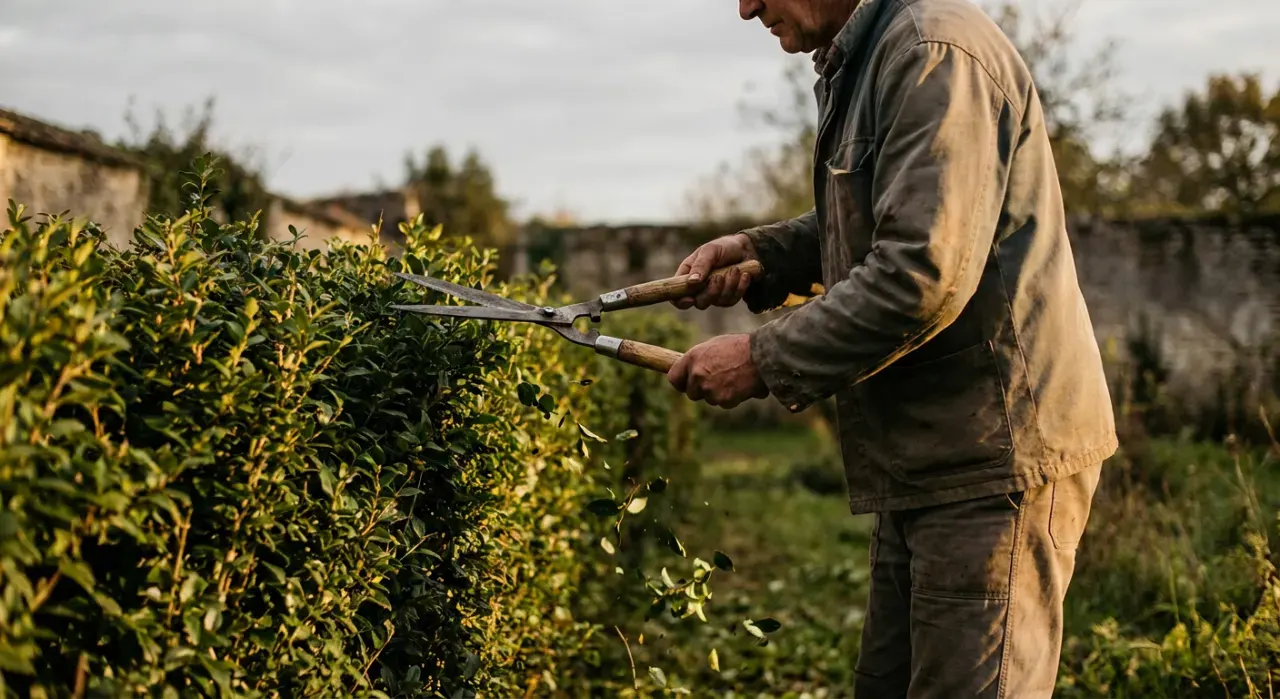
- Deciduous hedges — beech, hornbeam, hawthorn, privet, forsythia: late winter to very early spring, while dormant and before bud break. The plant then has the entire growing season to respond.
- Yew: mid to late spring, roughly April into May as growth begins. Yew responds better cut into active growth than cut in deep dormancy.
- Cherry laurel, holly and other broadleaf evergreens: mid to late spring, after the risk of hard frost.
- Boxwood: late spring, after the first flush has hardened. Avoid heavy work in high summer heat.
- Never in fall. There is no growing season ahead of the plant, and any growth that does appear will be soft and frost-tender.
One legal check applies regardless of species: active bird nests are protected under the Migratory Bird Treaty Act. Look through the hedge before you start any heavy cutting between roughly April and August, and postpone if you find an occupied nest.
The Three-Year, One-Side-at-a-Time Method
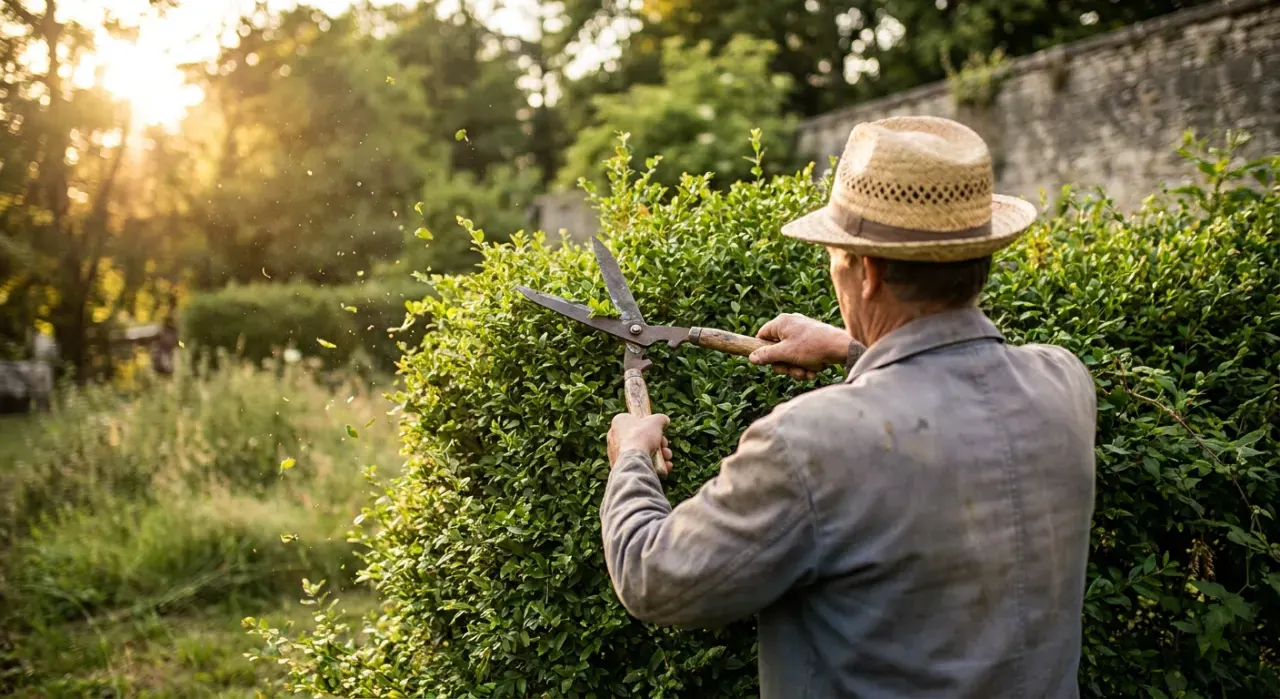
This is the standard professional approach, and it exists for a reason: it removes far less foliage at any one time, so the plant is never stripped of its ability to feed itself, and the hedge keeps functioning as a screen throughout.
- Year one — reduce the height. Take the top down to about 6 inches below your intended final height, so the regrowth fills back to the level you actually want. Feed, water and mulch. Leave both sides alone.
- Year two — cut one side back hard. Choose the less visible side, or the side facing the neighbor you get along with. Cut back to within a few inches of the main stems, taking each branch back to a joint or the trunk rather than shearing through the middle of wood. Feed, water and mulch again. The other side keeps the plant fed and the screen intact.
- Year three — cut the other side. Only once the first side has visibly regrown. If it has not, wait another year; there is no prize for speed.
- Year four onward — maintain properly. Cut little and often, with a taper so the base is wider than the top, and the hedge should never need this again. That maintenance technique is in how to trim a hedge straight.
On very tough species — privet, hawthorn, laurel — you can compress this to two years, or on privet even do the whole thing in one go. On yew, boxwood and beech, take the full three. Nothing is gained by rushing a plant that will take three years to look right either way.
Cutting technique for a renovation
This is not a shearing job. Use loppers for stems up to about an inch and a half and a pruning saw beyond that, and cut each branch individually back to a fork, a joint or the main stem. Cuts made to a joint heal and regrow; cuts made through the middle of an old branch leave a stub that dies back.
Work from the top down and from the outside in, clearing debris as you go so you can see the structure you are creating. Take out any dead wood in the interior while you have access — it is the only time you will. And accept that it will look shocking for a season; that is what renovation looks like, and the plant knows what to do about it.
Aftercare Decides Whether It Works
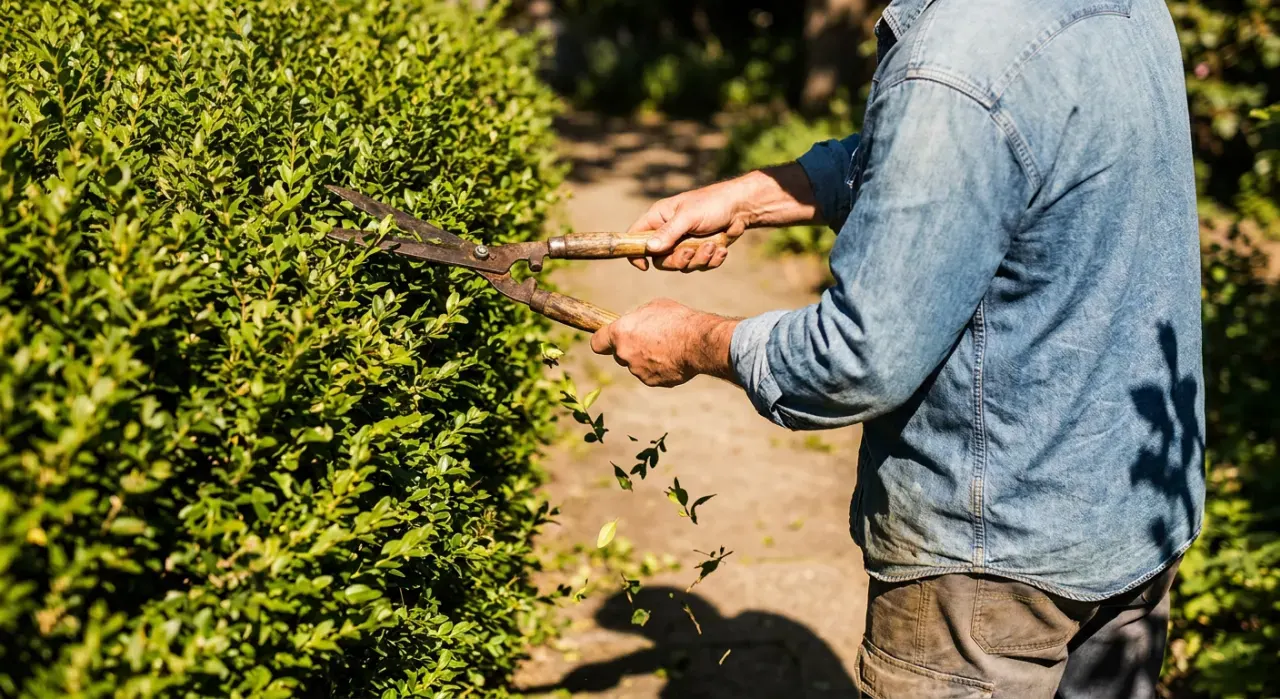
More renovations fail from neglect afterward than from the cut itself. A hedge that has just lost most of its leaf area has to rebuild from stored reserves, and the root zone under an established hedge is usually dry, compacted and full of competing roots.
- Feed in early spring with a balanced general fertilizer over the root zone — roughly out to the width of the hedge on each side. Repeat the following spring.
- Mulch 2 to 3 inches deep over the root area, kept an inch clear of the stems. This does more for recovery than the fertilizer does.
- Water deeply through the first two summers. A long soak every week or ten days in dry weather beats frequent light watering. This is the step people skip and the most common reason a species that should have regrown, did not.
- Do not cut anything else for a full season. Let it push growth freely; you can shape it the following year.
- Watch for weeds and grass moving into the newly sunlit ground at the base, and clear them before they establish.
When Renovation Is Not the Answer
Three situations argue for replacement rather than renovation.
A non-regenerating conifer that is too wide. A Leyland cypress or arborvitae hedge that has outgrown its footprint cannot be narrowed. You can reduce the height, and you can live with the width, but you cannot cut it back to the green and have it refill. Replacing with yew, hornbeam, beech or privet gives you a hedge that can be maintained at a set size indefinitely.
A hedge in genuinely poor health. Renovation is a demand on stored energy. A hedge that is already thin, diseased, root-damaged or drought-stressed frequently does not have the reserves, and hard cutting finishes it. Improve conditions for a season first — water, mulch, feed — then reassess.
A hedge that is simply the wrong plant for the space. If a hedge needs cutting three times a year to stay where you want it and still creeps outward, that is a species problem rather than a maintenance problem. Boxwood, yew and hornbeam hold a set size for decades; Leyland cypress does not, which is why so many of them end up in this article.
Before you start on anything, read the habits worth avoiding in pruning mistakes that kill plants, and check the timing for your species in the when to prune calendar. For the cutting itself, a sharp trimmer matters for the finishing cuts but the real work is loppers and a saw — the ranked field is in best hedge trimmers. More at pruning, trimming and hedges; our research method is on how we rank.