 Garden
Affiliate Disclosure
Some links on this page are affiliate links. As an Amazon Associate, we earn from qualifying purchases — at no extra cost to you. We do not buy, test, or physically handle the products we cover; our rankings come from aggregated owner reviews, ratings and expert consensus. Commissions never change our verdicts. How we rank · full disclosure.
The short version: a railing planter is the highest-value square foot on a balcony, because the rail is space you were never using anyway. Across five popular over-the-rail planters weighed on owner ratings, review volume and the complaints that keep repeating, our #1 pick is the Bloem Deck Rail Planter — a compression saddle that grips a standard deck rail without a single screw. If you rent and worry about water reaching the balcony below, the Novelty Click with its detachable drip tray is the safer buy, and the LaLaGreen 36-inch metal boxes are what to get when you want a rail that actually looks planted.
We do not buy, plant, or physically handle any of these products. These rankings come from aggregated owner reviews, star ratings, review volume and horticultural consensus — the full method is on how we rank. The wider balcony advice lives in our vertical and small-space gardening hub.
Top Picks at a Glance
Our #1 Pick: Bloem Deck Balcony Rail Planter
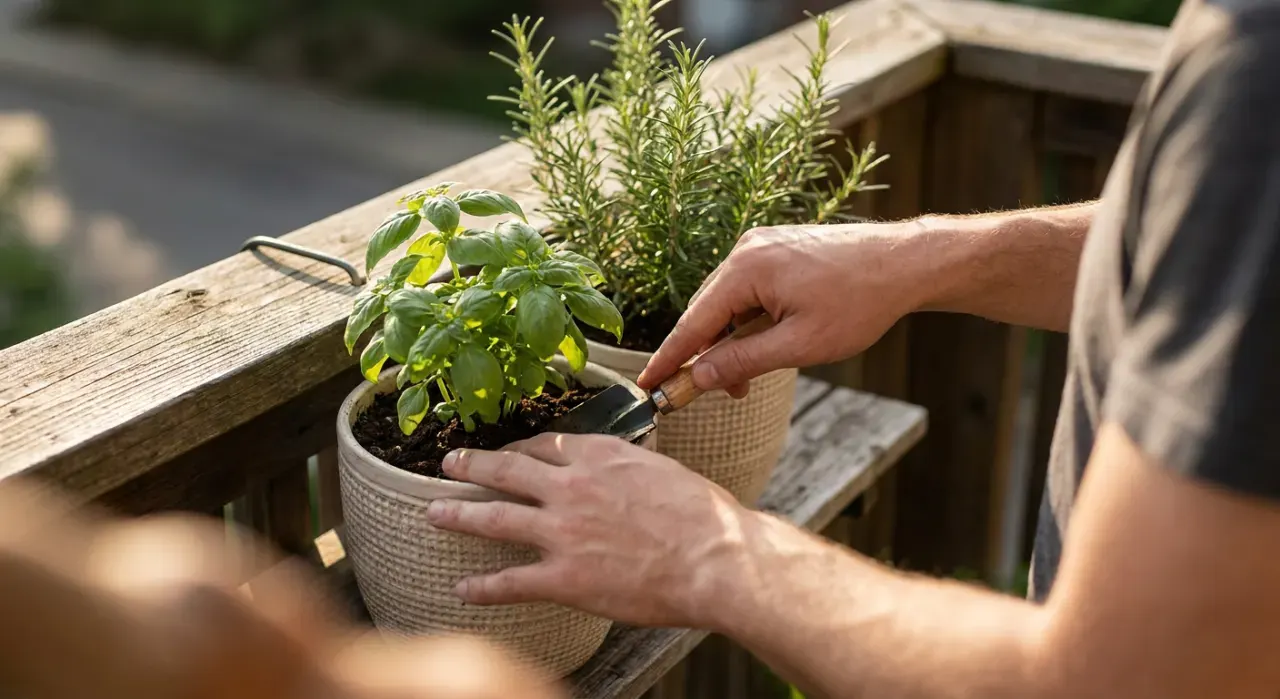
The reason this design has dominated the category for years is that it solves the mounting problem without hardware. The underside is a saddle sized to compress onto a rail roughly 3.75 or 5.75 inches wide — the two sizes that cover the overwhelming majority of wooden deck rails in the country — and the resin flexes just enough to grip rather than rest. Nothing is drilled, nothing is screwed, and the whole thing lifts off in one motion when you move out or need to stain the deck.
At 24 inches long it holds around four gallons of mix, which is a meaningful amount for a rail planter and the reason it performs better than the shallow trough designs. More soil means more buffer between waterings, and on a rail — fully exposed to sun and wind on all sides — that buffer is the difference between watering once a day and twice. The resin is UV stabilized, so it holds its color rather than chalking to gray after one summer, and it has real drainage holes rather than the token slots some boxes ship with.
The honest cons: the compression fit is sized for specific rail widths, and on an unusual rail — a metal apartment railing, a round tube, a wide capped rail — it will rock rather than grip. There is no integrated drip tray, so on an upper-floor balcony you will want a saucer or a different model. And it is plastic; attractive, durable plastic, but it does not have the presence of the powder-coated metal boxes.
Consensus Score █████████░░░ 8.7
Check price on Amazon → (paid link)
The Ranked Field

Best for standard 2x4 and 2x6 deck rails, no drilling
- Compression saddle fits rails roughly 3.75 or 5.75 inches wide
- Around 4 gallons of soil — deep enough for herbs, annuals and salad
- UV-stable resin that resists fading and cracking
- No hardware, no drilling, lifts straight off when you move
Why buy it: the saddle grips the rail by compression, so it sits level and stays put without a single screw.

Best for a first railing planter on a rental balcony
- Anchoring tabs click into position for a range of rail widths
- Detachable drainage tray catches runoff before it hits the neighbors
- Two separate planting compartments
- Thick UV-protected resin
Why buy it: the removable tray is the feature apartment gardeners actually need — water that drips downstairs is how balcony gardens end.

Best for a long run of rail and real planting volume
- 36 inches long — covers a full rail section per box
- Powder-coated metal trough with coconut coir liners
- Adjustable brackets hook over the rail or mount to a fence
- Two boxes per pack for a matched pair
Why buy it: the length is what makes a balcony read as planted rather than decorated — one box does a whole section.

Best for wrapping a whole balcony in herbs and flowers cheaply
- Adjustable metal hanging brackets fit a wide range of rail widths
- Six drainage holes plus a water-collecting tray on each box
- Works over a rail, on a fence or on a window ledge
- Six boxes at roughly the price of two premium ones
Why buy it: six matched boxes for the cost of two — the fastest way to make a bare rail look intentional.

Best for trailing plants, strawberries and anything with roots
- Deeper oval profile than the standard rail box
- Same UV-stable resin construction as the Bloem range
- More soil volume means longer between waterings
- Straddles the rail without fixings
Why buy it: the extra depth is the single most useful upgrade on a rail — shallow boxes dry out by lunchtime in July.
Quick Comparison
| Product | Best for | Rating | Price | Buy |
|---|---|---|---|---|
| Bloem Deck Balcony Rail Planter, 24" | Best Overall | — | Check (paid link) | |
| Novelty Click Railing Planter with Drainage Tray | Best Value | — | Check (paid link) | |
| LaLaGreen 36" Metal Deck Railing Planter Box, 2-Pack | Best Large Capacity | — | Check (paid link) | |
| ETELI Deck Railing Planter Boxes with Adjustable Brackets, 6-Pack | Best Multi-Pack | — | Check (paid link) | |
| Bloem Oval Classic Deck Rail Planter Box, 24" | Best Deep Box | — | Check (paid link) |

How We Rank Railing Planters
We never buy or physically handle the products on this site — we read the review record at scale instead. Four things carried the most weight here. Fit reports against real rails, because the single biggest driver of one-star reviews in this category is a planter that does not sit securely on the reviewer’s particular rail. Drainage design, weighted heavily — the presence or absence of a tray decides whether a balcony garden is a pleasure or a neighbor dispute. NC State Extension notes that drainage holes are necessary in any container to keep roots from standing in water and developing root rot, and on a rail box that runoff has to go somewhere managed rather than onto whoever is below. Soil volume and depth, taken from published dimensions and checked against reviews describing how fast the box dries out, since shallow rail boxes are the most common cause of dead plants in midsummer. Most containers need watering at least once a day once the plants inside them mature, according to NC State Extension, and a rail box — exposed to sun and wind on every face — dries faster than that baseline suggests. Weather durability from reviews written after a full season outdoors, where UV fading, cracking resin and rusting brackets appear.
Star ratings, review counts and prices were current at the time of writing and all move. The complaint patterns move far less, and those are what we weight hardest.
Consensus Scores
Each score is our weighted read of the owner-review record for that product — never a lab figure, and never a number we typed onto a rating we did not verify.
- Bloem Deck Rail Planter 24" █████████░░░ 8.7
- Novelty Click Railing Planter █████████░░░ 8.5
- LaLaGreen 36" Metal Boxes █████████░░░ 8.5
- ETELI 6-Pack Railing Boxes ████████░░░░ 8.2
- Bloem Oval Classic Rail Box █████████░░░ 8.6
The Planters, Reviewed
1. Bloem Deck Balcony Rail Planter — Best Overall
Covered above. Owners praise: a genuinely secure fit on standard deck rails, useful soil volume for a rail box, resin that holds its color through several seasons, and how quickly it goes up and comes off. Owners complain about: the fit being wrong on non-standard or metal railings, no drip tray for upper-floor balconies, and drainage that will run straight through onto whatever is below unless you add a saucer.
2. Novelty Click Railing Planter — Best Value
The apartment gardener’s choice, and the reason is the detachable tray underneath. Water that drips off a balcony is the fastest way to hear from a neighbor or a building manager, and a tray removes the problem entirely — you empty it rather than letting it fall. The anchoring tabs click into a range of positions, so it accommodates more rail widths than a fixed compression saddle, and two separate planting compartments let you keep mint from colonizing everything else. Owners praise: the drip tray, adjustable tabs that fit awkward rails, thick resin that survives freeze and thaw, and a low price. Owners complain about: a shallower planting depth than the Bloem, tabs that need firm seating or the box can shift, a tray that has to be emptied after heavy rain, and compartments that limit what you can plant in each half.
3. LaLaGreen 36" Metal Railing Planter Box — Best Large Capacity
Length changes how a balcony reads. A pair of 24-inch boxes on a long rail looks like two pots; a 36-inch trough looks like a planted border. These are powder-coated metal with coconut coir liners, which is both a look and a function — coir breathes, so the mix does not sour the way it can in a sealed plastic box. The brackets adjust and will hang on a fence or a wall as easily as a rail. Owners praise: the length and the visual impact, sturdy metal that does not flex when full, adjustable brackets that fit awkward railings, and the look of coir against powder coat. Owners complain about: coir liners needing replacement every season or two, faster drying than a solid plastic box because coir breathes on all sides, significant weight when full, and assembly that takes longer than a drop-on planter.
4. ETELI 6-Pack Railing Planter Boxes — Best Multi-Pack
Six matched boxes for around the price of two premium ones, with adjustable metal brackets that hook over a rail, a fence rail or a window ledge. If the goal is to turn a bare balcony into something that looks deliberately planted in one afternoon, buying six identical boxes is a far faster route than accumulating mismatched pots. Each box has drainage holes and a collecting tray. Owners praise: the value per box, brackets that adjust to a genuinely wide range of rails, integrated trays, and the coherent look of matched boxes along a rail. Owners complain about: individual boxes being small and shallow, lighter-gauge material than single premium planters, brackets that need tightening after a few weeks, and the practical reality that six small boxes need watering more often than two large ones.
5. Bloem Oval Classic Deck Rail Planter Box — Best Deep Box
Same family as our top pick, with a deeper oval profile, and depth is the single most useful upgrade you can make on a rail. A shallow trough in full July sun can go from watered to bone dry in a morning, and every plant in it is stressed by afternoon. More soil is more buffer. The oval shape also suits trailing plants and strawberries, which spill over the outside curve. Owners praise: longer intervals between watering, a shape that flatters trailing plants, the same durable UV-stable resin, and a secure fit on standard rails. Owners complain about: more weight when full, which matters on a lighter rail, the same lack of an integrated drip tray, and a rounded profile that holds slightly less usable soil than its outside dimensions suggest.
What Owners Actually Complain About
Read enough one- and two-star railing planter reviews and five patterns account for nearly all of them. It does not fit my rail leads by a wide margin, and it is almost entirely a measuring problem — buyers assume a rail is standard and it turns out to be a metal bar, a round tube or a wide capped top. Measure first, every time. Drying out too fast is second and is inherent to the format: a rail box is exposed to sun and moving air on every surface, so it dries faster than any pot on the floor, and shallow boxes dry fastest of all. Water dripping below is third, and it is the complaint most likely to end a balcony garden by way of a building manager. Wind movement is fourth, and it is usually a tall plant catching air rather than the planter itself failing — though a heavier, soil-based potting mix can help keep a box from shifting in a windy spot, per Illinois Extension. And UV degradation is fifth: cheap resin chalks, fades and eventually cracks after a couple of summers, which is where the UV-stable branded boxes justify their price.
How to Choose a Railing Planter
Measure, then decide on drainage, then think about depth. Measure the top rail — width and profile — and buy a compression saddle only if you have a flat wooden rail near 3.5 or 5.5 inches. Anything else wants adjustable brackets. Decide about drainage before you buy rather than after the first complaint: any balcony above ground level should have trays, either integrated or added underneath. Favor depth over length if you have to choose, because a deep box survives a hot weekend and a shallow one does not.
Then plant for the conditions, not for the picture. A rail is the windiest, sunniest and fastest-drying spot on a balcony. Low, bushy and drought-tolerant plants do well there — herbs, salad, strawberries, compact annuals — and tall plants act as sails. Mulch the surface even in a small box, and group boxes close together so they shade one another and raise the humidity around them.
Railing boxes are one layer of a small-space garden rather than the whole thing. The floor takes the big containers, the walls take pocket systems and trellises, and the ceiling takes hanging baskets — the ranked options for going upward are in best vertical garden planters. If watering is the part you keep losing at, reservoir containers cut the workload substantially and are ranked in best self-watering container pots.
The Verdict
The Bloem Deck Rail Planter is the pick the owner-review record backs most strongly for a standard wooden deck rail — secure without hardware, deep enough to be useful, and durable through several seasons. Choose the Novelty Click if you are above ground level and need the drip tray, the LaLaGreen metal boxes if you want a rail that looks like a border, the ETELI six-pack to cover a whole balcony cheaply, and the Bloem oval if midsummer watering is your weak point.
Next: work out what your space can actually grow with how much sun a balcony really gets, plan the whole setup in the balcony garden starter guide, or head back to the vertical and small-space gardening hub.