 Garden

Affiliate Disclosure
Some links on this page are affiliate links. As an Amazon Associate, we earn from qualifying purchases — at no extra cost to you. We do not buy, test, or physically handle the products we cover; our rankings come from aggregated owner reviews, ratings and expert consensus. Commissions never change our verdicts. How we rank · full disclosure.
The most common mistake with a motion sensor light is buying one that is far too bright. A 10,000-lumen floodlight aimed at a small porch does not make the area safer — it blows out your night vision and your camera's exposure, and everything just beyond the pool of light becomes a black wall. Lighting works by letting someone be seen, and a glare source that destroys contrast works against that. Size the output to the space, aim it downward, and the cheap fixture usually outperforms the expensive one.
The second most common mistake is where the sensor points. Almost every complaint about a light that switches on all night traces back to a sensor aimed at a street, a dryer vent, or a driveway that stays warm for two hours after sunset. Below are the six fixtures the ownership record supports, and then the aiming and sizing that decide whether yours is useful or a nuisance.
Top Picks at a Glance
Sizing the light to the space
Lumens measure light output; watts measure electricity consumed. LED fixtures broke the old habit of shopping on watts, and manufacturers have taken advantage by printing enormous lumen figures on boxes for spaces that need a fraction of them. Here is what each space actually wants.
| Where it is going | Sensible output | Color | Mounting height |
|---|---|---|---|
| Back door, single entry | 700–1,500 lumens | 3000K warm | 7–8 ft |
| Porch or patio people use | 800–1,500 lumens | 3000K warm | 7–8 ft |
| Path or side yard | 1,500–2,500 lumens | 3000K–4000K | 8–10 ft |
| Driveway, two cars | 2,000–4,000 lumens | 5000K if a camera watches | 9–10 ft |
| Wide yard or long fence | 4,000–7,500 lumens | 5000K | 10–12 ft |
| Barn, shop or parking area | 7,500 lumens and up | 5000K | 12 ft plus |
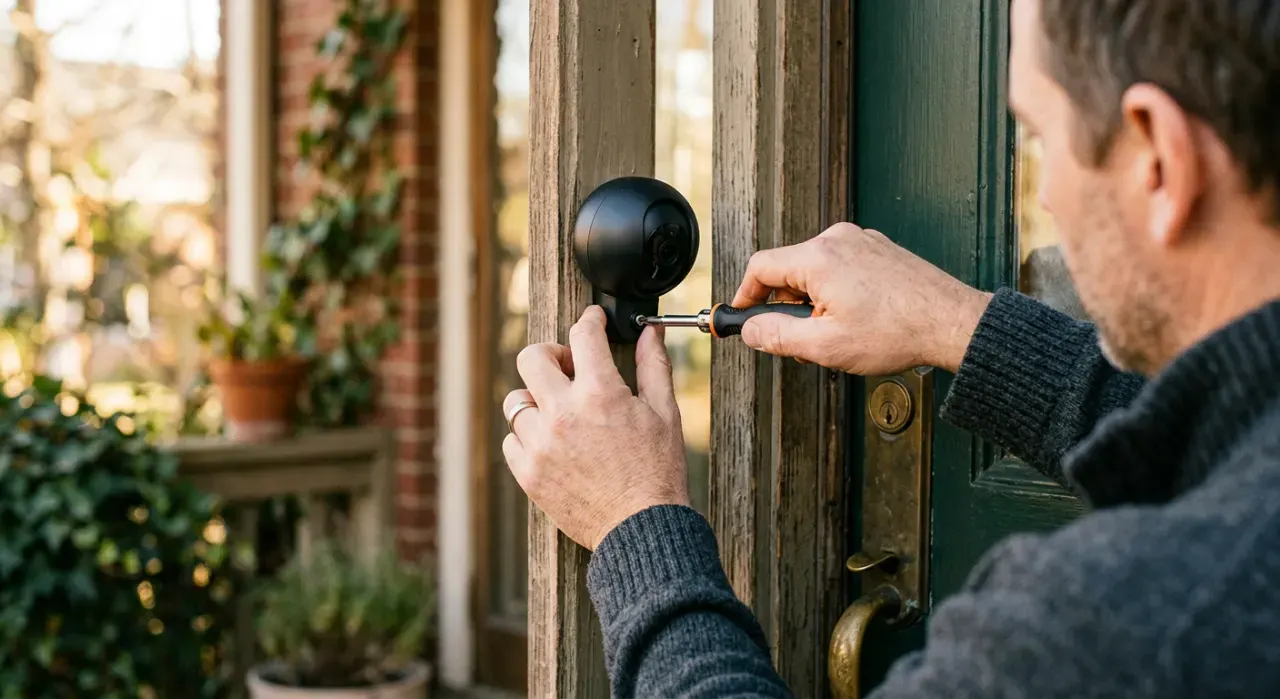
Two rules of thumb save most of the trouble. First, aim the fixture so the light lands on the ground rather than traveling horizontally — a light you can look directly into is a light that is blinding you and your camera. Second, more fixtures at lower output beat one fixture at high output, because even illumination produces fewer black shadows for someone to stand in.
Our #1 Pick: LEPOWER 38W Security Light
The LEPOWER 38W sits exactly where most households need to be. At 4,200 lumens it covers a two-car driveway or a broad side approach without turning the yard into a car dealership forecourt, and it does so on 38 watts, which is roughly what a single old incandescent porch bulb used to draw for a fraction of the output.
The detail that earns it the top spot is that the sensor is aimed independently of the lamp heads. That sounds minor and it is the difference between a light that works and one you eventually disconnect. Fixed-sensor fixtures force you to choose between lighting the right area and detecting in the right area; with a separate sensor you can point the lamps at the driveway and the sensor down at the walkway, so the light comes on when a person arrives rather than when a car passes on the street 60 feet away.
Owners consistently report that the adjustments — time delay, sensitivity, and the dusk threshold that stops it firing in daylight — are usable rather than token, and that the IP65 housing survives real weather. The recurring criticisms are that it is hardwired and therefore needs an existing junction box or an electrician, that the sensor range in the specification is measured in ideal conditions and is shorter across a cold yard, and that like every sealed LED fixture it cannot be re-lamped when the array eventually fails.
Check price on Amazon → (paid link)
The Ranked Field

Best for a driveway, a side path or a back door where there is already a junction box
- 4200 lumens from 38 watts — bright without being a floodlight stadium
- Passive infrared sensing to about 72 feet across a 180-degree arc
- Two adjustable heads plus an independently aimed sensor
- IP65 rated and adjustable for time, sensitivity and dusk threshold
Why buy it: the balance point of the whole category — enough light to cover a two-car driveway, a sensor that can be aimed separately from the lamps, and the largest ownership record among hardwired security lights.

Best for a shed, a gate, a fence line or anywhere with no power and no appetite for trenching
- 2500 lumens across three independently aimed heads
- Integrated solar panel with a remote for mode and timing
- Three modes including a dim-until-triggered setting
- No wiring, no electrician, no permit
Why buy it: three aimable heads is the feature that matters on a solar light, because it lets you put light on a path and a doorway from one mounting point rather than lighting a wall.
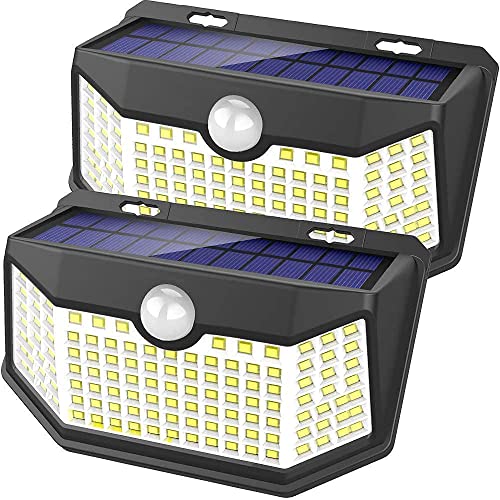
Best for lighting several dark corners of a property cheaply
- Three modes: motion only, dim-to-bright, and constant dim
- One of the largest ownership records of any outdoor light sold online
- IP65 weather rating
- Wall-mounted with two screws, no wiring
Why buy it: the dim-to-bright mode is what makes cheap solar lights genuinely useful — a low glow that shows the path all evening and jumps to full output when something moves.

Best for a wide yard, a barn approach, a parking area or a long back fence
- 7500 lumens — roughly the output of a small parking-lot fixture
- 5000K daylight color, which suits camera footage better than warm light
- Adjustable heads and a separately aimed sensor
- Hardwired, IP65, with a dusk-to-dawn option
Why buy it: the one to buy when the space is genuinely large. Below about 4000 lumens a wide yard simply looks patchy, and no amount of aiming fixes that.
Best for replacing a failed builder-grade fixture with something you can re-lamp instead of replace
- Takes standard screw-in bulbs rather than sealed LED arrays
- Classic twin-head geometry that fits existing mounting holes
- 110-degree detection arc with adjustable time and sensitivity
- Hardwired to a standard outdoor junction box
Why buy it: the only design here you can repair. Sealed LED fixtures are landfill when the array fails; this one takes a new bulb and keeps going, which is why the format has survived decades.
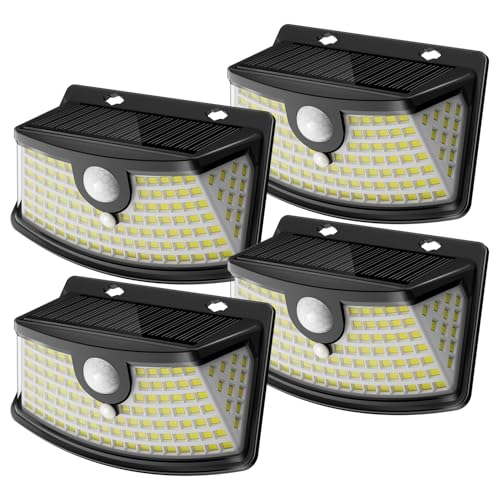
Best for ringing a whole property with light in one purchase
- Four solar units with a 270-degree lighting spread each
- Three modes including dim-until-motion
- Reflector design that spreads light sideways along a wall
- The largest review volume of any solar security light we track
Why buy it: four lights for the price of one hardwired fixture, and the wide 270-degree spread means each unit covers a corner rather than throwing a narrow beam at nothing.
Quick Comparison
| Product | Best for | Rating | Price | Buy |
|---|---|---|---|---|
| LEPOWER 38W LED Security Light, Motion Sensor Outdoor, 4200 Lumens, 72 ft Range, IP65 | Best Overall | — | Check (paid link) | |
| Tuffenough Solar Outdoor Lights, 2500 Lumens, 210 LED, 3 Heads, Motion Sensor with Remote | Best Solar | — | Check (paid link) | |
| HMCITY Solar Lights Outdoor, 120 LED, 3 Lighting Modes, Motion Sensor Wall Light, IP65 | Best Budget | — | Check (paid link) | |
| LUTEC 72W LED Security Light, 7500 Lumens, Motion Sensor, 5000K Daylight, IP65 | Best for Large Areas | — | Check (paid link) | |
| Globe Electric 110-Degree Twin Head Hardwired Motion Sensor Security Flood Light, White | Best Serviceable | — | Check (paid link) | |
| Aootek Solar Motion Sensor Lights Outdoor, 120 LEDs, 270° Wide Angle, 4 Pack, Black | Best Multipack | — | Check (paid link) |
Why the sensor false-triggers, and how to stop it
A passive infrared sensor does not see movement. It sees changes in infrared radiation across a grid of zones, which in practice means it reacts to warm things moving across its field. Understanding that explains every false trigger people report.
- Thermal mass releasing heat. A brick wall, an asphalt driveway or a metal garage door absorbs sun all day and radiates it for hours after dark. As air currents move over it the sensor reads changing heat. This is the leading cause of a light that fires repeatedly on the first warm evening of spring.
- Vents and exhausts. A dryer vent, a furnace flue or an air conditioner condenser produces a moving plume of warm air that is, to a PIR sensor, indistinguishable from a person.
- Vehicles. Engine heat and headlights both trigger. A sensor with any view of a public street will fire all evening.
- Animals. Cats, raccoons, possums and deer are warm and move. Mounting higher and angling down reduces this because the sensor sees less of the ground plane close in.
- Rain and snow. Heavy precipitation crossing a warm background can trigger sensitive units.
The order of fixes that actually works: aim the sensor away from streets, vents and large sun-facing surfaces; drop the sensitivity a step at a time rather than all at once; shorten the on-time to one or two minutes so a false trigger is a brief nuisance; and mount at 8 to 10 feet with the sensor angled down. Mounting higher than about 12 feet is counterproductive — the sensor covers a wider area, sees more warm ground, and detects people less reliably because they occupy fewer zones.
One more piece of PIR physics: a sensor detects movement crossing its field far better than movement coming straight at it. A light aimed down a driveway will trigger late, when the person is nearly at the door. The same fixture rotated so the approach crosses its view will trigger at the right moment. This is the same principle that governs camera placement, covered in where to place security cameras.
Hardwired, solar or battery
| Hardwired | Solar | Battery | |
|---|---|---|---|
| Brightness for the money | Best | Moderate | Lowest |
| Works in midwinter | Always | Reduced, sometimes not at all | Yes, until the cells die |
| Install effort | Junction box or an electrician | Two screws | Two screws |
| Ongoing effort | None | Wipe the panel, clear snow | Replace cells a few times a year |
| Best for | Driveways, entries, anywhere with power | Sheds, gates, fences, detached garages | Interiors, closets, temporary use |
Solar fixtures live or die on panel aim. Face the panel as close to due south as the building allows, tilt it steeply so it catches the low winter sun and sheds snow, and keep it clear of the shade cast by an eave or a bare tree in December that is not there in July. A solar light on a north wall will underperform in every month of the year.
Does lighting actually deter anyone? An honest answer
The figure repeated everywhere is that around 60 percent of burglars say visible security would push them to a different house. That comes from a University of North Carolina at Charlotte survey of convicted burglars, and it is worth knowing that the research was funded by the Alarm Industry Research and Educational Foundation — an industry body with a commercial interest in the result. That does not make it wrong, and it remains the most useful direct evidence available because it asked offenders rather than inferring from crime figures. It does mean it should be treated as indicative rather than as independent confirmation, and we say the same thing wherever it appears on this site, including in do security cameras deter burglars.
What the wider literature supports more confidently is the mechanism rather than the magnitude. Offenders overwhelmingly try to avoid being seen by a person, so lighting helps to the extent that it makes someone visible to somebody. A brightly lit side yard that no neighbor and no street overlooks adds little. The same fixture on a frontage in view of a sidewalk adds a lot. Before buying, ask who would actually see the person the light illuminates — that question predicts the value of the fixture better than its lumen rating does.
Two practical corollaries. Lighting that runs dim all evening and jumps to full on motion is more useful than a light that is simply off, because the change itself is what draws an eye. And light aimed so it does not spill into a neighbor's bedroom keeps that neighbor willing to look out of the window, which is the thing actually doing the work. Many towns and homeowner associations also have ordinances on light trespass and full-cutoff fixtures — worth a check before mounting something at 7,500 lumens.
How We Rank
We never buy, install or physically handle these fixtures. Rankings come from aggregated owner ratings across the most-owned outdoor motion lights, weighted toward reviews written after a full year outdoors where sensor drift, water ingress and LED failures appear, and cross-checked against published specifications for output, detection range and weather rating. Four things carry the weight: whether the sensor can be aimed independently of the lamps, which is the single strongest predictor of satisfaction; real usable output for the intended space rather than a headline lumen figure; weather survival, since these live outside permanently; and serviceability, because a sealed fixture is disposable. Prices were checked at the time of writing. Full method: how we rank.
What Owners Actually Complain About
Triggering all night. The dominant complaint in the category and almost always a sensor aimed at a street, a vent or a sun-warmed surface. Fixable in ten minutes.
Solar output collapsing in winter. Consistent across brands in northern states, and driven by panel angle and shade far more than by which unit was bought.
Sealed LED arrays failing. When an integrated LED fixture dies, the whole fixture is scrap. Owners who valued repairability keep going back to bulb-based twin heads for exactly this reason.
Detection range shorter than advertised. Specified ranges are measured under favorable conditions. In cold weather, where the temperature contrast between a person and the background is large, PIR actually performs better; on a hot night it performs noticeably worse.
Glare complaints from neighbors. A frequent theme, and a genuine one. Aim down, use the shortest on-time that works, and consider a lower-output fixture closer to the area you actually need lit.
The Verdict
For most homes with an existing junction box, the LEPOWER 38W is the buy — correctly sized for a driveway, adjustable where it matters, and with an independently aimed sensor that solves the problem most fixtures create. Step up to the LUTEC 72W only if the space is genuinely large, because on a normal suburban lot it is more light than the job needs.
Where there is no power, the Tuffenough three-head solar is the most flexible option and the HMCITY is the cheap way to light several dark corners at once. If you want a fixture you can still repair in ten years, the Globe Electric twin head takes ordinary bulbs and will outlive every sealed LED unit on this page. Whichever you fit, spend the ten minutes aiming the sensor — it matters more than the model. Check price on Amazon → (paid link)
More from this hub: Smart Home & Security · Best floodlight cameras · Do cameras deter burglars? · Where to place cameras · Best driveway alarms · How we rank