 Garden

Affiliate Disclosure
Some links on this page are affiliate links. As an Amazon Associate, we earn from qualifying purchases — at no extra cost to you. We do not buy, test, or physically handle the products we cover; our rankings come from aggregated owner reviews, ratings and expert consensus. Commissions never change our verdicts. How we rank · full disclosure.
Before storing anything in an unfinished attic, find out what the framing is rated for. Ceiling joists in many homes are sized to support the drywall below and nothing more, and truss-framed roofs are engineered as a system that should not be loaded without professional advice. Once that is settled, the second question is heat: an unconditioned attic commonly runs 30 to 50°F above outdoor air, reaching 130°F or more in a US summer. That rules out photographs, candles, electronics, batteries, paint, vinyl records, leather and anything else with adhesive or a battery in it. Holiday decorations, luggage, camping gear and plastic-safe bulky items are what an attic is genuinely good for.
The structural question, honestly
This is the part most attic storage advice skips. There are two very different situations up there.
Stick-framed roofs use rafters for the roof and separate ceiling joists across the span. Those joists may be 2x6 or 2x8 and may be capable of carrying a modest storage load — or may not, depending on span, spacing and lumber grade. Older homes with 2x4 or shallow 2x6 ceiling joists are frequently not.
Truss-framed roofs, standard in most US construction since the 1970s, are a different matter entirely. A truss is an engineered assembly where every member is sized for a specific role, and the bottom chord is generally designed to support the ceiling, not storage. Trusses should never be cut, notched or drilled, and adding significant load to them is a question for an engineer rather than a weekend project.
Practical signals that an attic is already carrying more than it should: sagging or bowed ceilings in the rooms below, cracks along drywall seams, popped nail or screw heads, and doors that have started sticking. If you see any of those, unload first and ask second.
When in doubt, keep loads light, keep them near the perimeter over load-bearing walls rather than in the middle of the span, spread them out instead of concentrating them, and have a contractor or structural engineer look at it before you build a floor. It is a small cost against a ceiling collapse.
What the attic environment actually does
Three forces act on everything stored up there.
Heat. The Department of Energy has cited summer attic temperatures reaching 150°F. Sustained heat softens adhesives, warps plastics and vinyl, melts wax, degrades rubber and accelerates every chemical reaction inside a battery.
Humidity swings. Attics cycle from hot and dry in the afternoon to cool and damp overnight. That cycling drives moisture in and out of paper, fabric and wood, which is what causes foxing on documents, mildew in textiles and warped wood over a few seasons.
Pests and dust. Rodents, wasps, silverfish and moths all find attics congenial, and cardboard is an invitation rather than a barrier.
| Store it | Do not store it | Why |
|---|---|---|
| Holiday decorations (non-candle) | Candles and wax items | Melt and deform well below attic peak temperatures |
| Hard luggage and suitcases | Photographs, negatives, slides | Emulsion sticks and colors shift permanently |
| Camping and outdoor gear | Vinyl records and tapes | Warp and delaminate in heat |
| Plastic sports equipment | Electronics and appliances | Capacitors, screens and solder joints degrade |
| Metal tools (dry, oiled) | Anything with a battery | Lithium cells degrade and can fail; alkalines leak |
| Ceramics and glassware | Paint, adhesives, aerosols | Separate, cure or become pressure hazards |
| Sealed archival documents | Leather goods | Dry, crack and grow mildew in the damp cycle |
| Empty containers | Musical instruments | Wood movement and glue failure |
| Wine, food, medication | Spoil rapidly; some become unsafe | |
| Wool and fine textiles | Moths, mildew, and heat-set creasing |
Batteries deserve their own line because they are the item people most often get wrong. Nothing with a lithium-ion cell in it — power tool packs, laptops, portable chargers, e-bike batteries, cordless vacuums — belongs in an attic or a hot garage. The related garage case is covered in can you store batteries in a hot garage.
Containers that survive up there
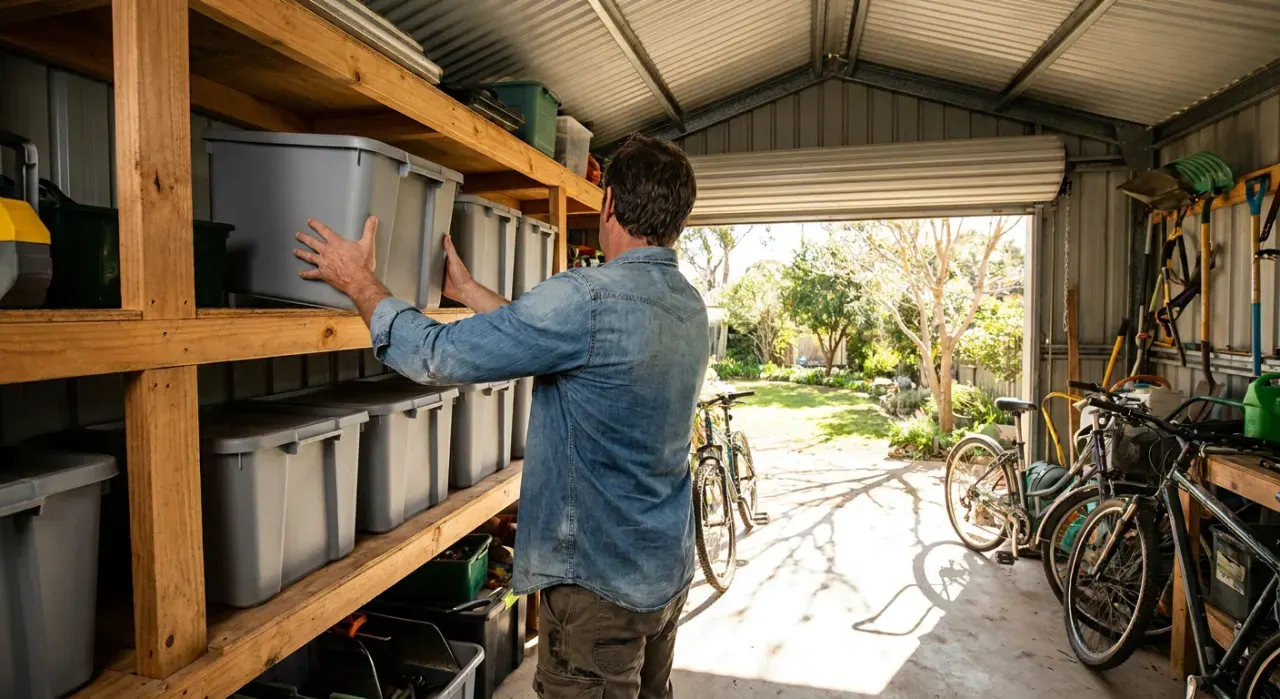
Cardboard fails in an attic. It absorbs humidity, collapses under stacking, and rodents treat it as nesting material. Rigid plastic with a latching lid is the only sensible default.

Best for anything that must stay dry and sealed against dust, insects and humidity swings
- Gasketed lid with latching buckles, not just a friction fit
- Clear body so you can identify contents without opening
- Stacks squarely, which matters on uneven attic decking
- Owners specifically cite them for attic and basement use
Why buy it: a gasketed lid is the difference between storage and slow damage — ordinary snap lids let humid air cycle in and out with every temperature swing.

Best for holiday decorations, camping gear and bulky items where a full weather seal is not critical
- Thicker walls than standard household totes, so they resist warping in heat
- Large capacity keeps the number of trips up the ladder down
- Rated for stacking when the load is even
- Opaque, so contents need labeling on the end
Why buy it: attic heat softens thin plastic and warps lids over a couple of summers — wall thickness is the specification that predicts which totes survive.
Two specifications matter. A gasketed lid with latches, rather than a friction-fit snap lid, keeps humid air from cycling in and out. And wall thickness, because thin plastic softens and warps over a couple of attic summers, and a warped lid no longer seals. Clear bodies help you find things without opening every tote, though opaque bins are fine when the ends are labeled properly — see labeling and bin systems.
Two additions worth making: throw a few silica gel packs into anything sensitive to humidity, and use cedar or a sealed garment bag for the rare textile that has to go up. The ranked field is in best storage bins.
Setting the space up safely
- Establish where you can walk. Step on joists or decking only. Insulation hides everything, and a foot through the drywall is the most common attic injury after ladder falls.
- Do not compress the insulation. Laying decking directly on top of batts crushes them and destroys their R-value, which raises your heating and cooling bill permanently. Where storage is genuinely appropriate, raised platforms that sit above the insulation are the correct approach.
- Keep clear of soffit vents. Blocking them stops the airflow that keeps the roof deck dry and, in cold climates, contributes to ice dams. Leave the baffles at the eaves alone.
- Never block or bury recessed lights, exhaust fans or flues. Some fixtures need clearance for heat, and storing against them is a fire risk.
- Store over load-bearing walls near the perimeter of the span rather than in the middle, and spread the load rather than stacking it all in one place.
- Light it and reach it safely. A work light and a stable ladder, and never carry a load up with both hands occupied. Slide totes up ahead of you.
- Work in the early morning in summer. Attic heat exhaustion is a genuine hazard and it comes on fast.
The annual check worth making
An attic is the part of the house nobody looks at, which is why problems there get found late. Once a year, ideally on a cool morning in fall, go up with a flashlight and check five things:
- Water staining on the underside of the roof deck, particularly around vents, chimneys and valleys. Dark patches or streaks mean a leak, and finding one in October is far cheaper than finding it through the ceiling in January.
- Daylight through the roof or at the eaves, which means a gap something can get through.
- Evidence of rodents or wasps — droppings, chewed insulation, nests. Sealed totes protect the contents; entry points are what needs fixing.
- Insulation that has been compressed or displaced by storage or by foot traffic. Compressed insulation has permanently lost most of its value.
- Anything you stored last year and did not use. This is the single most productive part of the visit, and it is the natural moment to cut the volume rather than add to it.
If you find persistent moisture, mold on the sheathing, or insulation that is damp rather than dusty, that is a ventilation or a roofing question and it needs a professional rather than a dehumidifier.
When something else is the better answer
If the item is temperature-sensitive, valuable, or fragile, the attic is the wrong place and no container fixes that. The alternatives, roughly in cost order: under-bed storage for textiles and flat items (under-bed storage picks), closet upgrades to recover vertical space you already have (small closet layout), garage shelving for anything tolerant of temperature swings but not extremes (best garage shelving), and a climate-controlled rental unit for genuinely irreplaceable items.
The honest framing is that an attic is excellent for bulky, cheap, heat-tolerant things you touch once a year, and actively destructive for everything else. Deciding which category each box falls into before it goes up the ladder saves the annual discovery that something valuable did not survive the summer.
We never buy, test or physically handle the products we rank. Every recommendation is drawn from aggregated owner reviews, star ratings, review volume and published expert consensus — see how we rank.
More from this hub: Storage & Organization · Best storage bins · Labeling and bin systems · How to organize a garage · How we rank