 Garden

Affiliate Disclosure
Some links on this page are affiliate links. As an Amazon Associate, we earn from qualifying purchases — at no extra cost to you. We do not buy, test, or physically handle the products we cover; our rankings come from aggregated owner reviews, ratings and expert consensus. Commissions never change our verdicts. How we rank · full disclosure.
A wall safe is a concealed container, not a strong one — and concealment is a real security mechanism, so that is fine as long as you know it. The steel is thin, the body sits in an open framing cavity, and the whole unit can often be cut free through drywall and carried off intact by somebody who knows where to cut. What it does have is the one advantage no free-standing safe can buy: a burglar in a house for four minutes searches drawers, closets, nightstands and the obvious cabinet, then leaves. He does not survey your walls.
The other thing to settle before you cut a hole in your house is depth. A standard interior wall framed with 2x4s gives you about 3.5 inches. That is the entire category constraint, and it is why every wall safe grows upward instead of inward.
Top Picks at a Glance
A Note on This Category
We normally look for six products with substantial owner bases. In-wall safes do not offer that. Two long-standing keypad models account for the large majority of reviews in the segment, and beyond them the field consists of many similar-looking imports with review counts in the low hundreds, plus a small number of genuinely better-built units from established safe makers at three to four times the price. We have ranked the best of what exists and said so plainly rather than padding the list. If you want a well-reviewed field with a lot of data behind it, a free-standing safe is the better-served category — see our home safe picks.
The Depth Limit, in Numbers
This is the specification that decides whether a wall safe works for you, and it is set by your framing rather than by the product.
| Wall framing | Cavity depth | Usable safe depth | What fits |
|---|---|---|---|
| 2x4 interior partition | 3.5 in | ~2.5–3 in | Documents, cash, jewelry boxes, drives, passports |
| 2x6 wall | 5.5 in | ~4.5–5 in | The above plus a small camera body or a handgun |
| Bay width, 16 in on center | 14.5 in clear | ~13–14 in wide | Legal-size documents landscape, just |
| Bay width, 24 in on center | 22.5 in clear | Wider bodies possible | Less common in modern residential framing |
Two practical consequences. First, measure your contents, not your wall — the disappointment in this category is almost always a laptop or a lens that will not lie flat. Second, height is your only variable, which is why the 25-inch models exist and why they are worth the premium if volume is the point.
Our #1 Pick: In-Wall Safe with Electronic Keypad
This design has been sold in essentially the same form for over a decade and it has the owner base to prove it — nothing else in the category comes close on review volume. That matters here more than usual, because the failure modes of an in-wall unit only show up after installation, and the aggregate record on this one is consistent: the keypad works, the override keys work, and the flange lands where it should.
The flange is the reason to choose it over a cheaper box. It extends past the safe body and screws directly into the studs on both sides of the bay, which means the safe is fastened to the structure rather than hanging in a hole. Owners who mounted one into drywall anchors instead — and some do — report exactly the outcome you would expect from that decision.
What owners consistently praise is that the cutout template works and the finished installation looks flush and deliberate rather than improvised. What they gripe about is the depth, which surprises people despite being clearly specified; the batteries, which live behind the door on most units, making the override keys critical; and the fact that the drywall cut is a genuinely fiddly job if you have never done one. Locate wiring and plumbing before you cut, and expect to spend an hour rather than fifteen minutes.
Check price on Amazon → (paid link)
The Ranked Field
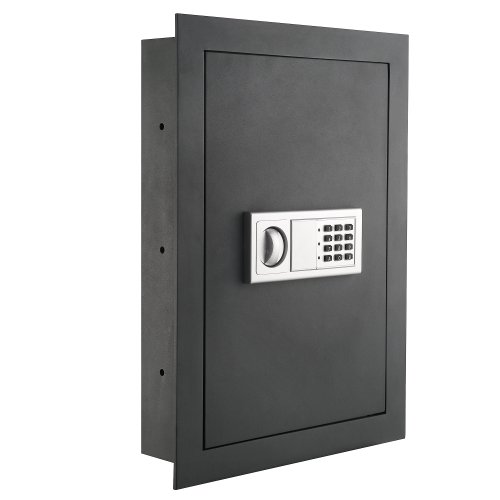
Best for a concealed box for documents, cash and small valuables
- Fits a standard 16 in on-center stud bay
- Electronic keypad with two mechanical override keys
- Mounting flange screws into both studs
- Interior shelf, roughly 3.5 in usable depth
Why buy it: far and away the largest owner base in a thin category, and the flange design is the part that matters — it screws into two studs rather than relying on drywall.

Best for a shallow bay, a partition wall or a closet side wall
- Smaller body for tight framing
- Keypad plus two override keys
- Screw flange for stud mounting
- Fits between 16 in on-center studs
Why buy it: the same design logic in a smaller footprint, which is the version that actually fits when a wall turns out to have a fire block or a wire run in the way.

Best for a concealed safe opened often enough that a keypad becomes friction
- Fingerprint reader with keypad and key backup
- Heavier body and door than budget in-wall units
- Motorized deadbolt latching
- Interior light and adjustable shelf
Why buy it: the only wall safe here built like a safe rather than a steel drawer — the door and latching are a genuine step up, and the price reflects it.

Best for documents standing upright, or a long item that will not lie flat
- 25.6 in tall body spanning most of a stud bay height
- Removable shelf and a hidden tray
- Combination lock
- Marketed as fire resistant by the manufacturer
Why buy it: height is the only dimension a wall safe can grow in — depth is fixed at the stud bay — so a tall body is how you get real volume out of a wall.

Best for the buyer whose whole plan is that nobody looks
- Front plate styled as a wall air return vent
- Combination lock, no electronics or batteries
- Fits between standard 16 in studs
- Removable interior tray
Why buy it: concealment is the actual security mechanism of every wall safe, and a convincing vent cover does more real work than another gauge of steel.

Best for a wall safe that gets opened daily
- Electronic lock with a fast-opening door
- Removable pegboard back for hanging small items
- Adjustable shelves
- Fits 16 in on-center stud bays
Why buy it: the pegboard back is the detail — a wall cavity is shallow and awkward, and hanging items beats stacking them in 3.5 inches of depth.
Quick Comparison
| Product | Best for | Rating | Price | Buy |
|---|---|---|---|---|
| In-Wall Safe with Electronic Keypad and 2 Manual Override Keys | Best Overall | — | Check (paid link) | |
| In-Wall Safe with Keypad and 2 Manual Override Keys, Compact Body | Best Compact | — | Check (paid link) | |
| Viking Security Safe VS-52BLX Hidden Wall Biometric Safe | Best Biometric | — | Check (paid link) | |
| 25.6 in Tall Wall Safe Between 16 in Studs with Combination Lock and Removable Shelf | Best Tall Capacity | — | Check (paid link) | |
| Hidden Wall Safe with Air Vent Cover and Combination Lock | Best Concealment | — | Check (paid link) | |
| Quick Access Electronic Wall Safe with Removable Pegboard and Shelves | Best Quick Access | — | Check (paid link) |
Installing One Without Wrecking the Wall
The safe is the easy part. The wall is where jobs go wrong.
- Choose an interior partition wall. Exterior walls carry insulation, sheathing and usually a vapor barrier, and opening one creates a thermal and moisture problem on top of a carpentry one.
- Find the studs and then find everything else. Use a stud finder with live-AC detection, then drill a small inspection hole and look with a phone camera or a borescope. Electrical runs, plumbing stacks, low-voltage cable and HVAC boots all live in walls, and a reciprocating saw finds them the hard way.
- Check for fire blocking. Horizontal blocking between studs is common in older framing and in tall walls, and it will stop a 25-inch safe dead. The inspection hole tells you.
- Cut to the template, from stud face to stud face. Score the drywall with a utility knife first so the paper does not tear beyond the line, then cut with a drywall saw. A clean cut is what lets the flange sit flush.
- Screw the flange into both studs with the supplied screws, or better ones. Never into drywall anchors. This is the entire structural attachment.
- Do not put it at eye level. Lower or higher than a person scans is free security, and costs nothing to decide before you cut.
If the wall turns out to be full of services, stop and move to a different bay — or reconsider the plan entirely and anchor a free-standing safe instead. The anchor selection logic for that is in anchoring into studs and concrete and the step sequence in how to bolt down a safe.
The Fire Claims
Several in-wall safes are marketed as fireproof or fire resistant. Be skeptical: fire resistance for this class of product is classified under UL 72, Tests for Fire Resistance of Record Protection Equipment, and we are not aware of a consumer in-wall safe that carries that listing. A number that appears nowhere except the product page is a marketing figure.
There is also a physical problem. A wall cavity is a poor location for fire performance: the safe is surrounded by combustible framing, and in a structure fire the cavity behaves like a flue. Burglary resistance is likewise a separate matter, tested under UL 1037, Antitheft Alarms and Devices, and no product here carries an RSC listing that we can verify. If documents need fire protection, buy a rated free-standing safe — the reasoning is set out in are fireproof safes actually fireproof?
The Field, Reviewed
1. In-Wall Safe with Electronic Keypad — Best Overall
Covered above. Owners praise: the flange that screws into studs, a template that matches the cutout, a flush finished look, and a keypad that keeps working. Owners gripe about: shallow depth, batteries behind the door, and a drywall cut that takes longer than expected. Check price (paid link).
2. In-Wall Safe, Compact Body — Best Compact
The version to buy when the wall does not cooperate. Same flange-and-keypad logic in a smaller body, which fits bays interrupted by blocking, a wire run or a shallow partition.
Owners praise: easier installation, the smaller cutout, and the same override-key redundancy. Owners gripe about: genuinely small interior volume, and that documents have to be folded. Check price (paid link).
3. Viking VS-52BLX — Best Biometric
The only unit here built to safe standards rather than cabinet standards. Heavier body and door, motorized deadbolt latching, a fingerprint reader with keypad and key backup, and an interior light. It costs three times the budget options and the construction difference is visible.
Owners praise: door and latch quality, fast biometric reads, and the interior light. Owners gripe about: the price, the weight during installation, and battery consumption from the motorized lock. Check price (paid link).
4. 25.6 in Tall Wall Safe — Best Tall Capacity
Height is the only way to get volume out of a wall, and this is the practical version of that idea. A tall body with a removable shelf and a hidden tray, spanning most of a bay. Verify there is no fire blocking in your chosen bay before ordering — a 25-inch body is exactly what blocking defeats.
Owners praise: real usable capacity, the removable shelf, and the concealed tray. Owners gripe about: the large cutout, unverifiable fire claims, and a combination lock that is slower than a keypad. Check price (paid link).
5. Hidden Wall Safe with Air Vent Cover — Best Concealment
A safe whose front plate looks like a wall air return. It is the most honest product in the category, because it puts its effort into the mechanism that actually works. A mechanical combination means no batteries and nothing to fail.
Owners praise: how convincing the vent looks in place, no electronics, and small enough to fit almost anywhere. Owners gripe about: small capacity, a combination that is slow in the dark, and that a vent in an odd location invites a second look. Check price (paid link).
6. Quick Access Electronic Wall Safe — Best Quick Access
Designed around the reality of a shallow cavity: a removable pegboard back lets you hang keys, chains and small items instead of stacking them three inches deep, and adjustable shelves make the rest of the space usable.
Owners praise: the pegboard, shelf adjustability, and a door that opens quickly. Owners gripe about: a smaller owner base than the established keypad models, and battery access behind the door. Check price (paid link).
What Owners Actually Complain About
The cutout. The most common complaint is not about the safe at all. Cutting a clean rectangle in drywall between two studs is fiddlier than it looks, and a ragged cut leaves a flange that does not sit flush.
Depth. Repeatedly, despite being clearly specified. Three and a half inches is not much.
Batteries behind the door. Same failure story as every keypad safe: battery dies, keypad dead, override key missing. Keep the keys in a different room.
Services in the wall. Owners who found a pipe or a cable with a saw. An inspection hole costs nothing.
Fire claims. Buyers who assumed a marketed fire rating was a listed one.
How We Rank
We do not buy, install or attack these safes. Rankings come from aggregated owner ratings across the in-wall safes with meaningful review volume on the US market, weighted toward reviews written after installation rather than on arrival, and cross-checked against published specifications and the text of UL 72 and UL 1037. Four things carry the weight: how the unit attaches to the structure, since the flange is the entire security of the installation; usable interior dimensions against the fixed cavity depth; lock redundancy; and concealment quality, because that is the mechanism actually doing the work. Prices were checked at the time of writing. Full method: how we rank.
The Verdict
Buy the standard in-wall keypad safe for the largest owner base and a flange that fastens to two studs. Pay up for the Viking VS-52BLX if you want a door and latch built to safe standards. Choose the vent-cover model if concealment is genuinely your plan, which it should be — that is where a wall safe earns its keep. And treat it as a layer rather than a solution: for anything irreplaceable, an anchored, rated free-standing safe is the stronger container, and a copy of anything digital belongs somewhere else entirely. Check price on Amazon → (paid link)
More from this hub: storage & organization · best home safe · where to hide a safe in a house · best fireproof safe · how to bolt down a safe · how we rank.