 Garden

Affiliate Disclosure
Some links on this page are affiliate links. As an Amazon Associate, we earn from qualifying purchases — at no extra cost to you. We do not buy, test, or physically handle the products we cover; our rankings come from aggregated owner reviews, ratings and expert consensus. Commissions never change our verdicts. How we rank · full disclosure.
Work in this order: empty it completely, sort ruthlessly, define zones, install vertical storage, then buy containers last. Almost every garage that gets reorganized and then unravels within six months did it in the reverse order — bought bins first, filled them, and put them back on the same floor. Budget two weekends for a two-car garage: one to empty and sort, one to install and refill. The finished state to aim for is nothing on the floor except what parks there, everything in a fixed home, and about 20 percent slack in the system so the next thing has somewhere to go.
Weekend one: empty and sort
Take everything out. Not most of it — everything. Sorting around the edges of a full garage produces a tidier version of the same garage, because you can only make decisions about what you can see all at once.
Pick a dry forecast, start early, and lay it out on the driveway in four groups: keep, donate or sell, dispose, and belongs somewhere else in the house. That last pile is usually bigger than people expect and it is free space.
Be honest in four specific categories: broken things you have not repaired in a year, duplicates beyond one spare, degraded products (separated paint, dried adhesive, expired chemicals, cracked hose), and the equipment of hobbies you have not touched in two years. That is typically a third of the volume, and none of it deserved a bin.
While the floor is clear, do the maintenance that is impossible otherwise: sweep and wash the slab, check for water ingress at the door seal, look for evidence of rodents, and test that the garage door auto-reverse safety sensors work. Fix anything you find now rather than after the shelves go up.
Dispose of chemicals properly. Old paint, solvents, pesticides, pool chemicals and automotive fluids are household hazardous waste in most US municipalities and cannot go in the trash. Nearly every county runs a drop-off or a collection event; check yours before the pile hits the curb.

Weekend two: zone before you install
A garage that stays organized is one where every item has an obvious address. Four zones cover most households, and the assignment is driven by frequency of use rather than by category.
| Zone | Where | What lives there | Storage type |
|---|---|---|---|
| Daily / grab-and-go | By the house door | Trash and recycling, dog leash, sports bag, shoes | Hooks and a low shelf |
| Frequent | Knee to shoulder height, back wall | Hand tools, cleaning supplies, hardware, car care | Freestanding shelving, cabinets |
| Occasional | Above shoulder, side walls | Yard tools, power tools, paint, spare parts | Wall-mounted shelving, pegboard |
| Seasonal / rare | Overhead | Holiday decorations, luggage, camping gear | Overhead racks |
The rule that makes this work: the prime real estate between knee and shoulder height goes to what you touch weekly, not to what is biggest or heaviest. Seasonal items get sent up. Long, awkward items — rakes, shovels, ladders, bikes — go vertical on the wall, where they occupy almost no floor.
Mark out the parking envelope before installing anything. Park the car, open both doors fully, and tape the floor. Everything you build has to live outside those lines, and finding that out after the shelving is lagged to the wall is a bad afternoon.
Get everything off the floor
The phase that produces the visible transformation. Three types of storage do different jobs and most garages want all three — the trade-offs are set out in wall vs freestanding vs overhead.

Best for the first purchase in almost any garage — vertical capacity before anything else
- Gets everything off the floor, which is the entire first phase of the job
- Adjustable shelf heights so bin sizes can change later
- No drilling, so it works in a rental or before you commit to a layout
- Strap tall units to a stud once loaded
Why buy it: people buy containers first and shelving second, and it is backwards — the shelf decides what bin fits, not the other way around.

Best for a single stackable size that fits standard shelving and survives temperature swings
- One size across the garage means everything stacks and interchanges
- Thicker walls than budget totes, so they resist warping in summer heat
- 18 gallons stays liftable when full, unlike 30-gallon boxes
- Opaque, so label the ends rather than the lids
Why buy it: mixed bin sizes are why tidy garages unravel — nothing stacks squarely and every shelf ends up with wasted air above it.
Buy in this order: freestanding shelving along the back wall first, because it is the cheapest capacity per dollar and needs no drilling. Overhead racks second, over the parking bays, for the seasonal bins currently eating floor space. Wall-mounted shelving third, once you know where you actually walk. Pegboard or slatwall last, for hand tools and the awkward items.
Two safety items are not optional. Strap any freestanding unit over about five feet tall to a wall stud — loaded high, they become top-heavy, and the CPSC has repeatedly warned about tip-overs. And fasten overhead racks into the center of ceiling joists with the supplied hardware, verified with a pilot hole. The method for both is in anchoring into studs and concrete, and the load figures in shelf weight ratings explained.

Containers, last and standardized
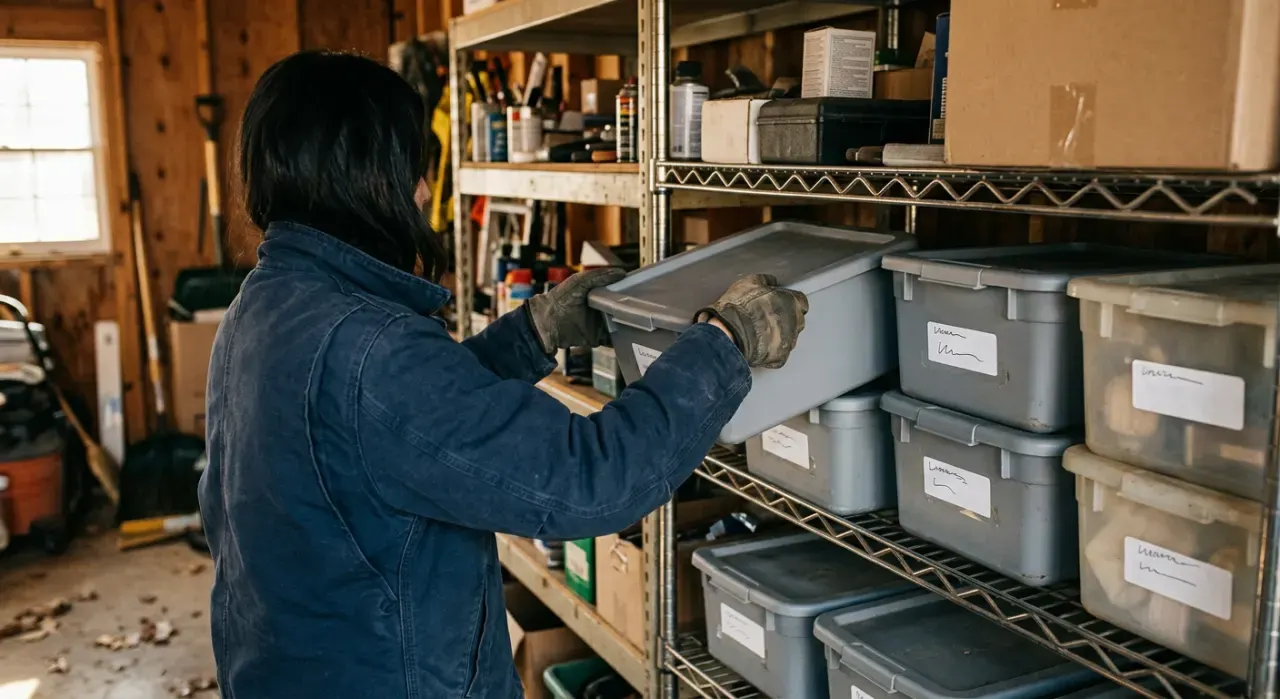
Now measure the shelf openings and buy one bin size that fits them. A single size means everything stacks squarely, interchanges between shelves, and never leaves four inches of dead air above it. Mixed sizes are the single most common reason a tidy garage looks chaotic again within a year.
- Clear bins for anything you access more than twice a year; opaque is fine for seasonal.
- Label the end, not the lid. On a shelf, the end is the only face you will ever see. Details in labeling and bin systems.
- Keep bins liftable. An 18-gallon tote full of tools is manageable; a 30-gallon one is not, especially overhead.
- Gasketed lids for anything sensitive to humidity, particularly in an unconditioned garage.
- Heavy low, light high. Always, and especially on freestanding units.
The ranked field is in best storage bins.
Hazardous materials and the things that should not be out there at all
A garage is an unconditioned space that frequently contains a water heater, a furnace, or a car. That combination sets some rules.
- Gasoline only in an approved container, in the quantity your local fire code permits, away from any ignition source or pilot light.
- Paint, solvents, pool chemicals, fertilizer and pesticides in a locked or high cabinet, in original labeled containers, out of reach of children and pets.
- Propane cylinders outdoors, not in an attached garage.
- Batteries indoors. Heat degrades lithium-ion cells and makes alkalines leak — see can you store batteries in a hot garage.
- Nothing stored against the furnace or water heater, which need clearance for combustion air and heat.

What it costs, realistically
For a two-car garage in 2026, a workable range is $400 to $900 in materials, spread over the two weekends. A rough allocation:
- $120–$300 — two to three freestanding steel shelving units, which is where most of the capacity comes from
- $180–$250 — one overhead rack, if the ceiling allows it
- $80–$200 — one bin size, bought in quantity after the shelving is up
- $40–$120 — pegboard or slatwall, hooks, and bike or ladder hangers
- $20–$60 — anchoring hardware, labels and shelf liners
The order matters more than the total. Buying shelving first and containers last is what keeps the bin spend efficient, because you buy one size that fits rather than an assortment that mostly does not. If the budget is tight, freestanding shelving alone delivers most of the visible improvement, and the rest can wait a season.
Keeping it that way
Three design decisions do more than any amount of resolve.
One fixed home per item. If putting something away requires deciding where it goes, it will end up on the floor. Deciding once, permanently, removes the decision.
Twenty percent slack. A system filled to capacity has nowhere to put the next thing, and the next thing always arrives. Leave a shelf empty and one bin unallocated.
A ten-minute reset, monthly. Put back whatever has drifted, break down the boxes, and note anything that has no home. It is short enough to actually happen and it catches drift before it compounds.
Add a seasonal review twice a year when the holiday bins come down anyway — that is the natural moment to reassess what went back up untouched last year.
We never buy, test or physically handle the products we rank. Every recommendation is drawn from aggregated owner reviews, star ratings, review volume and published expert consensus — see how we rank.
More from this hub: Storage & Organization · Wall vs freestanding vs overhead · Best garage shelving · Storing things in a hot attic · How we rank