 Garden

Affiliate Disclosure
Some links on this page are affiliate links. As an Amazon Associate, we earn from qualifying purchases — at no extra cost to you. We do not buy, test, or physically handle the products we cover; our rankings come from aggregated owner reviews, ratings and expert consensus. Commissions never change our verdicts. How we rank · full disclosure.
The horsepower number on a shop vac box is not a measurement of anything you will experience. You do not have to take our word for it — Shop-Vac publishes the disclaimer itself. On its own product pages the company states that "Peak Horsepower (PHP) is a term used in the wet-dry vacuum industry for consumer comparison purposes. It does not denote the operational horsepower of a wet-dry vacuum but rather the horsepower output of a motor, including the motor's inertial contribution, achieved in laboratory testing. In actual use, Shop-Vac motors do not operate at the peak horsepower shown." (shopvac.com)
The arithmetic makes it plainer. One horsepower is 746 watts. A shop vac drawing 12 amps on a 120-volt household circuit consumes about 1,440 watts, which is under two horsepower even if the motor were perfectly efficient — and it is not. Every "5 peak HP" and "6.5 peak HP" badge on the shelf describes an instant of inertial spin-up in a lab, not the machine sucking up your sawdust.
So what should you shop on? Three things, in this order: hose diameter, filtration matched to the mess, and sealed suction plus CFM where the manufacturer bothers to publish them.
Top Picks at a Glance

Hose Diameter: The Spec That Decides Whether It Clogs
Nearly every "this vac has no power" complaint is a clog, and nearly every clog is a hose too narrow for the debris. Shop vac hoses come in three common bores and they behave like three different tools.
| Hose bore | Relative airflow | What it is for | What it jams on |
|---|---|---|---|
| 1-1/4 inch | Lowest volume, highest velocity | Car interiors, seat seams, bench tops, stairs | Wood offcuts, wet leaves, insulation, anything fibrous |
| 1-7/8 inch | Middle | General garage and jobsite cleanup, most tool ports | Larger chips, clumped wet debris, drywall scraps |
| 2-1/2 inch | Highest volume | Sawdust, leaf litter, standing water, remodel debris | Very little — it will pass a fist-sized offcut |
Airflow through a pipe scales roughly with cross-sectional area, so a 2-1/2 inch hose has about 1.8 times the area of a 1-7/8 inch and nearly four times that of a 1-1/4 inch. That is why the CRAFTSMAN 16-gallon publishes 190.8 CFM while a mid-size 6-gallon on a 1-7/8 inch hose publishes 80 CFM. The motors are not that different; the plumbing is.
The corollary matters too: a wide hose is the wrong choice for a car. Low velocity will not lift grit out of carpet pile. If you own one vac and mostly clean vehicles, buy the small one and accept that it is not a workshop machine.
Our #1 Pick: CRAFTSMAN CMXEVBE17595
This is the machine that does not annoy you. A 16-gallon tank means you empty it after a project instead of during one, and the 2-1/2 inch hose means it does not stop mid-job because a wet leaf clump bridged the bore. CRAFTSMAN publishes 190.8 CFM for it, which is the honest reason it feels stronger than smaller vacs rather than the 6.5 peak HP badge.
Practical details that owners keep returning to: the drain port is large enough to actually empty water without wrestling a full drum, the blower port turns it into a leaf blower for a garage floor or a gutter run, and the Qwik Lock filter system means changing the cartridge does not involve a screwdriver and a lost wingnut.
What owners gripe about is consistent and worth knowing before you buy. It is loud — genuinely loud, the way all high-CFM shop vacs are. It is bulky, and the casters are the weak point on a rough concrete floor. And the supplied cartridge filter is not a fine-dust filter: if your first job is sanding drywall, order dust bags at the same time or you will spend an hour cleaning gypsum off the walls of the room you just cleaned.
Check price on Amazon → (paid link)
The Ranked Field

Best for a garage or workshop that has to swallow sawdust, leaves and standing water
- 2-1/2 inch hose — the widest common size, and the reason it does not clog
- Manufacturer-published 190.8 CFM airflow
- 16-gallon poly tank with a large drain for liquids
- Built-in blower port and Qwik Lock filter fastening
Why buy it: the hose is the real specification here. A 2-1/2 inch hose moves roughly twice the air of a 1-7/8 inch hose and will pass a wood offcut or a wet leaf clump that jams narrower machines — which is what owners actually mean when they say a vac has "no power".

Best for a first shop vac, a car-and-garage vac, or a second unit for the basement
- 6-gallon tank in a compact footprint
- Wet and dry pickup with a foam sleeve for liquids
- Onboard accessory storage and a short cord run
- One of the most-owned wet/dry vacuums in the United States
Why buy it: the ownership record is enormous, which is worth more than a spec sheet: the failure modes on this machine are documented by an unusually large body of long-term owners rather than a handful of reviews.
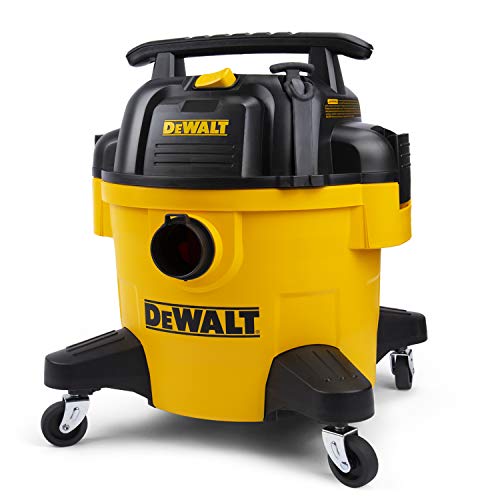
Best for a jobsite or garage vac you carry between tasks and also use as a blower
- Manufacturer-published 80 CFM airflow and 50 inch water lift
- 1-7/8 inch x 7 foot hose with two extension wands
- Blower function through a dedicated port
- Four swivel casters and a full-width carry handle
Why buy it: DEWALT is one of the few brands that publishes both CFM and water lift rather than only a peak-horsepower badge, and 50 inches of sealed suction on a 6-gallon body is a genuinely useful combination for wet pickup.

Best for car interiors, a shop bench, stairs and anywhere a 16-gallon drum will not go
- 2.5-gallon tank, light enough to carry one-handed
- 1-1/4 inch hose for crevice and upholstery work
- Wall-hangable body with onboard accessory storage
- Wet and dry pickup with a reusable filter
Why buy it: the small hose that makes it useless for wood chips is exactly what makes it good in a footwell — narrow bore raises air velocity, which is what lifts grit out of carpet pile and seat seams.

Best for drywall sanding, concrete grinding, tile cutting and remodel dust
- 12-gallon steel tank with 2-1/2 inch accessories
- Pleated cartridge filter designed to take a fine-dust bag
- Two-stage motor built for extended running
- Blower port and heavy-duty caster base
Why buy it: fine dust is where cheap shop vacs fail, because gypsum and concrete powder pack a standard filter in minutes and then blow straight through the exhaust. A machine that accepts a fine-dust filter bag over the cartridge is doing something the horsepower number cannot describe.

Best for a garage attached to a bedroom, or anyone who works with the door open
- Sound-damped housing aimed squarely at the noise complaint
- 6-gallon tank with wet and dry pickup
- Standard DEWALT hose and accessory compatibility
- Blower port retained
Why buy it: noise is the single most common complaint about every shop vac ever sold, and it is the one thing no amount of extra horsepower fixes. Worth flagging honestly: this is a newer model, so its owner record is much thinner than the Stanley or the CRAFTSMAN above.

Quick Comparison
| Product | Best for | Rating | Price | Buy |
|---|---|---|---|---|
| CRAFTSMAN CMXEVBE17595 16 Gallon 6.5 Peak HP Wet Dry Shop Vacuum | Best Overall | — | Check (paid link) | |
| Stanley SL18116P Wet/Dry Vacuum, 6 Gallon, 4 Peak Horsepower | Best Value | — | Check (paid link) | |
| DEWALT DXV06P Shop Vacuum 6 Gal 4 Peak HP Poly Wet/Dry Vacuum with Blower | Best Mid-Size | — | Check (paid link) | |
| CRAFTSMAN CMXEVBE17250 2.5 Gallon 2.5 Peak HP Wet Dry Shop Vacuum | Best Compact | — | Check (paid link) | |
| Vacmaster Professional Beast VJH1211 PF 12 Gallon 5.5 Peak HP Wet/Dry Vac | Best for Fine Dust | — | Check (paid link) | |
| DEWALT STEALTHSONIC Wet Dry Shop Vac 6 Gallon, 5 Peak HP, Ultra Quiet | Best Quiet Option | — | Check (paid link) |
Filtration: Match It to the Mess, Not to the Price
A shop vac's filter is not one product. Four types exist and using the wrong one is how people conclude their machine is broken.
- Pleated cartridge filter. The default. Fine for sawdust, leaves, general grit. Packs solid on gypsum and concrete powder.
- Foam sleeve. For wet pickup. On most machines the cartridge comes out and this goes on instead.
- Fine-dust collection bag. A bag inside the tank that catches powder before it reaches the cartridge. This is the single cheapest upgrade in the category and the one most owners skip.
- HEPA-rated filter. Necessary for silica-bearing dust from concrete, mortar or tile. OSHA's construction silica rule (29 CFR 1926.1153) defines HEPA as at least 99.97 percent efficient on 0.3-micrometer particles, and its silica standard specifies dust collection at that level for cutting and grinding masonry. This is a health specification, not a comfort one.
If you already own a household vacuum with a sealed HEPA system, the same logic applies there — see whether you can wash a HEPA filter before you rinse anything.
Using It Wet Without Killing It
Wet pickup is the whole reason to own this class of machine, and it is also where the mistakes are. The sequence is fixed: unplug, remove the paper or cloth collection bag entirely, then either take out the pleated cartridge or fit the foam sleeve according to the manual. Vacuuming water through a dry cartridge soaks the pleats, collapses the media and can carry moisture toward the motor bearings.
Two safety points that get skipped. First, plug into a GFCI-protected outlet any time you are picking up standing water, and do not work in a room where a live circuit is submerged — kill the breaker first. Second, a shop vac holds water; with rare exceptions it does not pump it. A 16-gallon tank of water weighs about 130 pounds, which is why a drain port matters more than a big number on the label. None of the machines here pumps continuously through a garden-hose outlet; if you need that, look specifically for a model described as having a pump, not just a drain.
What you must never vacuum, wet or dry: gasoline or any flammable liquid, fireplace or stove ash that could still hold an ember, and drywall mud that has not dried. Ash requires a dedicated ash vac with a metal canister.
How We Rank
We do not buy, run or physically handle these machines. Rankings come from aggregated owner ratings across the most-owned wet/dry vacuums, weighted toward long-ownership reviews where hose cracking, filter clogging and motor failure appear, and cross-checked against manufacturer-published airflow, sealed-suction and hose specifications. Four things carry the weight: hose bore and published CFM rather than peak horsepower; filtration options, because a machine that accepts a fine-dust bag and a HEPA filter is a different tool from one that does not; practical handling — drain port, blower port, caster quality, cord length; and the depth of the owner record, since a recently launched model tells you far less than one with years of accumulated long-term reviews. Prices were checked at the time of writing. Full method: how we rank.
What Owners Actually Complain About
Noise, above everything. High-CFM shop vacs are loud enough that hearing protection is a reasonable habit, and no amount of extra horsepower changes that. The sound-damped models exist precisely because this is the number one gripe.
Filters clogging on fine dust. The second most common complaint, and almost always a filter mismatch rather than a fault. Buy dust bags with the machine.
Hoses cracking at the cuff. The hose end that twists in the port is a stress point, and cold garages make it worse. Owners across every brand report this as the first part to fail.
Casters on rough concrete. Small plastic swivel casters on a 16-gallon drum full of water are the weakest link on nearly every large machine.
Expecting dust-extractor behavior. A shop vac is not a dust extractor: it has no automatic filter pulse and no variable suction, so hooking one to a sander and expecting hours of unattended running ends in a packed filter.
The Verdict
Buy on hose diameter and filtration, ignore the horsepower badge entirely. For a garage that sees sawdust, leaves and water, the CRAFTSMAN CMXEVBE17595 is the machine to get, with a box of fine-dust bags in the same order. The Stanley SL18116P is the honest budget answer and has the deepest ownership record here. If your real job is cars and benches, the small CRAFTSMAN CMXEVBE17250 with its narrow high-velocity hose will do it better than any drum. And if the mess is drywall or concrete, the filter matters more than the machine. Check price on Amazon → (paid link)
More from this hub: Vacuums & Floor Care · best wet/dry vacuum · best vacuum cleaners · how to clean a vacuum filter · how to unclog a vacuum hose · how we rank.