 Garden


Affiliate Disclosure
Some links on this page are affiliate links. As an Amazon Associate, we earn from qualifying purchases — at no extra cost to you. We do not buy, test, or physically handle the products we cover; our rankings come from aggregated owner reviews, ratings and expert consensus. Commissions never change our verdicts. How we rank · full disclosure.
Wet/dry vacuums are sold on the one number that describes nothing you will experience. "Peak horsepower" is a laboratory figure for the instant of motor spin-up, and Shop-Vac's own published disclaimer says its motors "do not operate at the peak horsepower shown" in actual use. The honest specifications are sealed suction (water lift, in inches), CFM, hose bore, and — for anyone who bought the machine because of the word "wet" — how you get the water back out.
That last one gets ignored and it is the practical difference between a useful machine and a heavy bucket. Water weighs 8.34 pounds per gallon. A full 10-gallon tank is 83 pounds of sloshing liquid you are being asked to lift and tip. Whether the tank has a drain port matters more than whether it claims four horsepower or six.
Top Picks at a Glance
The Water Math Nobody Prints on the Box
Choose a tank size by what you can physically handle, not by what sounds generous. The float shut-off also trips before the tank is genuinely full, so usable capacity is roughly 80 percent of the rating.
| Tank | Usable liquid | Weight when full | Realistic handling |
|---|---|---|---|
| 2 gallon | ~1.6 gal | ~13 lb | Carry with one hand, empty in a sink |
| 2.5 gallon | ~2 gal | ~17 lb | Carry and tip easily |
| 5 gallon | ~4 gal | ~33 lb | Two hands, tip over a floor drain |
| 9 gallon | ~7.2 gal | ~60 lb | Drag, do not lift; drain port preferred |
| 10 gallon | ~8 gal | ~67 lb | Drain port effectively required |
| 16 gallon | ~12.8 gal | ~107 lb | Do not attempt to lift full |
Read that once and the shopping decision changes. Most households would be better served by a 2-gallon cordless unit for spills plus a mid-size drum for the garage than by one giant tank they dread emptying.
Our #1 Pick: STANLEY SL18115, 5 Gallon Stainless
For a machine bought specifically because it says "wet" on the label, a stainless tank is the upgrade that pays off years later. Poly drums do not corrode, but they crack under impact in a cold garage; painted steel drums rust at the seam, and once a wet/dry vac has a rust bloom inside it, everything you pick up afterward gets streaked. Stainless sidesteps both problems, and the owner record on this machine reflects it — the long-ownership reviews are notably free of tank complaints.
Five gallons is also the right compromise for water. Full, it is about 42 pounds — heavy but tippable — and it will absorb a decent laundry overflow or a water heater drain-down without a mid-job empty. The blower function is not a gimmick either: blowing a garage floor dry after a wet pickup, or clearing a gutter run from a ladder, is a genuine second use.
What owners gripe about: it is loud, the supplied hose is shorter than you want the first time you need it, and — as with every machine in this class — you must remember to pull the cartridge filter and fit the foam sleeve before you touch water. People who skip that step and then report weak suction are describing a soaked filter, not a faulty vac.
Check price on Amazon → (paid link)
The Ranked Field

Best for flooded basements, laundry overflows, water heater failures and gutter runs
- Stainless steel tank — no rust seam to chase after wet jobs
- 5-gallon capacity, about 42 pounds of water when full
- Three-in-one wet, dry and blower operation
- Foam sleeve supplied for liquid pickup
Why buy it: wet work is where tanks fail, and a stainless drum removes the single most common long-term complaint about wet/dry vacs — a rust bloom that starts at the seam and stains everything you pick up afterward.
Best for the household that wants one machine for the garage, the car and the odd flood
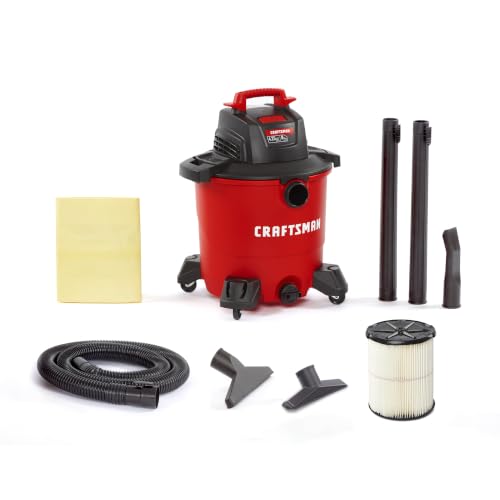
- 9-gallon poly tank — the sweet spot between capacity and portability
- 2-1/2 inch hose and accessories
- Blower port and onboard accessory storage
- Drain and dust bag both supported
Why buy it: nine gallons is the size most people should buy: enough to finish a wet job without emptying, small enough that a full tank is still liftable at roughly 75 pounds of water.
Best for car detailing, jobsites with no power, and spills you want to reach in 20 seconds
- Runs on 20V MAX batteries — no cord, no outlet hunt
- 2-gallon tank with wet and dry pickup
- Wall-mountable and light enough for one hand
- Sold bare tool on some listings — check whether a battery is included
Why buy it: the vac you actually use is the one you can grab without unwinding a cord, and for the wet pickup people really do at home — a mug of coffee, a pet accident, a leaking under-sink trap — two gallons and no cord beats sixteen gallons in the garage.

Best for repeated large water volumes — a sump failure, a finished basement, a flooded crawlspace
- 10-gallon tank with a built-in drain port
- Blower function and multiple wands
- Poly body that cannot corrode
- Long clean-range hose and cord combination
Why buy it: the drain is the feature. Ten gallons of water weighs about 83 pounds, and the difference between a drain port and tipping a full drum over a floor grate is the difference between a manageable job and a wet-shoe disaster.

Best for a garage bay or workshop where a hose on the wall gets used and a drum on the floor does not
- Mounts to the wall with a long hose reach
- 2.5-gallon tank, wet and dry capable
- Blower port and integrated accessory holders
- Keeps floor space clear in a single-bay garage
Why buy it: a wall-mounted vac with a permanently connected hose removes the friction that keeps most shop vacs in the corner — the whole job becomes pulling a hose off a hook.
Best for vehicle interiors, footwells, seat seams and trunk carpet
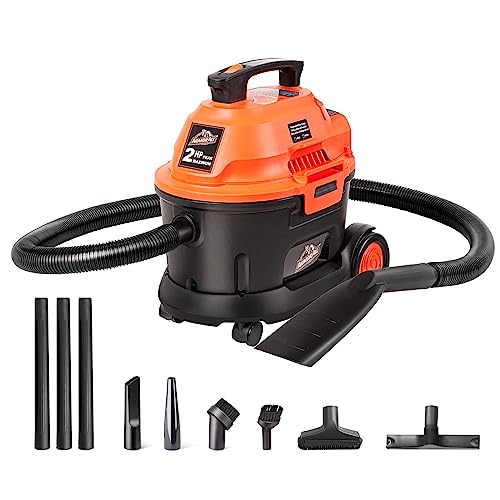
- 2.5-gallon tank sized for a trunk or a garage shelf
- Narrow-bore hose for high air velocity in tight spaces
- Blower function for drying and blowing out vents
- Detailing nozzle set included
Why buy it: the narrow hose that makes it useless for wood chips is exactly right for car carpet: a small bore raises air speed, and speed is what pulls sand out of pile that a wide 2-1/2 inch hose glides over.

Quick Comparison
| Product | Best for | Rating | Price | Buy |
|---|---|---|---|---|
| STANLEY SL18115 Shop Vacuum 5 Gallon 4 Peak HP Wet/Dry Vac with Blower | Best Overall for Wet Work | — | Check (paid link) | |
| CRAFTSMAN CMXEVBE17590 9 Gallon 4.25 Peak HP Wet Dry Shop Vacuum | Best All-Rounder | — | Check (paid link) | |
| DEWALT 20V MAX Cordless Shop Vac, Portable 2 Gallon Wet Dry Vac | Best Cordless | — | Check (paid link) | |
| STANLEY 10 Gallon Wet Dry Vacuum, 6 Peak HP Poly with Built-in Drain | Best for Big Water | — | Check (paid link) | |
| Vacmaster VOM205P 2.5 Gallon 2 Peak HP Wall Mount Wet/Dry Vacuum | Best Wall-Mount | — | Check (paid link) | |
| Armor All AA255W 2.5 Gallon 2 Peak HP Wet/Dry Utility Vac | Best for Cars | — | Check (paid link) |
Sealed Suction vs CFM, in Plain English
These two figures pull against each other and you need both.
- Sealed suction (water lift), in inches. How far the motor lifts a column of water with the hose fully blocked — zero airflow. High water lift is what drags liquid up a hose and pulls dense, wet material out of a corner. A mid-size 6-gallon machine typically publishes around 50 inches; a small cartridge Shop-Vac publishes 68 inches of sealed pressure at 11.6 amps.
- CFM, cubic feet per minute. The volume of air moved at a stated restriction. High CFM sweeps large volumes of light debris. A 16-gallon on a 2-1/2 inch hose can publish around 190 CFM; a 6-gallon on a 1-7/8 inch hose around 80 CFM.
- Air watts. A combination of the two, and the fairest single comparator when a manufacturer publishes it.
Suction pressure falls as airflow rises, which is why no machine maximizes both. Wet pickup and dense debris want water lift; leaves and sawdust want CFM. Peak horsepower tells you nothing about either.
Wet Pickup Without Wrecking the Machine or Yourself
The order of operations is not optional:
- Unplug. Then open the tank.
- Remove the collection bag completely. Paper and cloth bags disintegrate in water and block the float.
- Remove the cartridge filter or fit the foam sleeve, whichever your manual specifies. Never pull water through a dry pleated filter.
- Plug into a GFCI outlet. Any standing-water job, without exception.
- Kill the breaker if an outlet, extension cord or appliance is submerged. Do not vacuum around live electricity.
- Watch the float. When suction suddenly stops and pitch rises, the float has shut it off. Stop and drain — do not keep running it.
- Dry the tank before storage. A closed damp tank grows mold and the smell transfers to everything afterward.
Never vacuum gasoline or any flammable liquid, and never vacuum fireplace or stove ash with a standard wet/dry vac — a live ember in a poly tank full of fine ash is a real fire, and ash passes through standard filters. That job needs a metal-canister ash vacuum.
If the water came from a leak rather than a spill, drying matters on a clock. The EPA's guidance is explicit: "It is important to dry water-damaged areas and items within 24-48 hours to prevent mold growth." (EPA, A Brief Guide to Mold, Moisture and Your Home.) Extracting the surface water is step one; air movement and dehumidification are what actually finish the job.
How We Rank
We do not buy, run or physically handle these machines. Rankings come from aggregated owner ratings across the most-owned wet/dry vacuums, weighted toward long-ownership reviews where tank corrosion, float-switch failure and hose cracking show up, and cross-checked against manufacturer-published airflow, sealed-suction and hose figures. What carries the weight: tank material and drain design for machines bought to handle water; hose bore and published CFM rather than horsepower badges; filtration options, since a fine-dust bag or HEPA filter changes what the machine can safely do; and the depth of the ownership record. Prices were checked at the time of writing. Full method: how we rank.
What Owners Actually Complain About
Noise. Universal across the category, and unrelated to price. Hearing protection is a sensible habit with any of these.
Float switches tripping early. A tilted machine, a foamy liquid or a partially blocked float cage all stop suction before the tank is full. Owners often read this as a fault; it usually is not.
Tank rust on painted steel drums. The reason the stainless models earn their premium if you use the machine wet with any regularity.
Hose cuffs cracking. The twist-lock end at the tank is the stress point on every brand, and cold storage accelerates it.
Filters soaked by mistake. A very large share of "lost suction" complaints across the whole category resolve to a cartridge filter that was left in during a wet job.
The Verdict
Choose on tank material, drain design and hose bore, and treat the horsepower badge as decoration. The STANLEY SL18115 stainless 5-gallon is the machine to buy if water is the actual reason you are shopping. The 9-gallon CRAFTSMAN CMXEVBE17590 is the best single household compromise. Add the DEWALT 20V MAX cordless if the spills you really deal with are indoors and urgent, because the vac you can grab in twenty seconds gets used and the one in the garage does not. Check price on Amazon → (paid link)
More from this hub: Vacuums & Floor Care · best shop vacs · how to clean a vacuum filter · how to unclog a vacuum hose · cleaning vinyl plank floors · how we rank.