 Garden

Affiliate Disclosure
Some links on this page are affiliate links. As an Amazon Associate, we earn from qualifying purchases — at no extra cost to you. We do not buy, test, or physically handle the products we cover; our rankings come from aggregated owner reviews, ratings and expert consensus. Commissions never change our verdicts. How we rank · full disclosure.
The short version: Oregon State Extension puts vertical growing first among the options for cucumbers in a small space, and the best cucumber trellis for most home gardens is a self-supporting A-frame, because it needs no wall or posts, it is plantable from both faces, and it folds away in fall. Our pick is the adjustable 45 x 53 inch A-frame with climbing net. Two things decide whether any trellis works for cucumbers: it must offer at least five feet of climbable height for a vining variety, and the mesh must be four to six inches so you can reach a hand and a full-size cucumber back through it.
The reason to trellis is not tidiness. Cucumbers are among the most mildew-prone vegetables grown at home, and a sprawling vine sitting on damp soil holds humidity in its own canopy. Lifting the plant into moving air is the cheapest disease control there is. If your cucumbers are already misbehaving in other ways, why do my cucumbers taste bitter covers the other common problem, and the rest of the hub is at vegetable growing.
Top Picks at a Glance

Our #1 Pick: The Adjustable A-Frame Trellis
Most cucumber trellis problems are really siting problems. A flat vertical panel has to lean against something or be driven into the ground deeply enough to stand up under the weight of a fully cropped vine catching a summer wind, and in a raised bed full of loose soil that is a genuine engineering challenge. Every season, gardeners discover this the hard way when a fruited trellis goes over sideways in July. It is worth building for: University of Wisconsin Extension lists better air movement through the stems and leaves, and so less disease pressure, among the reasons to trellis vine crops at all.
Consensus Score ████████░░ 8.8 — the design most consistently recommended for raised beds by experienced growers
An A-frame solves it geometrically. The two faces brace each other, so the structure is stable standing on the soil surface without deep anchoring, and the wider the base the more stable it gets. It also doubles the useful growing area: you plant a row along each face, and the vines climb toward each other. That gives you roughly twice the plants for the same footprint, and the shaded triangle underneath is genuinely useful space for lettuce, spinach or radishes that would otherwise bolt in full summer sun.
The adjustability is what makes this frame work across different beds. At 45 by 53 inches with adjustable width and height, it sits in a standard 2 foot or 4 foot raised bed, and you can open the base wider for stability or close it up to save room. The climbing net matters more than it sounds — cucumber tendrils are only a few inches long and need something thin within reach to wrap around. A bare frame with 12 inch openings gives them nothing to grab, and the vine flops.
The included clips address the other early-season reality: cucumbers do not climb enthusiastically on their own for the first two or three weeks, and a young vine left alone will run sideways along the soil and never find the trellis. Ten seconds every few days clipping the leader to the net through that stretch is the difference between a climbing plant and a sprawling one.
The consensus criticisms are consistent. The tubing is light, and owners in windy sites report needing to peg or stake the feet despite the self-supporting design. Assembly instructions are described as minimal and largely pictorial. And the net is the weak component on nearly every trellis in this category — it tangles during assembly and it is the part most likely to need replacing after two seasons.
Check price on Amazon → (paid link)
Best Cucumber Trellises: The Ranked Field

Best for a raised bed where you want to grow up both faces of the frame
- A-frame stands on its own — no wall, fence or posts required
- Adjustable width and height to fit a 2 ft or 4 ft bed
- Climbing net spans the frame so tendrils have something to grip
- Includes plant support clips for guiding early growth
Why buy it: the A-frame is self-supporting and plantable from both sides, which doubles the growing area of the footprint it occupies.

Best for covering two beds, or one long bed, for the price of one premium frame
- Two folding A-frames per pack
- PVC-coated steel — no rust at the soil line
- Includes plant support clips, twist ties and plastic ties
- Folds flat for off-season storage
Why buy it: two self-supporting frames for less than most single trellises cost, and they fold flat rather than living in the shed all winter.

Best for full-size vining cucumbers that need real height
- 63 in. of vertical growing height — enough for a full vining variety
- Polyethylene-coated steel frame, rated to hold around 32 lbs
- Nylon netting spans the full frame for tendril grip
- Assembles in under 20 minutes without tools
Why buy it: over five feet of climbing height and a genuine load rating, which is what a fully cropped vining cucumber actually needs.
Best for cucumbers in large pots, half barrels and grow bags
- 67 in. tall with an adjustable width
- Poly-coated steel frame with plastic cross arms
- Four-leg obelisk footprint sits inside a large pot
- Two per pack, breaks down for storage
Why buy it: an obelisk puts five and a half feet of climbing height into a pot without needing a wall or a bed to anchor against.
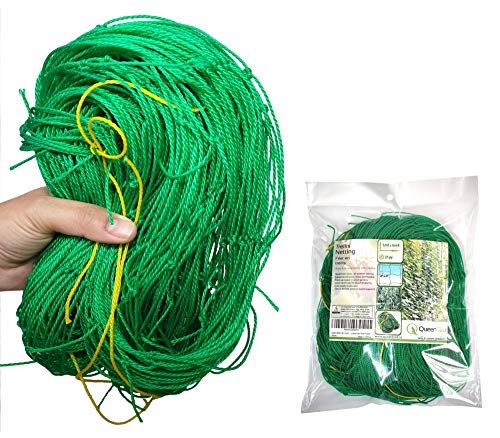
Best for spanning between posts, along a fence or across a cattle-panel arch
- UV-stabilized high density polyethylene
- Roughly 4 x 4 in. mesh — large enough to reach a hand through
- Soft on stems, so vines are not cut where they bear weight
- 5.9 x 16.4 ft covers a long run for very little money
Why buy it: netting between two posts is the cheapest cucumber support that actually works, and 4 in. mesh is the size that lets you pick through it.

Best for a long row on a shoestring, or replacing netting every season
- Two nets per pack, 6 x 16.5 ft each
- Flexible string construction that does not tangle badly
- Cuts to size without unravelling the whole net
- Light enough to pin to an existing fence or frame
Why buy it: two full nets for the price of a couple of coffees, which makes replacing tangled netting each spring a non-issue.

Quick Comparison
| Product | Best for | Rating | Price | Buy |
|---|---|---|---|---|
| Adjustable A-Frame Cucumber Trellis for Raised Beds, 45 x 53 in., with Climbing Net | Best Overall | — | Check (paid link) | |
| DoCred Cucumber Trellis, 2 Pack Foldable A-Frame for Raised Beds, PVC-Coated Steel | Best Value | — | Check (paid link) | |
| Metal Garden Trellis for Climbing Plants, 63 in. H x 63 in. L, with Nylon Netting | Best Premium Metal Frame | — | Check (paid link) | |
| FOLLOOK 67 in. Tall Obelisk Garden Trellis for Climbing Plants, 2 Pack | Best for Containers | — | Check (paid link) | |
| QueenBird Trellis Netting for Climbing Plants, 5.9 ft x 16.4 ft | Best Netting | — | Check (paid link) | |
| 2 Pack Garden Trellis Netting, 6 ft x 16.5 ft, Flexible String Net | Best Budget Netting | — | Check (paid link) |
How We Rank
We do not buy, assemble or load these trellises. We rank them by aggregating star ratings and review volume across owner reviews, weighting reports from a completed growing season above assembly-day impressions, checking published dimensions, tubing material and load ratings against manufacturer data, and reading negative reviews for the failures that only appear once a frame is carrying a fully fruited vine in wind.
Four factors set the order. Usable climbing height, judged against what vining cucumbers actually do rather than what fits in a product photo. Stability without deep anchoring, because most of these go into raised beds full of loose soil. Mesh suitability — four to six inch openings, soft material where fruit will rest against it. And owner satisfaction weighted by review count, read for bending, blow-over, net failure and assembly complaints. Full method: how we rank.
The Trellises, Reviewed
1. Adjustable A-Frame Cucumber Trellis — Best Overall
Covered above. Consensus Score ████████░░ 8.8. Strengths: self-supporting geometry that needs no wall or deep anchoring, two plantable faces from one footprint, adjustable to fit 2 ft or 4 ft beds, a proper climbing net rather than bare bars, and included clips for the critical first weeks. Recurring complaints: light tubing that wants pegging in exposed sites, sparse pictorial instructions, and netting that tangles during assembly and is the first thing to fail.
2. DoCred Foldable A-Frame, 2 Pack — Best Value
The same idea at volume pricing: two folding A-frames per pack, PVC-coated steel so the legs do not rust at the soil line, with clips, twist ties and plastic ties included. Folding matters here more than it might seem — a rigid frame lives in the shed taking up a corner all winter, while these collapse to a flat bundle. For anyone running two beds, or one long bed needing two frames end to end, this is comfortably the most sensible spend on the page.
Consensus Score ████████░░ 8.5 — strong value ratings, with build lightness the recurring reservation
Recurring complaints: the steel is thin and owners consistently describe the frames as flimsy until they are fully assembled and planted. The folding joints have some play, and a fully cropped frame can lean. Several reviewers report the coating chipping during assembly, which is where rust starts. And the frames are shorter than the vining varieties they will carry, so expect vines to top out and hang.
3. Metal Garden Trellis with Nylon Netting, 63 in. — Best Premium Metal Frame
The height answer. At 63 inches of climbing height with a polyethylene-coated steel frame rated around 32 pounds, this is the one product here genuinely sized for a full vining cucumber rather than a compromise. The nylon netting spans the whole frame, so tendril grip is available at every level rather than only where a bar happens to be. Assembly is tool-free and reported at under 20 minutes, and the compact footprint suits planters and raised beds as well as open ground.
Consensus Score ████████░░ 8.7 — well rated, with stability the main caveat at this height
Recurring complaints: it is a flat vertical panel rather than an A-frame, so it needs anchoring properly — owners in windy sites report it going over with a full vine on it unless staked or tied to a bed wall. The 32 lb load rating is honest but modest for a heavy pickling crop. Several reviewers report the connectors needing a firm push to seat. And the netting is the usual weak link, prone to tangling and to UV degradation after a few seasons.
4. FOLLOOK 67 in. Obelisk Trellis, 2 Pack — Best for Containers
Container cucumbers are a real category — half barrels, 15 gallon grow bags, large patio pots — and neither an A-frame nor a flat panel fits inside one. An obelisk does. Four legs push into the potting mix, the frame stands on its own, and 67 inches gives a vining variety somewhere genuinely useful to go. The width adjusts, so the same frame handles a narrow pot and a wide one, and two per pack covers a pair of containers.
Consensus Score ████████░░ 8.4 — well rated for its niche, with load capacity the known limit
Recurring complaints: the plastic cross arms are the weak point and owners report them cracking after a season or two of UV exposure. The frame is light, and a large fruited cucumber can pull a potted obelisk off vertical — several reviewers recommend weighting the pot. There is no netting, so tendrils only have the bars and cross arms to grip, which means more tying than a netted frame. And the legs are short, so in a shallow pot they do not seat deeply.
5. QueenBird Trellis Netting, 5.9 x 16.4 ft — Best Netting
If you already have posts, a fence, a cattle panel or a wooden frame, netting is by far the cheapest support that genuinely works, and it is what most market growers actually use. UV-stabilized high density polyethylene with roughly 4 by 4 inch mesh — the size that matters, because you have to reach a hand and a full-size cucumber back out through it. The material is soft enough not to crease a fruit resting against it, which rigid wire mesh will.
Consensus Score ████████░░ 8.9 — the highest-rated product in this roundup, and the best value per square foot
Recurring complaints: tangling during unrolling is the universal complaint, and owners recommend unrolling it in a straight line rather than trying to open it in a bundle. It needs a frame — this is not a standalone product, and buyers occasionally expect it to be. Cutting it releases loose strands unless you seal the ends. And at end of season it is genuinely tedious to disentangle dead vines from it, which is why many gardeners treat it as annual consumable rather than reusable.
6. 2 Pack Garden Trellis Netting, 6 x 16.5 ft — Best Budget Netting
Two full nets for less than the price of one trellis frame, which changes the calculation on the end-of-season problem entirely: rather than spending an hour picking dried vine off netting, you cut it down, compost the lot and put up fresh next spring. Flexible string construction, cuts to size, light enough to pin to an existing fence with cable ties.
Consensus Score ████████░░ 8.6 — good ratings for the price, with durability the honest trade-off
Recurring complaints: the string is noticeably lighter than the QueenBird net and owners report strands snapping under a heavy load, particularly with melons or squash rather than cucumbers. Tangling out of the pack is at least as bad. Mesh size varies slightly between production runs according to reviewers. And it degrades in UV within a couple of seasons — which is fine if you treat it as annual, and frustrating if you expected it to last.

How to Choose a Cucumber Trellis
Start with the variety type, because it sets the height requirement and nothing else can compensate for getting it wrong. Vining cucumbers — Marketmore, Straight Eight, most picklers, nearly all heirlooms — run six to eight feet and need at least five feet of climbable height. Bush and patio varieties — Spacemaster, Bush Champion, Salad Bush — stop around two to three feet and need very little. The packet will say. If it does not, assume vining.
Then match the structure to where it is going. Raised beds suit A-frames, because loose bed soil is poor anchoring and an A-frame does not need much. Open ground with posts already in place suits netting, which is far cheaper and performs just as well. Containers suit obelisks, which are the only design that stands up inside a pot. A sunny fence or wall suits a flat panel or netting pinned directly to it, which is the cheapest option of all.
Check the mesh before you buy. Four to six inches is the working range. Below four inches you physically cannot get a mature cucumber back out without damaging it or cutting the net. Above six inches, tendrils — which extend only a few inches — cannot find anything to grip and the vine flops instead of climbing. Soft string or nylon beats rigid wire wherever fruit will hang against it.
Finally, plan for the first three weeks and for the last day. Budget for clipping the leader to the support every few days until the vine has caught on properly. And at end of season, dried vine welded into fine netting is tedious to remove — a strong argument for cheap netting you replace annually rather than expensive netting you fight with. Space plants about 12 inches apart on the trellis rather than the 36 inches a sprawling plant needs, but no tighter, or you rebuild the humid canopy you trellised to avoid.
What Owners Actually Complain About
Too short for the variety is the most repeated complaint in the category, and it is almost always a vining cucumber on a four-foot frame. The vine reaches the top in early July, hangs back down over itself, and recreates exactly the dense humid canopy the trellis was meant to prevent. Buy for six feet if the packet says vining.
Blowing over or leaning under load is the second. A fully cropped cucumber vine is heavy and acts as a sail, and light tubing in loose raised-bed soil does not hold it. Pegging the feet, driving a rebar stake alongside, or tying the frame to the bed wall solves it, and almost nobody does it until after the first failure.
Netting tangles generate a startling share of the negative reviews across every product with a net. It arrives folded, it knots, and unrolling it in a straight line rather than trying to open it in a heap is the whole trick. Removing dead vine from it at season end is the other half of the complaint.
And two smaller consistent themes: thin coating chipping at the soil line, after which the steel rusts; and instructions, which across this whole product category are described as minimal, pictorial and occasionally wrong.
The Verdict
For a raised bed, buy the adjustable A-frame with climbing net — self-supporting, plantable both sides, and it folds away in fall. Need two frames, or working to a budget? The DoCred 2-pack is the same idea at better value. If you grow full-size vining varieties and want genuine height, the 63 inch metal frame with nylon netting is the only one here properly sized for them. Growing in pots, use the FOLLOOK obelisks. And if you already have posts or a fence, skip frames entirely — QueenBird netting costs a fraction and works just as well.
Check price on Amazon → (paid link)
Next: keep the soil evenly moist under the vines with the best mulch for a vegetable garden and how often to water a vegetable garden, feed them with the best vegetable garden fertilizer, and fix the classic flavor problem in why do my cucumbers taste bitter.