 Garden


Affiliate Disclosure
Some links on this page are affiliate links. As an Amazon Associate, we earn from qualifying purchases — at no extra cost to you. We do not buy, test, or physically handle the products we cover; our rankings come from aggregated owner reviews, ratings and expert consensus. Commissions never change our verdicts. How we rank · full disclosure.
The square-footage number on an oscillating sprinkler box is a laboratory figure, and almost nobody achieves it. "Covers up to 4,500 sq ft" is measured at a pressure — usually somewhere around 50 to 60 psi at the sprinkler inlet — that a typical household hose run does not deliver. Add 75 feet of 5/8-inch hose and a partly open faucet and the same sprinkler covers a fraction of that. This is why the most common one-star review in the entire category says a version of "it does not reach anywhere near what it claims."
So shop on pressure tolerance and adjustability rather than the headline area. A model that keeps sweeping at 40 psi and lets you set the left and right edges independently will water your actual lawn better than a bigger number that stalls halfway through its arc.
Top Picks at a Glance

Pressure is the whole story
An oscillating sprinkler has no motor. The water does the work: it drives a small turbine or gear train that rocks the tube back and forth. That single design fact explains nearly every complaint in the category.
| Pressure at the sprinkler | What you see | What to do |
|---|---|---|
| Below 30 psi | Tube barely rocks or stalls at one end; short, heavy throw | Shorter hose, turbo-drive model, or switch to an impact sprinkler |
| 30–45 psi | Sweeps but reaches well under the rated area | Turbo drive helps; expect roughly 60–75% of the rated coverage |
| 45–60 psi | Full smooth sweep, close to rated coverage | The design window |
| Above 70 psi | Fine mist, heavy drift, water past the target | Throttle the faucet or use the flow control |
Measure yours before you buy: a hose-bibb pressure gauge costs a few dollars and settles the argument. Then account for the hose itself, which is where much of the pressure goes — our hose pressure loss calculator shows how much you lose over a given length and diameter, and the water flow rate calculator converts a bucket-fill time into gallons per minute.
Our #1 Pick: Aqua Joe Metal-Base Oscillating Sprinkler
This is not the most adjustable sprinkler in the list and it does not claim the largest area. It ranks first because it is overwhelmingly the most-owned oscillating sprinkler in the United States, and that produces something no spec sheet can: a reliable picture of how the thing behaves once it has been left out in the sun for two summers.
What that record shows is a sprinkler that does the ordinary job well. The weighted metal base is the feature owners single out most, and for a good reason — the classic failure of a cheap oscillating sprinkler is that it walks sideways across the lawn every time the hose tugs, leaving you with a soaked patch and a dry one. The 16 nozzles are wide-bore enough to tolerate ordinary municipal water, and range, width and flow adjust separately so you can shape the pattern to a lawn rather than to a rectangle you do not have.
The recurring criticisms are equally consistent and worth knowing before you buy: coverage falls short of the rated area on modest pressure, and the plastic width sliders are the part most likely to break. Neither is a surprise, and both are true of most of the category.
Check price on Amazon → (paid link)
The Ranked Field
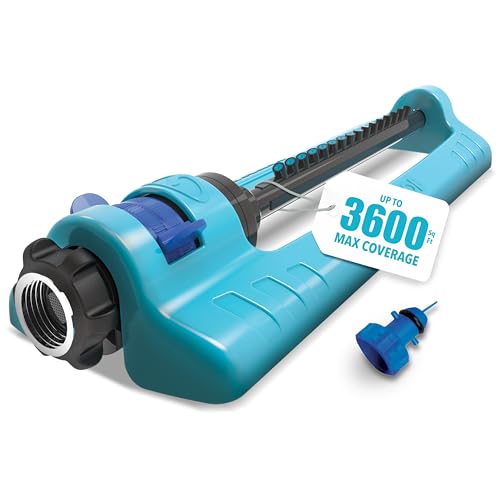
Best for rectangular lawns up to about 3,600 square feet
- 16 clog-resistant nozzles on an adjustable spray tube
- Weighted metal base rather than molded plastic
- Range, width and flow all adjust independently
- Rated to roughly 3,600 sq ft at good pressure
Why buy it: the most-owned oscillating sprinkler in the country by a wide margin, which means its failure modes are documented by an enormous body of long-term owners rather than a handful of reviewers.

Best for awkward lawns where you need to water grass and not the driveway
- Independent width sliders set the left and right limits separately
- Range dial shifts the pattern forward or back
- Flow control throttles output without touching the faucet
- Rated to roughly 4,500 sq ft
Why buy it: setting the left and right edges independently is the feature that stops you soaking a fence, a path and a neighbor to water a lawn.
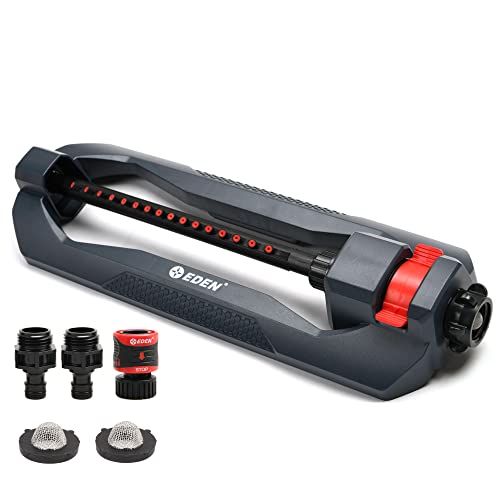
Best for a second sprinkler, or a first one on a tight budget
- 16 precision nozzles, up to roughly 3,600 sq ft
- Weighted base to resist walking under hose pull
- Adjustable range and width controls
- Quick-connect compatible hose fitting
Why buy it: two of these cost about what one premium model does, and running two smaller patterns beats stretching one across a lawn it cannot reach.

Best for anyone replacing a cracked plastic sprinkler for the third time
- Metal spray tube and metal base
- Full three-way adjustment: width, range and flow
- Rated to roughly 4,500 sq ft
- Nozzle clean-out feature for hard water areas
Why buy it: a metal tube survives the freeze-thaw cycles and UV embrittlement that end most plastic sprinklers after two or three seasons.
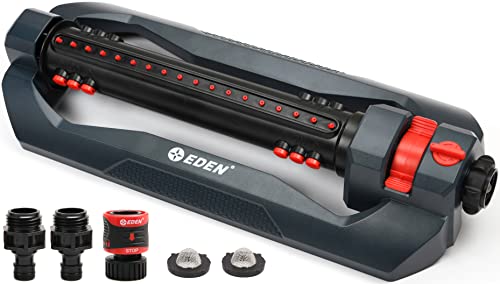
Best for homes with pressure below about 45 psi
- Turbo gear drive designed to sweep at lower pressure
- 18 precision nozzles for tighter droplet spacing
- Adjustable range and width
- Rated to roughly 4,400 sq ft
Why buy it: a turbo drive keeps the tube sweeping when a standard gear train stalls, which is the single most common complaint on low-pressure supplies.

Best for townhouse lawns, side strips and new seed
- Compact body rated to roughly 2,800 sq ft
- Turbo drive for smooth sweep at modest pressure
- Range adjustment to shift the pattern
- Gentle enough for newly seeded ground
Why buy it: a smaller pattern you can actually place accurately beats a big one that overshoots a 30-foot lawn onto the sidewalk.
Quick Comparison
| Product | Best for | Rating | Price | Buy |
|---|---|---|---|---|
| Aqua Joe Oscillating Sprinkler with Adjustable Spray, 16 Clog-Resistant Nozzles, Metal Base | Best Overall | — | Check (paid link) | |
| Melnor XT Oscillating Sprinkler, 4,500 sq ft, Flow, Width and Range Adjust | Best Adjustability | — | Check (paid link) | |
| Eden 96213EDAMZ Weighted Essential Oscillating Sprinkler, 16 Precision Nozzles | Best Value | — | Check (paid link) | |
| Melnor Metal Oscillating Sprinkler, 4,500 sq ft, Flow, Width and Range Adjust | Best Metal Build | — | Check (paid link) | |
| Eden 96212 Turbo Oscillating Sprinkler, 18 Precision Nozzles, up to 4,400 sq ft | Best Turbo Drive | — | Check (paid link) | |
| Melnor Turbo Oscillating Sprinkler, 2,800 sq ft, Range Adjustable | Best for Small Yards | — | Check (paid link) |
What actually separates these sprinklers
Base weight. The single best predictor of satisfaction. A light plastic sled slides whenever the hose is dragged; a weighted metal base stays put. Everything else is secondary to the sprinkler being where you left it.
Independent width control. Cheap models set width symmetrically around the center, so narrowing the pattern pulls in both edges at once. Independent left and right sliders let you cover a lawn that is not centered on the sprinkler — which is most lawns.
Drive type. A turbo drive uses a small water turbine geared down to the tube, and keeps sweeping at pressures where a simple gear drive stalls. If your supply is soft, this is the feature to buy.
Nozzle material and count. More nozzles means tighter droplet spacing and a more even pattern. Brass jets resist the mineral deposits that partly close plastic nozzles in hard water areas, producing the classic "one stream shoots twice as far as the others" fault.
Flow control on the sprinkler. Being able to throttle output at the sprinkler rather than at the faucet is more useful than it sounds, especially when you are running two sprinklers off a Y-splitter.
How long to run one
Oscillating sprinklers apply water slowly — typically 0.3 to 0.6 inches per hour — so they need long runs. Reaching half an inch usually takes 50 to 100 minutes. That slow rate is genuinely useful on clay soils and slopes, where faster application simply runs off, but it does mean an oscillating sprinkler is a poor match for a household that wants to water everything in twenty minutes.
Most lawns want roughly 1 to 1.5 inches of water per week including rainfall, delivered in one or two deep soakings rather than daily light watering, which grows shallow roots. EPA WaterSense sets the baseline at about an inch a week including rain, and Clemson's extension service advises never watering established turf every day. Water between about 4am and 9am: evaporation is lowest and blades dry quickly once the sun is up, while evening watering keeps the canopy wet overnight and invites brown patch and dollar spot. Our sprinkler run time calculator turns a catch-can measurement into minutes, and the irrigation water cost calculator tells you what the season costs.

How We Rank
We do not buy, run or physically handle these sprinklers. Rankings come from aggregated owner ratings across the most-owned models in the category, weighted toward long-ownership reviews where cracked tubes and stalled drives show up, and cross-checked against published specifications for coverage, nozzle count and construction. Four things carry the weight: pressure tolerance, because most disappointment traces to it; stability, since a sprinkler that walks waters nothing evenly; adjustability, particularly independent width control; and durability, especially the tube and the nozzles. Prices were checked at the time of writing. Full method: how we rank.
What Owners Actually Complain About
Coverage short of the claim. By far the most common complaint, and usually a pressure problem rather than a defect. Rated areas assume inlet pressure most household hose runs do not deliver.
The sprinkler walks. Light bases slide when the hose is pulled, which is why weighted metal bases dominate the top of this list.
Nozzles clog. Hard water leaves mineral scale in the jets and one stream ends up throwing twice as far as its neighbors. A pin and a soak in white vinegar fixes it; brass jets delay it.
Tubes crack in season three. UV embrittlement plus a winter left outdoors. Metal tubes are the fix, and storing the sprinkler in a shed over winter costs nothing.
Sliders snap. The thin plastic width sliders are the most-broken part across every brand.
The Verdict
For most rectangular lawns the Aqua Joe metal-base oscillating sprinkler is the sensible buy — not the most featured model here, but the best understood, and it does the ordinary job without drama. Step up to the Melnor XT if your lawn has edges you need to respect, take the Eden 96212 Turbo if your pressure is marginal, and buy the Melnor metal version if you have already thrown away two plastic sprinklers. Whatever you choose, measure your pressure before you shop and treat the coverage number on the box as an upper bound rather than a promise. Check price on Amazon → (paid link)
More from this hub: watering & irrigation · best lawn sprinkler · best impact sprinkler · how much water an oscillating sprinkler uses · best hose timer · how we rank.