 Garden


Affiliate Disclosure
Some links on this page are affiliate links. As an Amazon Associate, we earn from qualifying purchases — at no extra cost to you. We do not buy, test, or physically handle the products we cover; our rankings come from aggregated owner reviews, ratings and expert consensus. Commissions never change our verdicts. How we rank · full disclosure.
The first decision is not a brand — it is which of two entirely different head families you need. A fixed spray body throws 8 to 15 feet in a fan and applies water at 1.5 to 2.0 inches per hour. A gear-drive rotor throws 22 to 52 feet with a single sweeping stream and applies only 0.4 to 0.8 inches per hour. They are not interchangeable and they must never share a valve, because no run time can serve both without either flooding one area or starving the other. Get that right and brand choice becomes a minor question about parts availability.
Top Picks at a Glance

Spray body or rotor?
| Fixed spray body | Gear-drive rotor | |
|---|---|---|
| Radius | 8–15 ft | 22–52 ft |
| Application rate | 1.5–2.0 in/hr | 0.4–0.8 in/hr |
| Typical run time for 0.5 in. | 15–20 min | 35–75 min |
| Flow per head | 0.4–3.7 gpm | 1.0–8.0 gpm |
| Best for | Beds, strips, small lawns, tight corners | Open lawn, large areas |
| Runoff risk on clay | High — cycle and soak | Low |
| Adjustment | At the nozzle, by hand | Top socket, brand key |
Zone sizing follows from the flow column: a zone holds roughly 75 percent of your measured gallons per minute, so on a common 10 gpm service that is three to five rotors or six to ten spray heads. The arithmetic is worked through in how many sprinkler heads per zone, and our sprinkler zone calculator checks a proposed layout.
Our #1 Pick: Rain Bird 1804VAN
The 1800 series spray body is the closest thing residential irrigation has to a standard part, and the VAN — variable arc nozzle — version is why. One nozzle covers every arc from a sliver to a full circle, set by twisting the collar with your fingers, wet or dry, in about five seconds. Buy a box of these and you can build or repair anything under 15 feet without a second trip to the store.
The body itself is where the quality shows. The co-molded wiper seal flushes debris out as the riser retracts, which is the mechanism that keeps grit from scoring the seal and starting a leak. The retraction spring is strong enough to pull the riser down through mulch, and the head takes the whole 1800-series accessory family — check valves for heads at the bottom of a slope, pressure-regulating versions for high-pressure supplies, and six- and twelve-inch bodies for beds.
The recurring criticism is honest and predictable: heads that sit slightly proud of grade get destroyed by mower wheels, and seals eventually weep if the system was never flushed at install. Neither is a design fault. Fit heads on swing joints, set them flush with the soil, and flush every lateral with the nozzles off before you commission the system.
Check price on Amazon → (paid link)
The Ranked Field

Best for beds, side strips and lawn areas under about 15 feet across
- Variable arc nozzle adjusts 0°–360° by hand, no tool
- 8–15 ft radius depending on pressure
- Co-molded wiper seal that flushes debris on retraction
- Heavy stainless retraction spring, 1/2 in. female inlet
Why buy it: one part number covers every corner, edge and island on a property, which is why it is the default in almost every American irrigation van.

Best for open lawn areas more than about 20 feet across
- Adjustable 40°–360° arc with a fixed left stop
- 22–52 ft radius depending on nozzle fitted
- Nozzle tree included for radius and flow matching
- Arc adjusted from the top with the Hunter key
Why buy it: the most-installed residential rotor in the United States, so every irrigation counter stocks parts and every contractor already knows it.
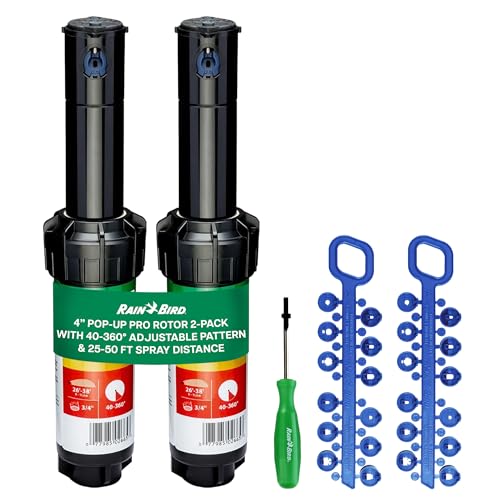
Best for matching an existing Rain Bird system
- 40°–360° arc adjustment, factory set to 180°
- Rain Curtain nozzle set for even close-in coverage
- Arc adjusts with a flat blade, wet or dry
- Radius reduction screw for up to ~25% trim
Why buy it: the Rain Curtain nozzles put down noticeably more water close to the head than older rotor designs, which is where rotor zones usually go dry.
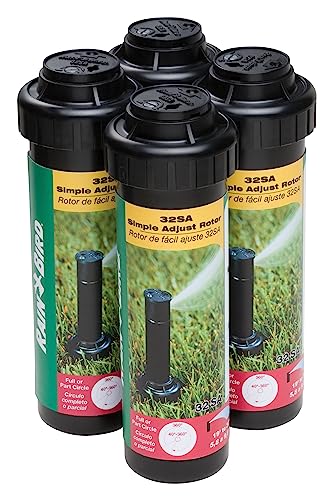
Best for homeowners who do not want to own a rotor key
- Arc set by hand on a collar — no tool required
- 19–32 ft spray distance, 40°–360° pattern
- Fits standard 1/2 in. riser
- Four heads per pack
Why buy it: removing the tool from the job is the difference between a system you adjust when it needs it and one you never touch again.

Best for planted beds and shrub borders where debris is constant
- Heavy-duty body with a co-molded wiper seal
- Adjustable 0°–360° nozzle, 8–15 ft
- Strong retraction spring for mulched beds
- Optional pressure-regulating and check-valve versions
Why buy it: the retraction spring is stronger than the budget class, which is what stops a head sitting proud in mulch and getting sheared by a mower.

Best for homes with static pressure above about 65 psi
- Built-in regulator holds nozzle pressure at 30 psi
- Adjustable 0°–360° pattern
- Eliminates misting on high-pressure supplies
- Standard 1804 body, drop-in replacement
Why buy it: on a high-pressure supply this single part turns drifting mist back into droplets that actually land, which no amount of adjustment can do.

Quick Comparison
| Product | Best for | Rating | Price | Buy |
|---|---|---|---|---|
| Rain Bird 1804VAN 1800 Series 4 in. Pop-Up Sprinkler Head, 5 Pack, Adjustable Nozzle | Best Overall Spray Head | — | Check (paid link) | |
| Hunter PGP-ADJ 3/4 in. Rotor Lawn Sprinkler Head, 22–52 ft, 4 in. Pop-Up | Best Rotor | — | Check (paid link) | |
| Rain Bird 5000 Series Rotor, 4 in. Pop-Up, 2 Count | Best Rain Bird Rotor | — | Check (paid link) | |
| Rain Bird 32SA Simple Adjust Gear Drive Rotor, 40°–360°, 19–32 ft, 4 Pack | Easiest to Adjust | — | Check (paid link) | |
| Hunter Pro 4 in. Pop-Up Sprinkler Head, Adjustable 0°–360°, 8–15 ft Coverage | Best Spray Body for Beds | — | Check (paid link) | |
| Rain Bird 1804APPR25 Pressure Regulating (PRS) Pop-Up Sprinkler, Adjustable 0°–360° | Best Pressure-Regulating | — | Check (paid link) |
If your heads mist, buy pressure regulation, not adjustment
This is the most common fixable fault in American residential irrigation and the least understood. Spray nozzles are engineered around roughly 30 psi at the nozzle. Plenty of US homes deliver 70 or 80 psi at the meter. Feed a 30 psi nozzle at 75 psi and the stream does not travel further — it atomizes into a fine fog that drifts on any breeze and evaporates before it lands.
You cannot adjust your way out of it. Winding the radius screw down makes it worse, because that screw works by driving a pin into the stream. The fix is a pressure-regulating spray body, which holds nozzle pressure at 30 psi regardless of what arrives at the inlet. Fitting these on a high-pressure zone typically restores the droplet size, restores the pattern edge and cuts the zone's water use at the same time, since an over-pressured nozzle also flows more than its rated gpm.
If a whole property runs high, a mainline pressure regulator ahead of the valves is the cheaper answer. Either way, measure first with a hose-bibb gauge — this is one of the few irrigation problems where a $10 gauge tells you the whole story.
Adjusting them once they are in
Spray heads are adjusted entirely at the nozzle: twist the VAN collar for arc, use the small slotted screw in the nozzle face to trim radius by up to about a quarter. Fixed-pattern nozzles stamped Q, T, H or F cannot be adjusted at all — swap the nozzle.
Rotors are different and brand-specific. Both the Hunter PGP and the Rain Bird 5000 have a fixed left stop and an adjustable right stop reached through a socket on top, plus a radius reduction screw beside the nozzle. Hunter uses a square drive — a flat screwdriver will round it out — while Rain Bird uses a flat blade. The full sequence for both families, and the mistakes that break heads, is in how to adjust sprinkler heads. The Rain Bird 32SA sidesteps the issue entirely with a hand-turned collar, which is a genuine convenience for a homeowner who adjusts heads once a year.

How We Rank
We do not buy, install or physically handle these heads. Rankings come from aggregated owner ratings across the most-installed residential heads, weighted toward long-ownership reviews where seal leaks, weak retraction and stripped gear trains appear, and cross-checked against manufacturer specifications for radius, flow, arc range and pressure. Four things carry the weight: seal design, since a leaking wiper seal is the usual end of a spray body; retraction strength, because a head that stands proud gets mown off; parts availability, which is the practical argument for Hunter and Rain Bird over cheaper brands; and pressure behavior, since misting wastes more water than any other single fault. Prices were checked at the time of writing. Full method: how we rank.
What Owners Actually Complain About
Wiper seals weeping. Nearly always grit, and nearly always from an install that skipped flushing the laterals with the nozzles off.
Heads sheared by mowers. A head set proud of grade, or a rigid riser instead of a swing joint. Swing joints bend; rigid PVC snaps at the tee.
Misting on high-pressure supplies. Fixed by pressure-regulating bodies, not by adjustment.
Rotors stalling or turning slowly. Usually too many heads on the zone rather than a defective head. Cap one head and see whether the others recover.
Counterfeit or gray-market heads. A recurring complaint in the online marketplace for both major brands. Buy from a seller you can identify, and be suspicious of prices well under the trade counter.
The Verdict
For anything under 15 feet, the Rain Bird 1804VAN in a five-pack is the buy, and it is the head most professionals reach for. For open lawn, the Hunter PGP-ADJ is the safest rotor in the country on parts availability alone, with the Rain Bird 5000 the equal choice if your system is already Rain Bird. Pick the 32SA if you want to adjust arcs without owning a key, the Hunter Pro spray body for mulched beds, and the 1804 PRS anywhere the supply runs above about 65 psi. Check price on Amazon → (paid link)
More from this hub: watering & irrigation · best sprinkler system · how to install a sprinkler system · how many heads per zone · why is my sprinkler system leaking · how we rank.