 Garden
Affiliate Disclosure
Some links on this page are affiliate links. As an Amazon Associate, we earn from qualifying purchases — at no extra cost to you. We do not buy, test, or physically handle the products we cover; our rankings come from aggregated owner reviews, ratings and expert consensus. Commissions never change our verdicts. How we rank · full disclosure.
The best humidity level for a house is a relative humidity of 30 to 50 percent, with the tightest comfort-and-health sweet spot around 40 to 50 percent. The EPA recommends keeping indoor humidity below 60 percent and ideally in the 30 to 50 percent band to discourage mold and dust mites while keeping the air comfortable. Below 30 percent the air feels dry and irritating; above 60 percent you invite mold, mites and condensation. The exact target shifts with the season and your climate.
Relative humidity is the percentage of moisture the air is holding compared with the maximum it could hold at that temperature, which is why the same amount of moisture feels dry when hot and damp when cool. We do not test products first-hand; our picks come from aggregated owner reviews and expert consensus, described in how we rank.
The best humidity level for a house: the target range
The 30 to 50 percent band is not arbitrary. It is the overlap where human comfort, respiratory health, and the health of the building all sit comfortably at once.
| Humidity | What happens |
|---|---|
| Below 30 percent | Dry skin and airways, static, cracked wood, lingering airborne dust |
| 30 to 50 percent | Comfortable, discourages mites and mold, protects wood and finishes |
| 50 to 60 percent | Acceptable ceiling; watch for mustiness in humid weather |
| Above 60 percent | Mold, dust mites, condensation, muggy feel |
The EPA is explicit that keeping indoor humidity below 60 percent — and ideally 30 to 50 percent — is a core mold-prevention measure. The American Society of Heating, Refrigerating and Air-Conditioning Engineers (ASHRAE) uses a similar comfort range.
Season-by-season humidity levels
The single best target changes with outdoor temperature, mostly because of condensation on cold surfaces in winter.
| Season / condition | Target RH | Reason |
|---|---|---|
| Summer / humid climate | 45 to 50 percent | Keep below 50 to block mold and mites |
| Winter / mild cold | 35 to 40 percent | Comfort without window condensation |
| Deep cold (below 0 F outside) | 25 to 30 percent | Prevent condensation and ice on windows |
The practical winter rule: if your windows fog or drip, your indoor humidity is too high for the outdoor temperature — lower it until condensation stops. See the ideal indoor humidity in winter for a deeper look at cold-weather settings.
What too-dry air does
Under 30 percent relative humidity, common in heated homes in winter, creates a familiar set of problems.
- Health: dry, cracked skin and lips, irritated nasal passages, sore throats, and more static shocks. Dry airways can also make you more susceptible to respiratory irritation.
- The home: wood floors, furniture and trim shrink and can crack or gap; musical instruments go out of tune; paint and drywall can develop hairline cracks.
- Dust and comfort: fine dust stays airborne longer, and the air simply feels colder at the same thermostat setting, tempting you to over-heat.
The fix is a humidifier sized to the space, held to 30 to 50 percent. Our field is in best humidifiers.

What too-humid air does
Above 50 to 60 percent, moisture becomes the problem instead of the cure.
- Mold and mildew grow on damp walls, in bathrooms and basements, and behind furniture on cool exterior walls. This is the single biggest reason to cap humidity.
- Dust mites thrive above about 50 percent, worsening allergy and asthma symptoms.
- Condensation forms on windows, cold pipes and exterior walls, which over time causes rot and stains.
- That muggy, clammy feeling makes a house feel warmer and stuffier than the thermostat suggests.
The fix is a dehumidifier and better ventilation. See how to reduce humidity in a room and the ranked best dehumidifiers. A persistent musty smell often points here — what causes a musty basement smell covers that case.
How to measure and hold the target
You cannot manage what you do not measure, and humidity varies room to room.
- Get a hygrometer. A digital one that also reads temperature costs little. Many air quality monitors and smart thermostats include one.
- Place it well. Central room, 2 to 6 feet off the floor, away from vents, windows, exterior walls, kitchens and bathrooms.
- Check multiple rooms. Basements run damp, upstairs and near heat runs dry. Aim to keep every lived-in room in the 30 to 50 percent band.
- Adjust the source. Add moisture with a humidifier in dry seasons; remove it with a dehumidifier, exhaust fans and ventilation in damp seasons.
- Re-check after changes. Give the house a day to stabilize after adjusting a humidifier or dehumidifier, then read again.
The tools that keep you in range
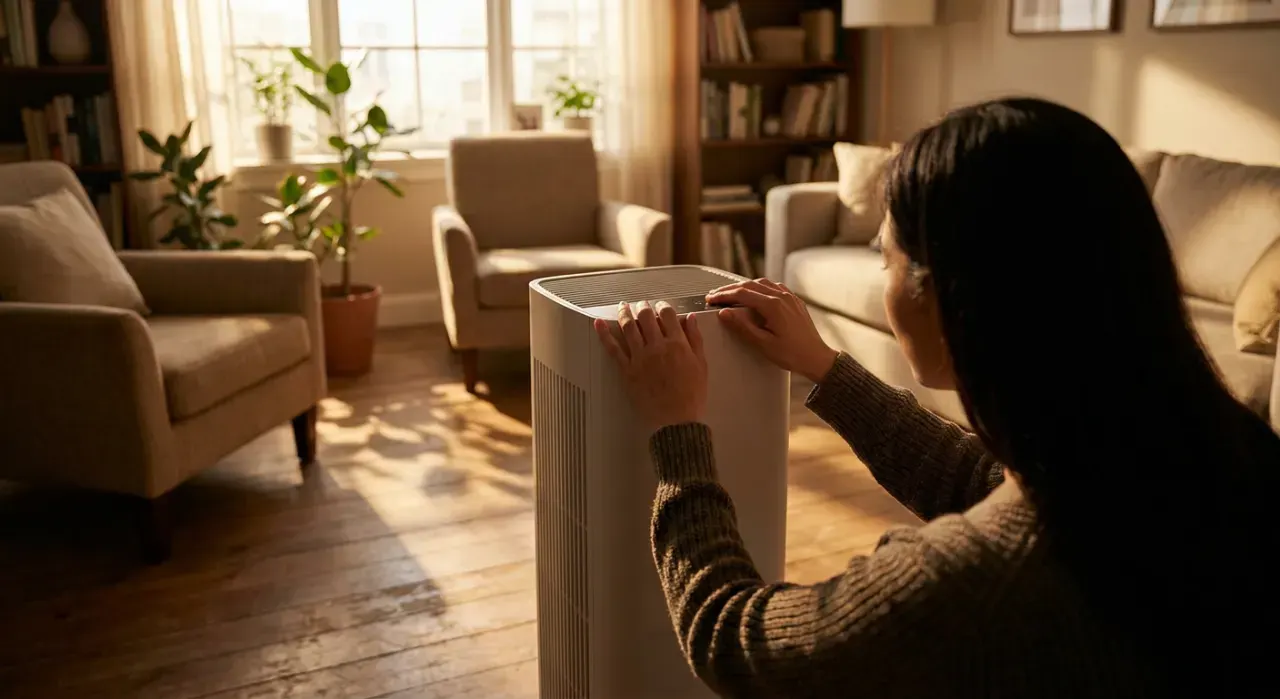
Holding 30 to 50 percent year-round usually takes both a way to measure and a way to add or remove moisture. Match the tool to the direction you need to move.
| Tool | Job | When you need it |
|---|---|---|
| Digital hygrometer | Measures RH and temperature | Always — you cannot manage what you do not measure |
| Humidifier | Adds moisture | Dry winter air below 30 percent |
| Dehumidifier | Removes moisture | Damp rooms and summers above 50 percent |
| Exhaust fans | Vent moisture at the source | Bathrooms and kitchens |
| Air conditioner | Removes moisture while cooling | Humid summer months |
A few practical notes. Choose a humidifier or dehumidifier rated for the room size — an undersized unit runs constantly and never reaches the setpoint, while an oversized one short-cycles. Cool-mist humidifiers are generally preferred over warm-mist for safety around children, and both need regular cleaning to avoid pushing mold and mineral dust into the air. For hard water, distilled water in a humidifier prevents the fine white dust that settles on furniture. A whole-house humidifier or dehumidifier tied into the HVAC system is the low-maintenance option if a single room unit cannot keep up with the whole home.
Room-by-room humidity levels
Different rooms have different moisture loads, so the same house can be dry upstairs and damp in the basement at the same time.
| Room | Tendency | Common fix |
|---|---|---|
| Basement | Too humid | Dehumidifier, seal leaks |
| Bathroom | Spikes after showers | Exhaust fan, run it 20 minutes after |
| Bedroom (winter) | Too dry | Small humidifier |
| Kitchen | Spikes when cooking | Range hood vented outside |
Getting humidity right pays off across comfort, health and the value of the home itself. Pair it with good filtration for the fullest effect. For related topics see how to improve indoor air quality and signs of mold in your home. Everything else is at the air quality hub.