 Garden

Affiliate Disclosure
Some links on this page are affiliate links. As an Amazon Associate, we earn from qualifying purchases — at no extra cost to you. We do not buy, test, or physically handle the products we cover; our rankings come from aggregated owner reviews, ratings and expert consensus. Commissions never change our verdicts. How we rank · full disclosure.
Yes, for the airborne part of the problem — and that is the honest limit. A true HEPA filter is rated to capture at least 99.97 percent of particles at 0.3 microns, which covers pollen grains, pet dander, mold spores and dust-mite fecal debris, the four things that trigger most indoor allergy symptoms. Run a correctly sized unit continuously in a closed bedroom and it measurably lowers how much of that you breathe. What it cannot do is remove allergens embedded in carpet, mattresses and upholstery, stop the source, or filter out gases. Allergy management is a medical matter — talk to a clinician about your symptoms; a purifier is one input, not a treatment.
We never buy or physically handle the products we rank; our picks come from aggregated owner reviews and expert consensus — see how we rank.
What filtration demonstrably does
The mechanism is not in dispute. Air is drawn through a dense pleated fiber medium; particles are captured by interception, impaction and diffusion; the air comes out with far fewer particles in it. The HEPA standard specifies performance at 0.3 microns because that is the most penetrating particle size — the hardest for a filter to catch, since both larger and smaller particles are trapped more easily. Rating the filter at its worst case means 99.97 percent is a floor, not an average.
Common indoor allergens sit comfortably inside that capture range:
| Allergen | Typical particle size | How long it stays airborne | HEPA capture | How much a purifier helps |
|---|---|---|---|---|
| Cat dander | 1 – 10 microns | Hours — stays suspended | Very high | Most of any allergen |
| Dog dander | 2 – 10 microns | Hours | Very high | Substantial |
| Mold spores | 2 – 20 microns | Minutes to hours | Very high | Good, but fix the moisture |
| Ragweed and grass pollen | 10 – 100 microns | Minutes — settles fast | Very high | Good while windows stay closed |
| Cockroach allergen | 2 – 20 microns | Minutes to hours | Very high | Limited — needs source control |
| Dust-mite debris | 10 – 40 microns | Minutes — settles fast | Very high | Least — handle bedding instead |
Notice that capture efficiency and real-world benefit are not the same column. HEPA catches all six easily; what differs is whether the particle is still in the air when the fan reaches it. Cat dander is the case where a purifier earns its keep most obviously, because those particles stay suspended for hours and the machine gets repeated chances at them. Pollen and mite debris settle within minutes, so a purifier only intercepts what happens to pass through while it is airborne — which is why dust mite allergen, the thing most buyers are shopping for, is the weakest case of the six, and why the reservoir in your carpet and mattress matters so much.
Why the bedroom matters more than the living room
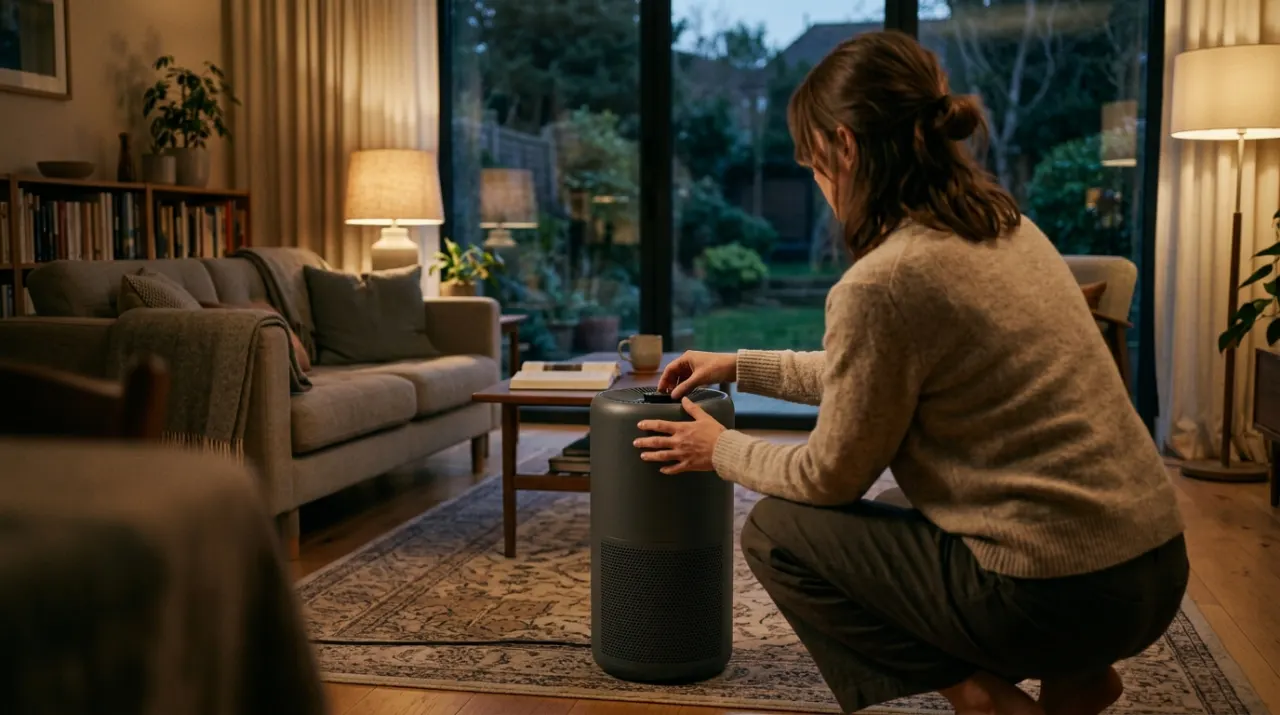
Exposure is concentration multiplied by time, and the bedroom is where you accumulate the most hours in one place with the door shut. Eight uninterrupted hours breathing filtered air in a defined volume you can size a machine for is worth more than a purifier chasing an open-plan living area during the hours you are mostly elsewhere. The closed door is doing real work here: a unit rated for 250 square feet is being asked to serve 900 if the bedroom opens onto a hallway all night. If you only buy one purifier, this is where it goes — out in the open, at least a foot from the walls, running continuously on a moderate speed rather than pinned on high for an hour, because a machine switched off for noise delivers nothing.
What it does not do
Being straight about this is the difference between a purifier that satisfies and one that disappoints.
- Nothing embedded in soft furnishings. The majority of dust-mite allergen in a bedroom is in the mattress, pillows and carpet, not in the air. A filter cannot reach it. Allergen-proof mattress and pillow encasements and weekly hot-water bedding washes address that part; the purifier never will.
- Nothing at the source. The cat keeps producing dander, the mold keeps sporulating, the pollen keeps entering on clothes and through open windows. A purifier is a continuous cleanup, not a fix.
- Gases and VOCs, unless there is real carbon. HEPA captures particles only. Formaldehyde, cooking gases and smoke odor need a substantial activated carbon stage — a thin carbon-impregnated mesh saturates in weeks and then does nothing.
- Air it never touches. A purifier cleans the room it is in, with the door closed. Placed in a hallway, or in a room with the door open to the rest of the house, its effective coverage collapses. Placement guidance is in where to put an air purifier.
Also be wary of ionizers, ozone generators and plasma add-ons marketed as allergy features. Ionizers charge particles so they stick to surfaces rather than removing them, which lowers airborne counts while raising the settled load you later disturb. Some ionizing and plasma devices produce ozone as a byproduct, and the EPA is explicit that ozone is a lung irritant that can worsen asthma; California restricts indoor air cleaners emitting above 0.050 parts per million. For an allergy or asthma household, mechanical HEPA filtration is the option with no byproduct risk. If a unit has an ionizer switch, the safe default is off.
Sizing it so it actually works
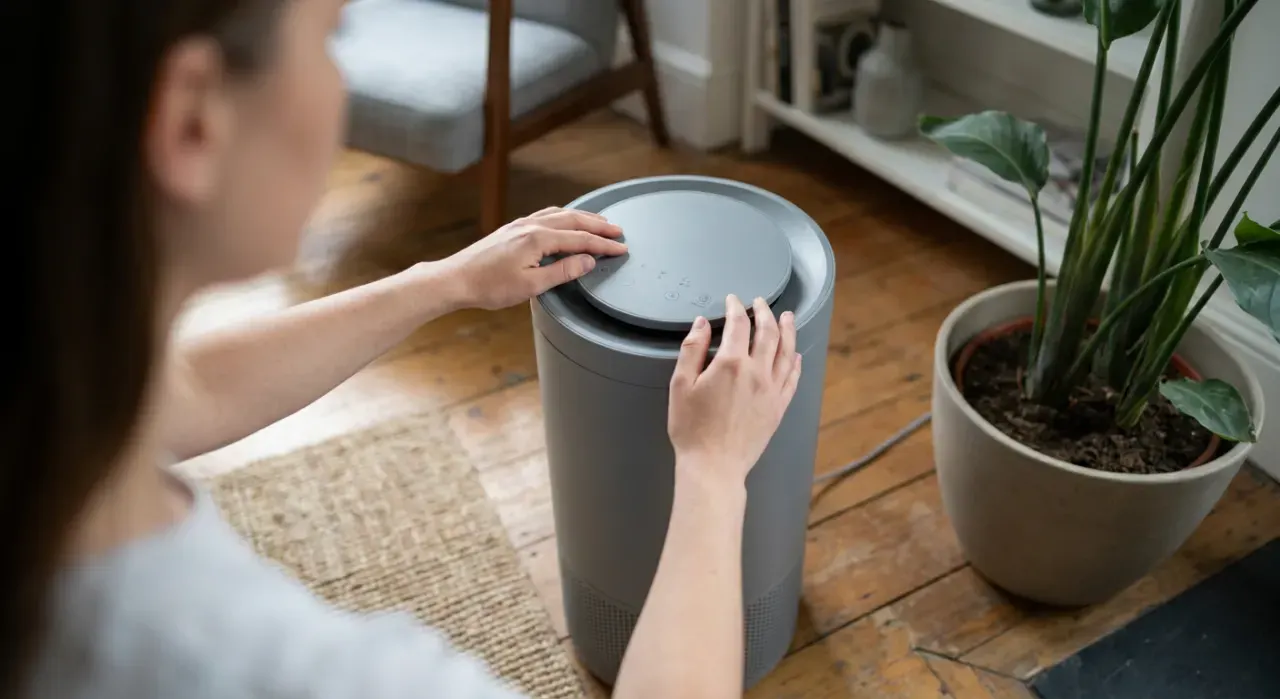
Most disappointment traces to an undersized unit. Aim for four to five complete air changes per hour in the room, not the optimistic square-footage figure on the box, which is usually calculated at two air changes.
- Floor area in square feet × ceiling height = room volume in cubic feet.
- Volume × 5 air changes ÷ 60 minutes = the CFM you need.
- Compare that number to the unit's CADR for dust, pollen or smoke — the higher the CADR, the more clean air per minute it delivers.
A 12 by 14 foot bedroom with 8-foot ceilings comes to 1,344 cubic feet, or about 112 CFM at five air changes. Look for a CADR of 110 or better, then buy one class up so you can run it on a quieter middle speed instead of pinning it on high all night. The full method, including why the three CADR numbers differ, is in understanding CADR ratings. AHAM publishes verified CADR figures for smoke, dust and pollen under the AC-1 standard, and because every brand is measured the same way it is the only genuinely comparable number on the carton — use the pollen or dust figure for allergies.
What moves the needle more than the purifier
Source control, and it is not close. The EPA frames air cleaning as a supplement to source control and ventilation rather than a replacement, and the ranking of interventions bears that out. Upgrading the furnace filter to MERV 13 filters the entire house volume every time the blower runs, which is far more air than any portable unit moves, and it is the cheapest single upgrade available — see how often you should change a furnace filter. Holding indoor humidity between 30 and 50 percent collapses dust mite populations, because mites draw water directly from the air and need roughly 50 percent to survive. A vacuum with genuinely sealed HEPA filtration stops the machine re-aerosolizing what it picks up. Walk-off mats at exterior doors cut what arrives on shoes. If mold is the trigger, the moisture question outranks the filtration question entirely — that is covered in do air purifiers help with mold spores.
The routine that owners report works
Across owner reviews, the people who say a purifier changed their allergy season are consistently doing more than switching a machine on. The pattern:
- Bedroom first, door closed, running 24/7. Eight hours of low-allergen sleep is the highest-value target in the house.
- Windows shut through peak pollen weeks, with the purifier compensating for the lack of ventilation.
- Encasements on mattress and pillows, bedding washed weekly in hot water.
- Sealed HEPA vacuuming rather than a machine that exhausts fines back into the room.
- Humidity held between 30 and 50 percent, because dust-mite populations track humidity more closely than they track cleaning. Targets are in ideal indoor humidity levels.
- Filters changed on schedule, since a clogged filter quietly stops delivering the airflow the sizing math assumed — see how often to change a HEPA filter.
Give the arrangement two to four weeks before judging it. Particle counts fall within the hour, but symptoms respond gradually and the reservoir allergens take time to deplete.
Where to go next
For shortlists, see best air purifier for allergies, best for pets and best for a bedroom. Check the filter label carefully first — true HEPA vs HEPA-type explains why the lookalike term matters here more than anywhere. It all sits under the air quality hub.
This page is general information about air filtration, not medical advice. If allergy or asthma symptoms are persistent or severe, see a clinician.