 Garden

Affiliate Disclosure
Some links on this page are affiliate links. As an Amazon Associate, we earn from qualifying purchases — at no extra cost to you. We do not buy, test, or physically handle the products we cover; our rankings come from aggregated owner reviews, ratings and expert consensus. Commissions never change our verdicts. How we rank · full disclosure.
The short version: after weighing six popular vermicomposting systems on owner star ratings, review volume, published capacity and the complaints that recur once a colony is actually established, our #1 pick is the VermiHut Plus 5-Tray. It is a conventional stacking-tray bin, which is the right architecture for most households, and it includes the small details — ant-trap feet, a moisture mat, a liquid tap and five trays rather than four — that decide whether the first year goes smoothly.
Worm composting is the answer to a specific problem: kitchen scraps, all year, with no yard and no heap. It is not a substitute for a pile — a worm bin will never eat a fall leaf drop — and it is not a race, since a colony processes about half its own weight in food per day. If you have outdoor space, run a stationary compost bin or a compost tumbler alongside it. The whole picture is at the composting and soil hub.
Top Picks at a Glance

Our #1 Pick: VermiHut Plus 5-Tray
Stacking-tray worm bins all work the same way. You start the colony in the bottom tray with bedding and food. When that tray is full, you set a second tray on top and feed into that instead; the worms migrate upward through the mesh floor toward the fresh food, and the tray they leave behind fills with finished castings you can lift off and empty. The design is elegant because the worms sort themselves, which is the part everyone dreads.
Consensus Score ████████░░ 8.6 — consistently strong ratings across a substantial review base
What the VermiHut Plus adds is a run of details that address the standard first-year failures. The feet sit in small water reservoirs, so ants — a genuinely common and demoralizing problem — cannot climb in. A moisture-control mat sits on the working tray to stop the surface drying out, which is what drives worms downward and stalls processing. The base has a proper tap for the liquid that collects, rather than a lip you have to tip. And it ships with five trays instead of the usual four, so the system keeps pace as the colony grows.
Reviewers repeatedly mention how compact the footprint is for the volume, at roughly sixteen inches square, and how straightforward the stacking is once the first tray is established. The consensus criticism is the plastic quality — trays are described as lighter than the price suggests, and a few owners report cracked corners — and that, as with every tray system, the bottom tray becomes heavy and awkward once it is full of wet castings.
Check price on Amazon → (paid link)
Best Worm Composting Bins 2026: The Ranked Field

Best for a household that wants castings all year without a yard
- Five stacking trays plus a liquid collection base with tap
- V-shaped “ant-trap” feet and a moisture-control mat
- Roughly 16 in. square footprint
- Trays add as the colony grows — start with two
Why buy it: the most complete tray system at the price, and the extra trays mean it grows with the worm population instead of capping it.

Best for first-time vermicomposters who want the process documented
- Four trays, expandable to eight
- Thermo-siphon airflow through the stack
- Ships with bedding, minerals, thermometer, rake and scraper
- Made in the USA with a 10-year warranty
Why buy it: the deepest instructional support in the category — the reason first-timers using it rarely kill their worms.
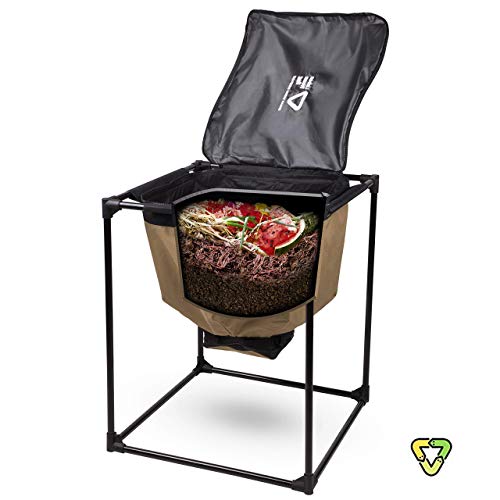
Best for harvesting castings without sorting worms out of them
- About 5 cubic feet in breathable 900D coated fabric
- Zippered base — castings drop out, worms stay up top
- Steel frame, assembles in minutes without tools
- Handles roughly 3 to 4 lbs of scraps a day at full population
Why buy it: a true continuous-flow design, so you never dismantle the bin or hand-sort worms at harvest time.

Best for apartments where the worm bin has to live in the kitchen
- Two working trays with a lid that doubles as a stand
- Roughly 15 in. square, tidy enough for indoors
- Built-in liquid reservoir with a spigot
- Made from recycled polypropylene
Why buy it: the least conspicuous worm bin here — it reads as a plant stand, which is the difference between keeping it and hiding it.
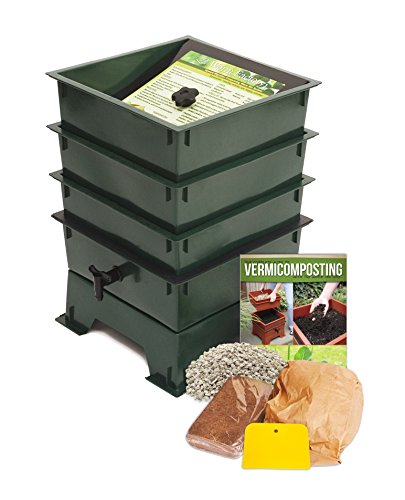
Best for testing whether vermicomposting suits you before committing
- Three trays, expandable later
- Same tray footprint as the 360 system
- Collection tray with spigot included
- Instruction booklet and starter bedding
Why buy it: the cheapest way into a proper tray system, and the trays are compatible if you upgrade later.

Best for a household producing serious volumes of kitchen scraps
- Tapered continuous-flow body — compresses castings at the base
- Handles up to about 4.4 lbs of waste a day
- Wheeled frame with a removable collection tray
- Liquid catchment built into the stand
Why buy it: processes several times what a tray system handles, and the tapered body harvests itself as the castings compress.

Quick Comparison
| Product | Best for | Rating | Price | Buy |
|---|---|---|---|---|
| VermiHut Plus 5-Tray Worm Compost Bin | Best Overall | — | Check (paid link) | |
| Worm Factory 360 4-Tray Worm Composter | Best Known System | — | Check (paid link) | |
| Urban Worm Bag Version 2 | Best Continuous-Flow Bin | — | Check (paid link) | |
| FCMP Outdoor Hot Frog Living Composter | Best Compact Indoor Bin | — | Check (paid link) | |
| Worm Factory DS3GT 3-Tray Worm Composter | Best Budget Starter | — | Check (paid link) | |
| Hungry Bin Continuous Flow Worm Farm, 20 Gallon | Best Premium Flow-Through | — | Check (paid link) |
How We Rank
We do not buy, assemble or run these systems. We rank them by aggregating star ratings and review volume across thousands of verified owner reviews, weighting recent reviews above launch-window ones, checking published tray count, capacity and material against manufacturer specifications, and reading negative reviews closely for the failures that only appear after a colony has been running for a season.
Four factors drive the order. Harvest method, because separating worms from castings by hand is the single biggest deterrent to sticking with vermicomposting. Realistic throughput, judged against what a household actually produces rather than headline capacity. Indoor liveability — footprint, drainage, whether it leaks and whether you would tolerate it in a kitchen. And owner satisfaction, weighted by review count. Prices were checked at time of writing. Full method: how we rank.
The Worm Bins, Reviewed
1. VermiHut Plus 5-Tray — Best Overall
Covered above. Consensus Score ████████░░ 8.6. Strengths: five trays rather than four, water-filled ant-trap feet, a moisture-control mat, a proper liquid tap, and a small footprint for the working volume. Recurring complaints: the plastic is thinner than the price implies, with cracked tray corners the most-mentioned failure. The liquid tap is described as prone to dripping if it is not fully seated. Full trays are heavy and awkward to lift off the stack, and — as with every tray bin — worms do not all migrate upward on schedule, so some hand-sorting is inevitable at harvest.
2. Worm Factory 360 — Best Known System
The Worm Factory 360 is the system most people meet first, and its real advantage is not hardware but documentation. It ships with bedding, minerals, a thermometer, a hand rake and a scraper, plus an instruction booklet and a video guide, which matters enormously in a hobby where the most common outcome of a bad first month is a dead colony. It is made in the USA, carries a ten-year warranty, and expands from four trays to eight.
Consensus Score ████████░░ 8.5 — a deep, long-established review base with consistently positive ratings
Recurring complaints: price is the main one — it costs more than functionally similar systems, and the included accessories are modest. Owners report the spigot leaking or seizing over time, and some describe the tray edges as sharp enough to notice. As with the VermiHut, migration between trays is slower in practice than the diagrams suggest, particularly if the upper tray dries out.
3. Urban Worm Bag Version 2 — Best Continuous-Flow Bin
A completely different architecture: a breathable fabric bag on a steel frame, fed from the top, harvested through a zip in the base. Worms stay in the upper region where the food is, castings compact downward, and you unzip and collect from underneath — no trays, no lifting, no sorting. The fabric breathes, which owners repeatedly credit for the bin staying aerobic and odor-free, and the whole thing assembles in a few minutes.
Consensus Score ████████░░ 8.3 — strongly rated, particularly by owners who have moved on from tray systems
Recurring complaints: the first harvest is a long wait — four to six months before there is anything worth unzipping — and reviewers who expected castings in eight weeks say so. The zipper draws criticism as the most likely thing to fail, and the fabric can weep moisture in a bin run too wet, so it wants a tray underneath. The frame is described as light and a little wobbly until it is loaded.
4. FCMP Outdoor Hot Frog Living Composter — Best Compact Indoor Bin
The design outlier. Two working trays and a lid that doubles as a stand, in muted recycled polypropylene, at about fifteen inches square — it looks like a plant stand rather than a worm farm, which is the whole point for anyone keeping one in a kitchen or on a balcony. The built-in reservoir and spigot handle the liquid, and it is light enough to move without dismantling.
Consensus Score ███████░░░ 7.7 — well rated, on a smaller review base than the tray-system leaders
Recurring complaints: capacity. Two trays is genuinely limiting, and owners composting for a family report it filling faster than the worms can process. Several describe the trays as flexing when lifted full. And because it is designed to look good, the ventilation is more restrained than a mesh-heavy system, which makes it less forgiving if you overfeed or run it too wet.
5. Worm Factory DS3GT 3-Tray — Best Budget Starter
The three-tray version of the same family, at a meaningfully lower price. If you are not yet sure whether you will enjoy keeping worms — and plenty of people discover they do not — this is a sensible way to find out without spending premium money, and the trays are compatible with the larger systems if you decide to expand.
Consensus Score ███████░░░ 7.8 — solid ratings from a modest review base
Recurring complaints: three trays runs out quickly once a colony is established, and owners consistently say they wished they had bought the larger system. The accessory package is thinner than the 360's. Reviewers also note that the older tray design has slightly less airflow, which makes moisture management a little more demanding.
6. Hungry Bin — Best Premium Flow-Through
The serious end of the category. The Hungry Bin is a tapered continuous-flow farm: material is added at the top, and as it descends through the narrowing body the castings compress into a plug that you slide out of a collection tray at the base. It handles several times what a tray system manages — roughly four pounds of waste a day at full population — sits on wheels, and catches liquid in the stand.
Consensus Score ████████░░ 8.2 — very well rated, with cost the near-universal reservation
Recurring complaints: the price, which is several times the tray bins and puts it beyond most households. It is also large and heavy once loaded, so wheels or not, it does not move easily. A few owners report the collection tray being awkward to release when the castings are compacted hard, and it needs a substantial worm population — and therefore a substantial scrap supply — before it earns its capacity.

How to Choose a Worm Composting Bin
Start with harvesting, because that is where enthusiasm dies. In a tray system worms migrate upward toward new food and you lift off the finished tray below — simple in principle, though in practice some worms lag behind and you will be picking them out. In a continuous-flow bin, castings are harvested from the base while the colony stays above, which is the least laborious option and the reason people who have kept worms for years tend to end up there.
Then size it against your kitchen honestly. A pound of worms eats about half a pound of scraps a day. A two-person household producing a couple of pounds of vegetable trimmings daily will overwhelm a small bin until the population catches up, which takes months. Buying more trays or a bigger bin does not speed that up — the colony is the bottleneck, not the container — but it does mean you are not rebuying in a year.
Consider where the bin will live before you buy it. Red wigglers want roughly 55°F to 77°F — the range Oregon State Extension gives for the species — so in most of the country that means indoors, a garage or a basement from late fall onward. Direct sun will kill a colony in an afternoon, and Oregon State Extension also advises keeping a bin away from washers and dryers, because the vibration encourages worms to try to escape. If it is going in a kitchen, footprint and appearance matter more than capacity, which is where the compact designs earn their place; if it is going in a garage, buy the biggest system you will actually feed.
Finally, plan for the liquid. Every bin here collects leachate — the liquid draining out of the working trays — and every bin here has owners who let it back up into the bottom tray and drowned worms. A spigot you can open weekly is worth having. And be clear that leachate is not the same thing as brewed worm tea: dilute it heavily, use it on ornamentals rather than food crops, and discard it if it smells sour.
What Owners Actually Complain About
Five complaints recur across every system here. Fruit flies and fungus gnats lead by a distance, and they are a management problem rather than a product fault — they breed in exposed food, so burying every feed under bedding and keeping a sheet of damp cardboard on the surface solves most infestations within a fortnight.
Worms escaping is the second, and it almost always signals conditions the colony is unhappy with: too wet, too acidic, or a bin that was just set up and has not settled. Leaving a light on above the bin for the first few nights is the standard fix. Leachate backing up is the third — a blocked or unopened spigot floods the lowest tray and can drown a colony overnight.
Slow migration between trays generates a lot of mildly disappointed reviews. Worms move up when the tray above is moist and full of food and the one below is exhausted; if the upper tray dries out, they simply stay put. And plastic quality is the consistent hardware gripe across tray systems generally, with cracked tray corners and dripping spigots the two failures owners mention most.
The Verdict
For most households the VermiHut Plus 5-Tray is the worm bin to buy — the right architecture, the right details, and two more trays than most rivals for less money. First-timers who want their hand held should look at the Worm Factory 360, whose documentation is the best in the category. If the thought of sorting worms out of castings puts you off entirely, the Urban Worm Bag is the answer, and the Hungry Bin is the same idea built for serious volume. Composting in a kitchen where the bin is on display? The Hot Frog Living Composter. Just trying it out? The Worm Factory DS3GT.
Check price on Amazon → (paid link)
Next: collect the scraps cleanly with the best kitchen compost bin, handle yard waste the worms will never touch with the best compost bin, check what your soil is actually short of with the best soil test kit, or put the castings to work in the vegetable growing hub.