 Garden

Affiliate Disclosure
Some links on this page are affiliate links. As an Amazon Associate, we earn from qualifying purchases — at no extra cost to you. We do not buy, test, or physically handle the products we cover; our rankings come from aggregated owner reviews, ratings and expert consensus. Commissions never change our verdicts. How we rank · full disclosure.
The short answer: a stalled pile is failing on one of five things — mass, moisture, nitrogen, particle size or oxygen. Check them in that order. A pile under 3 by 3 by 3 feet cannot hold heat. Moisture must sit at 40 to 60 percent, the dampness of a wrung-out sponge. The working band you are aiming for is 130 to 160°F in the center.
Buy a long-stem compost thermometer before diagnosing anything. A 20-inch probe costs $15 to $25 and it is the difference between managing a pile and guessing at one. Guessing by hand tells you almost nothing, and the reading is what separates a pile that has stalled from a pile that has simply finished its hot phase and is doing exactly what it should.
We never buy or physically handle the products we rank; recommendations come from aggregated owner reviews and expert consensus, described in how we rank. The wider system is at the composting and soil hub.
First, Is It Actually a Problem?
Piles cool for good reasons as well as bad. A pile that ran at 150°F for two weeks and has now settled at 90°F has usually consumed the easily available nitrogen and moved into the slower fungal stage. That is normal and desirable — turn it, and if it reheats there was material left unprocessed; if it does not, it is heading toward curing.
Season matters too. In a northern January a pile will not reach thermophilic temperatures unless it is large and well insulated. The microbes are not dead, only slow. Add insulation with a thick straw jacket around the outside, build bigger, and accept that winter piles run cold.
And a cold pile is not a failed pile. Cold composting works — it simply takes six months to two years and does not kill weed seeds or pathogens. If you are content with the timeline, none of what follows is urgent.
What Your Thermometer Reading Means
Take the reading in the center, not near the surface, and match it against this before you start pulling the pile apart.
| Center reading | What it means | Action |
|---|---|---|
| Ambient temperature | Nothing is happening, or the pile has finished | Check its age; if new, work the five causes below |
| 80–100°F | Mesophilic activity only — small pile, cool weather, or low nitrogen | Add greens, build bigger, insulate |
| 100–130°F | Working, but not hot enough to kill weed seeds | Turn and add nitrogen if you want the hot phase |
| 130–160°F | The target band | Nothing; turn when it drops below 110°F |
| Above 160°F | Too hot; beneficial microbes are dying off | Turn immediately to release heat |
| Was 150°F, now 90°F, smells earthy | Normal — the hot phase has ended | Turn once; if it does not reheat, cure it |
Smell narrows it down faster than anything else, and it is free. No smell at all, dry and unchanged for months means too dry and too brown. Sharp ammonia means too much nitrogen — the pile heated, then gassed the nitrogen off instead of using it. Sour or rotten eggs with a slimy texture means the core has gone anaerobic. Pleasant and earthy but cool means it is either finished or too small to hold heat. Each of those maps onto one of the five causes below.
1. The Pile Is Too Small
This is the most common cause and the least often suspected. Composting generates heat continuously, but a pile only gets hot if it generates heat faster than its surface loses it. Below roughly 3 feet in every direction — about 27 cubic feet — the surface-to-volume ratio is so unfavorable that the heat escapes as fast as it is made.
Diagnosis: measure it. If any dimension is under 3 feet, that is very likely the answer, especially in cool weather.
Fix: build bigger, all at once. Stockpile material until you have enough for a full pile rather than adding a bucket at a time — a pile assembled in one session behaves completely differently from the same material added over six weeks. If space is limited, insulate: surround the pile with straw bales, wrap the bin in cardboard, or nest it inside a larger pile of leaves. Aim for 3 to 5 feet cubed; much beyond 5 feet and the center starts running short of oxygen instead.
This is also why tumblers rarely get hot. At 37 to 60 gallons a drum holds a fraction of the required mass and radiates heat from every surface. A tumbler running at 100 to 120°F is working normally, and its speed comes from constant aeration and fine particle size rather than heat. The full comparison is in tumbler vs compost bin.
2. The Moisture Is Wrong
Microbes live in the film of water on the surface of the material. Too little and they go dormant; too much and water fills the air spaces, oxygen disappears, and the aerobic population collapses.
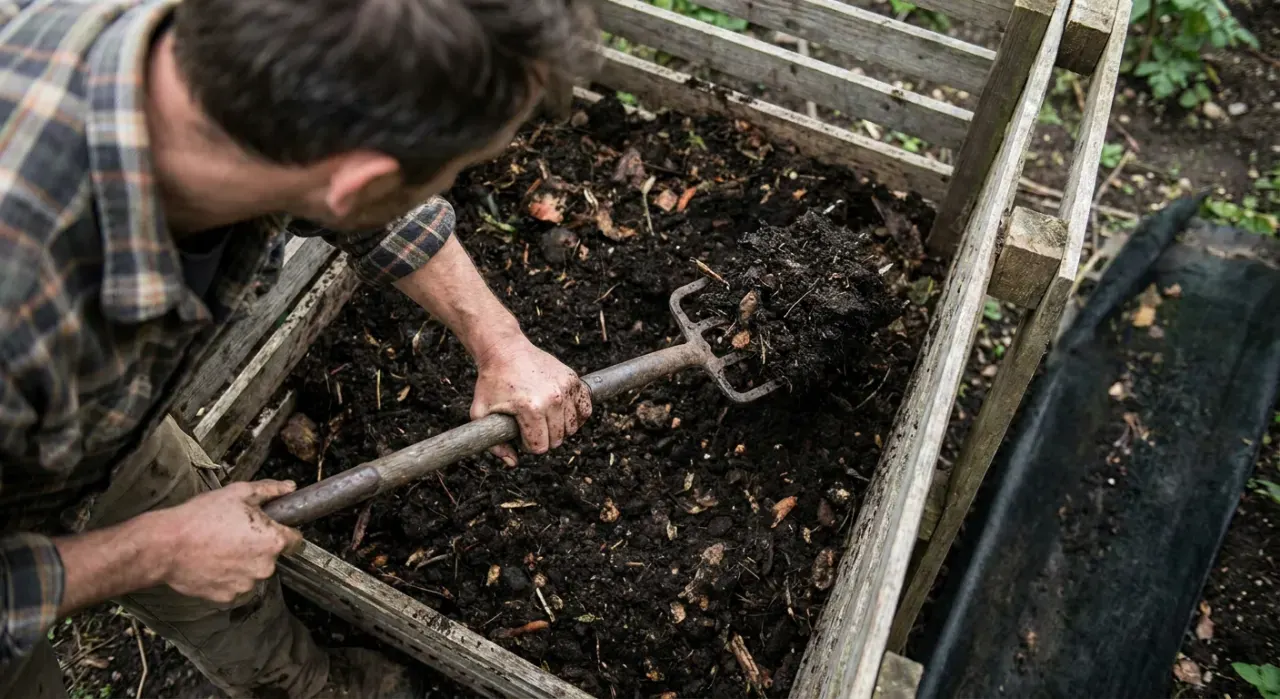
Diagnosis: take a handful from the center — not the surface, which is misleading in both directions — and squeeze hard. It should feel damp and hold its shape, releasing at most a drop or two. Crumbling apart dry means it is under about 40 percent. Water streaming between your fingers means it is over 60 percent, and the smell will usually confirm it.
Fix if too dry: water while turning, not from the top. Water applied to the surface of a dry pile runs off or channels straight through, leaving the interior untouched. Fork the pile into a new heap and wet each layer as you go. Dry cardboard and straw absorb far more than expected. Then cover to hold the moisture in.
Fix if too wet: turn it and mix in a generous volume of dry, coarse browns — shredded cardboard, straw, dry leaves, wood shavings. Break up any matted layers of grass clippings or wet leaves, since those are what created the airless zones. Cover the pile with a tarp if rain is the cause, and lift it off the ground on a base of coarse branches if it is sitting in a puddle.
3. Not Enough Nitrogen
Bacteria need roughly 30 parts carbon to 1 part nitrogen. A pile built mostly from leaves, straw and cardboard has plenty of energy and no protein, and the population never multiplies enough to generate heat.
Diagnosis: look at what went in. If it is mostly brown, dry material and the pile has been sitting unchanged for months with correct moisture, nitrogen is the missing ingredient. The absence of any smell at all is itself a clue — a nitrogen-short pile is odorless.
Fix: add greens and mix them through as you turn, rather than layering them on top. In rough order of usefulness: fresh grass clippings, coffee grounds collected free from a coffee shop, aged herbivore manure, and kitchen scraps. For a fast correction, alfalfa meal at around 12:1 or blood meal at around 3:1 will restart a stalled pile within a couple of days — sprinkle a few cups between forkfuls. Urine, diluted, is a genuinely effective and free nitrogen source that gardeners have used for centuries.
Aim to bring the mix toward 2 to 3 parts browns to 1 part greens by volume. The C:N numbers for each material are tabulated in browns and greens explained.
4. The Pieces Are Too Big
Decomposition happens on surfaces. A whole cabbage, an intact branch or a folded sheet of cardboard presents very little surface for its mass, so microbes work slowly around the outside of each piece and the pile never builds momentum.
Diagnosis: the pile is correctly moist, has plenty of greens and still runs lukewarm, and you can still identify whole items in it after several weeks.
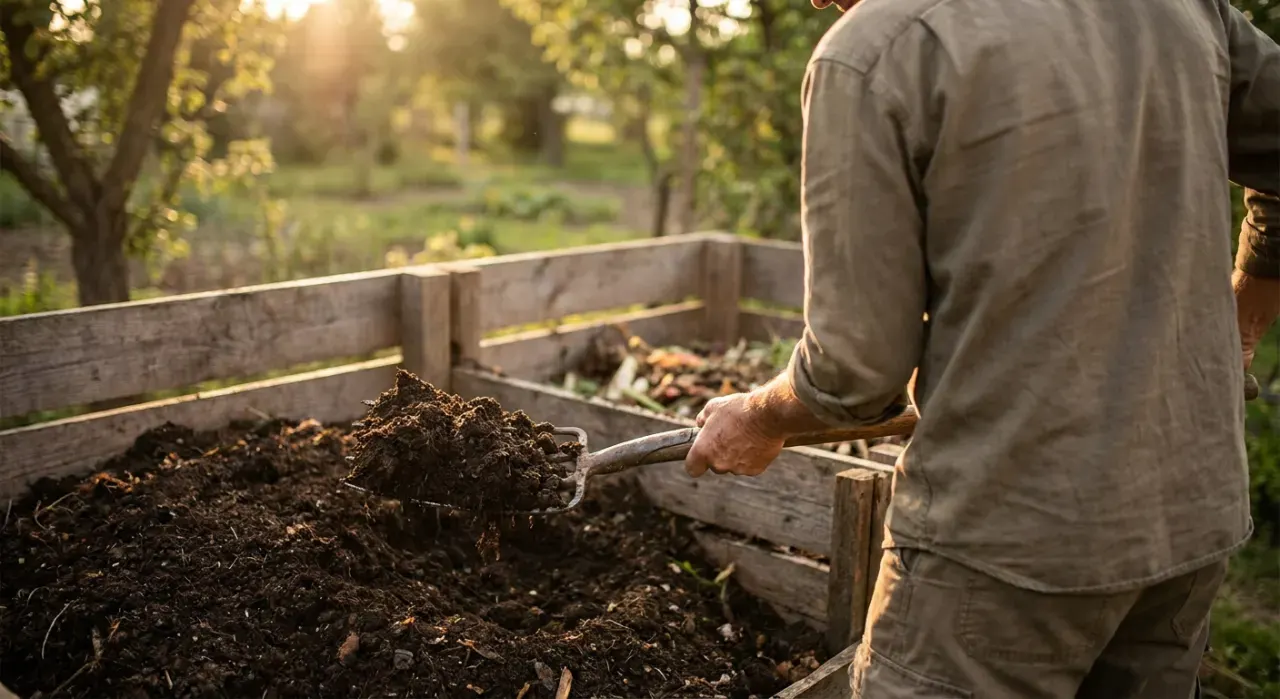
Fix: reduce particle size. Run fall leaves over with a mower before bagging them — whole leaves also mat into airtight layers, so shredding solves two problems at once. Chop kitchen scraps to about an inch. Shred cardboard rather than tearing it in half. Break garden stems into short lengths. There is a limit: material shredded to dust packs down and blocks air, so aim for pieces roughly half an inch to two inches.
5. No Oxygen Reaching the Center
Aerobic bacteria consume oxygen fast, and a pile that has settled and compacted runs out. What takes over is anaerobic decomposition, which is slow, cold and produces the sour, sulfurous smell everyone associates with a bad compost heap.
Diagnosis: smell it and feel it. Rotten-egg or sour odors, a slimy or greasy texture, dense matted layers, and a wet compacted mass that is cool in the middle all point to oxygen starvation. It usually accompanies the too-wet problem.
Fix: turn it thoroughly, and rebuild it with structure. Coarse straw is the best structural brown there is because its hollow stems resist compaction. Chopped woody stems, small twigs and wood chips do the same job. Start the new pile on a base of coarse branches so air enters from beneath, and consider standing a perforated pipe or a bundle of stems vertically through the center as a chimney. If you are turning by hand, a compost aerator tool — a shaft with folding wings — is much less work than a fork for a quick mid-week aeration.
Working Through It in One Session
| Symptom | Most likely cause | Action |
|---|---|---|
| No smell, dry, unchanged for months | Too dry and too brown | Add greens and water while turning |
| Ammonia smell, warm then quickly cool | Too much nitrogen, gassing off | Mix in shredded browns, turn |
| Rotten egg smell, slimy, cool center | Anaerobic — too wet, compacted | Add coarse browns for structure, turn hard |
| Correct mix, correct moisture, still lukewarm | Pile too small, or pieces too coarse | Build bigger, shred material |
| Was hot, now 90°F, smells earthy | Normal — hot phase finished | Turn once; if it does not reheat, cure it |
| Over 160°F | Too hot; beneficial microbes dying off | Turn immediately to release heat |
The single rebuild that fixes most stalled piles takes one afternoon: fork everything out, mix greens through it, wet it as you rebuild, add coarse straw for air, and put it back as one full-size heap. Piles that have sat inert for a year commonly reach 140°F within 48 hours of that treatment.
If the underlying issue is that you have no practical way to build enough mass, the answer may be a different system rather than a better technique — the options are compared in tumbler vs compost bin, with picks in best compost bin and best compost tumbler. And if the pile is fine and you simply want to build the next one properly, start from how to make compost.