 Garden

Affiliate Disclosure
Some links on this page are affiliate links. As an Amazon Associate, we earn from qualifying purchases — at no extra cost to you. We do not buy, test, or physically handle the products we cover; our rankings come from aggregated owner reviews, ratings and expert consensus. Commissions never change our verdicts. How we rank · full disclosure.
The short version: the Rheem RTEX-24 is the whole-home electric tankless to buy if your panel supports it. In cold-groundwater states step up to the EcoSmart ECO 27. If your service is 150 amps or less, the Rheem RTEX-13 on a single 60-amp circuit or a conventional Rheem PROE50 tank are the realistic options. And for one distant fixture, a 10-gallon plug-in tank solves the problem for a few hundred dollars.
Before any of that, one number decides whether an electric tankless will work in your house, and it is not on the box.
The kW-to-GPM math nobody prints on the carton
Electric resistance heating is essentially 100 percent efficient at the appliance, which makes the arithmetic unusually clean. One kilowatt is 3,412 BTU per hour, and raising one gallon per minute by one degree Fahrenheit takes about 500 BTU per hour. So:
GPM = (kW × 3,412) ÷ (temperature rise °F × 500)
Temperature rise is your target outlet temperature minus your incoming groundwater temperature. Southern groundwater sits near 70°F, so a 105°F shower is a 35°F rise. Northern groundwater in February can be 40°F, making the same shower a 65 to 70°F rise. Here is what that does to real units:
| Unit | 40°F rise (warm climate) | 55°F rise (moderate) | 70°F rise (northern winter) |
|---|---|---|---|
| 13 kW (RTEX-13) | 2.2 GPM | 1.6 GPM | 1.3 GPM |
| 18 kW | 3.1 GPM | 2.2 GPM | 1.8 GPM |
| 24 kW (RTEX-24) | 4.1 GPM | 3.0 GPM | 2.3 GPM |
| 27 kW (ECO 27) | 4.6 GPM | 3.4 GPM | 2.6 GPM |
| 28.8 kW (Tempra 29) | 4.9 GPM | 3.6 GPM | 2.8 GPM |
A modern shower runs 1.8 to 2.5 gallons per minute; the EPA WaterSense specification caps certified showerheads at 2.0 GPM. Read the table again with that in mind. In a northern winter, even a 27 kW unit is one shower. Two simultaneous showers in a cold climate is not something residential electric tankless does, at any price. That is not a product flaw; it is the reason gas tankless exists.
Top Picks at a Glance
Our #1 Pick: Rheem RTEX-24
The RTEX-24 sits at the practical center of the electric tankless market: enough output to serve a whole house in most of the country, a control system that modulates power to the actual flow rather than switching in crude stages, and — the reason it outranks the higher-output EcoSmart here — heating elements you can replace yourself without pulling the unit off the wall. On an appliance meant to run for twenty years, being able to buy a $40 element in year twelve is worth more than three extra kilowatts.
Owners consistently report it holding a set temperature accurately on a single draw, and consistently report the same limit: it is a one-shower-at-a-time appliance once groundwater gets cold. The negative reviews are overwhelmingly reviews of an undersized installation rather than of a faulty product, which is exactly why the table above is at the top of this page.
Check the panel before you order. Twenty-four kilowatts is roughly 100 amps at 240 volts, wired as three separate 40-amp double-pole circuits, on top of your existing load. That is not possible on a 100-amp service and rarely possible on 150. Have an electrician run a load calculation first — the most expensive mistake in this category is discovering the requirement after the box arrives.
Check price on Amazon → (paid link)
The Ranked Field
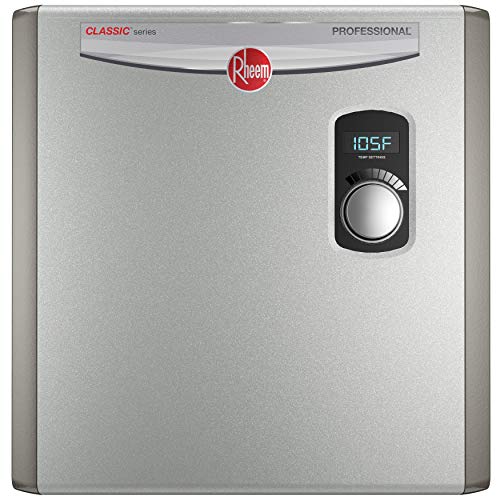
Best for whole-home electric hot water where the panel has genuine headroom
- 24 kW across three chambers, self-modulating to actual flow
- Digital control in 1°F steps between 80 and 140°F
- Field-replaceable heating elements — serviceable on the wall
- About 100 amps at 240V across three 40-amp double-pole breakers
Why buy it: the most-owned whole-home electric tankless in America, so its cold-weather behavior is documented by years of real ownership rather than a marketing figure.
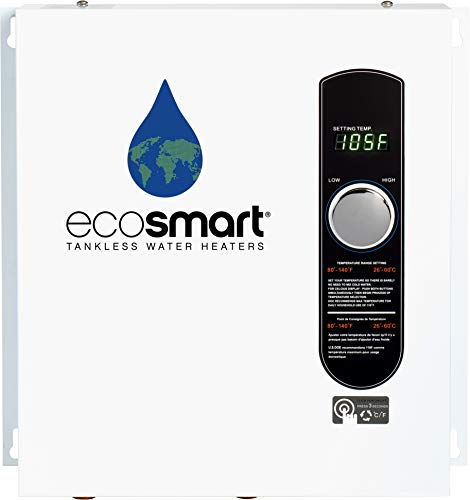
Best for northern states where winter groundwater arrives near 40°F
- 27 kW — the top of the common residential electric range
- Self-modulating power delivery rather than fixed-stage heating
- Digital thermostat with 1-degree resolution
- Roughly 112.5 amps at 240V; three 40-amp double-pole breakers
Why buy it: temperature rise is the only thing that limits an electric tankless, and the extra 3 kW is what keeps a February shower from turning lukewarm.

Best for buyers who want flow-sensing control rather than simple modulation
- 28.8 kW with Advanced Flow Control — throttles flow to hold temperature
- Digital setpoint display with memory presets
- German engineering with a long-standing U.S. service presence
- Silent operation with no fan or combustion
Why buy it: the Plus models reduce flow slightly rather than letting the water go cold when demand exceeds capacity, which is the single most useful feature in an undersized moment.

Best for a like-for-like replacement of a failed 50-gallon electric tank
- 50 gallons with dual 4500-watt elements on a 30-amp 240V circuit
- Enhanced-flow brass drain valve instead of the usual plastic one
- Replaceable anode rod and replaceable elements
- Standard footprint and 3/4-inch NPT connections
Why buy it: no panel upgrade, no load calculation, no surprise: a 50-gallon tank drops into the space and the circuit the old one used, and the whole project costs a fraction of any tankless conversion.

Best for a single bathroom, a warm climate, or a cabin on a modest service
- 13 kW on a single 60-amp 240V circuit — one circuit, not three
- External digital thermostatic control
- Compact wall box roughly the size of a hardback book
- Threaded 1/2-inch NPT connections
Why buy it: the electric tankless most houses can actually power: one 60-amp circuit is a realistic ask where three 40-amp circuits are not.
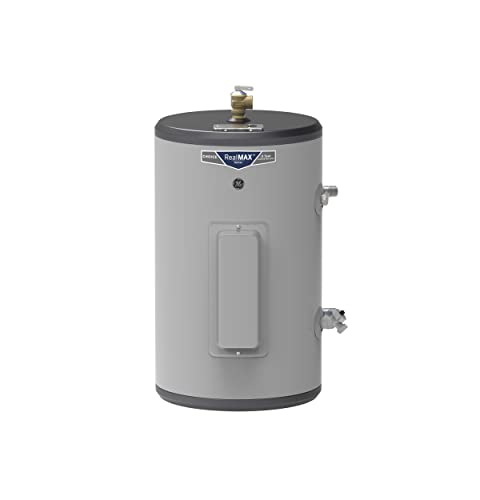
Best for a workshop, a guest bath, an ADU or a bar sink
- 10-gallon glass-lined tank on an ordinary 120V outlet
- Adjustable front thermostat dial
- Mounts on a shelf, a wall or the floor
- Serviceable anode rod, unusual at this size
Why buy it: no electrician and no circuit run — it plugs into the outlet already in the room, which is why it fits places a full water heater never could.

Quick Comparison
| Product | Best for | Rating | Price | Buy |
|---|---|---|---|---|
| Rheem RTEX-24 24kW 240V Electric Tankless Water Heater | Best Overall | — | Check (paid link) | |
| EcoSmart ECO 27 Electric Tankless Water Heater, 27 kW at 240 Volts | Best for Cold Climates | — | Check (paid link) | |
| Stiebel Eltron Tempra 29 Plus Electric Tankless Water Heater, 28.8kW | Best Premium | — | Check (paid link) | |
| Rheem PROE50 M2 RH95 50-Gallon Professional Classic Electric Water Heater | Best Conventional Tank | — | Check (paid link) | |
| Rheem RTEX-13 240V Heating Chamber Residential Tankless Water Heater | Best for One Bathroom | — | Check (paid link) | |
| GE Appliances 10 Gallon Versatile Plug and Play Electric Water Heater with Adjustable Thermostat | Best Point of Use | — | Check (paid link) |
Why electric tanks recover slowly — and why that is fine
A conventional electric tank has two 4500-watt elements, and almost every residential unit is wired for non-simultaneous operation: the upper element gets priority and the lower one only runs when the upper thermostat is satisfied. They never fire together. That is why a 50-gallon electric tank recovers about 20 to 21 gallons per hour at a 90°F rise while a 40,000 BTU gas tank does roughly double.
In practice this matters less than it sounds, because a tank is a buffer. Fifty gallons of stored hot water covers back-to-back showers comfortably; the slow recovery only bites when the household drains the tank twice in an evening. This is precisely what First Hour Rating measures, and it is the number to size on rather than gallons:
| Household | Target First Hour Rating | Typical electric tank size |
|---|---|---|
| 1–2 people | 30–40 gallons | 30–40 gallon |
| 3–4 people | 50–60 gallons | 50 gallon |
| 5+ people | 60–80 gallons | 66–80 gallon |
One structural advantage of electric over gas: an electric tank has no flue tube running up through its middle, so there is less internal surface to corrode and no second hot zone. Electric tanks routinely outlive gas tanks of the same age, typically 10 to 15 years against 8 to 12 — assuming the anode rod gets changed, which is covered in how long water heaters last.
The option that beats all of these on running cost
A heat pump (hybrid) water heater is still an electric tank, but instead of generating heat with a resistance element it moves heat from the surrounding air into the water. That makes it roughly three times as efficient as anything else on this page, and it attracts more utility and federal incentives than any other water heater type. Certified models and their efficiency ratings are listed at Energy Star.
The constraints are real and worth stating plainly: it needs roughly 700 to 1,000 cubic feet of air around it, it blows cool dry air into that space, and it makes noise comparable to a dehumidifier. In a Texas garage that is a bonus. In a small conditioned closet in Vermont it is a problem, because you are paying your furnace to reheat the air the water heater just chilled. If you have the space and a moderate climate, price one before buying anything above.
How We Rank
We never buy or install these units. For electric water heaters we weight: honest output at real temperature rise rather than the headline kW; electrical feasibility, because a heater your service cannot power is not a candidate; serviceability of elements, thermostats and the anode rod; and aggregated owner reports on the failures that appear in years two to eight — element burnout, control board faults, scale and leaks. Star ratings and review counts come from verified Amazon listing data and refresh automatically. Prices were checked at the time of writing. Full method: how we rank.

The Field, Reviewed
1. Rheem RTEX-24 — Best Overall
Covered above. Owners praise: accurate, stable outlet temperature, genuinely endless hot water on a single draw, the space it frees up, and elements that can be replaced in place. Owners gripe about: insufficient capacity for two simultaneous showers in cold climates, the three-circuit electrical requirement, and a minimum activation flow that means a slow trickle never triggers the heater. Check price (paid link).
2. EcoSmart ECO 27 — Best for Cold Climates
Twenty-seven kilowatts is about the ceiling for residential electric, and in Minnesota or Maine that margin is the difference between a warm shower and a disappointing one. Self-modulation means the 112-amp draw is a peak rather than a constant, but the circuit still has to be there for it.
Owners praise: the extra headroom in winter, a precise digital setpoint, and a compact body. Owners gripe about: the electrical requirement above everything else, reports of control board failures, and a warranty that expects documented professional installation and, in hard water, documented flushing. Check price (paid link).
3. Stiebel Eltron Tempra 29 Plus — Best Premium
The Plus designation is the reason to consider it. Standard tankless units let outlet temperature fall when demand exceeds capacity; Advanced Flow Control instead throttles the flow slightly to hold the temperature you asked for. Given that undersizing is the defining failure of electric tankless, a unit that degrades gracefully rather than going cold is worth the premium to some buyers.
Owners praise: temperature stability under varying demand, silent operation, and build quality that reads as a step above the mainstream. Owners gripe about: the price, the same substantial electrical requirement as any 28 kW unit, and installation instructions that assume more plumbing knowledge than average. Check price (paid link).
4. Rheem PROE50 M2 — Best Conventional Tank
If the electrician's answer is no, this is the answer. A 50-gallon dual-element tank runs on a 30-amp 240-volt circuit — the circuit your old tank was already on — and needs no load calculation, no service upgrade and no new venting. The brass drain valve is a genuine improvement over the plastic valves that seize with sediment and make an annual flush miserable.
The honest caveat: tanks this size are mostly bought locally, so this listing carries very few ratings. Judge it on specification and service network rather than on a review count. Owners praise: a straightforward drop-in replacement and serviceable elements, anode and drain valve. Owners gripe about: freight damage in transit, the perennial complaint for any 130-pound appliance shipped to a house. Check price (paid link).
5. Rheem RTEX-13 — Best for One Bathroom
The electric tankless most American houses can actually power. Thirteen kilowatts is about 54 amps on a single 60-amp double-pole circuit, which is a realistic addition to a 150 or 200-amp panel where three 40-amp circuits are not. Read it against the table above before buying: 1.3 GPM at a 70°F rise is a single low-flow shower and nothing else, but 2.2 GPM in a warm climate is a comfortable one-bathroom solution.
Owners praise: the single-circuit installation, the compact size, and instant hot water at a cabin or guest suite. Owners gripe about: people buying it as a whole-house heater and finding out what 13 kW means in January, and the external thermostat control being easy to nudge off setting. Check price (paid link).
6. GE 10 Gallon Plug and Play — Best Point of Use
Ten gallons on a standard 120-volt outlet, mountable on a shelf, a wall or the floor. It will not serve a house and does not pretend to; it serves the workshop sink, the guest bath over the garage, the bar sink, the ADU. What sets it apart from a 2.5-gallon mini tank is that ten gallons is enough for a short shower, which widens what it can be used for considerably.
Owners praise: installation with no electrician, a serviceable anode rod at a size where most units have none, and a simple front thermostat. Owners gripe about: slow recovery, which is unavoidable on a 120-volt element, and the need to route the T&P relief valve discharge properly — a step some installations skip and should not. Check price (paid link).
What owners actually complain about
Buying before checking the panel. By a wide margin the most common bad review in this category is a correctly functioning appliance in a house that cannot supply it. Load calculation first, purchase second.
Believing the headline GPM. Manufacturers publish maximum flow at a modest temperature rise. Your January rise is not modest.
Dry-firing an element. Elements are designed to be submerged. Switching a breaker on while a tank is empty or partially drained burns one out in seconds. This is the most common self-inflicted damage to an electric tank, and it happens during flushing and during element replacement.
Sediment burying the lower element. In hard water the lower element eventually sits inside a mound of scale, overheats and fails. Annual flushing prevents it; see how often to flush a water heater.
Scale in a tankless heat exchanger. Electric tankless units have narrow passages and hard water closes them. Annual descaling is a warranty condition on several of the models here. If your water is hard, read how to test water hardness and consider a softener.
Where to stop and call a licensed professional
Any panel or feeder work is licensed electrical work in every U.S. jurisdiction. A whole-home electric tankless requires a documented load calculation and, frequently, a service upgrade. Do not improvise this, and do not run it on an undersized circuit "just to test it".
Before touching an element or thermostat: switch the dedicated breaker off, verify with a tester at the terminals, then drain below the element. Refill fully and bleed the air before restoring power.
Set the thermostat to 120°F. The CPSC reports third-degree burns after about six seconds at 140°F and two seconds at 150°F (Avoiding Tap Water Scalds). Where a higher tank temperature is wanted for Legionella control, the correct answer is a thermostatic mixing valve at the outlet rather than hot water at the tap — the CDC covers the water-system side of that trade-off.
The verdict
The Rheem RTEX-24 is the electric water heater we would fit in a house that can power it, and the EcoSmart ECO 27 is the version to buy if your groundwater arrives cold. If the panel says no — and for a great many American homes it does — the Rheem RTEX-13 on one circuit or the Rheem PROE50 tank are the honest answers, and neither is a consolation prize. Whatever you fit, change the anode rod or descale the exchanger, because that is what decides whether you buy another one in eight years or in twenty. Check price on Amazon → (paid link)
More from this hub: DIY plumbing · best water heater · best 50 gallon electric water heater · tankless vs tank · how long do water heaters last · how we rank.