 Garden


Affiliate Disclosure
Some links on this page are affiliate links. As an Amazon Associate, we earn from qualifying purchases — at no extra cost to you. We do not buy, test, or physically handle the products we cover; our rankings come from aggregated owner reviews, ratings and expert consensus. Commissions never change our verdicts. How we rank · full disclosure.
The short version: the best UV water purifier for most wells is the iSpring UVF55FS — 55 watts, 12 gallons per minute, 1 inch ports and a flow sensor that only runs the lamp when water moves. The HQUA-OWS-12 is the value pick for a smaller home and ships with a spare lamp. VIQUA is the brand a water treatment professional will recognize and still have parts for in a decade.
Before any of that, the thing that gets people into trouble: UV disinfects, it does not filter. It inactivates microorganisms using ultraviolet light and removes nothing from the water. Lead, nitrate, arsenic, PFAS, chlorine, iron, hardness and sediment all pass through untouched. UV is the last stage of a treatment train, not a substitute for one.
How UV Actually Works
Water flows through a stainless steel chamber around a low-pressure mercury lamp housed in a quartz sleeve. The lamp emits ultraviolet light at 254 nanometers, which damages the genetic material of microorganisms so they can no longer reproduce. Nothing is added and nothing is taken out — the organisms are still in the water, they are simply inactivated.
Two consequences follow from that, and both are practical.
There is no residual. Chlorine keeps working downstream of where it was added; UV does not. Anything that contaminates the plumbing after the lamp is untreated, which is why UV is normally installed as close to the point of entry as possible and why a system should be sanitized whenever it has been opened.
The dose depends on the water being clear. UV effectiveness is a function of light reaching the organism multiplied by the time it is exposed. Turbidity scatters that light, iron and manganese absorb it, and hardness scales the quartz sleeve until it is a frosted window. This is why UV is fitted last, behind sediment and, where needed, iron and hardness treatment.
NSF/ANSI 55: Class A or Class B
UV systems have their own certification standard, and the two classes within it mean genuinely different things. This is the single most useful thing to know before buying.
| NSF/ANSI 55 Class A | NSF/ANSI 55 Class B | |
|---|---|---|
| UV dose | 40 mJ/cm² | 16 mJ/cm² |
| Intended for | Water not known to be microbiologically safe | Supplemental treatment of water already deemed acceptable |
| Targets | Bacteria, viruses, and protozoan cysts including Cryptosporidium and Giardia | Nonpathogenic nuisance organisms |
| Typical use | A private well with a history of coliform detections | Municipal water, or a well already tested clean |
| Monitoring | UV sensor and alarm required | Not required to the same level |
If you are treating water that has tested positive, Class A is the specification. A great many inexpensive UV units on the market are certified to neither class, which does not make them useless but does mean nobody independent has verified the delivered dose. Check the exact model number in NSF's certified treatment unit database rather than reading the listing copy.
And note what UV certification does not replace. If a well tests positive for coliform bacteria, the correct sequence is to disinfect the well itself, retest, and then fit UV as continuing protection — not to fit UV instead of dealing with the well. EPA's private wells guidance and CDC's well testing guidelines both set annual coliform and nitrate testing as the baseline, and a UV system does not change that. It also does nothing whatsoever about nitrate.
Top Picks at a Glance
Our #1 Pick: iSpring UVF55FS
Fifty-five watts at 12 gallons per minute through 1 inch ports is the configuration that fits the largest number of American homes, and iSpring has priced it well below the professional brands without cutting the parts that matter — stainless chamber, replaceable quartz sleeve, standard lamp size.
The feature that earns it the top spot is the flow sensor. A UV lamp on a timer or a plain switch runs continuously, which burns lamp hours around the clock and heats standing water in the chamber when nothing is being drawn. A flow-activated system energizes the lamp when water moves and shuts it down when it stops. Owners consistently report that as the difference between a system they think about and one they do not.
The honest limitations. Like most units in this price band it does not carry the full monitoring hardware that an NSF/ANSI 55 Class A listing requires, so if you are treating water known to be unsafe, confirm the class before you rely on it. The lamp needs replacing annually regardless of whether it still glows. And it will underperform badly on water that has not been pre-filtered — fit a 5 micron sediment cartridge ahead of it as a minimum.
Check price on Amazon → (paid link)
The Ranked Field
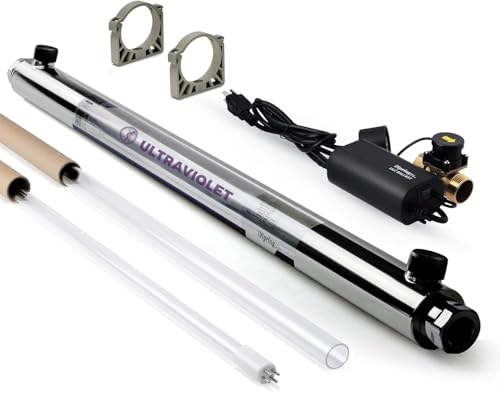
Best for whole-house UV on a typical family well
- 55 watt lamp rated at 12 gallons per minute — enough for most family homes
- 1 inch MNPT ports, so it does not throttle a whole-house line
- Smart flow sensor energizes the lamp only when water is moving
- Stainless steel chamber with a replaceable quartz sleeve
Why buy it: the flow-sensor switch is the feature that matters most day to day: the lamp runs when water runs, which extends lamp life and cuts standby power without you having to think about it.

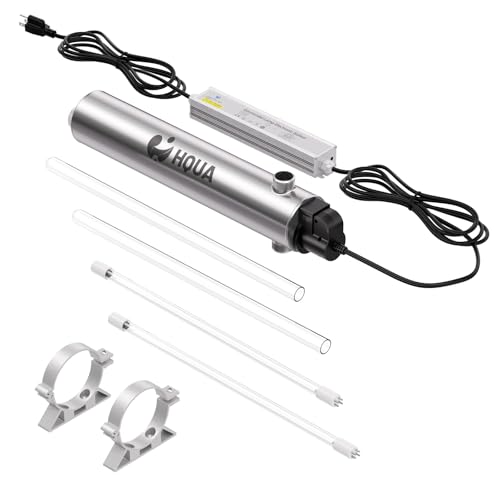
Best for smaller homes and cabins on 3/4 inch plumbing
- 40 watt lamp with 3/4 inch MNPT ports, around 12 gpm rated flow
- Ships with a spare UV tube, which is a year of running cost included
- Stainless steel chamber with mounting hardware
- Straightforward ballast with a lamp-on indicator
Why buy it: a spare lamp in the box is worth more than it looks — lamps are the entire consumable cost of UV, and having the next one on the shelf means it actually gets changed.
Best for larger homes where several fixtures run at once
- 55 watt lamp at 12 gpm through 1 inch ports
- Spare UV tube supplied
- Stainless steel chamber with quartz sleeve
- Sized for a three or four bathroom home
Why buy it: flow rating is the one specification you cannot fudge on UV — undersize it and water passes through faster than the dose requires, so buy for peak demand, not average.

Best for buyers who want the brand well drillers actually install
- VIQUA is the residential UV brand most commonly specified by water treatment professionals
- 9 gpm rated flow from a 35 watt lamp
- Constant-current ballast with lamp countdown and audible alarm
- Well-supported parts and lamp supply across North America
Why buy it: UV systems live or die on whether you can still get a lamp and a quartz sleeve in year seven, and this is the brand a local water treatment dealer will recognize.

Best for the kitchen tap or the last stage of an under-sink system
- 11 watt lamp sized for drinking-water flow rather than whole-house flow
- Flow control switch so the lamp only runs on demand
- Fits alongside standard 10 inch under-sink housings
- Common lamp size, inexpensive to replace
Why buy it: if the only water you want treated is the water you drink, treating a few gallons a day costs a fraction of treating everything that goes to the toilet and the yard hydrant.
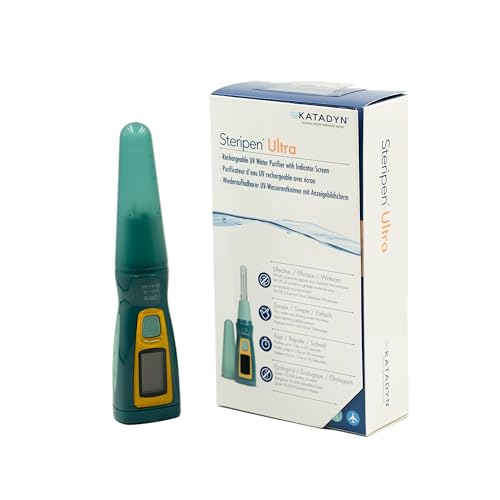
Best for backpacking, travel and emergency kits
- Handheld UV wand that treats a liter at a time in about 90 seconds
- USB rechargeable rather than dependent on disposable batteries
- OLED display confirms a completed treatment cycle
- Rated for thousands of liters over the lamp life
Why buy it: the only UV device here that works without plumbing or power, which makes it the one that belongs in an emergency kit rather than a utility room.
Quick Comparison
| Product | Best for | Rating | Price | Buy |
|---|---|---|---|---|
| iSpring UVF55FS Whole House UV Water Filter, 55W, 12 GPM, 1 inch MNPT Inlet and Outlet | Best Overall | — | Check (paid link) | |
| HQUA-OWS-12 Whole House Ultraviolet Water Purifier, 120V 40W, 3/4 inch MNPT, Plus Spare UV Tube | Best Value | — | Check (paid link) | |
| HQUA-TWS-121 Whole House Ultraviolet Water Purifier, 120V 55W, 12 GPM, 1 inch MNPT, Plus Spare Tube | Best High Flow | — | Check (paid link) | |
| VIQUA VH200 Home Stainless Steel Ultraviolet Water System, 9 GPM, 35W | Best Build Quality | — | Check (paid link) | |
| iSpring UVF11A UV Ultraviolet Light Water Filter with Smart Flow Control Switch, 11W, 110V, 10 inch | Best Point-of-Use | — | Check (paid link) | |
| SteriPEN Ultra UV Water Purifier, USB Rechargeable, High-Contrast OLED Display | Best Portable | — | Check (paid link) |
The Pre-Treatment UV Requires
UV is the only home water technology whose performance is silently destroyed by water quality it does nothing about. Manufacturers publish pre-treatment limits and they are worth taking seriously, because exceeding them does not make the lamp fail visibly — it just reduces the delivered dose while everything looks fine.
| Parameter | Typical limit before UV | Why it matters | Fix |
|---|---|---|---|
| Turbidity | Below 1 NTU | Suspended particles scatter UV and shield organisms behind them | 5 micron sediment filter |
| Iron | Below 0.3 ppm | Absorbs UV and coats the quartz sleeve | Iron filter |
| Manganese | Below 0.05 ppm | Same as iron, and stains black | Iron and manganese media |
| Hardness | Below about 7 gpg | Scales the quartz sleeve into a frosted window | Water softener |
| Tannins and color | Low | Colored water absorbs UV directly | Tannin filter or carbon |
The ordering in a well system is nearly always the same: sediment first, then iron and manganese, then softening if needed, then carbon, then UV last. Put the lamp first and you will be cleaning the sleeve every month.
How We Rank
We never buy or install these systems. For UV the ranking priorities are: flow rating against realistic peak household demand, since an undersized system delivers an inadequate dose without any visible symptom; certification and monitoring, weighted toward NSF/ANSI 55 Class A where water may be unsafe, and toward units with sensors and alarms rather than a lamp-on light; lamp and sleeve availability, because a UV system with an orphaned lamp is scrap; and aggregated owner reports on ballast failures, sleeve cracking and real lamp life, which is where these systems actually go wrong. Ratings come from verified Amazon listing data and refresh automatically. Prices were checked at the time of writing. Full method: how we rank.
The Systems, Reviewed
1. iSpring UVF55FS — Best Overall
Covered above. Owners praise: the flow sensor, 1 inch ports that do not throttle the house, a clear installation manual, and a price well below professional-brand equivalents. Owners gripe about: ballast failures within a couple of years on some units, a quartz sleeve that must be handled carefully during lamp changes, and documentation that is thin on pre-treatment requirements. Check price (paid link).
2. HQUA-OWS-12 — Best Value
Forty watts on 3/4 inch ports, which suits a cabin, a small home or a point-of-entry install on a modest supply. The spare UV tube in the box is a genuinely useful inclusion: lamps are the entire recurring cost of owning UV, and a spare on the shelf is the single best predictor of the change actually happening on schedule.
Owners praise: the price, the included spare lamp, and simple installation. Owners gripe about: 3/4 inch ports limiting flow in larger homes, a basic indicator rather than a dose monitor, and instructions that assume some plumbing experience. Check price (paid link).
3. HQUA-TWS-121 — Best High Flow
The same idea as the OWS-12 with a 55 watt lamp and 1 inch ports, which is what a three or four bathroom house needs when two showers and a dishwasher run together. Sizing UV on peak flow rather than average consumption is the most commonly botched calculation in this category, and this is the model that gives most homes headroom.
Owners praise: real whole-house flow, the spare lamp, and solid stainless construction. Owners gripe about: the mounting hardware, and a ballast that some owners report running warm. Check price (paid link).
4. VIQUA VH200 — Best Build Quality
The brand water treatment dealers actually install, which matters more in UV than in almost any other category. A UV system needs a specific lamp and a specific quartz sleeve every year for as long as you own it, and an orphaned system is landfill. VIQUA parts are stocked across North America, and the constant-current ballast with a lamp countdown and audible alarm is a step above a lamp-on light.
Owners praise: build quality, parts availability, the countdown and alarm, and dealer support. Owners gripe about: the price, which is roughly double the value units, and a 9 gpm rating that is modest for the money. Check price (paid link).
5. iSpring UVF11A — Best Point-of-Use
Eleven watts, sized for drinking water rather than for the whole house. If the concern is the water you drink and cook with rather than the water that flushes the toilet, treating a few gallons a day instead of a few hundred cuts both the purchase price and the lamp cost dramatically. It sits neatly alongside standard 10 inch under-sink housings as a final stage.
Owners praise: the low price, flow-activated operation, and how easily it integrates with an existing under-sink setup. Owners gripe about: that it treats only one tap, and that plumbing it into an under-sink cabinet takes more space than expected. Check price (paid link).
6. SteriPEN Ultra — Best Portable
A handheld wand you stir through a liter of water for around 90 seconds. It needs no plumbing and no outlet, which makes it the only device here that belongs in a backpack or an emergency kit rather than a utility room. USB charging beats hunting for camera batteries in the field.
Owners praise: genuine portability, the clear OLED confirmation of a completed cycle, and USB charging. Owners gripe about: that it treats a liter at a time, that it needs relatively clear water to work — pre-filter cloudy sources — and that a dropped unit is a fragile one. Check price (paid link).
What Owners Actually Complain About
Assuming a glowing lamp means a working system. The most consequential misunderstanding in UV. Germicidal output falls well before the lamp stops emitting visible light. Replace annually on a calendar, not on appearance.
Scaled and fouled quartz sleeves. On hard or iron-bearing water the sleeve frosts over within months and the dose collapses silently. Clean it at every lamp change with a mild acid descaler, and treat the underlying hardness or iron rather than the symptom.
Ballast failures. The most common hardware failure across the budget end of this category. Check that a replacement ballast is available for the model you buy before you buy it.
Undersizing. People buy for average use and get an inadequate dose whenever two fixtures run together. Size on peak flow, and if you are between ratings, go up.
Expecting UV to make bad water good. It does not remove nitrate, arsenic, lead, PFAS or anything else dissolved, and it does not clarify cloudy water. UV is one stage. Best well water filter system covers how the stages fit together, and best water test kit covers finding out what you are actually dealing with.
The Verdict
UV is the right answer to one specific question — microbiological safety on a private supply — and the wrong answer to every other water problem. Get the well tested, deal with any contamination at the well itself, then fit UV as continuing protection with proper pre-filtration ahead of it. The iSpring UVF55FS is the sensible whole-house choice for most homes, the HQUA-OWS-12 is the value option with a spare lamp included, the HQUA-TWS-121 handles larger homes, and VIQUA is what to buy if long-term parts support is worth the premium. Where the water may genuinely be unsafe, look for an NSF/ANSI 55 Class A listing specifically. And change the lamp every year, whether or not it is still glowing. Check price on Amazon → (paid link)
More from this hub: DIY plumbing · best well water filter system · best sediment filter · best water test kit · best iron filter for well water · how we rank.