 Garden

Affiliate Disclosure
Some links on this page are affiliate links. As an Amazon Associate, we earn from qualifying purchases — at no extra cost to you. We do not buy, test, or physically handle the products we cover; our rankings come from aggregated owner reviews, ratings and expert consensus. Commissions never change our verdicts. How we rank · full disclosure.
Start with an honest note about this category. Full-size 40 and 50-gallon tanks are overwhelmingly bought at a supply house or a big-box store and installed the same day, so their online listings carry only a handful of ratings each — a couple of dozen at best, against tens of thousands for a mini-tank. That is a fact about how Americans buy water heaters, not a judgment about the products, and we say it plainly rather than dressing up a six-review listing as a consensus. The ranking below leans toward the formats with a real ownership record behind them, and flags where it does not.
The short version: for whole-home electric, the Rheem RTEX-24. For gas, the Rheem RTG-70DVLN-3. For a straight tank replacement, the Rheem PROE50. For one distant fixture that runs cold forever, the Bosch Tronic 3000 T.
Decide the format before you shop the models
The format decision determines your installed cost far more than the model does, and it is the part most buyers skip. Tankless vs tank covers this in full, but the short form:
| Format | Typical life | Installed cost, mid-2026 | The catch |
|---|---|---|---|
| Gas storage tank | 8–12 years | $1,200–$2,200 | Standby losses; 40+ gallons on the floor when it fails |
| Electric storage tank | 10–15 years | $1,100–$2,000 | Slow recovery; same flood risk |
| Gas tankless | 20+ years | $2,500–$4,500 | Often needs a 3/4-inch gas line and new venting |
| Electric tankless | 20+ years | $1,200–$3,500 | Needs 100–112 amps of 240V capacity |
| Heat pump / hybrid | 10–15 years | $2,000–$3,800 | Needs 700–1,000 cu ft of air; exhausts cool air |
| Point of use | 6–10 years | $150–$400 | Solves one fixture, not a house |
Prices are typical U.S. installed ranges as of mid-2026 and vary widely with local labor rates and with how much gas, vent or electrical work your house needs. Get quotes that itemize those separately from the appliance.
Top Picks at a Glance
Our #1 Pick: Rheem RTEX-24
The RTEX-24 is the most widely owned whole-home electric tankless heater in the country, and in a category where the honest question is "how does it behave in February", that ownership base is worth more than any specification. Owners consistently report it holding a set temperature well on a single shower, and consistently report the same limitation: in northern states with cold incoming groundwater, 24 kW is one comfortable shower, not two simultaneous ones. That is physics, not a defect, and the reviews that call it a failure are almost always reviews of an undersized installation.
What earns it the top spot over the higher-output EcoSmart is serviceability. The heating elements are field-replaceable — you can open it, pull an element and fit a new one without removing the unit from the wall. On a device meant to last twenty years, that matters more than a few extra kilowatts, and it is the same reasoning that puts a serviceable control valve at the top of our water softener rankings.
Before you buy it, check your panel. Twenty-four kilowatts at 240 volts is roughly 100 amps, wired as three separate 40-amp double-pole circuits. On a 100-amp service this is not possible. On a 150-amp service it usually is not once the rest of the house is counted. Even on 200 amps it needs a load calculation. Have a licensed electrician confirm capacity before the unit arrives, not after.
Check price on Amazon → (paid link)
The Ranked Field
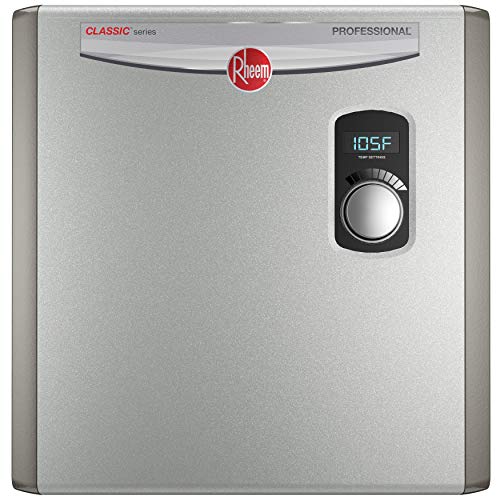
Best for whole-home electric hot water in a house with real panel capacity
- 24 kW across three heating chambers, self-modulating to the draw
- Digital thermostatic control in 1°F increments from 80 to 140°F
- Field-serviceable heating elements — replaceable without pulling the unit
- Roughly 100 amps at 240V across three 40-amp double-pole breakers
Why buy it: the most-owned whole-home electric tankless in the country, which means its behavior in a cold-groundwater winter is documented by an enormous body of long-term owners rather than a spec sheet.

Best for a gas house with an existing indoor mechanical space and a vent path
- 7.0 GPM maximum flow, 180,000 BTU per hour input
- Direct-vent sealed combustion — draws combustion air from outside
- Low NOx burner meets SCAQMD Rule 1146.2
- Built-in freeze protection to -30°F with power connected
Why buy it: the sensible middle of the gas tankless market: non-condensing so it is simpler and cheaper than a condensing unit, sealed combustion so it is not competing with your furnace for air.

Best for a like-for-like replacement of a failed 50-gallon electric tank
- 50-gallon capacity with dual 4500-watt elements
- Enhanced-flow brass drain valve rather than the usual plastic
- Replaceable anode rod — the part that decides how long the tank lives
- Standard 3/4-inch NPT connections and a conventional footprint
Why buy it: the boring answer, and often the right one: a straightforward 50-gallon tank drops into the space and pipework the old one occupied, with no gas, vent or panel work in the quote.
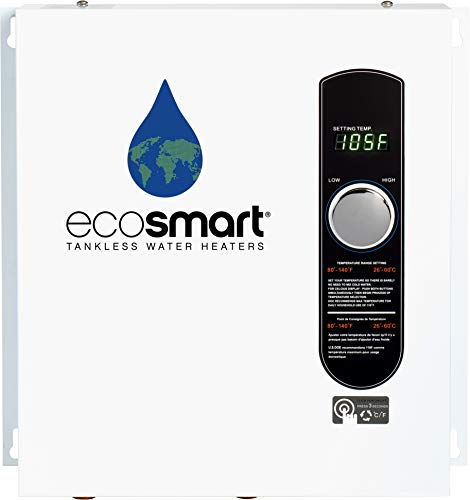
Best for northern climates where incoming groundwater is genuinely cold
- 27 kW — the highest common residential electric output
- Patented self-modulating technology matches power to actual flow
- Digital temperature control in 1-degree increments
- Draws about 112.5 amps at 240V; needs three 40-amp double-pole breakers
Why buy it: temperature rise is what limits an electric tankless, and 27 kW is the difference between two comfortable showers in July and two comfortable showers in February.
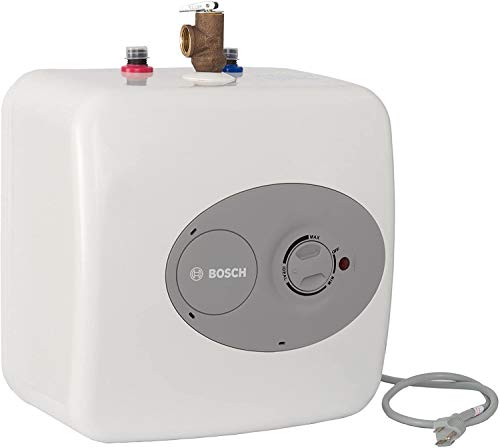
Best for a far-flung bathroom sink, a bar sink, a workshop or an office kitchenette
- 2.5-gallon glass-lined tank, shelf, wall or floor mounted
- Plugs into an ordinary 120V outlet — no dedicated circuit
- Fits under a sink in a standard vanity cabinet
- Can be plumbed as a standalone or as a buffer ahead of a longer run
Why buy it: the fix for the fixture that takes ninety seconds to run hot: it solves a plumbing distance problem rather than a heating capacity problem, and it costs a fraction of re-piping.

Best for apartments, ADUs, tiny homes, RVs and shop bathrooms
- 18-gallon tank on a standard 120V plug — no electrician required
- Adjustable thermostat with a simple front-mounted dial
- Compact enough for a closet, a crawl space or under a counter
- Glass-lined tank with a serviceable anode rod
Why buy it: the rare water heater a renter or an ADU owner can actually install, because it plugs into a normal outlet instead of needing a 40-amp circuit run to it.
Quick Comparison
| Product | Best for | Rating | Price | Buy |
|---|---|---|---|---|
| Rheem RTEX-24 24kW 240V Electric Tankless Water Heater | Best Overall | — | Check (paid link) | |
| Rheem RTG-70DVLN-3 High Efficiency Non-Condensing Indoor Tankless Natural Gas Water Heater | Best Gas Tankless | — | Check (paid link) | |
| Rheem PROE50 M2 RH95 50-Gallon Professional Classic Electric Water Heater | Best Conventional Tank | — | Check (paid link) | |
| EcoSmart ECO 27 Electric Tankless Water Heater, 27 kW at 240 Volts | Best High-Output Electric Tankless | — | Check (paid link) | |
| BOSCH Tronic 3000 T 2.5-Gallon Electric Mini-Tank Water Heater (ES2.5) | Best Point of Use | — | Check (paid link) | |
| GE Appliances 18 Gallon Versatile Plug and Play Electric Water Heater with Adjustable Thermostat | Best Small Tank | — | Check (paid link) |
Sizing: First Hour Rating, not gallons
Gallons is the number on the box; First Hour Rating is the number that predicts whether you run out. FHR is how many gallons of genuinely hot water the unit can deliver in the busiest hour, and it combines tank volume with recovery rate — which is why a well-designed 40-gallon gas tank can outperform a mediocre 50-gallon electric.
| Household | Tank FHR target | Tankless GPM target (warm climate) | Tankless GPM target (cold climate) |
|---|---|---|---|
| 1–2 people, 1 bathroom | 30–40 | 3.5–4.5 | 5–6 |
| 3–4 people, 2 bathrooms | 50–60 | 5–6 | 7–8 |
| 5+ people, 3 bathrooms | 60–80 | 7–8 | 9.5+ |
For a tankless unit the trap is that manufacturers publish maximum flow at a small temperature rise. A heater advertised at 9.5 GPM might deliver that with 70°F incoming water in Georgia and half of it with 40°F incoming water in Wisconsin in January. Size on your coldest month. Efficiency ratings and certified model lists are published at Energy Star.
How We Rank
We never buy or install these units. For water heaters the priorities are: serviceability, because a twenty-year appliance with sealed parts is not a twenty-year appliance; honest output at real-world temperature rise rather than the headline figure; installed cost including the gas, vent and electrical work the unit actually demands; and aggregated owner reports on the failure modes that show up in years three to eight — element burnout, scale, control board faults and leaks. Star ratings and review counts come from verified Amazon listing data and refresh automatically; where a listing has few ratings we say so rather than implying a consensus that does not exist. Prices were checked at the time of writing. Full method: how we rank.
The Field, Reviewed
1. Rheem RTEX-24 — Best Overall
Covered above. Owners praise: accurate temperature holding, genuinely endless hot water on a single draw, the compact wall box that frees a closet, and field-replaceable elements. Owners gripe about: insufficient capacity for simultaneous showers in cold climates, the electrical requirements catching them out after purchase, and a minimum activation flow that means a trickle from a faucet never fires the heater. Check price (paid link).
2. Rheem RTG-70DVLN-3 — Best Gas Tankless
Seven gallons per minute and 180,000 BTU puts this in genuine whole-home territory for most of the country, and the sealed direct-vent combustion means it draws its air from outside rather than competing with the furnace and the dryer for makeup air in a tight house. Non-condensing keeps it simpler and cheaper than a condensing unit, at the cost of needing Category III stainless venting rather than PVC.
Owners praise: strong sustained output, quiet operation compared with older tankless units, and freeze protection that holds up in northern installs. Owners gripe about: the cost of the stainless vent kit, which frequently surprises people who priced only the heater, and the cold-water sandwich on short draws. Check price (paid link).
3. Rheem PROE50 M2 — Best Conventional Tank
The unglamorous, frequently correct choice. A 50-gallon electric tank with dual 4500-watt elements drops into the footprint and pipework the failed one occupied, needs no gas line, no vent and no panel upgrade, and costs a fraction of any tankless project to install. The brass drain valve is a real detail — the plastic ones on cheaper tanks are the part that seizes shut with sediment and turns an annual flush into a wrestling match.
The honest caveat: this listing carries very few ratings, because tanks this size are almost always bought locally. Judge it on the specification and on Rheem's service network rather than on a review count. Owners praise: straightforward installation and the serviceable drain valve and anode rod. Owners gripe about: freight damage on delivery, which is the recurring theme for any 150-pound appliance shipped to a house. Check price (paid link).
4. EcoSmart ECO 27 — Best High-Output Electric Tankless
At 27 kW this is about as much as residential electric tankless gets, and it is the answer for cold-groundwater states where a 24 kW unit runs out of temperature rise. Self-modulating control means it only draws what the flow requires, so the 112-amp figure is a peak rather than a constant.
Owners praise: real two-fixture capability in moderate climates, precise digital temperature setting, and a compact body. Owners gripe about: the electrical service requirement above all else — three 40-amp double-pole breakers is a serious ask — plus reports of control board failures and a warranty process that requires proof of professional installation and, in hard water, documented flushing. Check price (paid link).
5. Bosch Tronic 3000 T (ES2.5) — Best Point of Use
The most-owned water heater in this entire roundup, and it is a 2.5-gallon box. That tells you how common the problem it solves is: a bathroom or kitchenette at the end of a long pipe run where the hot tap takes a minute and a half and wastes gallons every time. Mounted under the sink on an ordinary 120-volt outlet, it delivers hot water instantly at that one fixture.
Owners praise: immediate hot water at a distant fixture, simple installation with a plug rather than a circuit, and a compact body that fits a standard vanity. Owners gripe about: the 2.5-gallon capacity being exactly what it says — this is for handwashing and dishes, not a shower — and the T&P relief valve needing a proper discharge route, which some installations ignore. Check price (paid link).
6. GE 18 Gallon Plug and Play — Best Small Tank
An 18-gallon tank that runs on a normal household outlet is an unusual and useful thing. It will not serve a family, but it will run a single bathroom, an ADU, a shop or a tiny home without an electrician running a 40-amp circuit to it. Recovery is slow, as it must be on 120 volts, so it suits sequential use rather than back-to-back showers.
Owners praise: genuinely plug-and-play installation, a sensible size for accessory dwellings, and a serviceable anode rod. Owners gripe about: slow recovery after a long draw, which is inherent to a 120-volt element, and the tank being physically awkward to lift into a tight closet alone. Check price (paid link).
What owners actually complain about
Buying before checking the panel or the gas line. The single most common one-star review in this category describes an appliance working exactly as specified in a house that cannot supply it. Confirm electrical capacity or gas line size before ordering.
Undersizing tankless for winter. Rated flow is quoted at a modest temperature rise. In January in the northern half of the country your rise is far larger and your effective GPM is far smaller.
Freight damage. Any large tank shipped to a residential address arrives dented some of the time. Inspect before the driver leaves and photograph anything suspect.
Skipping maintenance, then blaming the unit. Tanks that were never flushed and never had the anode rod changed fail at eight years and get reviewed as poor quality. Tankless units that were never descaled scale shut in hard water. Both are documented in the manual and both void warranties.
Not budgeting for the discharge and the pan. A T&P relief valve needs a discharge pipe routed per code, and any heater above a finished space needs a drain pan piped somewhere useful. These are cheap parts and the absence of them is expensive.
Where to stop and call a professional
Gas and venting: gas piping, sizing, and combustion venting are life-safety work. An undersized line or an improperly terminated vent produces carbon monoxide, which is why the NFPA treats CO alarms as essential in any home with fuel-burning appliances. Hire a licensed plumber or gas fitter.
Electrical: a whole-home electric tankless needs a documented load calculation and multiple dedicated circuits. Panel and feeder work is licensed electrical work everywhere in the United States.
Temperature: set the thermostat to 120°F unless you have a specific reason not to. The CPSC notes that an adult suffers third-degree burns after roughly six seconds at 140°F and two seconds at 150°F (Avoiding Tap Water Scalds). Where Legionella control argues for a higher tank temperature, the standard answer is a thermostatic mixing valve at the outlet — see water heater temperature.
The verdict
If your panel supports it, the Rheem RTEX-24 is the electric tankless we would fit, because it is the best-understood unit in the category and you can service its elements in fifteen years. On gas, the Rheem RTG-70DVLN-3 hits the practical middle at 7.0 GPM with sealed combustion. If the tankless quote comes back with a gas line upsize or a service upgrade in it, take the Rheem PROE50 tank and put the difference into an expansion tank, a drain pan and a habit of changing the anode rod. And for the one fixture in the house that has always run cold, the Bosch Tronic 3000 T solves it for two hundred dollars. Check price on Amazon → (paid link)
More from this hub: DIY plumbing · best electric water heater · tankless vs tank · how long do water heaters last · best water heater blanket · how we rank.