 Garden
Affiliate Disclosure
Some links on this page are affiliate links. As an Amazon Associate, we earn from qualifying purchases — at no extra cost to you. We do not buy, test, or physically handle the products we cover; our rankings come from aggregated owner reviews, ratings and expert consensus. Commissions never change our verdicts. How we rank · full disclosure.
The short answer: most garbage disposal problems fall into three fixable categories. If it hums but does not spin, it is jammed — cut the power and free the flywheel with the hex key in the bottom hole. If it is completely dead, press the red reset button on the underside, then check the breaker and outlet. If it leaks, the fix depends on where: flange and hose leaks are repairable, but a leak from the body means replacement. Nearly all of this is safe DIY as long as you never put your hand in the disposal.
The one rule that matters more than any other: the power stays off whenever your hand or a tool is near the grinding chamber. Disposals cause serious hand injuries, and every step below is built around eliminating that risk.
Before anything: cut the power
A disposal will start if someone flips the switch while you are working. Do not rely on the wall switch being off.
- Turn off the wall switch and unplug the unit under the sink if it is cord-connected.
- If it is hardwired, switch off its breaker at the electrical panel.
- Never put your hand into the disposal, even with the power off. Use tongs, pliers, or a tool to remove anything from the chamber.
- Keep a flashlight handy to see into the chamber.
Problem 1: it hums but does not turn (jammed)
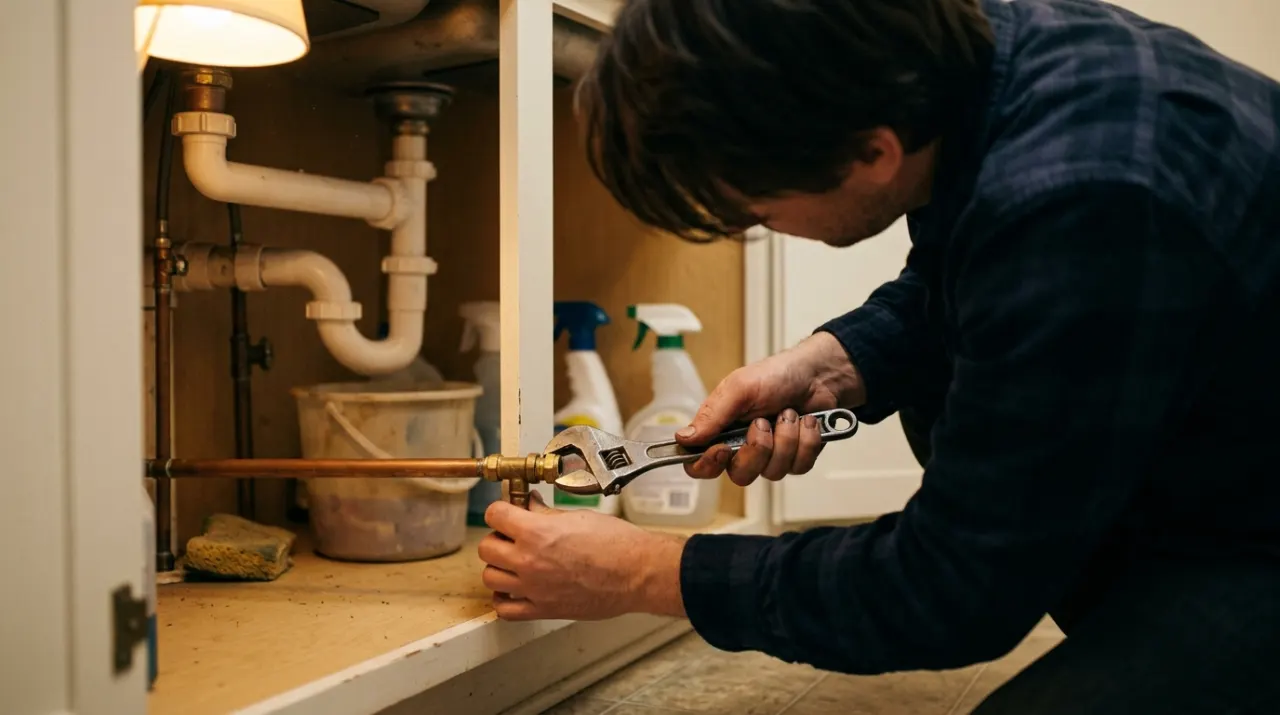
A hum with no spinning means the motor has power but something is wedged between the impellers and the grinding ring. Running it in this state overheats and can burn out the motor, so switch it off at once.
- Turn the disposal off and cut the power as above.
- Look inside with a flashlight and remove any visible object — a bone, fruit pit, or utensil — with tongs or pliers, never your fingers.
- Free the flywheel. Most disposals have a hex-shaped hole in the center of the bottom. Insert the hex key that came with the unit (a standard 1/4-inch Allen wrench fits most) and work it back and forth until the flywheel turns freely a full rotation.
- No hole? Turn it from the top with the handle of a wooden spoon, pressing against the impeller to rock it free. Never use your hand.
- Restore power and press the reset button, then run water and test with a quick pulse.
If it grinds normally afterward, you are done. Common jam culprits are silverware, fruit pits, bones, and fibrous scraps like celery and corn husks.
Problem 2: it is completely dead
No sound at all means no power reaching the motor. Work through the causes in order — the fix is usually the first one.
| Step | What to do |
|---|---|
| 1. Reset button | Press the red/black button on the bottom of the unit until it clicks and stays in |
| 2. Breaker | Check the electrical panel for a tripped breaker; reset it |
| 3. Outlet / switch | Confirm the under-sink outlet has power; check for a wall switch or tripped GFCI |
| 4. Still dead | Motor or wiring has likely failed; replace the unit |
The reset button trips when the disposal overloads or overheats, which is the single most common reason a disposal appears dead. If it just overheated, let it cool a few minutes before resetting.
Problem 3: it is leaking
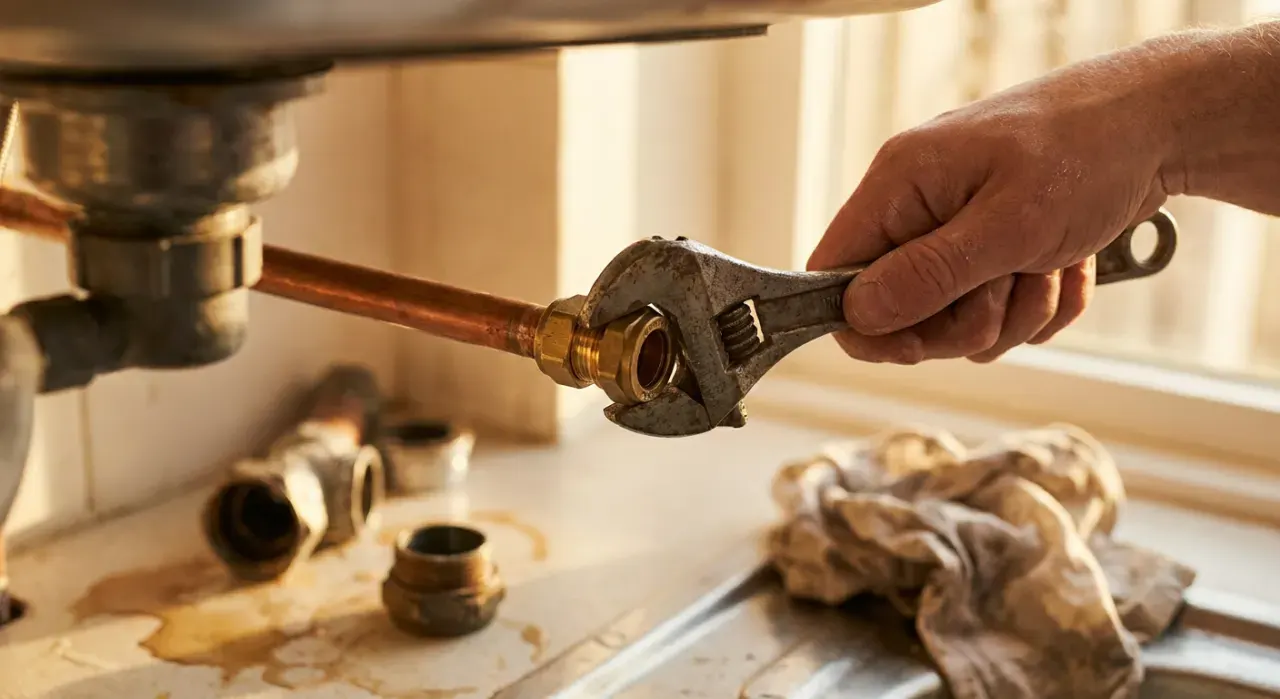
Identify where the water is coming from before deciding whether it is a repair or a replacement.
- Top (sink flange): the mounting has loosened or the plumber's putty seal failed. Tighten the mounting or re-seal the flange with fresh plumber's putty.
- Side (dishwasher hose or drain pipe): usually a loose hose clamp or a worn gasket. Tighten the clamp or replace the gasket at the connection.
- Bottom (body of the unit): an internal seal has failed. This is not repairable — the disposal must be replaced.
To pinpoint the source, dry everything, put a stopper in and fill the sink, then release it while watching each connection. For a full swap, see how to install a garbage disposal.
Slow grinding and odors
A disposal that grinds slowly or smells is usually not broken — it needs cleaning or the drain below it is partially clogged.
- Odor: grind ice cubes with a little coarse salt to scour the chamber, then a few citrus peels for scent. Avoid harsh chemical drain cleaners in a disposal.
- Slow drainage: the clog is often downstream in the P-trap or drain line, not in the disposal. See how to clear a clogged kitchen sink.
- Buildup: run cold water for 15 seconds after every use to flush ground food fully down the line.
If drainage is slow throughout, the P-trap may be clogged — how to replace a P-trap under a sink covers clearing and replacing it.
Preventing future garbage disposal problems
| Do | Do not put in |
|---|---|
| Run cold water before, during, and after | Grease, oil, and fat (they solidify in the drain) |
| Feed scraps in gradually | Bones, fruit pits, and hard shells |
| Grind small pieces | Fibrous scraps: celery, corn husks, onion skins, potato peels |
| Clean monthly with ice and salt | Coffee grounds and pasta/rice (they expand and clog) |
Most disposals last 8 to 12 years. Frequent resets, constant jamming, body leaks, and odors that cleaning will not clear are all signs it is near the end.
Diagnosing unusual garbage disposal noises
The sound a disposal makes is a reliable clue to what is wrong. Learn to read it before you take anything apart.
| Sound | What it usually means | Action |
|---|---|---|
| Loud metallic rattle | Foreign object — silverware, a bottle cap, a bone | Cut power, remove it with tongs |
| Hum with no spin | Jammed flywheel | Cut power, free with the hex key |
| Grinding that never finishes | Dull or worn impellers, or fibrous overload | Feed less at a time; replace an old unit |
| Sudden silence mid-use | Thermal overload tripped the reset | Let it cool, press reset |
| Vibration or new rattle in the mount | Loose mounting ring or worn bracket | Tighten the mount; check for a body leak |
A metallic rattle is the one to act on immediately — running the disposal against a hard object chips the impellers and can crack the grinding chamber. Cut the power and clear it before doing anything else.
When to replace a garbage disposal or call a pro
Replace the unit if it leaks from the body, if it is dead after checking reset, breaker, and outlet, or if it is more than a decade old and failing repeatedly. Swapping a disposal is a manageable DIY job for many people, but call an electrician if you suspect a wiring fault, or a plumber if the drain plumbing needs reworking. The tools you will want are covered in best plumbing tools, and the units themselves in best garbage disposal.
How we evaluate disposals, parts, and tools — from aggregated owner reviews and expert consensus rather than first-hand testing — is explained in how we rank. For every kitchen plumbing task, the DIY plumbing hub has the full library.